AI almost pried open the gap for the mass popularization of 3D printing.
The just-concluded 2026 Double 11 shopping festival saw 3D printers emerge as a dark horse in the consumer electronics track.
According to *Securities Daily*, Bambu Lab completed a "triple jump" on Tmall, growing from a new platform entrant, to the No.1 player in the 3D printer category, and finally to the No.1 player in the office supplies category. "AI modeling" and "customization on demand" are the core selling points shared by numerous brands.
In addition, since the beginning of this year, an increasing number of 3D printing experience stores have begun to occupy core storefronts in top business districts of first- and second-tier cities.
Data from the National Bureau of Statistics shows that in the first half of 2026, the domestic output of 3D printing equipment increased by 48.5% year on year, ranking first in terms of growth rate among all major industrial products. In the first half of the year, China's total export volume of 3D printers reached 3.62 million units, up 90.2% year on year, with an export value of 96.11 billion yuan, a year-on-year increase of 109.3%. The market is extremely hot on both the production and sales ends.
AI is widely recognized by the industry as the core catalyst of this market boom. It has significantly lowered the modeling threshold that has plagued the industry for a decade, making "creating physical objects with language" a reality from a concept, and countless people are hailing that the era of mass adoption of 3D printing has finally arrived.
But is that really the case?
01
Content Bottleneck as the Ultimate Ceiling
The popularization process of consumer-grade 3D printing over the past decade can be described as a protracted battle to lower hardware access barriers.
Just five or six years ago, an entry-level FDM (Fused Deposition Modeling, a mainstream 3D printing technology that forms objects by melting plastic filaments and stacking them layer by layer) printer required users to manually level the platform, calibrate the extruder, and repeatedly adjust temperature parameters. New users might spend a whole week without being able to print a complete finished product, and the steep learning cost was enough to deter the vast majority of ordinary people.
Today, automatic leveling, vibration compensation, and material breakage detection have become standard configurations for mainstream models. Mid-to-high-end models are even equipped with LiDAR and AI visual monitoring, allowing users to unpack the device, plug in the power, and start printing with one tap. The learning cost for users has been reduced from several weeks to just a few hours.
The price threshold has also collapsed simultaneously. The mature supply chain system in Shenzhen has pushed the cost of the whole machine to the extreme. Entry-level models such as Bambu Lab A1 mini and Creality Ender-7 have dropped below 1000 yuan after superimposing policy subsidies; most mainstream mid-to-high-end models are priced in the range of 3000 to 4000 yuan, which is comparable to a mid-range sweeping robot, reaching the consumption decision threshold of ordinary families.
The printing speed has also increased by 4-6 times compared with five years ago. The ornaments that used to take most of the day to print can now be formed in one or two hours, greatly reducing the time cost.
The result of this fierce hardware competition is that Chinese manufacturers have secured absolute dominance in the global market. Industry data shows that four Shenzhen-based enterprises, Bambu Lab, Creality, PiMaker, and Anycubic, have jointly captured nearly 90% of the entry-level market share. That means for every 10 consumer-grade 3D printers sold worldwide, 9 are made in China.
Bambu Lab Technology disclosed that as of June this year, the cumulative domestic online and offline sales of Bambu Lab 3D printers have exceeded 1 million units, making it the first brand in the industry to achieve this goal. According to Tianyancha, Creality was listed on the Hong Kong Stock Exchange in May this year, becoming the first public stock in the consumer-grade 3D printing sector.
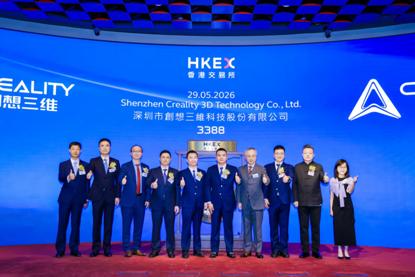
*Image source from the Internet
However, the extreme progress of hardware has finally hit the ceiling of the geek user group. The head of a 3D printing enterprise in Chengdu analyzed that the current household penetration rate of consumer-grade 3D printers worldwide is less than 1%, which is highly similar to the situation of civilian drones before 2020 — the products are mature enough and affordable enough, but they just cannot step out of the niche geek circle.
The real bottleneck is no longer the printer itself, but the printable content. For a long time, when ordinary consumers want to print something, they can only download ready-made files from model communities, and independent modeling is almost impossible — the learning threshold of professional software such as Blender (open-source 3D modeling software) and SolidWorks is high enough to block 99% of ordinary users.
The content supply is completely dependent on a small number of professional creators, like a narrow barrier lake. No matter how sufficient the printer production capacity at the downstream is, there is not enough "water source" to support high-frequency use.
The direct consequence is the lingering "dust accumulation curse". A 2026 survey by the JD Institute of Consumer and Industrial Development shows that among users who have purchased 3D printers, only 11.3% are high-frequency users, and 58.2% of users have printed less than 5 works in total after purchase. After the novelty fades, the equipment is stuffed into the storage room.
Spending thousands of yuan on a device that cannot be used even once in half a year is by no means a cost-effective deal for ordinary families.
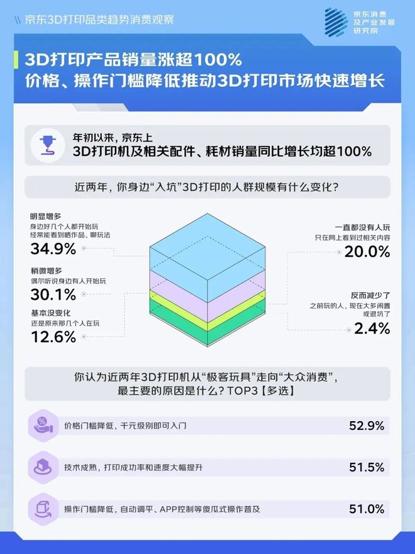
*Image source: JD 3D Printing Category Consumer Trend Observation
Over the past decade, manufacturers have competed on printing speed, precision and price, to the point where there is almost no room for hardware improvement, but they have never been able to get around the core dilemma of "having nothing to print". Everyone is waiting for a key to blow open the gate of content supply.
02
AI Unlocks the Imagination of Mass Adoption
2026 has become a turning point for the industry. The intensive breakthroughs of large AI models in the field of 3D generation have made the entire industry believe that they have got that key.
In September, OpenAI released GPT-6 Astra, a demo video showing "generating a rocket model through voice commands and sending it to the printer with one click to output a physical object" went viral in the tech circle, becoming a landmark event for the industry.
This demo conveys a signal: Ordinary people do not need to understand any modeling knowledge, and can complete the full closed loop from creativity to physical object only through natural language. The Shenzhen-made printer priced at less than 3,000 yuan in the video further showed everyone the huge imagination space brought by the combination of "top AI capabilities + affordable Chinese manufacturing".
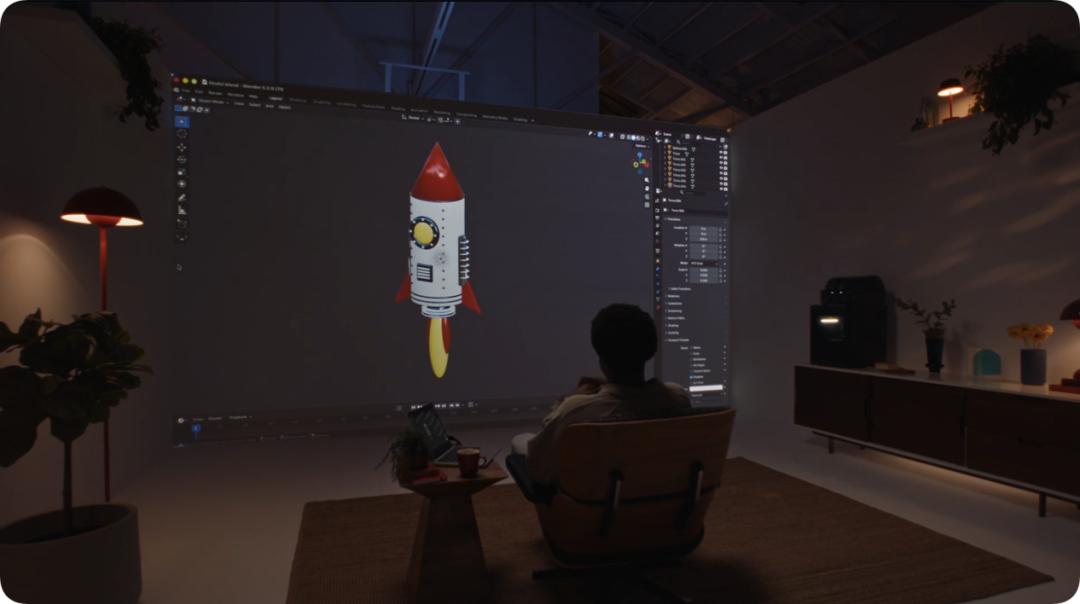
*Image source: GPT-6 Astra release demo screenshot
Domestic large model manufacturers are also catching up quickly. On October 24th, Moonshot AI released Kimi K3.1 Pro, and launched the Kimi 3D Make function at the same time, which directly drives modeling software such as Blender through large models, supports generating 3D printing models in STL (the universal standard model file format for 3D printing) format from texts, sketches and photos, greatly advancing the usability of AI generation.
Tencent Hunyuan and other leading domestic large models have also opened 3D content generation interfaces, which have more advantages in Chinese scene understanding and localized model adaptation, and have become the mainstream choice for domestic manufacturers to access. At the same time, AI 3D startups such as Meshy and Tripo are iterating rapidly, upgrading from one-click generation to local fine editing, gradually getting closer to the real creation process.
The iteration of AI modeling capabilities has been quickly implemented in the industrial side. Bambu Lab's MakerLab laboratory has connected five mainstream large AI models including Hunyuan, Tripo and Meshy. Users can upload photos and enter text on the mobile APP, and get the 3D file adapted to their own equipment in a few minutes.
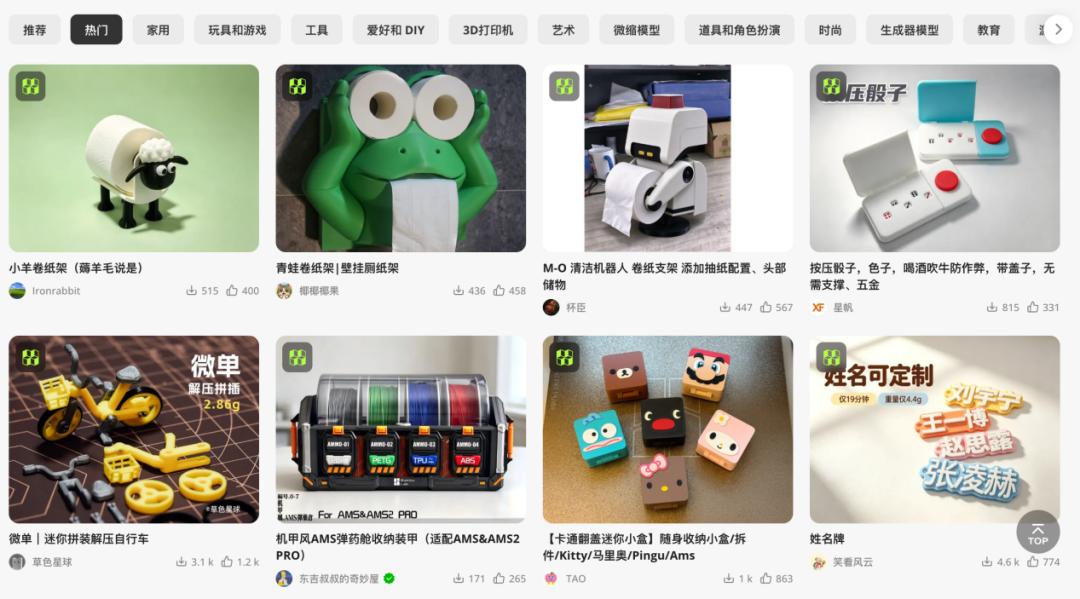
*Image source: Screenshot of Bambu Lab MakerWorld website
Creality takes a scenario-based approach, launching 9 AI creation tools on its Creality Cloud platform, covering high-frequency public demands such as figurines, reliefs and keychains. Its 2026 interim report shows that the usage of AI-related applications surged by 85.6% in the first half of the year, and the number of new public models increased by 137.6% year on year.
It seems that a gap has been blown open in the barrier lake of content supply. The model that used to take professional creators a whole day to make can now be generated by ordinary people in dozens of seconds; while the community used to update thousands of models a month, AI can continuously produce unlimited content now. The biggest bottleneck that has plagued the industry for a decade seems to have been solved by AI overnight.
AI has reduced the modeling cost, making the business model of small-batch customization more feasible, and the 3D printing farm model is rising rapidly. According to incomplete industry statistics, there are thousands of printing farms of different scales in China, with a total installed capacity of about 300,000 units. A site of dozens of square meters, hundreds of consumer-grade devices, and one or two administrators can undertake custom orders for figurines, cultural and creative products, and small accessories.
Offline channels are also expanding simultaneously, Bambu Lab has entered MixC and Sam's Club, Creality has settled in hundreds of JD Home and Lenovo stores, the experience model of "AI generation + on-site printing" has become a new tool for shopping malls to attract customers.
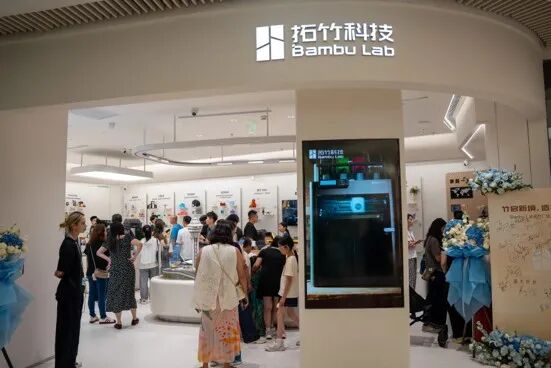
*Image source from the Internet
The sales growth during the Double 11 shopping festival is more like the concentrated realization of this AI boom. Most brands place the AI function in a prominent position on the product detail page, accurately hitting the core pain point of novice users who "worry about not being able to model".
Everyone feels that the critical point for 3D printing to enter thousands of households is finally coming.
03
AI Cannot Unlock All Real-world Constraints
But the truth is, although AI has solved the content generation problem of "from nothing to something", it has not solved the full-link experience of "from something to easy to use"; it has lowered the modeling threshold, but left more hidden thresholds in front of users.
The first and foremost is the printability dilemma of AI models that "look good but are hard to print". The training logic of current mainstream AI 3D generation tools is vision-first, pursuing good-looking shape and high restoration, but it does not deeply integrate the physical process constraints of 3D printing.
Actual test data from the media shows that among the models generated by commercial AI, only about 17% can be directly used for FDM/photocuring (forming objects by curing liquid resin layer by layer through ultraviolet irradiation) printing without manual repair, and the rest generally have hard flaws such as non-watertight meshes (the model has broken surfaces and gaps, and cannot be recognized as a solid entity), thin-wall structures below the lower limit of the nozzle size, large-angle overhangs that cannot be formed, and unbalanced size proportions.
These problems are only minor flaws in the CG industry, but fatal defects in 3D printing. Thin-walled parts break directly after printing, overhanging structures collapse into a mass, and broken surface models cannot even be recognized by slicing software (a special tool that cuts 3D models into printing paths layer by layer).
Although leading manufacturers have made optimizations for automatic repair and wall thickness detection, they can only handle simple problems. Complex shapes still require users to manually modify the model with professional software — which is exactly the ability that ordinary users do not have.
What affects the experience more than model defects is the fragmentation of the whole process experience. The AI functions of most current manufacturers are superficial access, not native full-link integration. Users need to generate the model in a third-party AI tool first, export the STL file, then open the slicing software to verify the parameters, and finally send it to the printer. The whole process requires jumping between three or four platforms and operating more than a dozen steps.
For novices, just understanding file formats and parameter adjustment is enough to deter them, which is completely different from the "one sentence to finished product" experience in the demo video. Even tools like Kimi 3D Make that natively support export only solve the problem of model generation, and subsequent slicing matching, support optimization and device adaptation still need to be handled by users themselves.
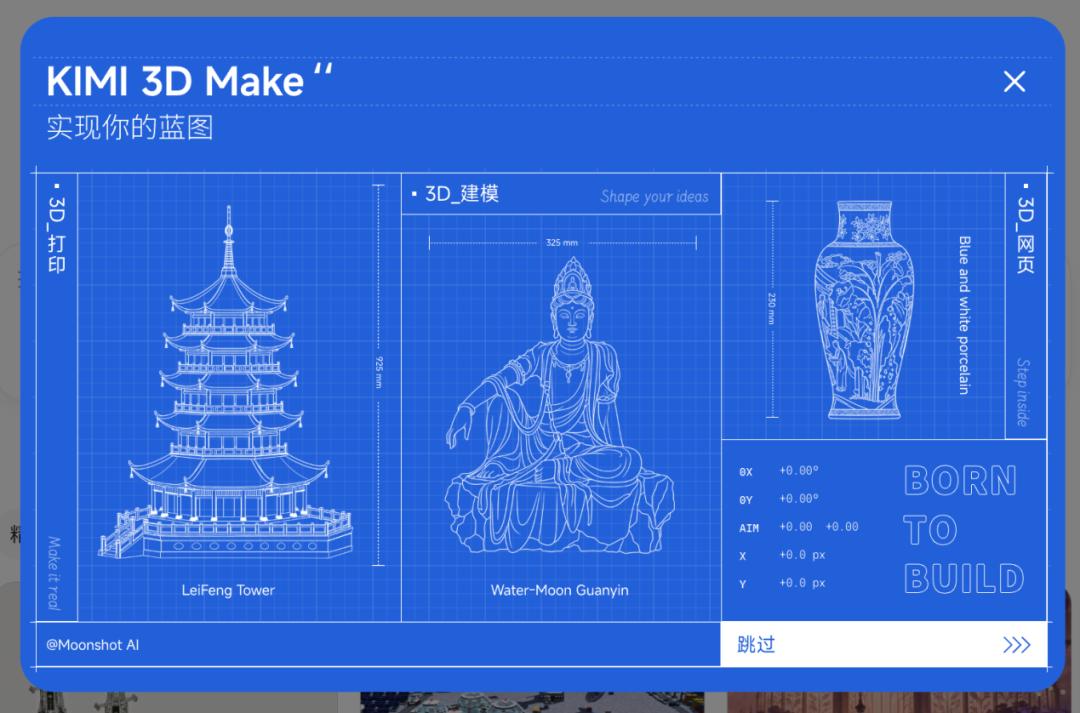
*Image source: Screenshot of Kimi official website
The more hidden and more fatal deterrent point is hidden in the post-processing link after printing is completed. AI solves the front-end digital creation, but cannot touch the back-end physical manufacturing. After a 3D printer finishes printing the object, it cannot be used directly: FDM printing requires removing supports, polishing layer lines and repairing flaws, which is cumbersome and produces dust; photocuring printing requires alcohol cleaning and UV (ultraviolet) secondary curing, involving chemical waste liquid and pungent odor, which is a common concern for families with the elderly and children.
These dirty and troublesome physical tasks cannot be completely replaced by AI, and are the core deterrent point for ordinary family users.
The core of all problems is the essential lack of mass-demand scenarios. There are not so many things in ordinary family life that need 3D printing. Storage boxes, small ornaments, toy accessories... These things can either be bought ready-made for a few yuan, or are dispensable, and cannot