A quantum angel round is born out of the Shanghai Jiao Tong University-affiliated startup ecosystem.
PE Daily AI learned that today (November 17), Shanghai Unitary Quantum Technology Co., Ltd. (hereinafter referred to as "Unitary Quantum") announced the completion of its angel round financing, with investors including Yunqi Capital and Jiaming Haochun, while existing shareholders Hanyuan Asset, Xiaomiao Langcheng and Qigao Capital continued to increase their investment.
It has been less than three months since its last round of financing.
This is a quantum scientific computing platform enterprise driven by quantum algorithms, initiated and established in 2025 by the top scientific research team of Shanghai Jiao Tong University. Its core competitiveness comes from the team's original "Schrödingerization" algorithm framework and complete self-developed algorithm library.
Nowadays, quantum computing has entered the stage of system engineering competition. Unitary Quantum is building an integrated platform of "algorithm framework + software infrastructure + tool chain + application ecosystem entry" to participate in the global competition for quantum software infrastructure.
Shanghai Jiao Tong University Team Breaks Through Pain Points of Quantum Computing Scientific Solution
While the global quantum industry is focusing on the number of qubits and the iteration of hardware chips, a practical problem has always stood in front of the industry: a large number of real-world engineering problems, the partial differential equations behind fluid dynamics, meteorology, finance and electromagnetism are naturally dissipative and non-unitary dynamic systems, but quantum computers can only perform unitary evolution, and the languages of the two are not interoperable.
Even if more qubits are manufactured, without a set of underlying algorithms to complete the "translation and conversion", it is still difficult for hardware computing power to be implemented in industrial scenarios — the story of Unitary Quantum starts from this mathematical gap between quantum and the real world.
The origin of their entrepreneurship is rooted in the decades of scientific research accumulation of computational mathematics at Shanghai Jiao Tong University:
The quantum computing team of Shanghai Jiao Tong University has laid the foundation of the "Schrödingerization" algorithm paradigm. They have been deeply engaged in multi-scale scientific computing for many years, facing the "curse of dimensionality" that classical computing power cannot overcome, found a gap on the scientific research soil of many top scholars, and realized that the industry has long lacked a general quantum scientific computing solution framework.
Therefore, after devoting themselves to mathematical derivation, this scientific research team originally developed the "Schrödingerization" algorithm framework — this method transforms linear ordinary differential equations, partial differential equations and some important nonlinear differential equations into forms suitable for quantum simulation through mathematical transformation, providing a new algorithm path for quantum computing to solve scientific and engineering problems, filling the gap in related fields.
After that, their relevant achievements were published in Physical Review Letters and PNAS, became the only representative achievement in the field of mathematics in the 2024 annual report of the National Natural Science Foundation of China, were selected into the selected collection of outstanding achievements of the National Natural Science Foundation of China for the 14th Five-Year Plan, were rated as one of the top ten scientific and technological progresses of Shanghai Jiao Tong University, and were included in the "2030 Plan".
Paradigm breakthrough has been achieved in academia, but if it stops at journals, it still cannot become an available tool for engineers and researchers.
With the original intention of transforming academic achievements into usable tools, Professor of Shanghai Jiao Tong University, International Mathematical Olympiad gold medal winner Lei Zhang and Dr. Hu Junpeng saw the opportunity of algorithm engineering, and introduced top AI for Science experts to start a business together. Unitary Quantum was officially established in 2025 — its name is derived from the core concept of quantum mechanics, Unitary Transformation. The team is centered on quantum and AI scientific research talents from top universities such as Shanghai Jiao Tong University, National University of Singapore, Columbia University, California Institute of Technology, and University of Science and Technology of China, and also gathers talents from leading enterprises such as ByteDance, Alibaba and Tencent to jointly promote R&D, engineering, intelligence and product delivery of quantum algorithms.
Different from developing a single quantum algorithm for specific scenarios, Unitary Quantum hopes to develop this mathematical method into an algorithm and software system applicable to different scientific computing tasks, and open up the links between scientific problem modeling, algorithm design, simulation verification and quantum computer execution.
Based on the underlying algorithms, Unitary Quantum has implemented two core products: UnitaryLab quantum scientific computing platform and desktop heterogeneous base UnitarySpark.
In May this year, Unitary Quantum released the Agent-driven quantum scientific computing platform UnitaryLab 2.0, and launched the public beta version of UnitaryLab 2.5 in September. Specifically, they encapsulated the Schrödingerization algorithm into the UnitaryLab platform. With the help of AI Agent, researchers do not need to be proficient in quantum professional knowledge, and can complete simulation computing tasks only through natural language, making complex algorithms easier to use. This workflow was selected as an official success case of NVIDIA.
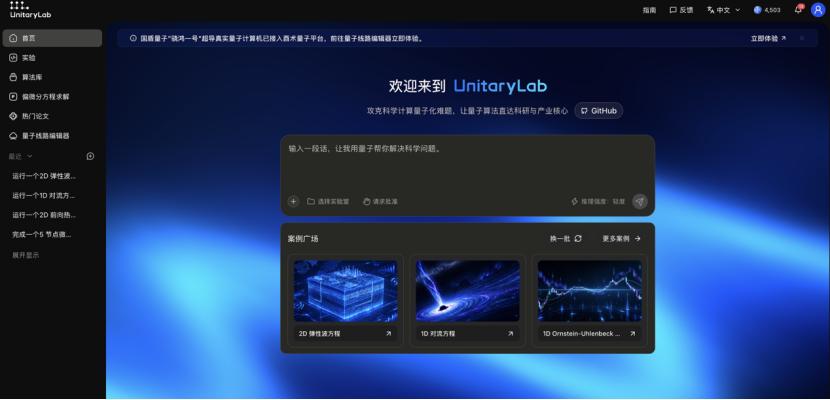
Quantum scientific computing platform UnitaryLab
UnitarySpark is a desktop-level heterogeneous computing workstation for scientific research and enterprise R&D teams. It integrates AI Agent, GPU quantum simulation, and external quantum real machine call interfaces in the local environment, adapts to the local deployment requirements with a budget of hundreds of thousands of RMB, takes into account algorithm debugging, teaching and scientific research, and joint PoC verification scenarios. It does not have to wait for the maturity of large-scale fault-tolerant quantum computers in the future, and can carry out engineering verification under the existing NISQ hardware conditions.
In terms of hardware ecology, Unitary Quantum has reached strategic cooperation with Origin Quantum, Bose Quantum and Zhongqi Wuliang Quantum, covering multiple mainstream domestic quantum hardware routes such as superconductivity, photonic quantum and neutral atoms, and completed the joint debugging and verification of real machines.
Investors also came. In June this year, Unitary Quantum obtained seed round financing jointly led by Yuanhe Origin and Oriental Fortune Capital, with Hanyuan Asset participating in the investment; in August, new shareholders including Shenzhen Venture Capital, Xiaomiao Langcheng and Qigao Capital were added, while old shareholders Yuanhe Origin, Oriental Fortune Capital and Hanyuan Asset continued to increase their investment, with an amount of tens of millions of RMB. Up to this time, it has completed 3 rounds of financing within 5 months.
Eve of the Outbreak of Commercial Quantum Computing
Stepping out of the laboratory, commercialization is an unavoidable test.
In the entire industrial chain of quantum computing, Unitary Quantum is positioned at the midstream quantum software infrastructure layer. It does not produce quantum chips and complete hardware machines, but acts as a bridge connecting the underlying heterogeneous computing power and the real needs of thousands of industries. Adopting the implementation idea of "based on the present, compatible with the future", Unitary Quantum anchors the general industrial demand of partial differential equations that spreads across finance, meteorology, fluid simulation, and biomedicine, and divides three types of target customers:
For universities and scientific research institutions, it provides algorithm platforms, teaching and research platforms, scientific research tool chains and localized deployment solutions; for quantum hardware enterprises, it explores cooperation in software adaptation, algorithm services and Agent tool chains; for industry customers in finance, simulation, automotive and new energy, life sciences, meteorology and aerospace, communications and electromagnetism, it finds application opportunities with clear computing needs through joint R&D and scenario verification.
In September this year, Unitary Quantum completed scenario cooperation signing with Bank of Shanghai, Hefei Meteorological Quantum Technology Innovation Research Center, Changchun Jinsai Pharmaceutical, Shanghai Normal University, Chongqing University of Posts and Telecommunications, and Zanqi Technology, covering multiple tracks such as finance, meteorology, biomedicine, and quantum education, to explore the implementation and application of quantum computing in actual business scenarios — commercialization has advanced to the stage of scenario verification.
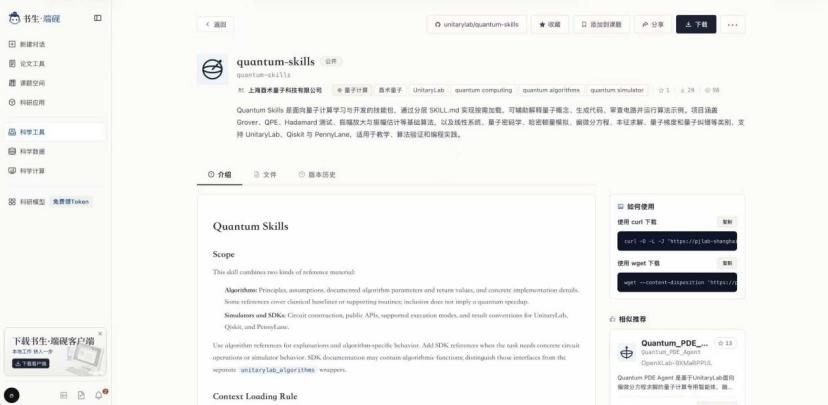
At the same time, its self-developed quantum-skills tool components have settled in the "Xuanshu · Duanyan" platform of Shanghai AI Laboratory, integrating into the domestic AI for Science scientific research ecology.
Since the 15th Five-Year Plan listed quantum technology as the first of the six future industries, the primary market has maintained high attention to this track. Capital flows here — in the first half of 2026, 47 financing deals in the domestic quantum technology field were disclosed, involving 35 enterprises, with the total disclosed amount reaching 6.24 billion RMB, and the number of deals has exceeded the whole year of 2025.
For the quantum computing track, a clear division of labor has gradually emerged: some enterprises take root downward, focus on quantum chips and complete machine hardware, and build a quantum computing power base; other enterprises move upward to the software and algorithm layer, acting as a bridge connecting computing power and real industrial needs, and Unitary Quantum belongs to the latter.
But the consensus is also clear — the industry is still in the stage of principle verification and application demonstration at present. The indicator to measure the critical point of commercialization is not the qubit scale, but the verifiable quantum advantage, which should not only solve real problems with practical value, but also have verifiable results.
In other words, industrialization will not be a sudden outbreak, but will be continuously accumulated through small verifications in each subdivided scenario. Abandoning the conceptual narrative of "quantum advantage" and giving priority to solving real solution problems in the engineering world is a more pragmatic path at this stage.
For Unitary Quantum, the funds brought by several rounds of financing will continue to be invested in polishing original algorithms, iterating AI-Agent capabilities, adapting multi-route real machines and implementing more industry pilots.
Before the pattern is finalized, all parties are competing to take a good position.
This article is from the WeChat official account "PE Daily AI", author: Yang Jiyun, published with authorization from 36Kr.