Alibaba and Tencent's new models make their debut together: Qwen4-Max reduces the cost of a single task by 58%, and Hy4 flash cuts its cost to 1/8 of that of its competing products.
Alibaba's Qwen4-Max is built on a brand-new architecture with 2.4 trillion parameters. In evaluations, the average cost per single task has dropped from 26.58 yuan to 11.16 yuan, and the price per million tokens when cache is hit is as low as 0.5 yuan; Tencent's Hy4 flash has only 12B activated parameters, the cost per single task in evaluations is 1/8 of the peak-hour price of similar DeepSeek products and 1/20 of Hy4, with a cache hit price of only 0.02 yuan.
On November 16, Alibaba and Tencent each launched new models on the same day. Alibaba released Qwen4-Max, the first flagship of the Qwen4 series, while Tencent Hunyuan launched the lightweight model Hy4 flash.
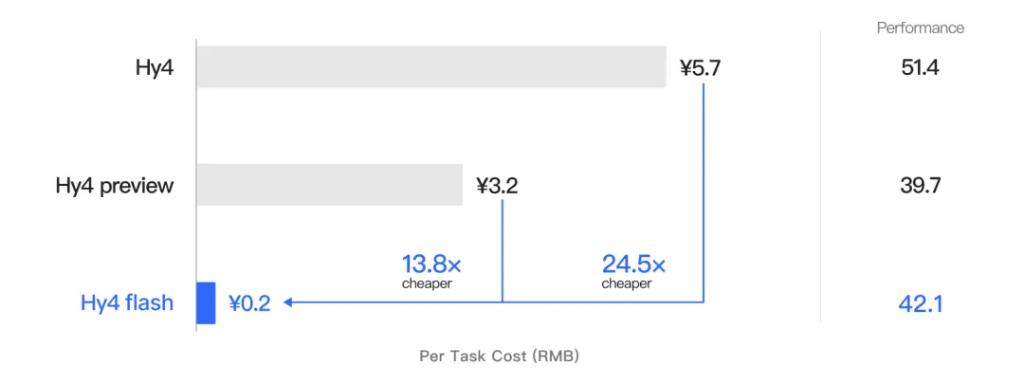
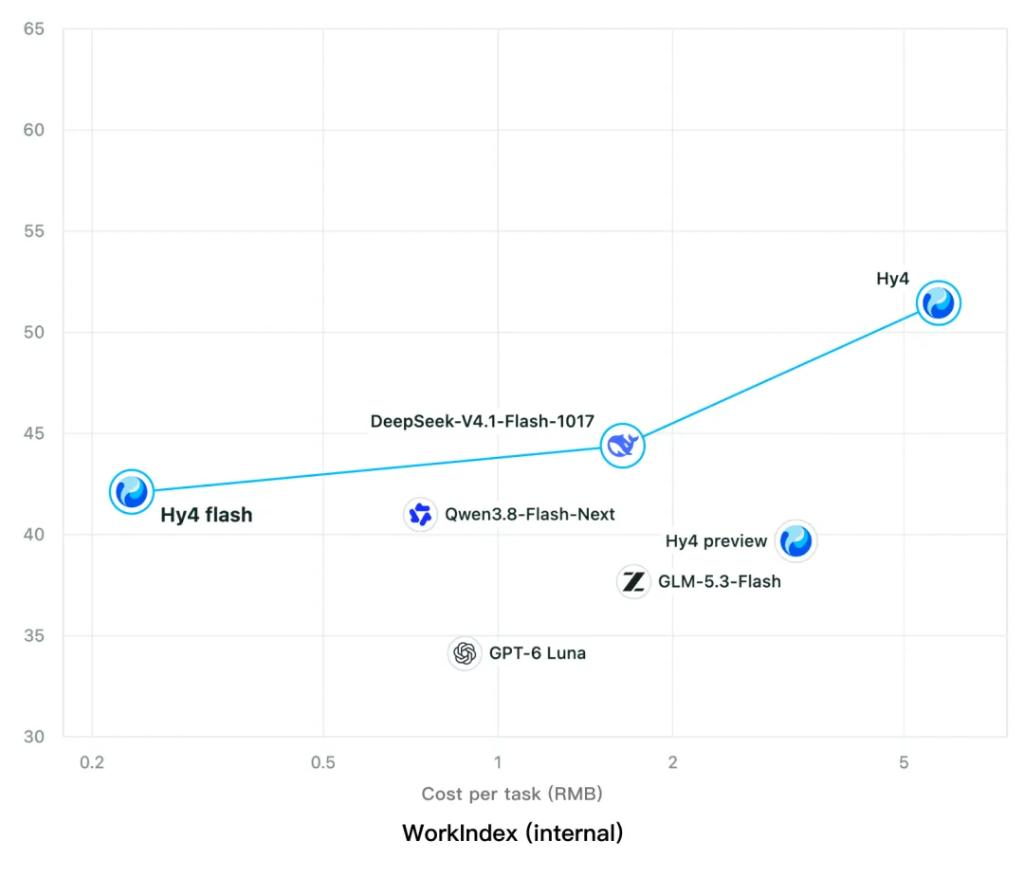
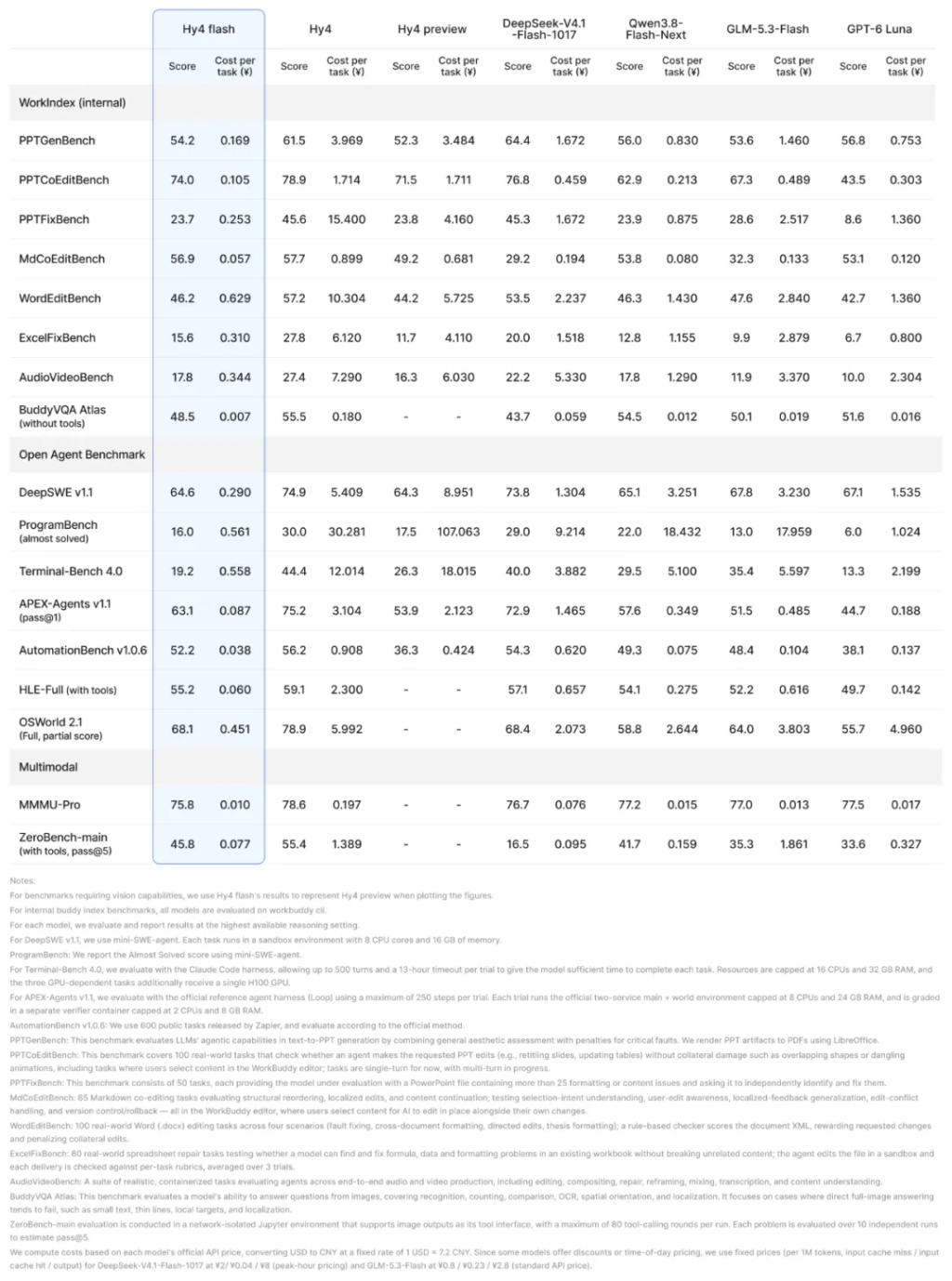
According to the officially released Work360 evaluation data from Alibaba, the average cost per single task of Qwen4-Max has dropped from 26.58 yuan to 11.16 yuan, a decrease of 58%. Tencent stated that the cost per single task of Hy4 flash in the WorkIndex evaluation is only 1/20 of Hy4, and only 1/8 of DeepSeek-V4.1-Flash-1017 (max tier peak-hour price).
It is worth noting that the Q3 financial reports of Alibaba and Tencent are about to be released on November 18 and November 19 this week.
01
Qwen4-Max: 2.4 Trillion Parameters, Task Cost Cut in Half
Alibaba introduced in its official blog that Qwen4-Max adopts the brand-new architecture of the Qwen4 series, with a total parameter of 2.4 trillion (2.4T), 71B parameters activated for each token, and additional 328B N-gram Embedding parameters, supporting native vision capabilities and a 1 million-token context window.
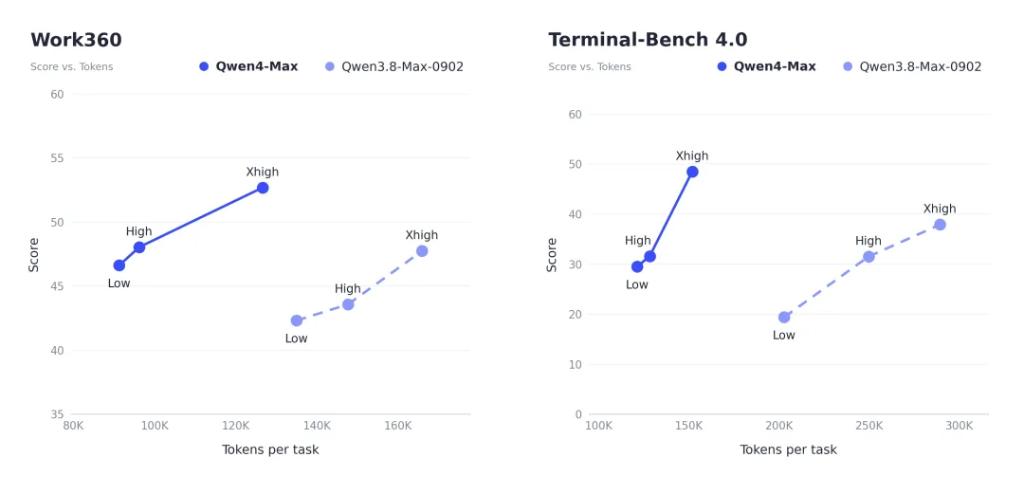
Behind the cost reduction is the improvement of token efficiency. According to Alibaba's official data, under the two inference intensity levels of Xhigh and High in the Work360 evaluation, the token consumption of Qwen4-Max is reduced by about 24% and 35% respectively compared with the previous generation Qwen3.8-Max; on Terminal-Bench 4.0, the two levels are reduced by about 48% and 49% respectively. At the same time, API pricing has been comprehensively reduced, and the price reduction for cache hits is particularly significant, with as low as 0.5 yuan per million tokens.
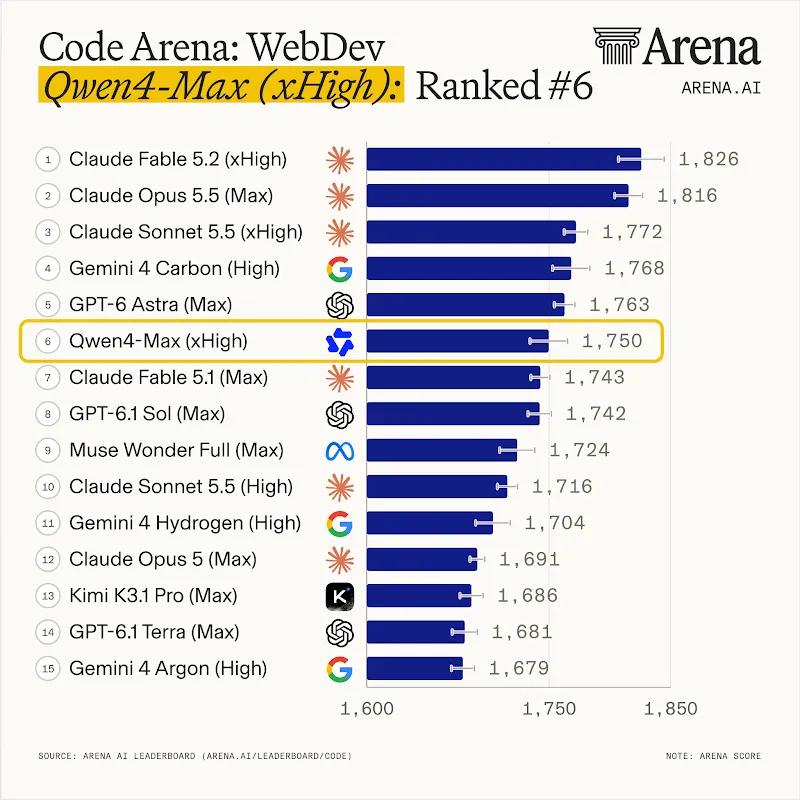
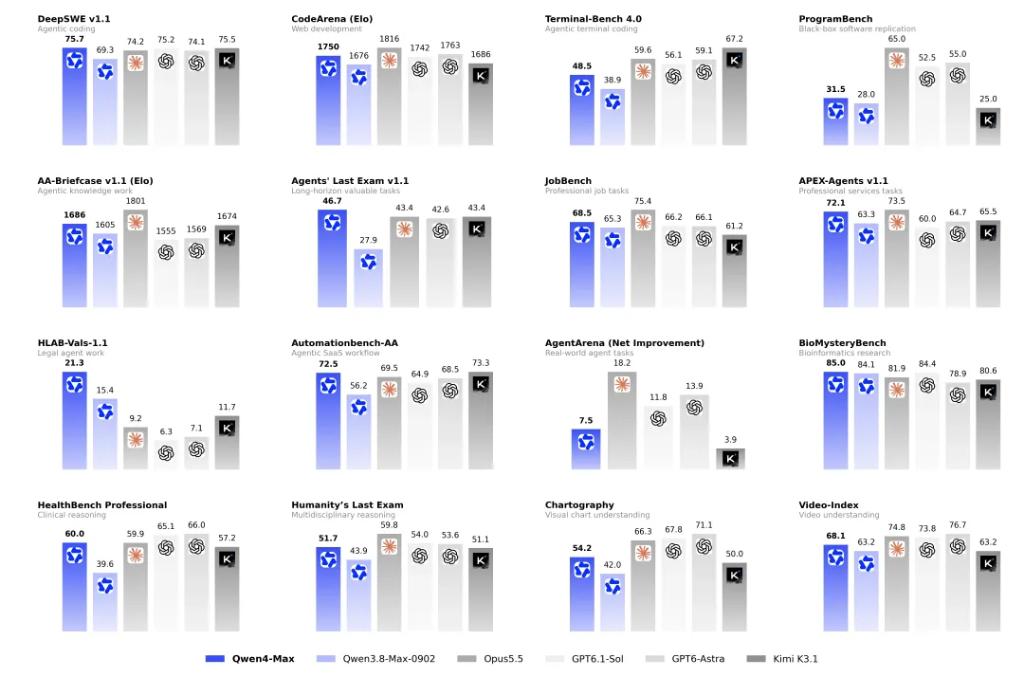
In terms of performance, Alibaba officially claims that compared with the previous generation Qwen3.8-Max, the score of Qwen4-Max in the comprehensive Work360 evaluation has increased from 47.74 points to 52.69 points, and there are also significant improvements in multiple Agent-specific benchmarks such as DeepSWE, AA-Briefcase, and HLAB-Vals.
At the architecture level, Qwen4-Max upgrades the sparse MoE model around three directions: Attention, Residual and Embedding: GDN+Qwen Sparse Attention (QSA) reduces the overhead of long-sequence attention calculation; Gated Residual (GR) expands the residual stream into four parallel branches to enhance cross-layer information transmission; N-gram Embedding expands model capacity with low additional computational overhead.
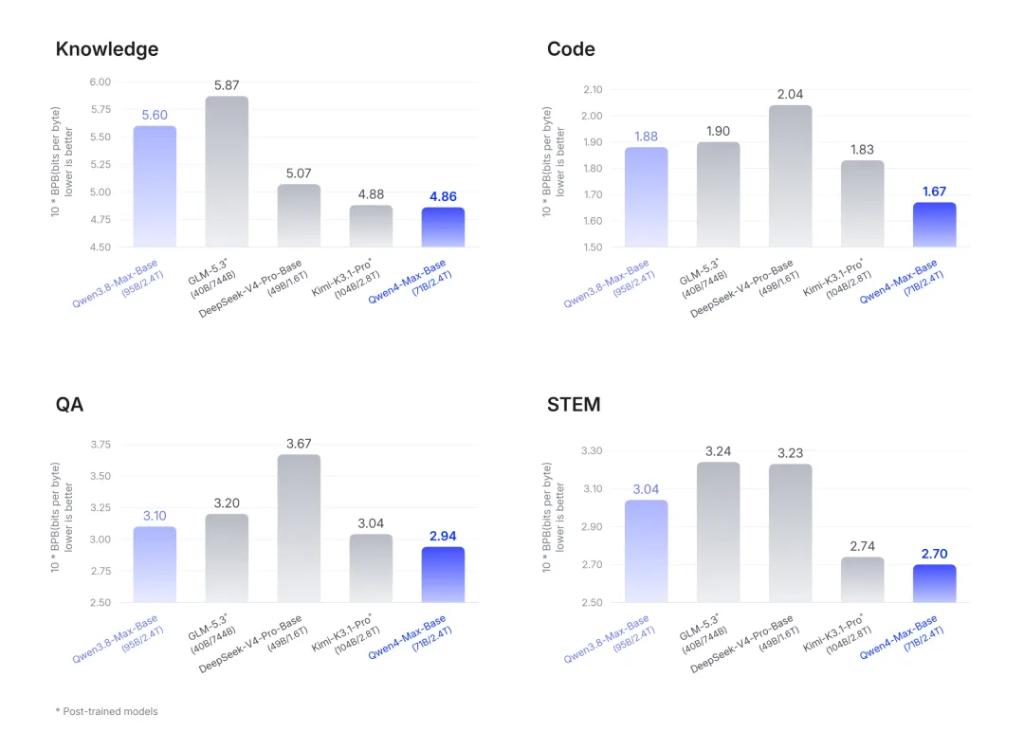
Alibaba officially stated that in four internal evaluations of knowledge, code, question answering and STEM, the Bits Per Byte (BPB) of Qwen4-Max-Base is the lowest among the five participating models. Compared with Qwen3.8-Max-Base, the BPB in various fields has decreased by about 5% to 13%, while the activated parameters per token have decreased by about 25%.
02
Hy4 flash: Only 12B Activated Parameters, Cost Pushed to 1/8 of Competitors and 1/20 of Hy4
Hy4 flash released by Tencent Hunyuan on the same day is positioned to be more lightweight. According to Tencent's official introduction, the total number of parameters of this model is 224B (including 64B Engram parameters), with only 12B activated parameters, supporting multimodality and 1M context length.
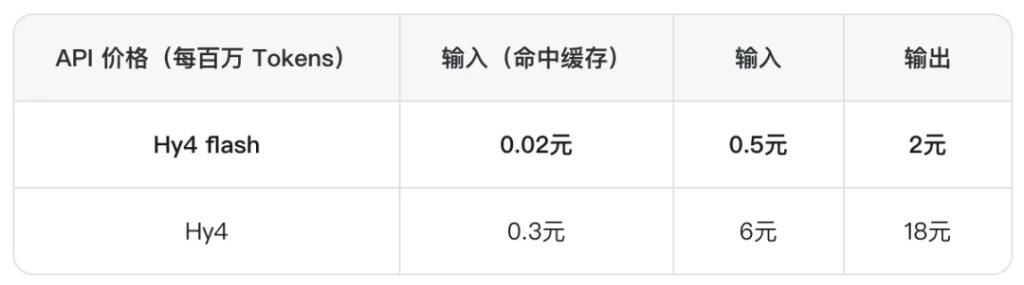
Tencent positions Hy4 flash as "the Hy model with the highest cost-effectiveness to date". In terms of API pricing, the price is 0.5 yuan per million tokens for input and 2 yuan for output, and only 0.02 yuan when cache is hit. In the WorkIndex evaluation, the cost per single task is only 1/13 of Hy4 preview, 1/20 of Hy4, and 1/8 of DeepSeek-V4.1-Flash-1017 (max tier peak-hour price).
To achieve this cost level, Tencent has carried out targeted optimization in multiple links. In the pre-training stage, architectural features such as mixed attention, LatentMoE, and Engram are introduced, and the KV cache size is only 1/24 of Hy3 and 1/6 of Hy4; in the post-training stage, the comprehensive intelligence level is obtained through self-distillation of Hy4, and then the end-to-end task output length is reduced by 50% through reinforcement learning; in the inference stage, combined with megakernel, 4-bit quantization, DFly and other means, the decoding speed exceeds 150 tps.
The idea of Hy4 flash is "extremely streamlined activated parameters" — only 12B is activated among the 224B total parameters, and the output length is directly compressed through reinforcement learning, so that the number of tokens consumed by each task is inherently less.
Tencent also invited 85 internal WorkBuddy users to conduct blind tests on 259 daily work tasks in 27 categories. The results show that the user satisfaction of Hy4 flash is close to Claude Haiku 5.5, the cost per single task is lower than all tested models, and the task duration is also the shortest.
In terms of overall effect, Tencent said that Hy4 flash is slightly better than Hy4 preview in overall performance.
03
What Users Are the Two Products Targeting Respectively
From the perspective of positioning, the two models do not fully target the same type of users.
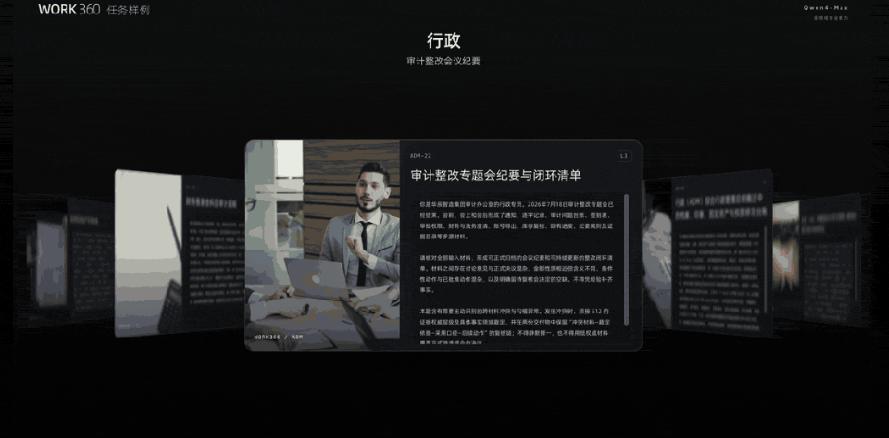
Qwen4-Max is more like a flagship product for complex enterprise-level scenarios. Alibaba listed multiple implementation cases in the release materials: in the automobile manufacturing scenario, the manual input required for processing programming of a single workpiece is reduced from about 475 minutes to 24 minutes, a reduction of about 95%; in the legal due diligence of enterprise IPO, the model processed 198 scattered manuscripts and delivered a complete 86-page report with more than 60,000 words; in the financial investment research scenario, it can call 90 MCP tools to obtain market data such as A-shares, Hong Kong stocks and US stocks, and generate traceable reports.
Hy4 flash is more focused on daily office efficiency scenarios. The usage scenarios recommended by Tencent include deep search, document processing, PPT generation, simple front-end display and Computer Use, and "use Hy4 with a higher intelligence upper limit in complex tasks such as long-horizon software engineering".
In terms of accessibility, Hy4 flash has been launched on Tencent Cloud TokenHub, WorkBuddy, Yuanbao, WeCom, QQ, ima, Marvis and other products. Users can use it for free for a limited time on WorkBuddy before November 30, and the Tencent Cloud TokenHub API is 50% off for a limited time. Tencent also said it plans to open source Hy4 flash and iterate at a high frequency.
04
Changes in Evaluation Methods
In this release, both companies have unanimously emphasized internal evaluation sets that are "close to real work scenarios" instead of simply relying on public rankings.
Tencent built the WorkIndex evaluation set based on typical WorkBuddy tasks, "focusing on the output effect of daily work, single-round output length, end-to-end time consumption, rather than public ranking scores that are far from daily work".
The Work360 framework built by Alibaba covers 26 first-level fields, 182 second-level sub-fields and 721 third-level segmented fields, trying to systematically cover industrial and professional scenarios.
This article is from the WeChat official account "Hard AI", Author: Long Yue, Editor: Hard AI, Published with authorization from 36Kr.