Occupying an EV charging parking spot for one hour incurs a 300-yuan fine, and carmakers are finally no longer indulging the "giant babies" who hog charging spaces for non-charging purposes.
"BYD Flash Charging, I parked my car for an hour and was charged 300 yuan as a parking occupancy fee? Are you guys completely out of your minds for money? I'm going to defend my rights!"
A screenshot of a bill showing a 300-yuan occupancy fee has been widely spread on social media recently. According to the car owner, he was charging at a flash charging station in Tianjin at that time, consuming 17.74 kWh of electricity in 27 minutes, with the electricity fee being 28.03 yuan. However, after the charging was completed, the car owner did not pull out the gun and move the car in time, thus incurring this expensive fee.
The aggrieved car owner hoped to get support from netizens to get BYD to waive this "unexpected bill". However, after the post went viral, the comments section showed a completely opposite attitude —
All netizens who left messages unanimously believed that BYD "did a great job".

"I parked for an hour, and you charged me 300 yuan as occupancy fee?" (Photo/Social media screenshot)
The flash charging station is a high-power electric vehicle charging station network launched by BYD, known by the outside world as the "gas station in the charging industry". According to its publicly announced fee rules, the system reserves a 15-minute free car-moving window after the vehicle finishes charging. An occupancy fee of 3 yuan per minute will be charged for overtime, with less than 1 minute counted as 1 minute, and the daily maximum cap is 300 yuan.
Some careful netizens calculated based on the above rules that if the free time is included, being charged 300 yuan as occupancy fee means the car owner occupied the flash charging pile for at least 115 minutes, which is far from what he claimed "only parked for 1 hour". Some netizens even suggested that BYD should charge more: "He is occupying other people's time, and these uncivilized people have to pay to learn a lesson."
It is obvious that netizens are not speaking for BYD. Their unanimous support for charging occupancy fees seems to be in support of a "punitive fee" on the surface, but in essence, they are voting for a long-obscured issue:
When scarce space resources are occupied without compensation, rules must redraw the boundary at a visible cost.
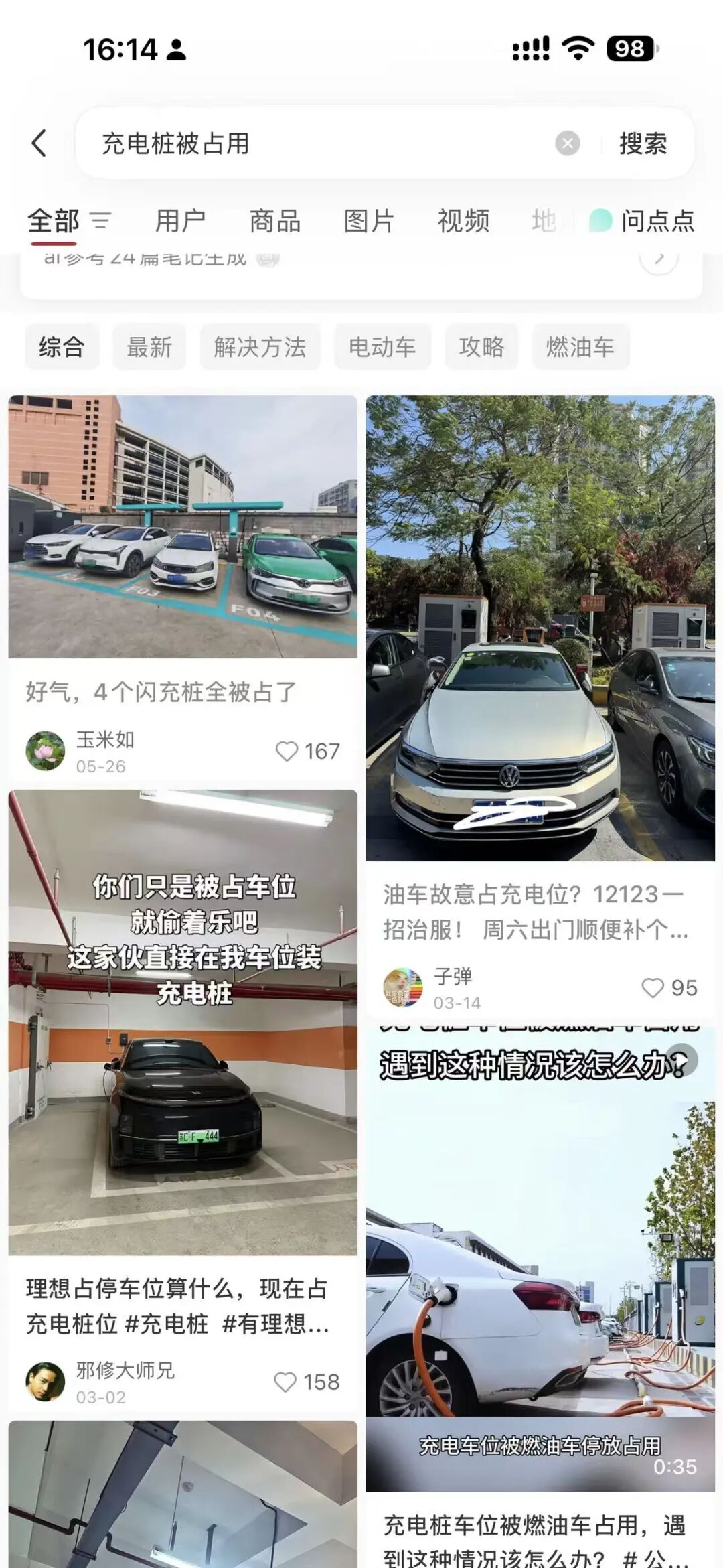
Searching for "charging pile occupied" on social media, there are countless similar complaint posts. (Photo/Social media screenshot)
01
Refusing to leave after charging is completed,
why should you expect sympathy from the whole network?
Gasoline car owners can hardly imagine the trouble of encountering occupied parking spaces at gas stations.
When a car drives into a gas station, parks, turns off the engine, opens the fuel cap, and inserts the fuel gun, refueling starts immediately. After refueling is completed, the clerk pulls out the gun and puts it back, and the car owner pays and drives out of the gas station. If someone tries to use the refueling parking space as a temporary parking lot, they will probably be driven away immediately, and if the incident goes viral online accidentally, they will also face public condemnation.
The experience of electric car owners is much more complicated:
When you want to charge your car, the navigation shows that the nearest charging station still has empty spaces, but when you arrive, you find that four cars are parked in four spaces, three of which are gasoline cars, and the remaining electric car has long been fully charged but never moved away.
You stand next to the charging pile, holding the charging gun in your hand, but cannot find a position where you can actually charge. Looking at the remaining low battery level in the car, you seem calm on the surface, but you have already collapsed inside.
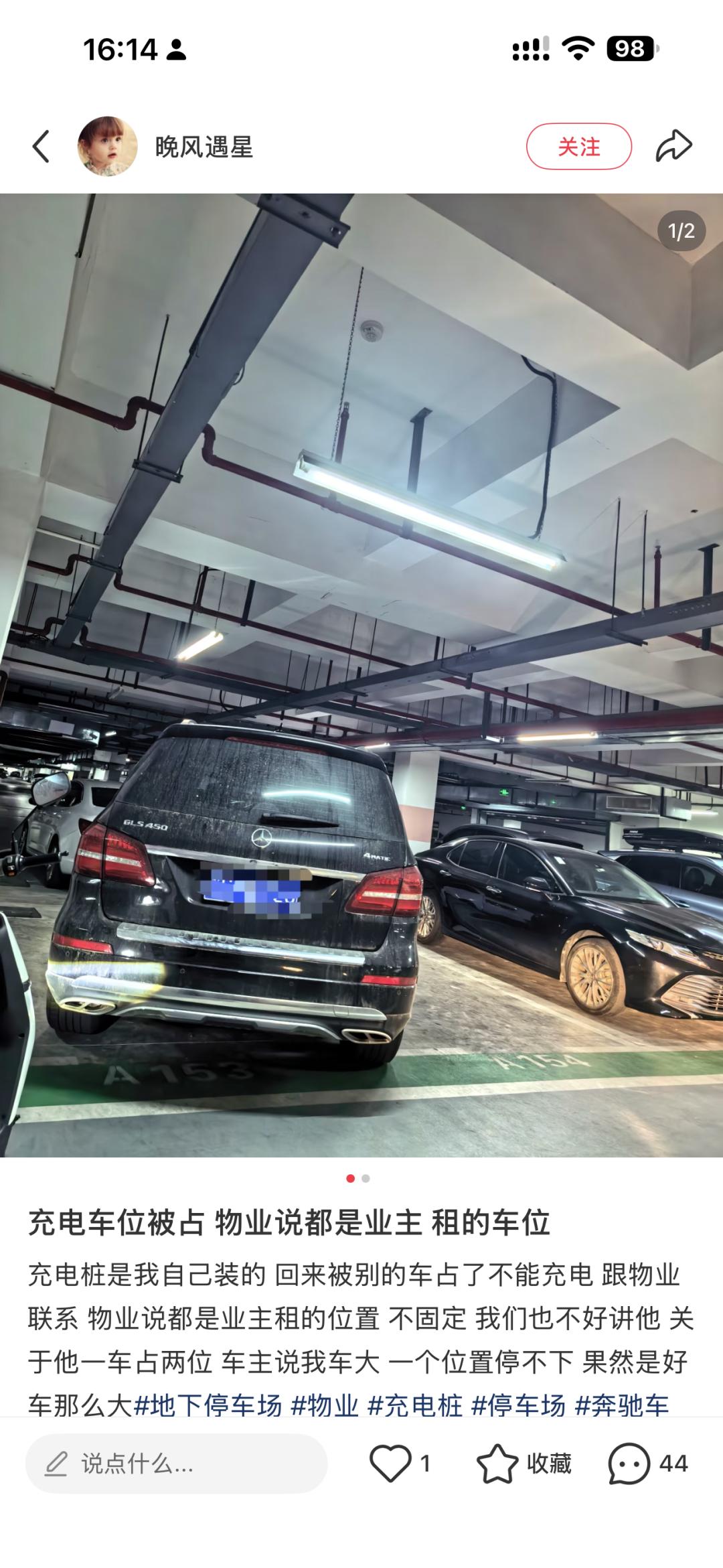
Even charging piles installed at one's own expense are at risk of being occupied. (Photo/Social media screenshot)
Therefore, for current charging stations, the phenomenon of "charging pile exists but no available space" is a stumbling block that directly hits the efficiency bottleneck, especially for those supercharging stations and flash charging stations with higher power that focus on "assembly line operation". According to BYD's promotion of "full charge in 9 minutes", if one flash charging gun is blocked for 115 minutes, it can theoretically squeeze out the energy replenishment windows of at least 12 electric vehicles.
To make sure car owners "leave immediately after charging", the occupancy fee is one of the few restrictive measures for charging stations.
Taking the self-operated charging piles of mainstream new energy brands as examples, the single-time maximum occupancy fee for NIO and Zeekr is 50 yuan, 100 yuan for XPeng, and 200 yuan for Li Auto, with relatively moderate fees. The strictest one is Tesla's supercharging station: when there are no empty parking spaces, an occupancy fee of 6.4 yuan per minute will be charged 20 minutes after charging is completed, with no upper limit.
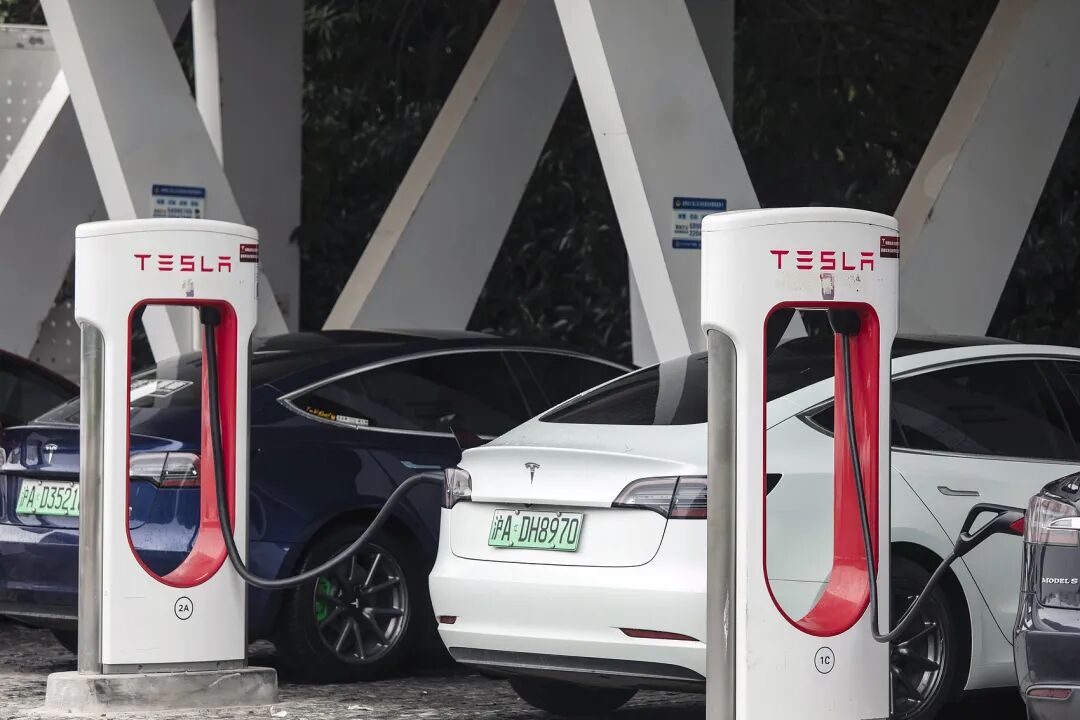
Tesla's supercharging station occupancy fee standard is to charge 6.4 yuan per minute 20 minutes after charging is completed, with no upper limit, making it the "strictest" among all new energy automakers. (Photo/VCG)
Compared with electricity prices, the occupancy fee is much higher, and some people have even taken automakers to court over this issue.
The Shanghai No.1 Intermediate People's Court announced a case in October 2025: a new energy car owner incurred a total fee of 546.85 yuan after charging in October 2024, of which 438.4 yuan was the occupancy fee generated by parking for 94 minutes after charging was completed. After failing to reach a settlement with the automaker, the car owner sued to the court, demanding a full refund of the occupancy fee.
The result made netizens feel very satisfied: the car owner lost both the first and second instance, and all his claims were rejected.
According to the judgment of the Shanghai No.1 Intermediate People's Court, the overtime occupancy fee is a sum of money charged for the car owner's breach of contract of occupying the charging space beyond the time limit. It has the nature of a penalty, and appropriately reflecting the punitive nature for the breaching party with obvious subjective fault is not prohibited by law. During the period when the car owner occupied the charging pile, even if there were 2 remaining charging piles at the charging station involved, it objectively caused the charging station to be busy in turnover, damaging the energy replenishment rights and interests of other users and the operating interests of the new energy automaker.
In other words, charging occupancy fee is reasonable and legal.
However, the restrictive power of this sum of money is still limited. If a car (or even non-motor vehicle) directly uses the charging space as a parking space, the operator cannot find a reason to charge the occupancy fee — without a charging order, there is naturally no entry for fee deduction.
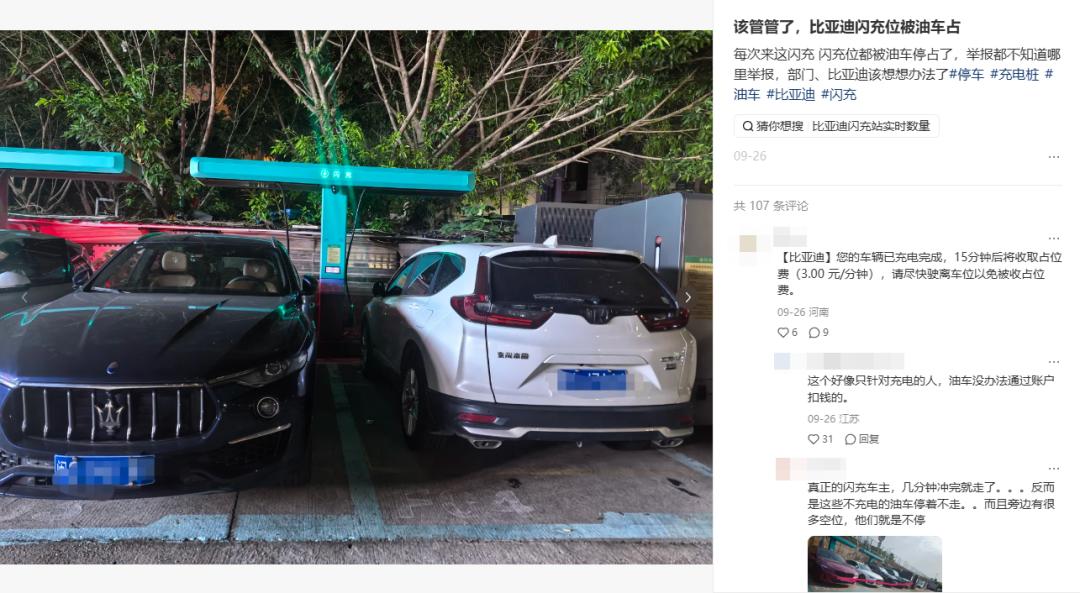
Many charging stations, including BYD Flash Charging, are almost helpless against the phenomenon of gasoline cars occupying charging spaces, as "no fee can be deducted without a charging order". (Photo/Social media screenshot)
After the "300-yuan occupancy fee" incident, many people suggested that BYD learn from automakers such as Tesla and Zeekr, and install facilities such as scanning-code-controlled ground locks and cameras for flash charging spaces. BYD previously also stated that when fuel cars or non-charging vehicles occupy flash charging piles, car owners can use the "One-click Car Moving" function on the Traffic Management 12123 App, enter the license plate number of the occupying vehicle and upload on-site photos, and the platform will notify the car owner to move the car after submission.
But most people know very well how effective this kind of persuasion is — if a phone call can solve the problem, no one would take risks to splash red paint on the occupying car, stuff foreign objects into the exhaust pipe, or even smash the window of the occupying car to vent their anger.
Of course, most people will not be so impulsive. Instead of wasting sunk cost on unnecessary entanglement, when you and I encounter this situation, we will mostly feel depressed for a while, then quickly leave to find the next charging place.
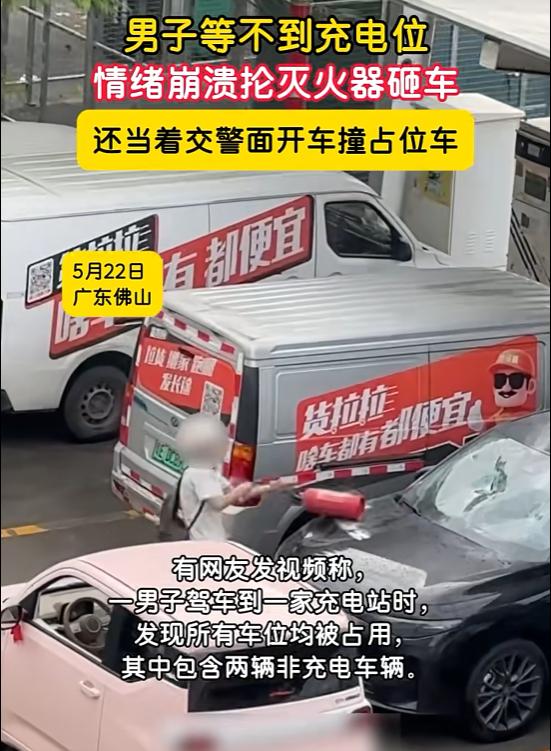
Someone once collapsed emotionally and smashed the car with a fire extinguisher because they couldn't wait for a charging space. (Photo/WeChat Channel @XinkuaiBao)
02
To maintain the "turnover rate" of flash charging guns,
the penalty has to be painful enough to make people remember
The "occupation war" in charging stations has long been commonplace in recent years. What people are fighting for seems to be the charging gun, but in fact it is the parking space where the gun can be inserted.
During this year's National Day holiday, high-speed service areas in Hubei, Sichuan and other places came up with the unique trick of "number-based charging". Car owners queued up with numbers to wait for charging, which was accurately complained by netizens as "just like queuing for meals in the canteen".
Data from the China Passenger Car Association shows that the retail penetration rate of new energy passenger vehicles in October has reached 67.5%, hitting a record high. Technology is constantly updated, more and more ultra-high-power charging stations are built, and the charging speed is getting faster and faster. But to get charged, people seem to be nothing but anxious.
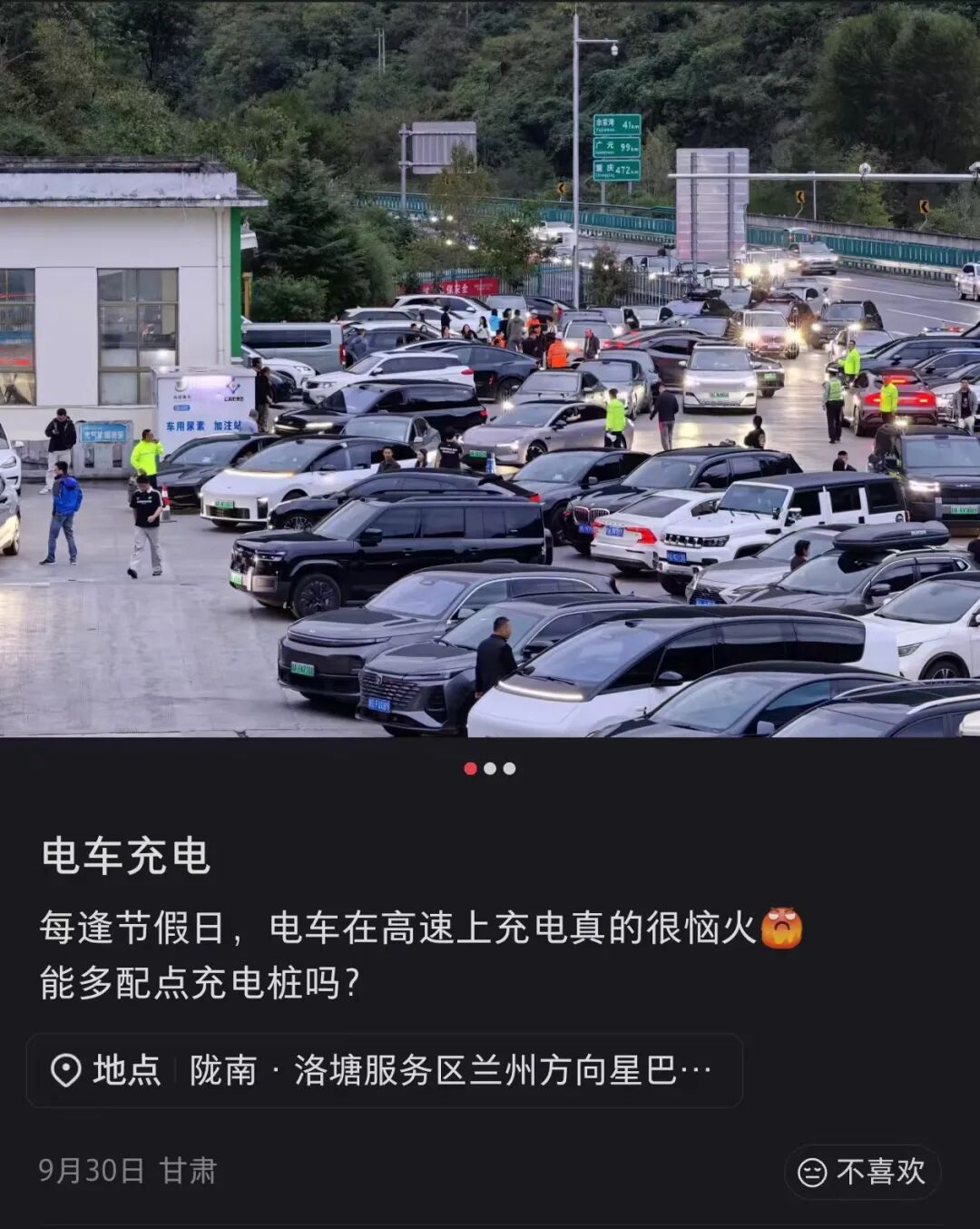
The phenomenon of anxiety for charging is particularly obvious during large holidays. (Photo/Social media screenshot)
Are there really too few charging piles? Not exactly. Data released by the National Energy Administration shows that by the end of September, the total number of charging facilities (guns) across the country reached 24.777 million, a year-on-year increase of 37.2%, and the car-to-pile ratio reached 2:1 — which is enough to meet the needs of most new energy vehicles.
Looking at the data in detail, the vast majority of the increment is installed in private parking spaces (19.57 million private charging piles), and there are only 5.207 million public charging piles that truly meet the public energy replenishment needs. In the first half of this year, 292,000 new public charging facilities were added nationwide, with a year-on-year increment decrease of 43.5%, further exacerbating the already tight public charging demand.
More and more cars are being sold, but the construction of public piles is getting slower and slower. This huge gap naturally aggravates the "energy replenishment anxiety" of new energy car owners.
Even if the total number of more than 5 million public piles has long exceeded the number of gas stations, when you go on the highway during holidays, you will find that among the public charging piles all over the country, the 4.8118 million ordinary fast charging piles with power below 250kW are the absolute main force — according to the data of China Electric Vehicle Charging Infrastructure Promotion Alliance as of August, they even account for 90.3% of the total number of public charging piles.
In addition, most charging stations need at least 6 to 8 years of operation to recover their costs after being put into use, and are restricted by factors such as power connection time cost, land lease period, technology upgrading, and electricity price policies. As energy replenishment facilities are improved, and the national construction and operation subsidies for new energy charging stations are gradually phased out, as business premises, charging stations naturally have the same "turnover rate anxiety" as coffee shops and tea shops.
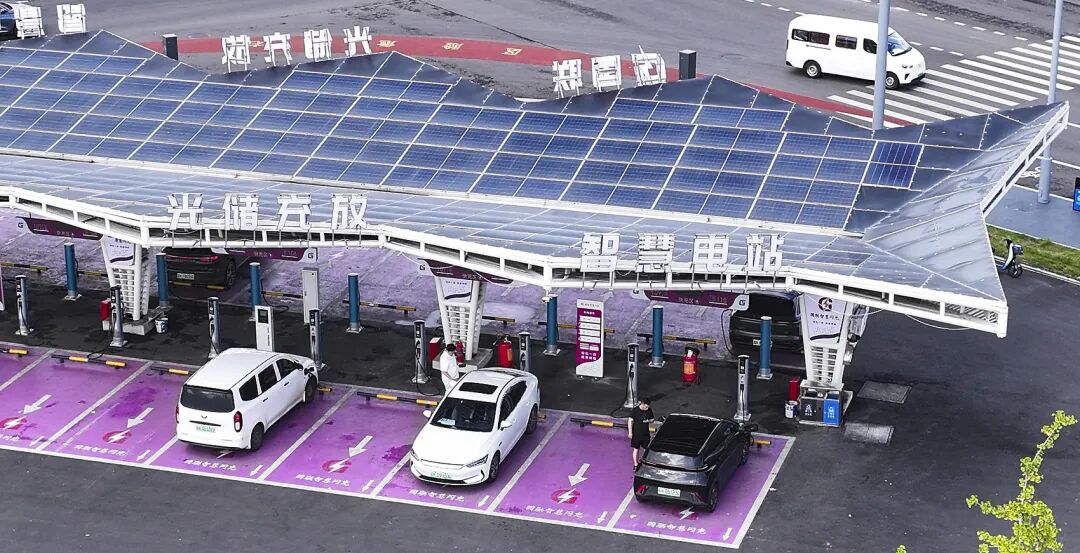
Public charging stations are also business premises, and they also have the same "turnover rate anxiety" as coffee shops and tea shops. (Photo/VCG)
When new energy vehicles were not yet popular, people thought that "occupying the space while charging" was the right that new energy car owners deserved, regarded the sky-high occupancy fee as a "consumption assassin", and criticized charging stations for being "mean". But when per capita public resources are increasingly scarce, people realize that the expensive charging occupancy fee is a reasonable and legal consumption item.
What's more, all kinds of public kindness based on business decisions have now been completely exhausted by various "wool speculators".
03
The unspoken rule of "occupying space is justified",
and the disappearing "sense of boundary"
In late October this year, Starbucks announced the implementation of the "consumption for seating" rule in all its national stores. At the same time, many chain brands such as IKEA, Nayuki, and Bawangchaji followed suit one after another, putting up prominent signs with prompts such as "no long-term seat occupancy", "no outside food allowed", and "no gathering for card games".
Just like the discussion on the occupancy fee this time, this series of seemingly "unreasonable" rules has almost received support from the whole