Why is AI making us increasingly busier instead? Three paradoxes related to AI
First, let me share my intuitive observation:
AI is getting increasingly adept at writing articles, and it can churn out a decent draft in just three minutes.
However, writing a heartfelt, engaging article that people actually want to read has not become any easier at all.
Many of my former colleagues at large tech companies use AI every day, but it is obvious that bosses are raising their requirements higher and higher, and many product managers are required to bring a working demo to the review meeting.
In the end, AI does not save us time, but instead makes us busier and busier.
Today, Wei Xi discusses three paradoxes around this topic — the Cowan Paradox, the Solow Paradox, and the Jevons Paradox.
We will cover respectively:
Why do tools that are supposed to improve efficiency end up making us busier?
Why has the productivity output of AI not met our expectations?
And why have model prices dropped many times over, but our spending on AI has not decreased?
Let's get straight to the point:
I
Let's start with the Cowan Paradox, which explains only one question:
Why didn't the washing machine liberate housewives?
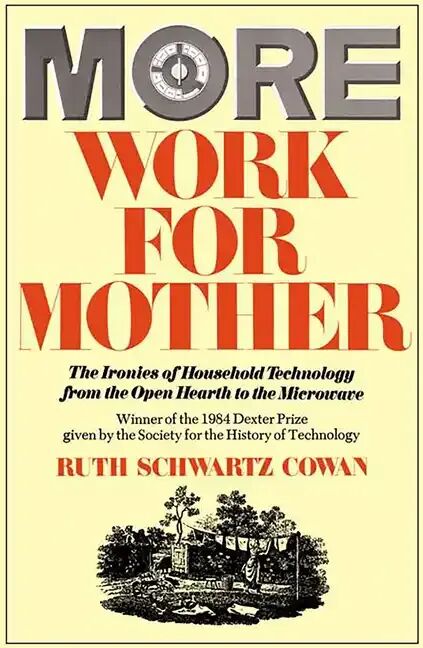
In 1983, American tech history scholar Ruth Schwartz Cowan published a book titled More Work for Mother.
As a woman who was already a mother, Cowan had a very down-to-earth observation:
By the 1970s, washing machines, vacuum cleaners, and electric stoves were all widely available, but why was she busier than her mother's generation decades earlier?
Sociologist Joann Vanek released a set of comparative data in 1974:
Full-time housewives in the US spent about 52 hours a week on housework in 1924, and the figure rose to around 55 hours a week by 1966.
With all the household appliances available, total working hours did not drop but instead rose. Economic historian Joel Mokyr named this phenomenon the Cowan Paradox.
So here comes the question: Where did the saved time go?
Cowan summed up 3 reasons:
The first one is that standards have changed. It used to be normal to do laundry once a week, but with washing machines, changing clothes and washing them every day has become the standard for many families.
The second one is the disappearance of helpers. According to Cowan, the amount of work one housewife did in 1950 would have required three or four people to work together in 1850, and all the work that used to be shared by maids, daughters and husbands fell entirely on one person.
The third one is that new tasks emerged: driving to the supermarket, picking up and dropping off children, which did not exist at all in the horse-drawn carriage era.
These 3 rules are basically repeating themselves in the AI era:
A hand-made prototype was enough in the past, but now product managers need to make demos, and even produce videos. You could hire an intern to do the work before, but now that budget is allocated to AI instead.
II
This is backed up by concrete data.
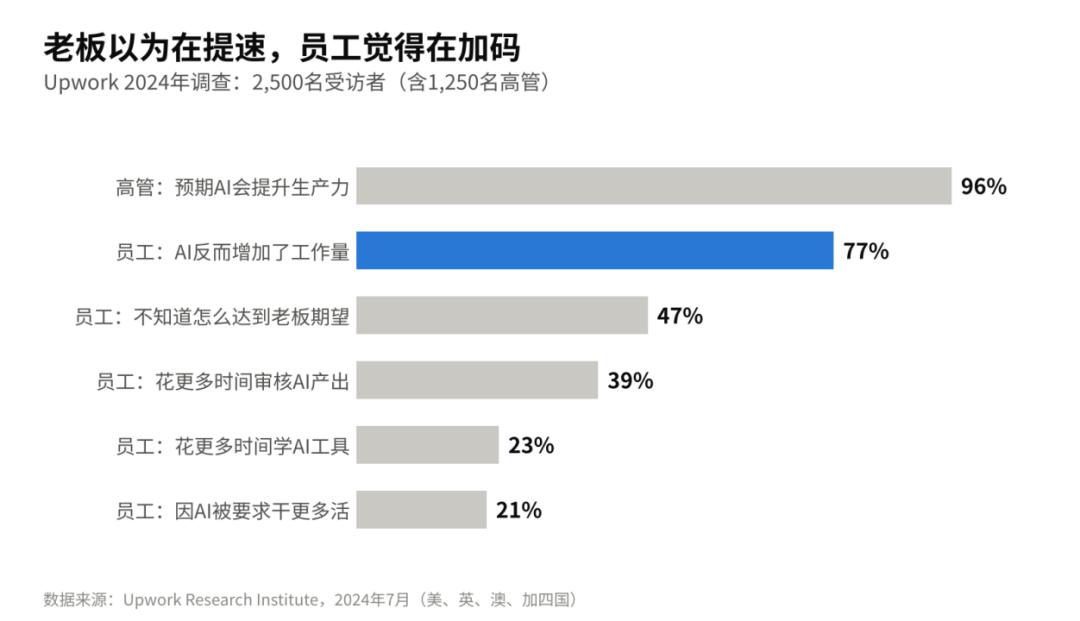
American staffing agency Upwork surveyed 2500 people about the impact of AI on work, and the results show that:
Among employees who use AI, 77% say their workload has increased instead, and 81% of executives admit that they have raised work requirements for their employees in the past year.
In February 2026, Aruna Ranganathan and Xingqi Maggie Ye from UC Berkeley published an article in Harvard Business Review titled AI Has Not Reduced Work, It Has Made Work More Intensive.
They spent eight months observing a tech company with about 200 employees, and found that product managers started to write code, researchers started to take on engineering tasks, and the workload many people took on would have been enough to hire a new employee in the past.
Renowned developer Simon Willison shared this article and said that this exactly matches his own experience.
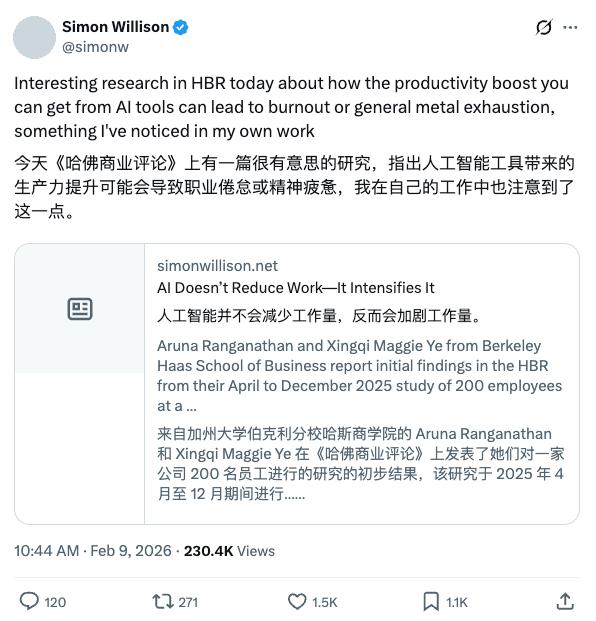
Tweet link: https://x.com/simonw/status/2020901645597683870
III
Another thing that makes people exhausted by AI is rework.
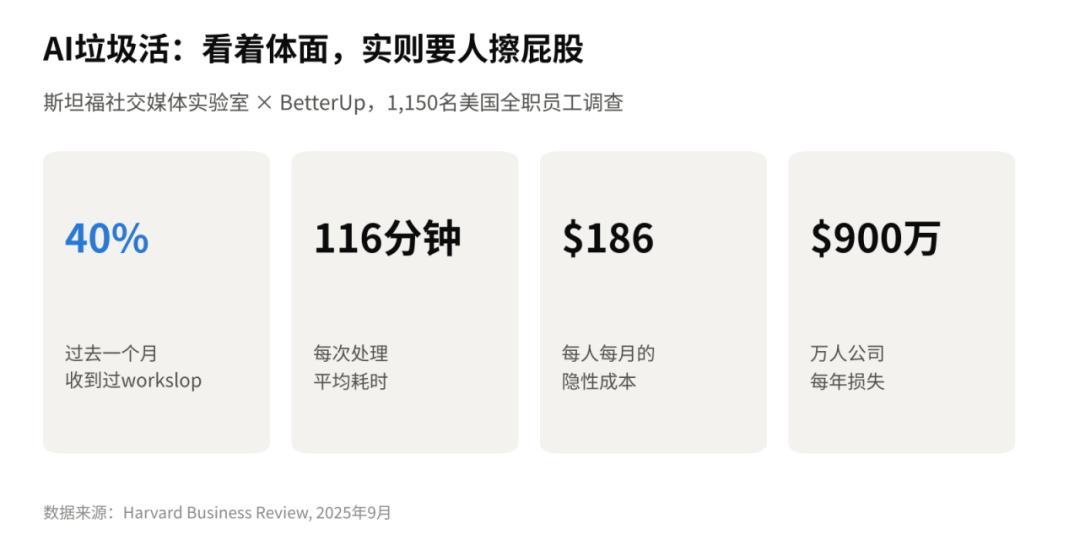
In September 2025, Stanford Social Media Lab coined the term "workslop": AI-generated outputs that look decent at first glance but cannot actually push any work forward.
They surveyed 1150 full-time American employees, 40% of whom received such works in the past month. Each time they spent an average of 116 minutes processing these outputs, resulting in an implicit loss of $186 per person per month.
I can totally relate to this. In the past two years, all the documents I received have become longer and look more professional, but the process of digging out important information from these documents has become more tiring.
Sometimes I even have to ask Claude what the core purpose of this document is.
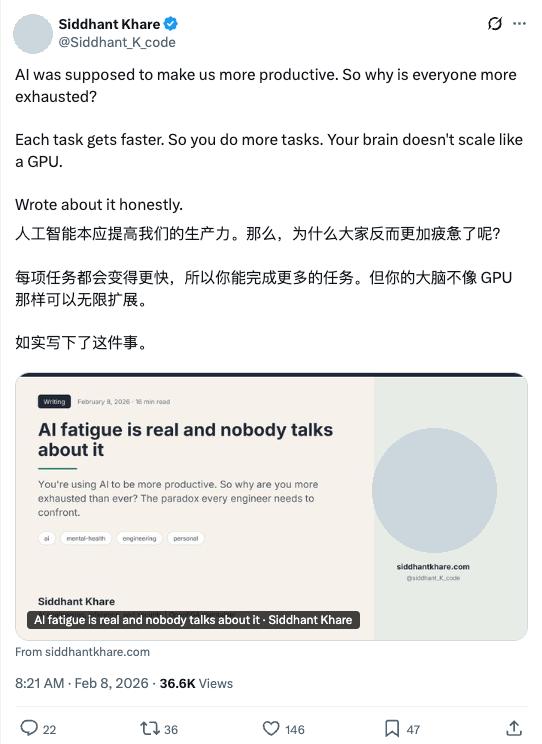
Engineer Siddhant Khare wrote an article in February 2026 titled AI Fatigue Is Real, No One Is Talking About It, which topped the Hacker News leaderboard.
This long article is well worth reading for everyone who uses AI (link: https://siddhantkhare.com/writing/ai-fatigue-is-real)
His core point is: Every single task gets done faster, so you take on more tasks, but your brain cannot expand its capacity.
Tweet link: https://x.com/Siddhant_K_code/status/2020503345476391330
IV
In 1930, John Maynard Keynes wrote a short essay titled Economic Possibilities for Our Grandchildren.
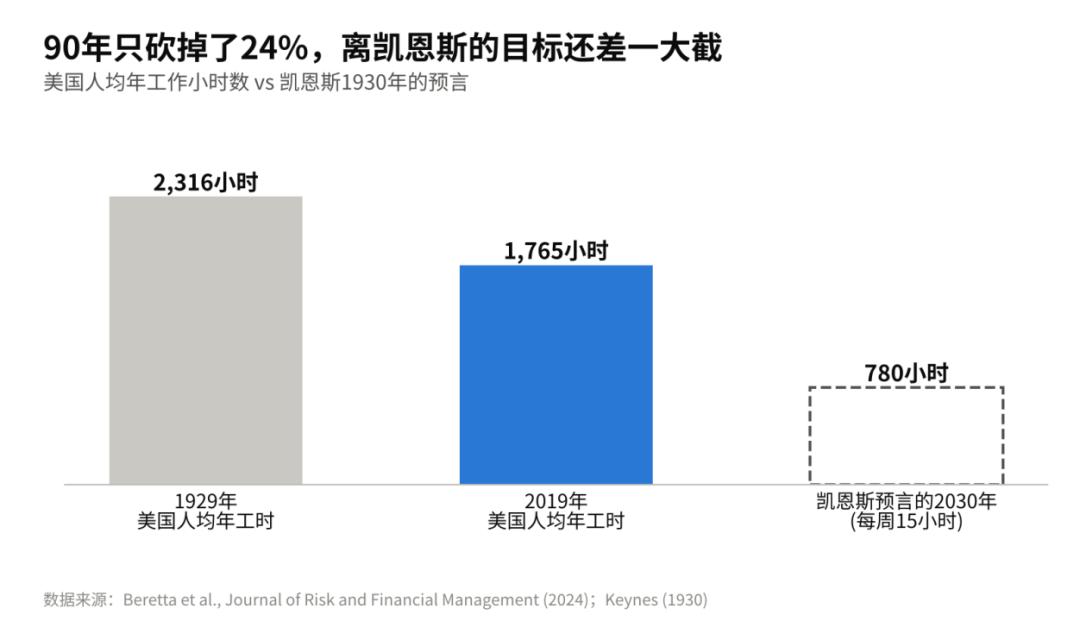
He did the math: as long as capital grows by 2% every year and technology advances as usual, by 2030, people only need to work three hours a day, 15 hours a week.
He even worried that people at that time would be so bored with leisure that they would not know what to do with their time. (Keynes really worried a lot for us)
With less than four years left before 2030, let's look at the data:
According to calculations by several Swiss and Spanish economists in 2024, the annual working hours per capita in the US dropped from 2316 hours in 1929 to 1765 hours in 2019, a 23.8% reduction in 90 years.
Keynes' target translates to about 780 working hours per year.
So the conclusion is obvious: Keynes was wrong.
Sam Altman said publicly this summer that every technological revolution in history promised more leisure time, but the whole society has never really lived a life with less work.
He does not think AI will change this, because humans are naturally competitive.
Let me give a simpler example:
In the past, rickshaw pullers worked extremely long hours every day. Suppose one rickshaw puller got a taxi while everyone else was still pulling rickshaws.
Then he could earn as much money in two hours as others earned in a whole day. But the question is: would he only drive for two hours?
Obviously not.
And the harsher reality is that every competitor of his has a taxi, and the cost of buying a taxi is not low.
This is the taxi market today, and in fact, it is also the AI market today.
V
The Cowan Paradox explains why individuals are busy, but will this busyness be reflected in economic data?
That's where Solow comes in.
In July 1987, economist Robert Solow left a famous quote in a New York Times book review:
"You can see the computer age everywhere but in the productivity statistics."
In October of the same year, he won the Nobel Memorial Prize in Economic Sciences.
Let's look at the concrete data:
The labor productivity of the US non-farm sector grew at an average annual rate of 3.19% from 1948 to 1973.
From 1974 to 1995, the two decades when computers spread across American enterprises, the growth rate fell to 1.53%.
After the internet boom in 1996, the growth rate returned to 3.15%, and dropped back to 1.39% after 2004.
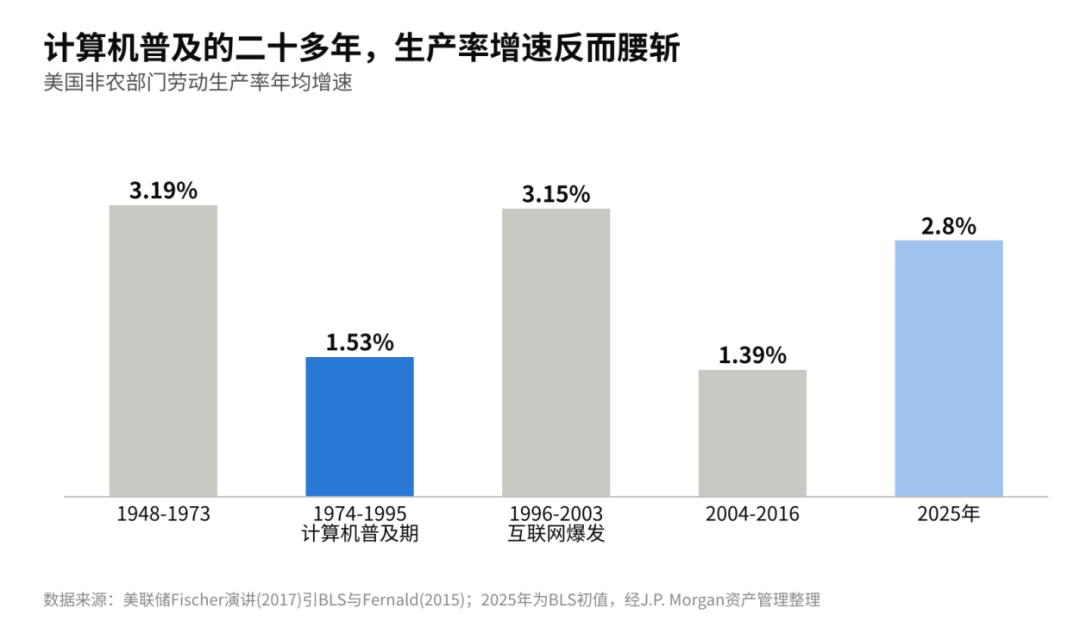
A person can be busier and produce more output, or be busier while the output remains unchanged. The latter is exactly what Solow was worried about.
So will AI repeat the Solow Paradox?
VI
If you replace "computer" in Solow's quote with "AI", it fits 2025 perfectly without any modifications.
At the micro level, Professor Anders Humlum from the University of Chicago linked the survey data of 25,000 Danish employees with official tax and employment archives for analysis.
The conclusion is that people who use AI only save an average of 2.8% of their time, with no significant impact on their income or working hours.
At the enterprise level, MIT released the Generative AI Divide report last July: enterprises have invested 300 to 400 billion US dollars in generative AI, but 95% of institutions have not seen measurable returns.
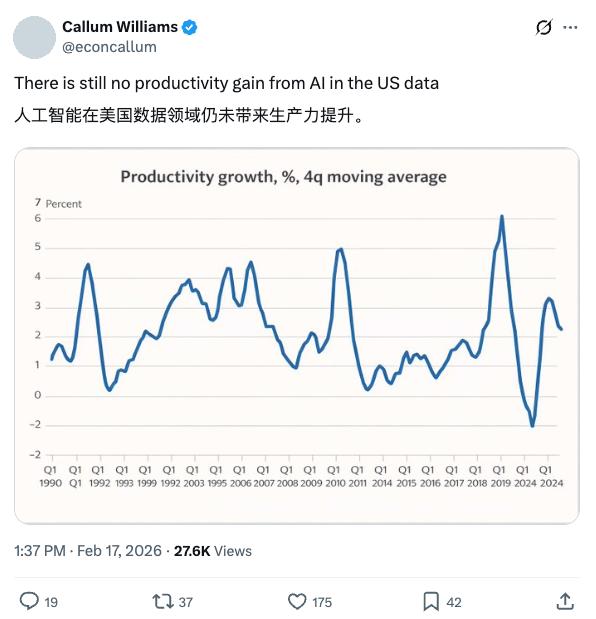
At the macro level, in February 2026, Callum Williams from The Economist posted a US productivity curve.
The caption had only one sentence: The productivity boost brought by AI is still not visible in US statistics.
Tweet link: https://x.com/econcallum/status/2023844211842576592
Indeed Hiring Lab also pointed out that after deducting massive investments, the US total factor productivity slowed down from 1.5% to 0.8% in 2025.
VII
So here comes the question: Why has such a clearly powerful technology not been reflected in economic data for so long?
Stanford economist Paul David gave a widely recognized explanation: Electricity once also faced the Solow Paradox.
Power stations were built as early as 1881, but by 1900, there was barely any evidence of electricity improving efficiency in factories.
It was not until a generation later that factories rearranged their production lines according to material flow, and equipped each worker with a small electric motor.
It was not until the 1920s that the productivity growth rate of US manufacturing exceeded 5% per year, 40 years after electricity was commercialized.
This is the famous productivity J-curve: When new technologies are first implemented, enterprises need to adjust their processes and train their employees, so productivity will experience a process of first declining then rising.
Therefore, according to this explanation, today's AI is stuck at the bottom of the J-curve.
Workday's research found that in 89% of institutions, less than half of the jobs have been redesigned to match AI capabilities.
In other words, most of us are still lagging behind the development of AI.
VIII
So will the Solow Paradox be broken?
The flagbearer of the optimists is American economist Erik Brynjolfsson.
His view is backed by data: in March 2026, the US Bureau of Labor Statistics announced that productivity grew by 2.8% in 2025, while the average growth rate in the decade before the pandemic was only 1.2%.
He tweeted that it is still hard to determine how much of this growth is contributed by AI, but the Solow Paradox might be ready to retire.
