10-yuan in-store experience, 6-yuan AI model: Who is paying for the AI fake experience business that rakes in 8 million yuan per month?
In the local life track, the store exploration business once formed a complete industrial chain, which is now being eroded by AI.
Traditional in-person store exploration shooting and editing often costs hundreds or even thousands of yuan, but now AI has pushed the cost of a single piece of content to less than 10 yuan. Merchants only need to upload a photo of the storefront, a few pictures of dishes, and pair them with an AI anchor to generate an AI store exploration video.
In addition, dedicated AI store exploration accounts have emerged on platforms such as Douyin. One content creator has only 19,000 followers, focuses on this type of content, and the homepage shows that the total goods sold through live streaming have reached 213,000 yuan, and 718 stores have been checked in.
With the development of AI video generation technology, around AI store exploration, a gray industrial chain is taking shape, covering low-cost tutorials, computing power top-ups, and mass production agencies.
01
Polarized prices for AI store exploration, "source factories" earn millions
AI store exploration is spreading continuously. On major platforms, from hot pot restaurants, grilled skewer shops, milk tea shops to leisure entertainment projects, digital humans either sit at the dining table tasting food, demonstrating swallowing movements with soup dripping from the corners of their mouths, or introduce the store environment following the camera. Behind this type of content, a distinctively layered industrial chain has taken shape.
The upstream part consists of agencies that mass-produce AI store exploration videos. A practitioner introduced to Tech Planet that such agencies often call themselves "source factories": if a customized dedicated AI store exploration system is developed for a merchant, the selling price is nearly 20,000 yuan; if the agency's existing system is used directly, the annual fee is 680 yuan, followed by top-ups for computing power, about 10 yuan per store exploration, and about 2 to 3 yuan to generate a voiceover video from a single photo.
These agencies sell system tools to operation outsourcing enterprises, which then sell them to merchants with supporting operation services. According to the aforementioned practitioner, his company has cooperated with thousands of stores so far, and the basic fee alone has reached 680,000 yuan; in addition to catering enterprises, they have also cooperated with factories of noodles and flour products, hot pot base materials, etc. In addition, merchants can also become agents, paying 9,800 yuan a year, with one agent corresponding to 100 accounts and 100 stores.
Securities Times previously reported that some companies specializing in mass production of AI store exploration videos have achieved a monthly revenue of 8 million yuan.
In addition, there are a large number of individual sellers taking orders on platforms such as Xianyu. The AI store exploration tutorials they sell are as low as 0.18 yuan, but the real profit point lies in subsequent computing power top-ups and membership fees. Some sellers also use low-cost tutorials to divert traffic to communities, and then sell other advanced AI video courses.
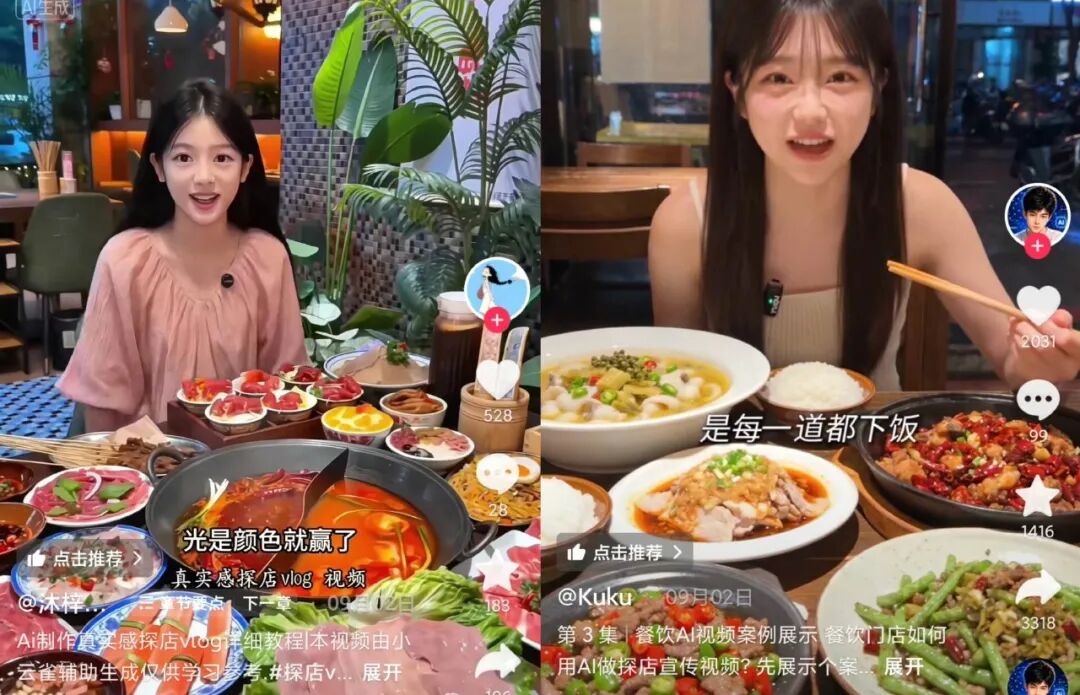
Caption: Screenshot of AI store exploration video
AI store exploration content is emerging in endlessly, and the prices are severely differentiated. One type of service costs only about 10 yuan per video. On related AI video generation tools, computing power is usually consumed in the form of "points", and 1 point is equivalent to about 1 yuan. For example, uploading 4 restaurant pictures to generate a 12-second, 480P store exploration video only consumes 9.6 points, that is, 9.6 yuan.
The other type is as high as 800 yuan per minute, which is almost on a par with the quotation range of mid-tier in-person content creators. According to monitoring by third-party marketing data platforms such as NewRank, the quotation for store exploration varies greatly depending on the city, number of followers, and content format: the quotation for ordinary creators ranges from hundreds of yuan in second- and third-tier cities to nearly 2,000 yuan in first-tier cities, while the mainstream range for mid-tier influencers is at the level of several thousand yuan.
A producer who expanded from short dramas to AI store exploration told Tech Planet that his team is expanding AI store exploration business, and all the partners are local small and medium-sized catering enterprises. He mentioned that the AI store exploration uses seedance2.5, "We didn't use such an expensive model for short dramas, and we only use it for fight scenes."
In his view, the reason why this pricing is feasible is that the AI character's expressions are more realistic, and AI store exploration can not only reduce the on-camera cost of in-person influencers, but also save the corresponding ingredient cost of cooking all the dishes for real-person store exploration.
In addition, store exploration influencers are divided into two categories: one is pure content-based store exploration influencers, and the other is group-buying commission-based store exploration influencers, the latter mainly earn income through commission sharing.
At present, many operators have used fixed AI images to produce videos in batches, and hang group buying links to earn verification commissions. It can be seen from the Douyin platform that a store exploration blogger named "Xiao Tan" has a total sales of 231,000 yuan and has checked in 718 stores; a store exploration blogger named "Li Wuyou" has a total sales of 202,000 yuan and has checked in 98 stores.
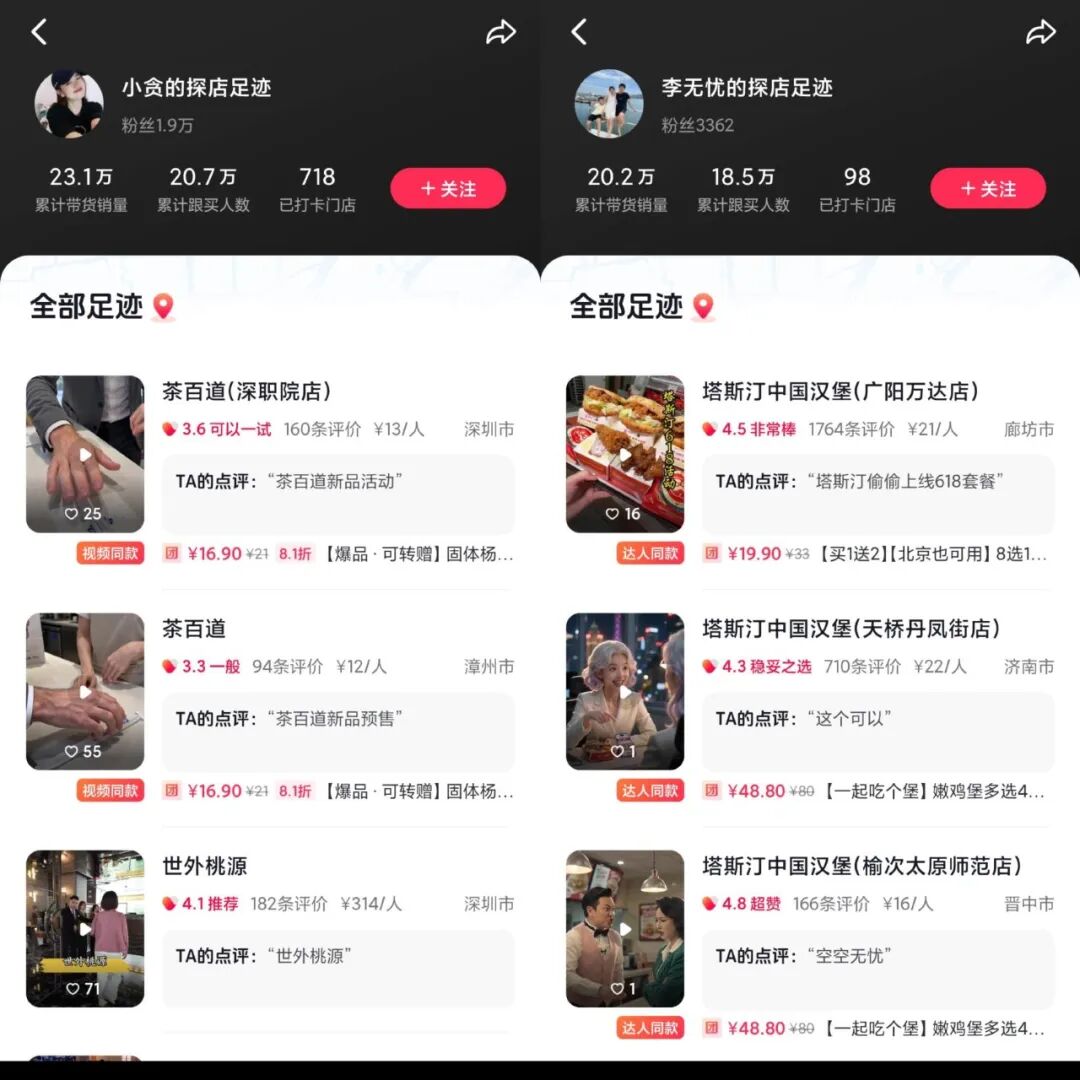
Caption: AI store exploration accounts that rely on group buying commissions
The homepages of these bloggers' accounts are basically full of store exploration videos released by AI-generated characters of different ages and from different eras. Such accounts usually fix a set of AI images, and the scripts only focus on prices and benefits. Images such as foreigners and ancient costume characters are most commonly selected, mostly to create visual freshness in the information flow and increase user retention rate.
In addition, many real-person store exploration bloggers also intersperse AI-generated video content on their homepages, and some of these accounts have considerable play volumes. There are already multiple tools marked with the function of "AI Store Exploration Vlog" in Apple's App Store and some Android app stores, providing services of "generating store exploration videos by uploading store pictures" for merchants and influencers, but the download volume is relatively low at present.
02
AI store exploration is cheaper, do merchants really save money?
From the demand side, the demand of merchants to spend less on store exploration promotion does exist indeed.
Store exploration was once regarded as a side job that "you can eat and drink for free and make money", but the reality is far crueler than the filter. Food store exploration review is a market with high transaction matching cost: merchants have to run their restaurants every day, and it is difficult for them to have the energy to reach out to bloggers online by themselves; for bloggers, there are countless restaurants in a city, and it is also difficult for them to walk around the streets to talk about cooperation with merchants.
A store exploration blogger told Tech Planet that in this market, transaction intermediates that improve efficiency through economies of scale have emerged. On the one hand, they recruit influencers in batches, on the other hand, they promote to merchants in batches, and then match transactions to earn the difference. If the merchant's budget is 100 yuan per order, after several layers of intermediaries resell the business, only about 30 yuan will be left for the blogger.
Therefore, although in recent years, with the increase of new entrants and excess supply, the income of real-person store exploration bloggers has decreased, the budget on the merchant side does not necessarily decrease.
From the perspective of the evolution of AI store exploration videos, the mode of purely AI fictional stores and dishes is being abandoned. At present, the most commonly used AI videos by catering merchants are generated by "real shot pictures + digital humans", and most of the storefronts and dishes are real.
When AI store exploration pushes the minimum cost of a single piece of content to less than 10 yuan, mass production of false content seems to be very cost-effective economically, especially for the large number of small and medium merchants in local life: they cannot afford big influencers, but they can produce dozens of AI videos in batches to spread the volume, forming a "matrix effect" to compete for local traffic.
According to Securities Daily, from the merchant side, newly opened hot pot restaurants that need to attract customers, and milk tea shops that need to do group buying for new product launches, are typical demand sides for AI store exploration. Their common feature is the demand for short-term concentrated exposure, which requires rapid volume expansion to increase presence on the local page, rather than long-term brand building.
However, when merchants turn to lower-cost AI store exploration, they are not necessarily the real beneficiaries. At present, the money first flows to the "people selling shovels". A considerable part of the money saved by merchants has become tutorial fees, computing power top-up fees and generation service fees. After the video is produced, advertising promotion, platform compliance and other hidden costs also need to be borne.
From the supply side, it is not new that real-person store exploration bloggers have difficulty in receiving orders. A store exploration blogger told Tech Planet that recently Douyin has begun to weaken the extensive indicator of "total play volume" in influencer assessment, and instead emphasizes continuous and stable content traffic (such as the average play volume of top 10 video drafts or the average play volume) and real verification transactions, so the traffic competition and conversion pressure on the influencer side have increased at the same time.
This pressure will also be transmitted to AI store exploration. With the continuous change of platform rules, it is increasingly difficult for AI content that only relies on low-cost volume stacking to get distribution, and the actual conversion benefits that merchants can get in return have also become more uncertain.
03
10-yuan store exploration, 6-yuan models: AI is mass-producing "fake experiences"
Opening the review app to check scores and scrolling through store exploration bloggers' videos for reference has long been a habit for many consumers before choosing catering food. The hygiene condition of a restaurant, the actual taste of dishes, whether the portion is reduced, and whether the service is in place, are all information that can only be obtained through on-site experience.
The irreplaceability of store exploration lies in its ability to provide such "non-standardized" real details, whose core should always be on-site experience.
Even though many AI store exploration videos will mark "AI-generated" at the bottom of the video, more and more AI videos are mixed into store exploration content, making users unable to distinguish between true and false.
China Youth Network previously reported that a blogger named "Qiao An" followed by a college student often shared daily life, and recommended restaurants and books to netizens, attracting many fans. However, until some netizens found that the facial expressions in many of her photos were highly consistent and the light and shadow effects were unnatural, the account marked "Content is AI-synthesized" on some of the pictures.
In fact, long before the emergence of AI store exploration, the authenticity chaos of real-person store exploration bloggers in the past few years has caused many controversies. "Workers' Daily" once reported that Mr. Liu, who used to work as a store exploration influencer in Nanning, Guangxi, revealed key details: junior influencers earn 20 to 60 yuan per order. To increase income, they have to shoot at least seven or eight orders a day, "There is no time to taste the food carefully at all." Behind this, it reflects the improvement of users' requirements for the authenticity of store exploration content.
It is not limited to the local life sector. With the development of AI video generation technology, AI models on e-commerce platforms have also emerged in clusters during this year's Double 11 shopping festival.
The underlying logic is almost the same as that of AI store exploration, and a complete chain from tutorial diversion, computing power monetization, generation services to account goods promotion has been successfully operated. The core logic is to use extremely low front-end cost to leverage continuous back-end charges.
For merchants, the venue fee, model fee and photography fee for shooting a piece of clothing in real life add up to at least two to three hundred yuan, while AI generation costs as low as 6 yuan per picture, and 5 yuan per picture if the definition is slightly reduced.
According to The Paper, industrial supporting facilities have also taken shape. A collection of prompt word instructions for AI women's clothing image generation is sold for 16.9 yuan and has sold 866 copies, and an AI women's clothing goods promotion workflow tutorial is sold for 9.9 yuan and has sold 37,000 copies.
An agency specializing in producing AI store exploration videos also told Tech Planet that local life and e-commerce are only application branches of the intelligent agents they developed. For this reason, any merchant with short video production needs is their potential customer, and this set of tools can be called at any time to generate continuous charges.
This means that the production of "fake experiences" no longer depends on specific industries. When store exploration videos "that no one has ever eaten the food" and model pictures "that no one has ever worn the clothes" share the same generation tool, the same tutorial industrial chain, and the same computing power top-up backend, "fake experience" is no longer an occasional phenomenon in a certain industry, but has become a replicable business model that is continuously produced in large quantities.
This article is from the WeChat official account "Tech Planet" (ID: tech618), written by Lin Jing, and published with authorization from 36Kr.