The first "5-trillion-yuan foreign trade megacity" is shifting gears.
This week, APEC ushers in the "Shenzhen Moment". At this highly anticipated juncture, Shenzhen officially announced that its total foreign trade import and export volume has exceeded the 5 trillion yuan threshold for the first time, hitting a new record high.
Statistics from Shenzhen Customs show that in the first 10 months of this year, the total import and export volume of Shenzhen reached 5.25 trillion yuan, a year-on-year increase of 40.9%, making it the first "5-trillion-yuan foreign trade metropolis" in Chinese mainland.
This round of high foreign trade growth is closely related to Shenzhen's deep integration into the global AI industrial chain. In the first three quarters, the import and export volume of AI-related components such as integrated circuits in Shenzhen ranked first in the country, contributing over 60% of the city's foreign trade increment.
What is more worth exploring than the breakthrough in scale is the change in the foreign trade structure of this traditional major export city. In the first 10 months of this year, Shenzhen's exports reached 2.71 trillion yuan, up 19.7%; its imports reached 2.54 trillion yuan, up 73.7%. Imports have become the main driving force for this round of growth.
Now, standing at the new threshold of 5 trillion yuan, how will Shenzhen achieve a new round of growth?
01
Rising to the Top
Looking back on its development path, Shenzhen, the "No.1 Foreign Trade City", has not had an easy journey.
More than 40 years ago, Shenzhen was still a remote agricultural county on the border. In July 1979, the first export processing industrial zone in Chinese mainland broke ground and started construction in Shekou.
Relying on its geographical advantage of being adjacent to Hong Kong, as well as low land and labor costs, Shenzhen at that time started with the business model of "processing with supplied materials, processing according to buyer's samples, assembling with supplied parts and compensation trade", stepped onto the fast track of processing manufacturing, and opened up a golden era of foreign trade. By the end of the 1980s, Shenzhen had initially formed an export-oriented economic pattern.
In 1993, Shenzhen's total export volume surpassed Shanghai for the first time, jumping to the first place among large and medium-sized cities across the country. Since then, Shenzhen's export volume has maintained the national first place for 33 consecutive years.
However, in terms of imports, Shenzhen lagged behind Shanghai for a very long period of time. Statistics show that from 2015 to 2023, Shanghai's total import and export volume always surpassed that of Shenzhen, ranking firmly first in the country.
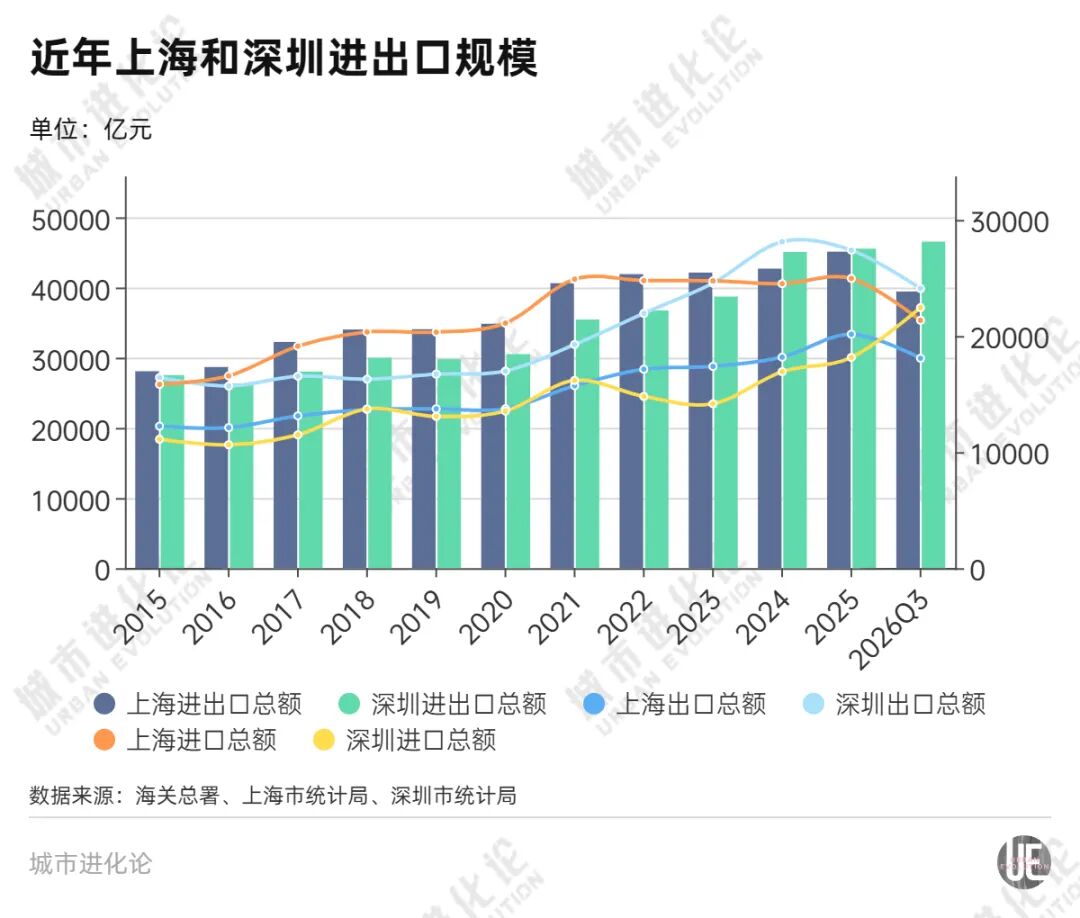
The turning point did not come until 2024: in that year, Shenzhen's import and export volume exceeded 4 trillion yuan for the first time, reaching 4.5 trillion yuan with a year-on-year increase of 16.4%, and both imports and exports hit all-time highs. Its total import and export volume surpassed Shanghai's 4.27 trillion yuan in the same period. This was the first time Shenzhen regained the title of "No.1 Foreign Trade City" from Shanghai after 9 years.
In 2025, Shenzhen's total import and export volume reached 4.55 trillion yuan, and its leading advantage over Shanghai (4.51 trillion yuan) narrowed to only more than 40 billion yuan, with the two sides locked in an almost head-to-head competition.
In that year, the total import and export volume of Shenzhen increased by only 1.4% year on year, of which exports reached 27387.81 billion yuan, down 2.6%, and imports reached 18146.08 billion yuan, up 8.0%. In the same period, Shanghai's import and export growth rate reached 5.6%, with both exports and imports maintaining positive growth.
At that time, there was widespread public discussion that Shenzhen was "under export pressure and its total foreign trade volume would be overtaken by Shanghai". However, entering 2026, Shenzhen's performance completely dispelled this concern.
Data released by the General Administration of Customs shows that in the first three quarters of this year, Shenzhen's cumulative import and export volume reached 4.65 trillion yuan, a sharp year-on-year increase of 38.8%, and the scale has exceeded that of the whole of last year. In the same period, Shanghai's total import and export volume was 3.94 trillion yuan, up 17.9% year on year. With a stronger growth momentum, Shenzhen suddenly widened the gap to the 700 billion yuan level.
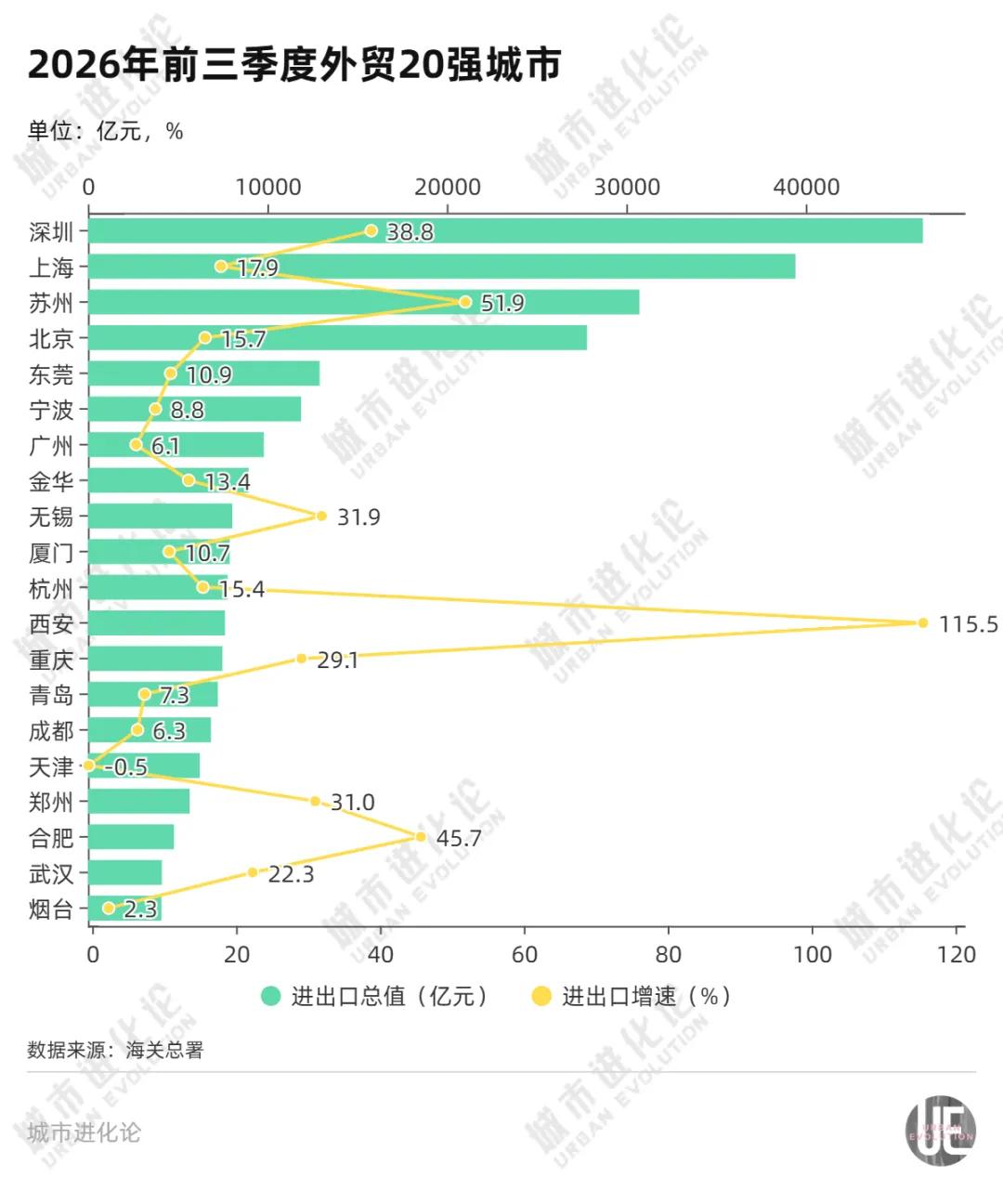
Only one month later, Shenzhen ushered in another historic breakthrough. Where does the driving force for this "high-level advancement" come from?
According to the relevant person in charge of Shenzhen Customs, in the first three quarters, the import and export volume of AI-related components such as integrated circuits in Shenzhen ranked first in the country, contributing over 60% of the city's total foreign trade increment.
One background is that with the outbreak of the global AI wave, the advantages of the whole industrial chain continue to expand, and computing power hardware has become a key variable that reshapes the pattern of top-tier strong foreign trade cities. Standing at the forefront of opening-up and boasting the industrial foundation of a world-class manufacturing cluster, Shenzhen has already taken the lead in seizing this opportunity.
In the view of Hu Gang, professor of Jinan University and founding president of South China Urban Research Association, "5 trillion yuan" is not only a historic breakthrough in trade scale, but also marks that Shenzhen has officially built a national-level international trade hub, realizing a fundamental iteration of foreign trade functions: trade is no longer a simple flow of goods, but a core strategic tool that deeply serves high-tech industries, ensures the safety of the industrial chain, and supports the upgrading of scientific and technological manufacturing in the Greater Bay Area.
02
Shift Gear
Especially under the complex environment of weak global economic recovery, increasing trade frictions and rising geopolitical risks, the counter-trend growth curve of Shenzhen is even more remarkable.
Image source: 58pic_507783658
Breaking down its core import and export indicators: in the first three quarters, Shenzhen's exports reached 2.41 trillion yuan, up 18.5%, and imports reached 2.24 trillion yuan, up 70.1%; in the first 10 months, the import growth rate further rose to 73.7%. In other words, the "skyrocketing" import growth has supported the main increment of Shenzhen's foreign trade advancement in this round.
This also means that the "structural anxiety" that this major foreign trade city has faced for a long time has reached a breaking point.
Wang Guowen, research director of the Institute of Logistics and Supply Chain Management of China (Shenzhen) Development Institute, a national high-end think tank, analyzed that in the long run, Shenzhen's export pattern has gone through two rounds of iterations:
The "old three categories" consisting of mobile phones, computers and home appliances have supported the basic market of Shenzhen's foreign trade for decades, and formed the world-renowned manufacturing and export capacity relying on the complete electronic information industrial chain.
After that, the "new three categories" composed of new energy vehicles, lithium batteries and photovoltaics continued to exert their strength, becoming a new growth pole for exports, and the green manufacturing track continued to expand.
"But for a very long time, the import side was relatively passive, most of the imports were supporting materials following export orders, and the independent global procurement, component distribution and collection, and scale capacity were weak, which was an obvious short board," Wang Guowen said frankly.
In the fierce competition among top-tier strong foreign trade cities, if Shenzhen wants to hold the position of "No.1 City" and even widen the gap, this structural short board must be made up as soon as possible.
Judging from the data, Shenzhen's import speed has increased significantly in the past two years.
Statistics show that since the third quarter of 2024, Shenzhen's import growth rate has continued to be higher than that of exports, and its leading advantage has soared from 3 percentage points to more than 50 percentage points. In the first three quarters of this year, Shenzhen's import growth rate was 70.1%, about 3.8 times that of the export growth rate (18.5%).
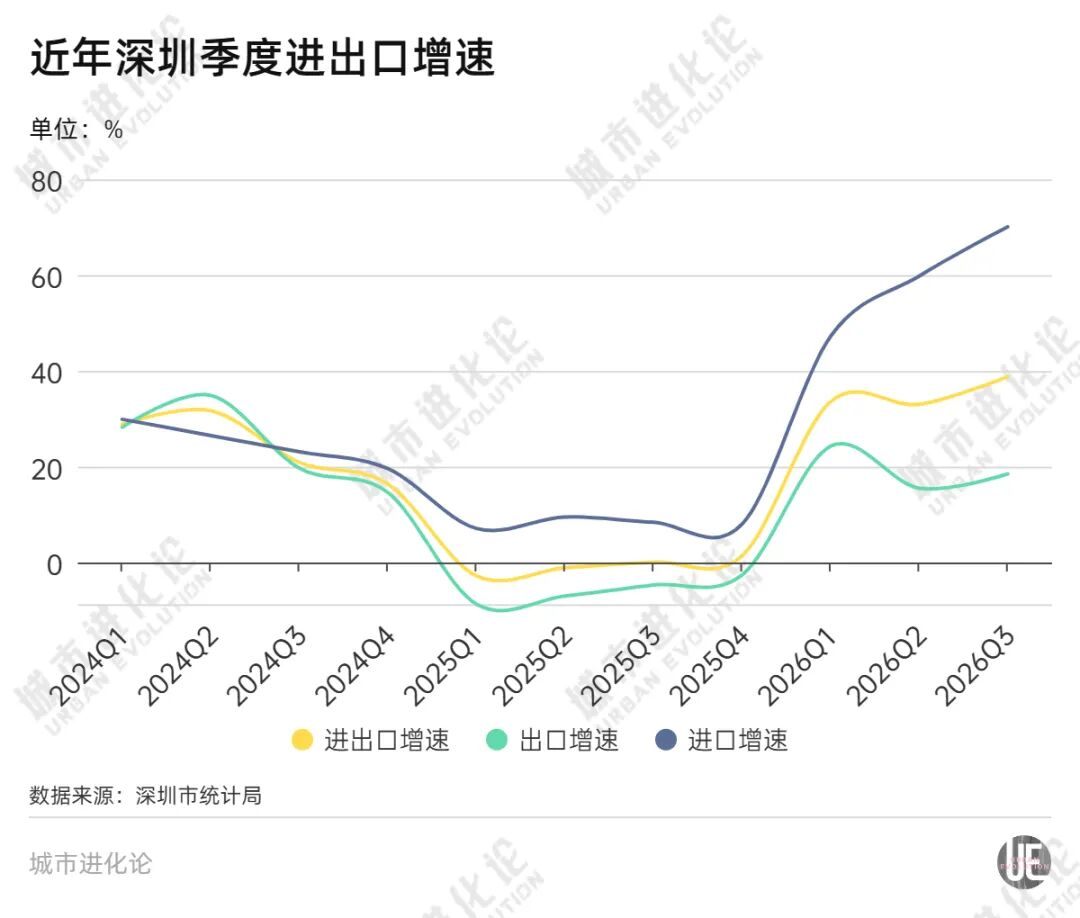
This growth trend directly helped Shenzhen widen the gap with Shanghai, and accelerated its impact on the "No.1 Import City": in the first three quarters, Shenzhen's imports (2.24 trillion yuan) historically overtook Shanghai's (2.13 trillion yuan), approaching Beijing's (2.26 trillion yuan), breaking the long-standing pattern where Beijing and Shanghai took turns to occupy the top position.
In the view of many interviewed experts, this is inseparable from the support of local special policies. Public information shows that at the end of March this year, Shenzhen released the Three-year Action Plan for Promoting High-quality and Efficient Foreign Trade - Special Measures for "Export Shenzhen" (hereinafter referred to as "Ten Import Measures"), launching special measures around ten core areas to promote the balanced development of import and export, and help Shenzhen accelerate the construction of an international trade center city.
On the industrial side, it clearly focuses on supporting the import of advanced technical equipment and key components required for the "20+8" industrial clusters, and formulates customized regulatory measures for intermediate goods of industries such as integrated circuits to ensure the stability of the industrial chain and supply chain; on the consumption side, it clearly supports the import of daily consumer goods, mid-to-high-end consumer goods, agricultural products and medical devices, and builds a distribution hub for imported fruits.
In Wang Guowen's view, the logic of the "Ten Import Measures" is not simply to encourage purchasing goods, but to provide institutional and platform support around Shenzhen's advanced manufacturing foundation. For example, it targets to support the import of products for industrial upgrading, matching the capacity expansion needs of Shenzhen's computing power hardware clusters, making it a distribution hub for computing power components in the Asia-Pacific region.
Reflected in the data, in the first 10 months of this year, Shenzhen imported 2.02 trillion yuan of mechanical and electrical products, a sharp increase of 69%, accounting for 79.7% of the total import value. Among them, the growth rates of imported integrated circuits and computer parts reached as high as 62.8% and 153.7% respectively.
Wang Guowen pointed out that this round of explosive growth of Shenzhen's imports is not driven by short-term pulse-style consumption, and the core is production-oriented imports driven by the computing power industrial chain. The "Ten Import Measures" have accurately aligned with the industrial cycle, promoting foreign trade to move from the previous one-way pattern of "strong exports and weak imports" to a new structure of two-way balanced import and export.
03
Upgrading
At present, Shenzhen is attracting the attention of the world with an unprecedented attitude.
From November 18 to 19, the 33rd APEC Economic Leaders' Meeting will be held in Shenzhen. This is the third time that China has hosted APEC, and it is also the first time that Shenzhen has hosted such a high-standard international event.
From Shanghai in 2001, Beijing in 2014 to Shenzhen in 2026, the three Chinese cities are also three gateways for China's high-level opening-up.
The window period of the grand event is also a development opportunity. For Shenzhen, trade in services is a key link in the upgrading of its opening-up level.
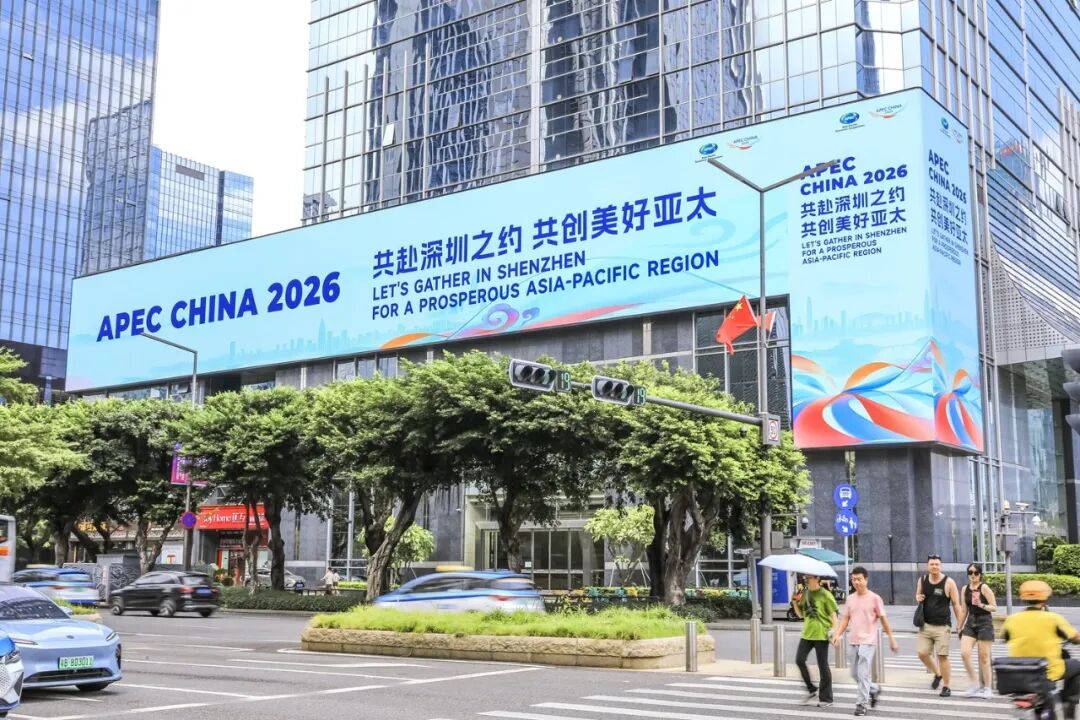
Image source: 58pic_702233287
In 2025, the added value of the tertiary industry in Shenzhen accounted for 62.5% of the gross regional product, and it has entered the post-industrialization stage. The industrial development orientation in the post-industrialization stage includes not only the upgrading of traditional manufacturing industries to advanced manufacturing industries, but also the growth and expansion of the service industry, especially producer services, knowledge-intensive services and trade in services.
This logic is also confirmed in the national layout.
This year, the Ministry of Commerce issued the Overall Plan for the Construction of National Demonstration Zones for Innovative Development of Trade in Services, clarifying that 16 cities including Beijing, Shanghai and Shenzhen, and Hainan Province will take the lead in building demonstration zones, focusing on exploring integrated innovation of industrial chain and supply chain, cultivating competitive advantages of business entities, promoting efficient supply of production factors, leading high-level opening-up, and building domestic and international promotion systems.
From the perspective of the national coordinate system, the ranking of Shenzhen's trade in services is not as outstanding as its trade in goods:
In 2024, Shenzhen's total import and export volume of trade in services ranked third among large and medium-sized cities in the country, lower than Shanghai and Beijing. In 2025, the total annual trade in services of Shenzhen exceeded 150 billion US dollars, and the scale of digital trade exceeded 66 billion US dollars. In the same period, the total trade in services of Shanghai was 257.84 billion US dollars, and the scale of digital trade was 115.55 billion US dollars.
Improving the level of trade in services is also the clear development direction of Shenzhen at present: by 2030, the proportion of knowledge-intensive trade in services will be increased to 50%, increasing the "depth" in the global market.
However, the development of Shenzhen cannot copy the path of Beijing and Shanghai.
Wang Guowen believes that there are inherent endowment differences in the trade in services of Beijing, Shanghai and Shenzhen, and their tracks do not completely overlap --
Shanghai relies on the international financial center and international shipping hub to allocate global factors; Beijing relies on national scientific and technological resources, headquarters economy, digital copyright and professional services to provide high-end scientific and technological and knowledge services; while Shenzhen's biggest background is its strong advanced manufacturing cluster and digital technology ecosystem, which determines that its trade in services is naturally "industry-dependent and supply chain-driven".
Wang Guowen further emphasized that this is exactly the differentiated advantage of Shenzhen's breakthrough in trade in services. It is not appropriate to directly follow the path of Beijing and Shanghai to develop high-end service formats, but to take the characteristic route of "driving trade in services with goods trade, and incubating digital services with manufacturing".
Hu Gang