17 new car models released in just 48 hours, the automotive industry is speeding up its end-of-year sales sprint, when will this cutthroat internal competition come to an end?
Releasing 17 new car models in just two consecutive days, is the year-end sales push in the automotive industry this intense?
Last Thursday and Friday, which fell on November 12 and 13, the entire automotive industry held a total of 12 launch events, unveiling 17 new car models. Dianchetong (ID: dianchetong233) has also produced a table for your detailed reference.
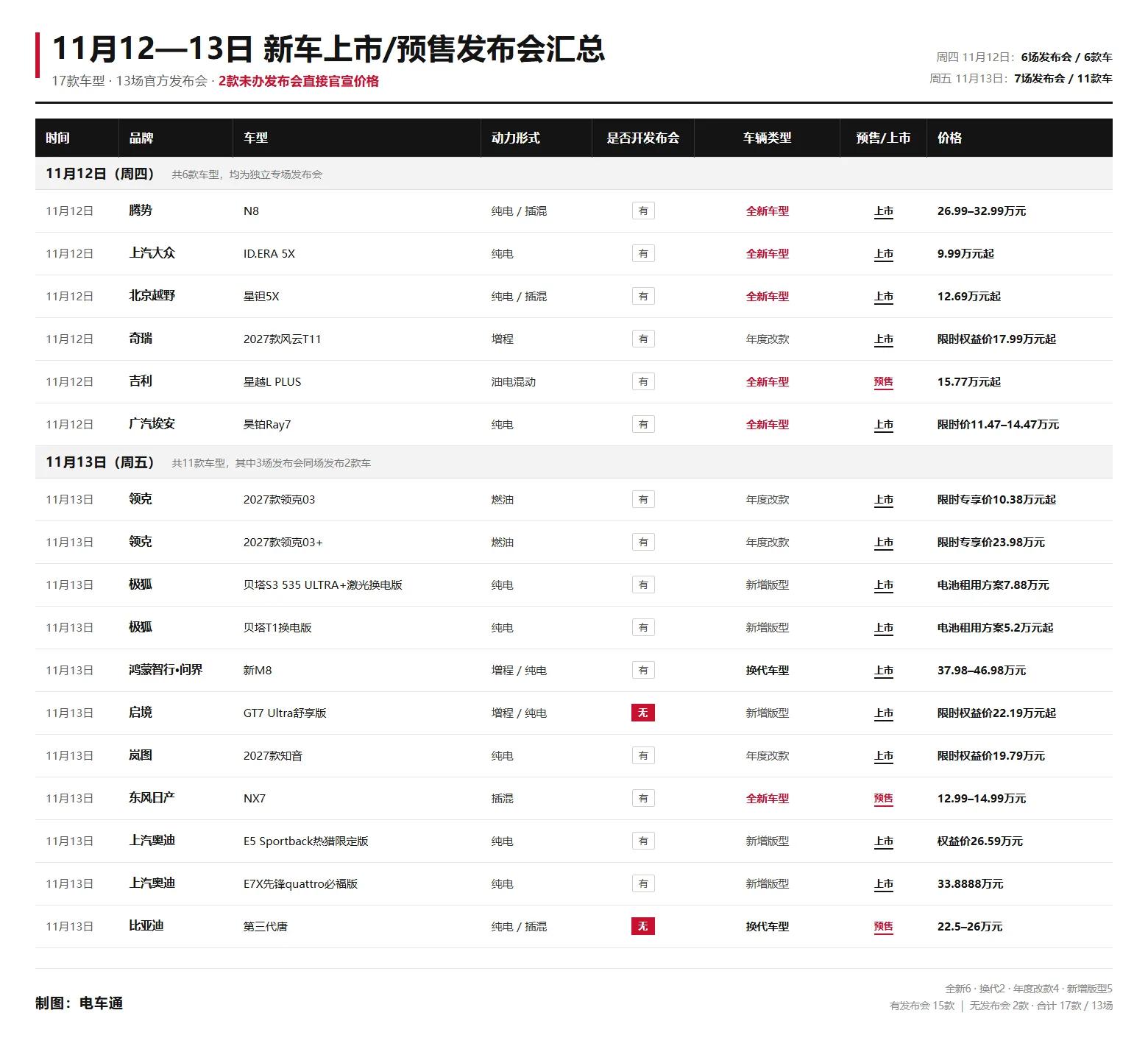
(Source: Graphic produced by Dianchetong)
As we can see, among these 17 new models, 6 are all-new vehicles, 2 are generational facelift models, 4 are annual updated versions, and 5 are new trim variants. That means even at the end of 2026, when the automotive industry's sales continue to decline year-on-year, there are still carmakers launching completely new models.
Moreover, among all these vehicles, only the third-generation BYD Tang and the Qijing GT7 Ultra Comfort Edition did not hold launch events, and directly officially announced their pre-sale/market launch. That is to say, the remaining 12 brands and 15 new car models all held launch activities. Such a density of launch events is indeed quite staggering.
In Dianchetong's view, such a high density of launch events is mainly driven by the approaching Guangzhou Auto Show and the year-end sales push pressure that carmakers are facing. In the one or two weeks before the opening of the Guangzhou Auto Show, this high-frequency new car release rhythm is likely to continue.
So why are carmakers so keen on releasing new cars in clusters? What is the point of launching so many new models in a short period of time? Today, Dianchetong will discuss this topic with you.
As the year draws to a close, carmakers are hitting sales KPIs with new models
We can draw further insights from the previous launch event data.
For example, among the launch events held in these two days, the ratio of domestic independent brands to joint-venture brands is about 3:1, while the ratio of new energy vehicles to fuel vehicles is about 5:1, and all the models released by several joint-venture brands are new energy vehicles.
It can be seen from these figures that the current automotive industry is dominated by independent brands and new energy brands, while joint-venture brands are accelerating their new energy transformation, and independent brands are the main players launching all-new and generational updated models.
However, it is worth noting that none of the 12 launch events and 17 new models came from new EV power brands.
After Dianchetong's verification, among the new EV power brands (excluding HarmonyOS Intelligent Mobility), NIO, XPeng, Li Auto and Xiaomi have all launched their new models for this year. Only Leapmotor's Lafa5 annual facelift will be launched at the Guangzhou Auto Show. In the remaining time of this year, apart from the regular launch events at the Guangzhou Auto Show and Leapmotor's new model launch at the auto show, the remaining launch events of other new EV power brands only include NIO's annual regular NIO IN (NIO Tech Day) and NIO Day, as well as XPeng's annual regular XPeng Tech Day.
(Source: NIO)
Therefore, the brands that concentrated on releasing new cars before the Guangzhou Auto Show are basically traditional independent brands and joint-venture brands. Their concentrated new model launches at the end of the year also reflect the anxiety of the entire automotive industry.
With the "Golden September and Silver October" sales peak fading this year, carmakers can only rely on the last one and a half months to push for a sales surge and make their annual sales figures look better. In addition, the Guangzhou Auto Show itself is a small peak for new car launches at the end of the year. The combination of these two factors has led to the cluster of new model launches.
It is worth mentioning that one or two weeks before the 2025 Guangzhou Auto Show, some carmakers also chose to release new cars off-peak, but the launch rhythm of those new models was spread over several weeks, and there was no situation of clustered new model launches within two days as seen this year.
From the changes between the eve of the 2025 Guangzhou Auto Show and the eve of the 2026 Guangzhou Auto Show, we can clearly feel that the competition among carmakers for market share has become far more intense. Carmakers hope to release new cars on the eve of the Guangzhou Auto Show to avoid the dense release period during the auto show, so as to maximize exposure. On the other hand, they also want to compete for public attention with other brands, which finally leads to the phenomenon of "avoiding the cluster of launches during the auto show, but failing to avoid the cluster before the auto show" — a situation that is rather ironic.
In a downward market, where does the industry's involution end?
The phenomenon mentioned above also reflects that the anxiety of carmakers about the future development of the industry and their own sales performance has, to a certain extent, turned into industry-wide involution.
Against the industry background of "too many monks but too little porridge", carmakers and their sub-brands can only seize the few available windows to compete for consumers, so as to make the figures on the monthly sales ranking list look better. As a result, the competition between enterprises and between brands has become even fiercer this year.
I believe many people will ask: Now that market demand has decreased, why do carmakers keep releasing new models? At such a moment, shouldn't they stabilize the current situation and wait for demand to recover?
The problem is that the automotive industry is a capital-intensive industry. It takes a very long process for a car model to go from project approval to market launch.
For example, the new models launched this year may have been approved two or even three years ago. After completing "one winter and one summer" or even "two winters and two summers" of tests, these models are almost in mass production-ready state. If they are cut off at this point due to industry changes, the sunk cost will be too high, and most carmakers will not make such a decision.
Another example is large automotive groups, which have a large number of sub-brands and project teams. Carmakers not only need to make enterprise-level business plans, but also need to balance the internal competition among these different "factions" under their umbrella, which naturally leads to the situation of "a large ship is hard to turn around".
Therefore, in the face of reduced market demand, new EV power brands are relatively more flexible. Even XPeng, Xiaomi and Leapmotor, which have seen rapid development, have not chosen to continue massive R&D of new models. Instead, they maintain stable iteration of existing models and moderate new model launches. As for NIO and Li Auto, the former cut the ES7 and the latter cut the L7 while adding the i9, and their overall development tends to be stable.
However, it is believed that many carmakers have realized this point. Judging from the number of new model filings submitted to the Ministry of Industry and Information Technology in the second half of the year, more and more carmakers are consciously reducing the launch of all-new models, and starting to shift their focus to maintaining their existing market share.
Dianchetong speculates that in the next one to two years, the number of newly added all-new models will continue to decrease, and some dispensable annual facelifts or new trim additions will be abandoned by some carmakers. In addition, under the background that regulatory authorities are cracking down on "rush-to-market vehicles" and requiring sufficient testing, the R&D and testing cycles of some models will be longer, which may further reduce the number of all-new models in the next one or two years.
Therefore, in such a general environment, the industry's involution may be eased. Carmakers may shift from simply competing in sales volume and iteration speed to competing in who can make more profits or suffer less losses.
The degree of involution may decrease, but the competition between carmakers and brands may become even more intense. At present, the knockout round in the automotive industry has already begun, and some brands have shown signs of being eliminated. Which brands will regretfully exit the market in the next one or two years depends on whether they can bottom out and rebound.
Back to the topic of clustered new car launches, is releasing so many models in two days a good thing or a bad thing for brands?
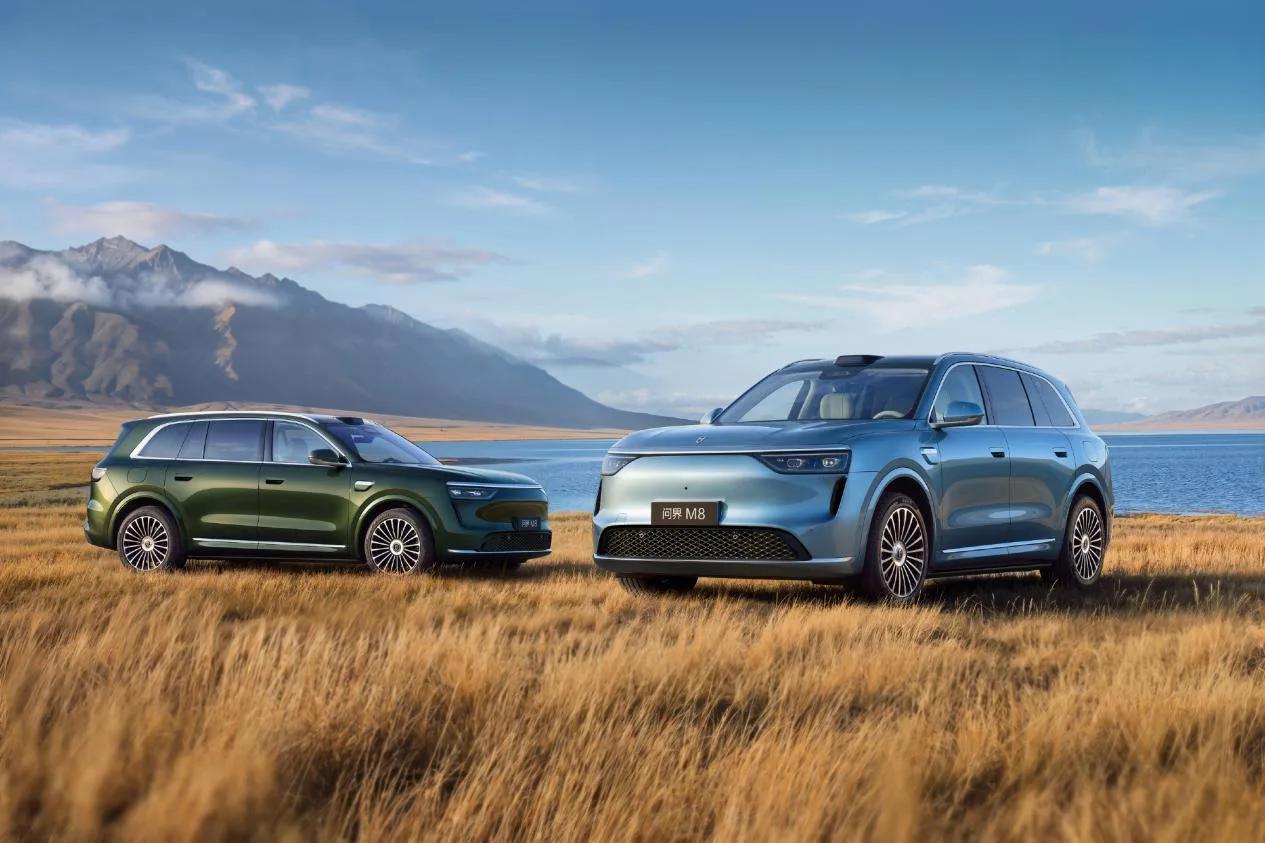
In Dianchetong's view, this depends on specific situations. If a brand has strong enough strength and the model itself has sufficient public attention, even if it is released in the same period as other models, its sales performance will not be affected. Examples include the new AITO M8, Denza N8, third-generation BYD Tang and other models launched last week. However, if a brand has relatively weak brand power and its product competitiveness is relatively mediocre, choosing to release models in clusters will put it at a greater disadvantage.
(Source: AITO)
Therefore, all things considered, brands need to find a development strategy that suits themselves, and not follow others blindly. Otherwise, they may end up like the man who tried to imitate the Handan walking style and lost his own way of walking, which would not be worth the loss.
This article is from "Dianchetong", and is authorized for release by 36Kr.