iQiyi, Youku, Tencent Video and Mango TV are vying for AI directors, whose offer is the most attractive?
Last year, Zhang Bei led her team to participate in the AI short film competition "Peter Pau · iQiyi AI Theater" hosted by iQiyi. Among the 16 shortlisted works, her team was the only one that created animation. After the competition, iQiyi reached out to her and raised a question: would it be possible to expand the work into a full-length production?
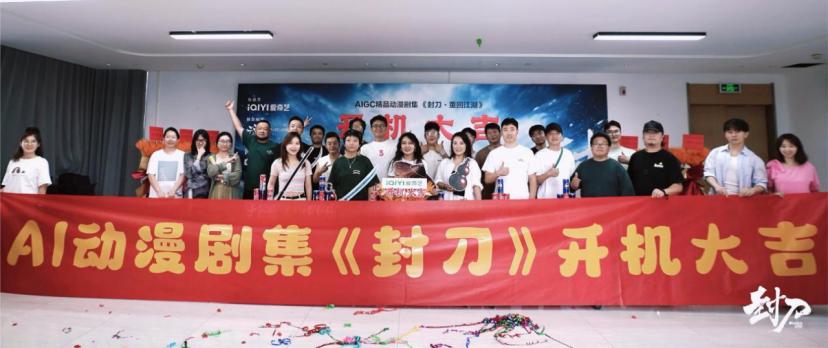
This connection later turned into the currently advancing AI animation project Feng Dao (Sheathed Blade).
Zhang Bei originally ran an advertising team of about 20 people. For this team, AI has evolved from a tool for participating in competitions and producing TVCs, to a business that requires dedicated investment of manpower, time and energy.
Experiences like this are happening to more and more AI creators.
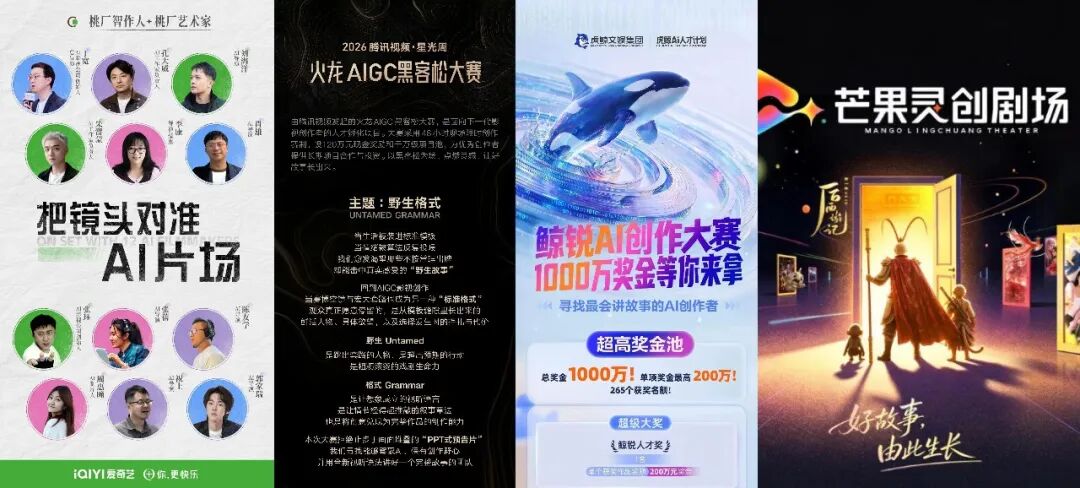
Long video platforms have entered a new round of horse race of "snatching AI creators". In October, iQiyi officially announced the signing of 8 AI creation labels and 3 individual creators; Mango TV's Lingchuang Theater recruits new creators from film and television universities, and currently has more than a dozen AI creators who have signed contracts or reached cooperation intentions; Tencent Video hosts hackathons and continuously contacts AI short drama teams to cooperate on AI short dramas through revenue-sharing models, while Orca Entertainment launched the "Orca AI Talent Program" to seek creators.
Finding creators is only the first step. Not all creators selected through competitions and resource recommendations can get landed projects, which ultimately depends on the specific cooperation model. At present, the cooperation between platforms and AI creators is roughly divided into three categories:
The platform provides full investment, and the creator is responsible for the production;
The platform produces AI projects in-house, sets up a project team, and AI creators join the team as part of the director group;
The creator bears the production cost on their own, and recoups the investment through platform revenue sharing.
Different models correspond to different capital investment, creative autonomy and income distribution.
The pricing also varies. Under the revenue-sharing model, for an AI short drama with more than 30 episodes, the total computing power and labor cost of the production party exceeds 70,000 to 80,000 yuan, and the revenue sharing provided by the platform needs to reach this amount to cover the cost; for pure commissioned production projects, the quotation for AI dramas is generally 1,000 to 2,000 yuan per minute, and some creators quote 3,000 to 5,000 yuan per minute.
From the perspective of AI creators, countless olive branches have been extended to them recently. For many creators who originally wanted to work in the film and television industry but lacked the resources and project access of the traditional industry, this round of recruitment by long video platforms has also opened up a new access channel.
To sort out this round of actions by long video platforms, *Entertainment Capital* talked with 9 AI creators and relevant platform insiders, trying to see how this "talent grabbing war" unfolds: what kind of access do platforms provide for creators? How much initiative are creators willing to give up? How will the entire film and television creation ecosystem change?
# This article has interviewed nine relevant people, who are also the 346th to 354th interviewees interviewed by *Entertainment Capital* in 2026
1
Competitions, universities, short videos: where do long video platforms go to recruit AI creators
From the contacts of *Entertainment Capital* in the past few months, the sources of AI creators are quite scattered.
Therefore, if long video platforms want to bring these people into their own content systems, the first problem to solve is where to find them, and how to judge whether they have the ability to continuously produce content.
At present, platforms are more or less adopting a "wide net casting" strategy, and recruitment actions are roughly divided into three paths: selecting creators through competitions and work exhibitions; actively looking for teams from projects that have already gained popularity; cultivating and reserving talents in universities and creator ecosystems in the long term.
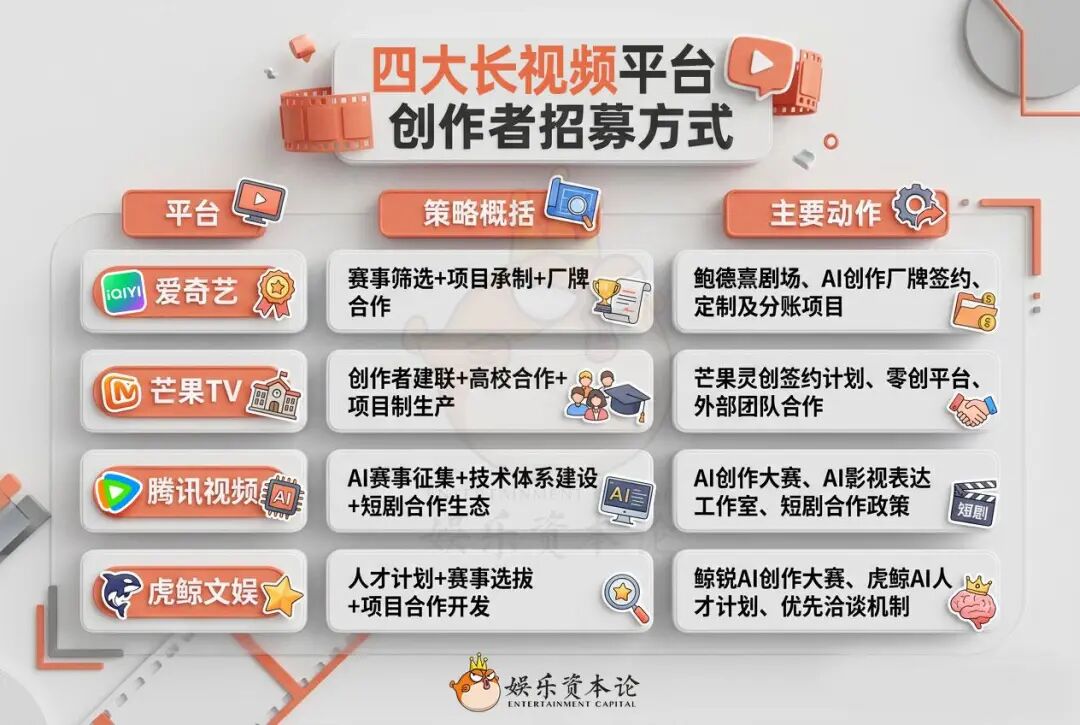
The difference between several platforms lies more in where they place their entry points.
The most common way is to hold AI image creation competitions.
For example, the "iQiyi · Peter Pau AI Theater" mentioned above, as well as the Huolong AIGC Hackathon and Huolong Man Drama Challenge recently launched by Tencent Video Starlight Week, all lower the threshold and expand the scope for platforms to find creators. Orca Entertainment is also using competitions to expand its creator entry. In September this year, Orca Entertainment launched the "Orca AI Talent Program" and simultaneously launched the "Jingrui AI Creation Competition".
For platforms, they hope to reach creators who are not originally in the traditional film and television industry's social network through relatively open work calls. At the same time, competitions provide a relatively concentrated observation window: "We first see the creator's aesthetic and production ability from their works, and then judge whether there is potential for further development."
But these competitions are all the same: priority negotiation does not mean that the platform has purchased the work or signed a contract with the creator, it is more like leaving an entry for subsequent contact. The work first serves as a business card, and whether it can enter the project process later depends on the platform's further judgment on the content and the team.
Secondly, short videos have also become a must-contested area for various platforms and film and television companies that are transforming to AI.
Almost all the AI super-creators that *Entertainment Capital* has contacted who publish content on short video platforms have received olive branches from long video platforms.
AI creator Yidi'e connected with Tencent Video through his hit short video Boyfriend Limited for Three Days posted on short video platforms.
He originally created manhua drama content, then resigned and set up a video production studio with his partners. The team currently has 7 to 8 people. He said he took the initiative to contact Tencent Video to seek cooperation, hoping to continue expanding this story into a medium and long version.
Yidi'e told *Entertainment Capital* that Tencent Video will judge whether to promote cooperation based on the project proposal and the popularity of existing projects. During the evaluation, they will also consider the script quality, traffic performance, project completion possibility, project scale and team production capacity.
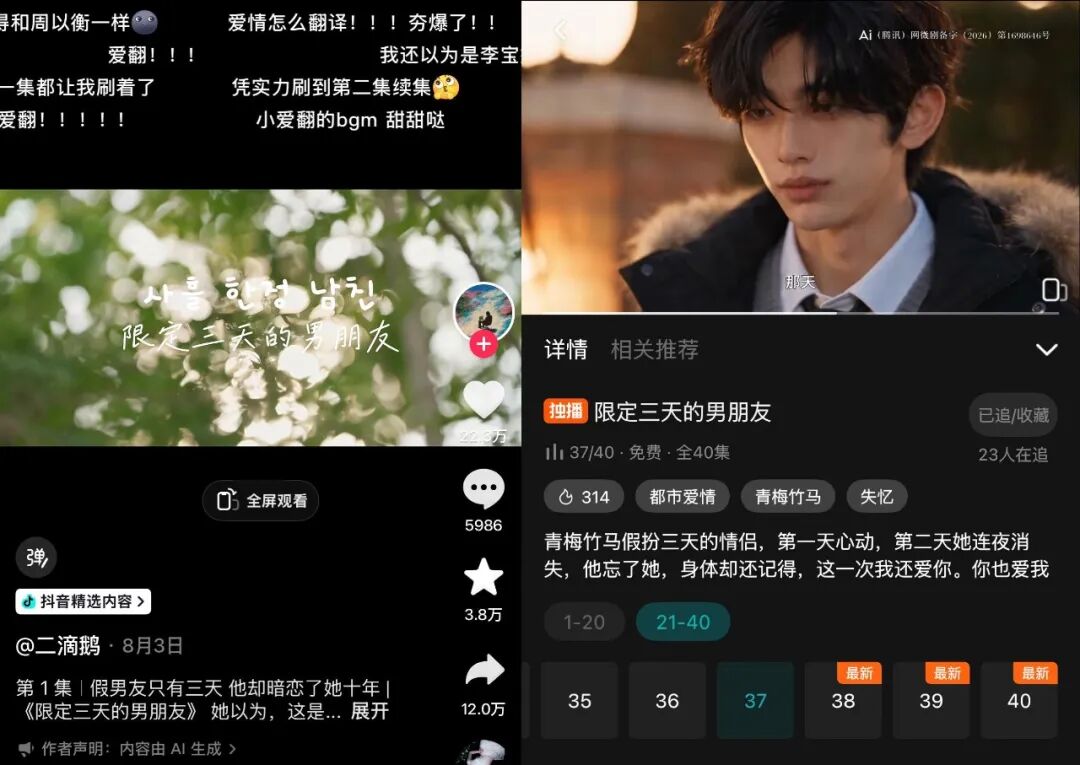
(The right picture shows the in-app interface of Tencent Video)
For platforms, the attractiveness of the story is only one part, and it is more important for the team's production capacity to complete the whole project.
In addition, professional film and television universities also bring AI creator reserves for long video platforms.
Mango TV is relatively active on this path. The person in charge of AI creator signing and ecological construction of Mango Lingchuang Theater told *Entertainment Capital*: "Mango has already connected with more than 50 creators in the early stage, and more than a dozen have reached cooperation intentions, including both mature AI production teams and young creators in universities."
He mentioned that Mango has established connections with institutions such as Beijing Film Academy, Communication University of China, and Shanghai Theatre Academy. First, students are recommended by tutors to enter the AI drama/documentary project team, and then judge whether to cooperate for a long time based on their performance in the project.
Lin Mo, who participated in the production of Later Journey to the West, entered Mango's signing system through this process. He is currently a postgraduate student at Communication University of China, and spends his spare time creating AI images. The tutor's recommendation gave him the opportunity to participate in Chronicles of Taiwan Island, and later participated in the production of Later Journey to the West.
Another AI director Chen Lifan comes from the School of Intelligent Image Engineering of Beijing Film Academy. He has a background in traditional visual effects workflow and turned to AIGC at the end of 2023. In Mango's AI documentary Chronicles of Taiwan Island, he served as the main creator and AI director, responsible for visual style setting, AI image generation and aesthetic control.
Mango Lingchuang Theater is relatively cautious in screening creators. It is understood that the platform hopes to establish long-term relationships with creators, and creators with good cooperation tacit understanding may even be "signed into the platform as working partners" in the future.
However, the current contracts are not exclusive, and creators can still retain their own work and projects.
Behind these three paths is the platform's attention to different stages of AI creators: competitions can quickly discover works, project contacts can verify the team's actual delivery capacity, and university and ecological construction are more focused on long-term reserves.
For creators, being noticed by the platform is only the beginning. To truly enter the platform's content production system, they still need to pass the test of the next round of specific projects.
2
Custom production, joining the team, revenue sharing: how do AI creators enter the platform's production chain
After entering the platform project, the first thing creators face is the cooperation model and cost allocation.
At present, the cooperation between long video platforms and AI creators is roughly divided into three categories:
The platform provides full investment, and the creator is responsible for the production;
The platform produces AI projects in-house, sets up a project team, and AI creators join the team as part of the director group;
The creator bears the production cost on their own, and recoups the investment through platform revenue sharing.
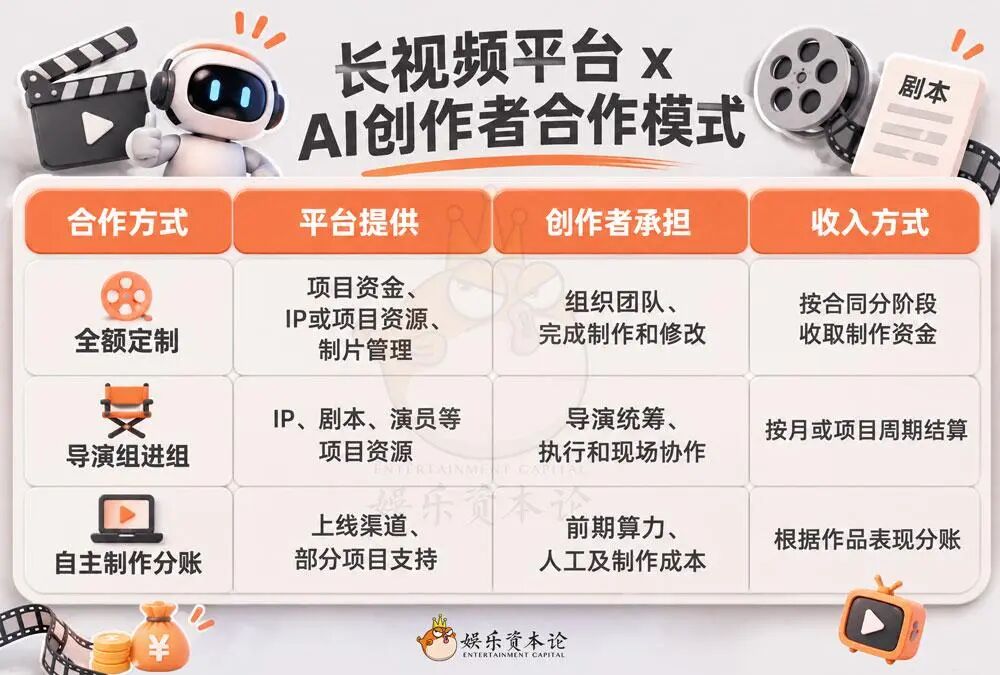
The first type: the platform provides full investment, and the creator undertakes the production.
The AI animation Feng Dao that Zhang Bei is currently cooperating with iQiyi belongs to this category.
Zhang Bei told *Entertainment Capital* that after participating in "Peter Pau · iQiyi AI Theater" last year, some people inside iQiyi continued to follow up with creators, and the copyright center would also provide IP for creators to choose from, and then producers would assist in project initiation and approval.
While providing IP, iQiyi also gave the team three options: custom production, revenue sharing and pure investment. Zhang Bei finally chose to undertake the production.
For the 20-person team trying AI full-length production for the first time, this approach allows them to complete the full project first, stabilize cash flow, and get familiar with the full-length production workflow. "Our team is not very large, and this is the first time we make an AI full-length production. To be on the safe side, we chose custom production, which means iQiyi fully invests. We are exploring a stable path first."
From the adaptation of the novel IP to the start of production, Feng Dao has already gone through two months. In this process, the platform participates throughout the whole process. At the pilot film stage, the platform provided 20,000 points for production. After the official signing, the production funds are paid in stages according to the contract. Zhang Bei revealed that after completing the first 4 episodes, the team has received part of the payment.
After entering the production stage, every time the team finishes one episode, they will submit the finished film to the platform for review. The producer will put forward modification suggestions on plot, continuity errors, character expressions and picture logic. At the script stage, the platform will also give suggestions, and the team will still handle the specific adjustments combined with the director's creative judgment.
This custom project has also changed the team's work arrangement. In order to concentrate on completing Feng Dao, Zhang Bei invested the main manpower in it and voluntarily gave up some projects of original advertising clients.
"Only by going all in on one thing can we do it well. If we are making this drama while taking on some scattered short films, our whole attention will be scattered."
With the exploration of increasingly mature cooperation models, different production quotations have gradually formed in the market.
A creator told *Entertainment Capital* that currently AI commissioned production mainly has two quotation systems: TVC and film and television content.
At present, TVCs in the market are quoted according to the duration of the picture, ranging from 20 to 2000 yuan per second; AI dramas are calculated according to the minutes of the finished film, priced according to whether Party A will provide points and the production requirements. The quotation ranges from 1000 to 5000 yuan per minute, and quotations above 3000 yuan are considered relatively high in the market.
The second type: long video platforms producing AI dramas in-house will invite AI creators to join the director group, and settle accounts in the way of traditional film and television projects.
AI creator KAT told *Entertainment Capital* that one AI creator he knew was a traditional short drama director before transformation. Later, this creator came across the platform's AI drama project, served as the lead director in it, and planned to bring several of his own executive directors to join the team together.
The specific cooperation model is that the platform provides IP, scripts and actor portrait authorization, and an AI production company is responsible for the generation and production. The production company has the ability to generate AI images, but is relatively lacking in director and content coordination, so people with relevant experience need to join the director group to be responsible for overall control and execution.
KAT himself also received an invitation to join the project team, "It uses the quotation form of traditional film and television. After joining the team, I get paid for the whole project, not quoted by the duration of the produced content, such as how much per minute."
The project cycle is about three and a half months, half a month of which is used for testing and team running-in, and the following three months are for video production. KAT finally did not participate because he could not be on site.
Mango Lingchuang's cooperation methods also include recruiting creators into the project team, then selecting good creators from this project to steadily join the next project.
Take Later Journey to the West as an example, Lin Mo served as one of the AI directors, responsible for receiving the chief director's creative intention, and then converting it into storyboards, shots and specific production tasks for team members. He needs to communicate repeatedly with team members, and also cooperate with editing, screenwriting and other departments to finally form a complete segment, which is then submitted to the director for review.
Lin Mo recalled to *Entertainment Capital* that during the project production, the team experienced the model upgrade from Seedance 2.0 to 2.5. Due to the obvious difference in video texture generated by the two versions, the about 10-minute Peach Blossom Land segment in the second chapter