Exclusive Financing Announcement | Mass 3D Printing Manufacturing Expands to Embodied Intelligence, Polymaker Has Completed Multiple Consecutive Rounds of Financing Totaling Over 500 Million Yuan
36Kr learned that recently, Polly Polymer (POLLYPOLYMER) has successively completed two rounds of equity financing, the B2 round and the B+ round, with a total financing amount exceeding RMB 500 million. The B2 round was co-led by Cornerstone Capital and existing shareholder GSR United Capital, with participation from Gezhi Capital, Tiantang Silicon Valley, Zhongshi Capital, Yunjin Capital and Zhuopu Fund; the B+ round was led by Matrix Partners China, with participation from Annaide Capital and Tiantang Silicon Valley, and industrial investor Eson Precision also joined the investment synchronously.
The funds raised from this round of financing will be mainly used for R&D of polymer material systems and composite material systems, expansion of equipment production capacity and construction of the headquarters base, industry application development in cutting-edge fields such as embodied intelligence, and construction of a global delivery network.
Founded in 2017, Polly Polymer focuses on polymer elastomer materials and ultra-high-speed 3D printing mass manufacturing, with business covering material R&D, equipment manufacturing, software system development and mass production services. Talking about the origin of the brand name, Wang Wenbin, the founder, said that "Polymer" in PollyPolymer represents macromolecular polymer, and "Polly" is taken from his own English name. Materials are the starting point of Polly Polymer's business development, and equipment, self-developed software and mass production services are all extended on this basis. Relying on the self-developed HALS ultra-high-speed 3D printing technology platform, Polly Polymer develops special high-performance materials for different industries, and provides customers with mass manufacturing capabilities through integrated solutions.
Since the Series A financing in 2020, Polly Polymer has completed four rounds of financing successively, and has continued to invest in material R&D, equipment iteration and production capacity construction.
With the gradual deepening of the application of 3D printing technology in consumer goods, industrial parts and other fields, industry competition is extending from single technical indicators to large-scale manufacturing capabilities. How to balance production efficiency, cost and delivery stability has become a problem that additive manufacturing enterprises need to solve in the process of commercialization.
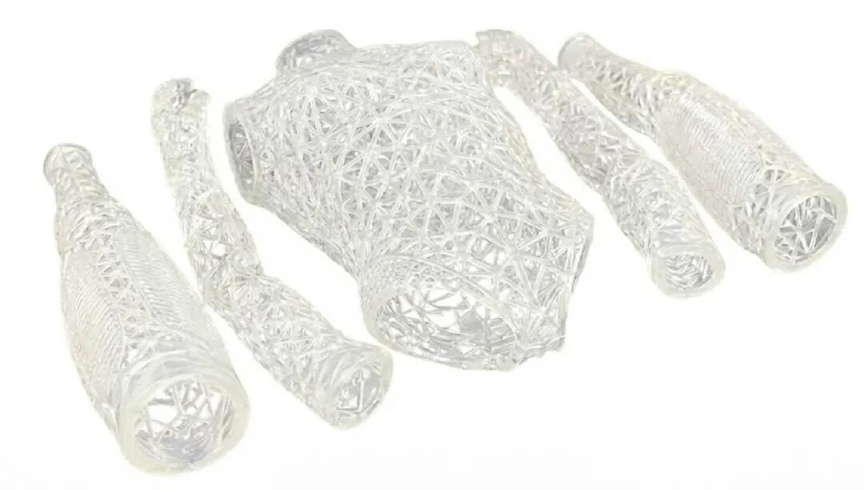
Robotic parts
From material R&D to intelligent cloud factory, promote large-scale 3D printing manufacturing
3D printing does not require pre-opening molds, and has the characteristics of high design freedom and integrated forming of complex structures. It has long been mainly used in product design, prototype verification and batch customized production. However, to enter the main industrial production line, it is still necessary to solve problems such as continuous and stable operation, consistent batch performance and production efficiency.
On the material side, as of 2026, Polly Polymer has accumulated more than 16,000 sets of polymer material formulas, covering multiple material systems such as elastomers, high toughness, high strength and high temperature resistance. In terms of material development, Polly Polymer does not only provide standardized general materials, but matches special material formulas and process parameters according to the performance requirements of different industries.
For example, footwear products need to take into account properties such as breathability, zoned shock absorption, rebound, flex resistance and wear resistance; robotic parts put forward requirements for flexible cladding, designable buffer, topological structure and impact resistance; cultural and creative products pursue delicate surface texture; medical parts need to meet standards such as biocompatibility and forming accuracy.
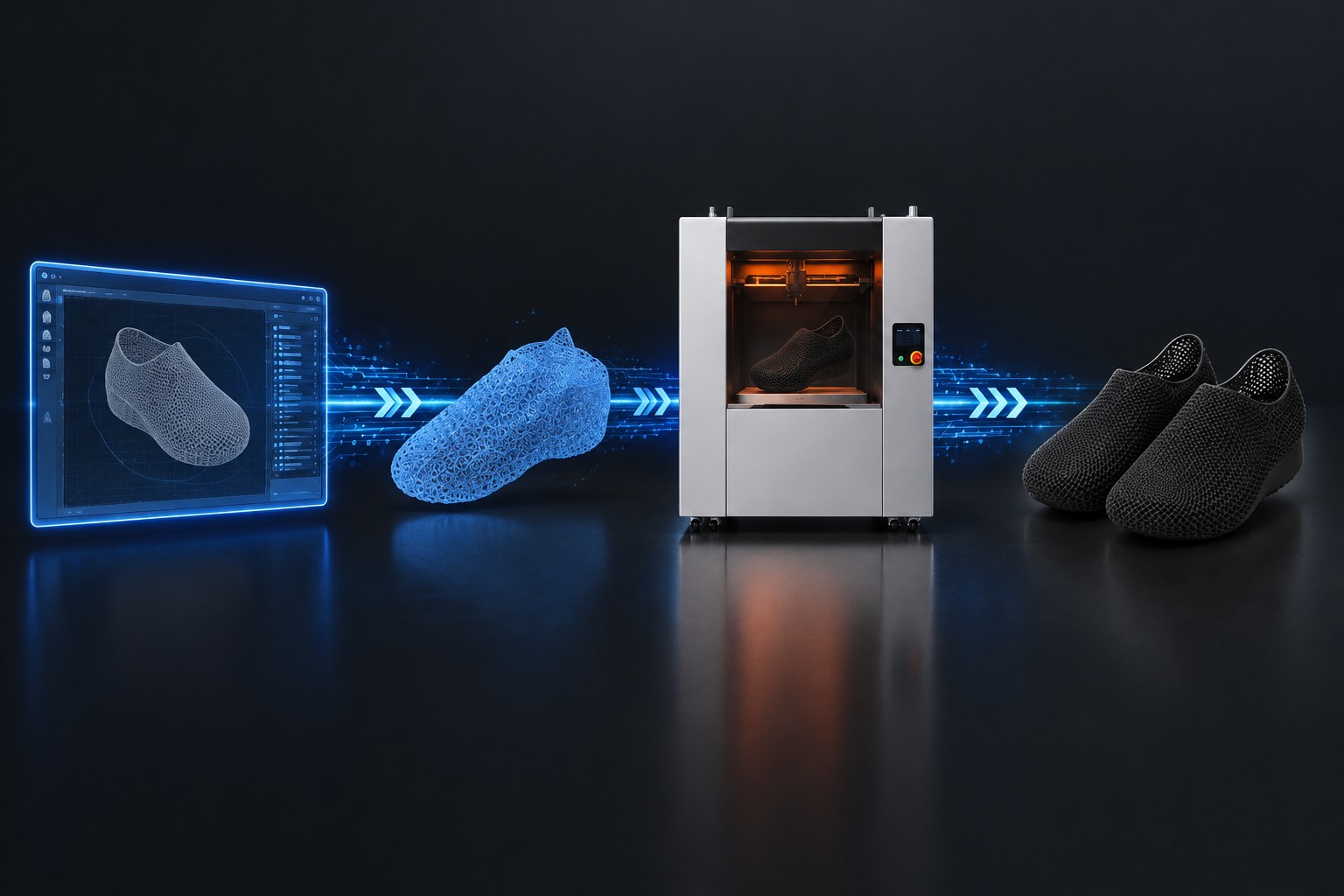
3D printed shoe production process
Based on the same HALS technology platform, with differentiated materials and process parameters, product solutions for different fields can be formed. In August 2026, Polly Polymer launched two industry solutions: RoboFab for the robot track, and PollyAlign for footwear digitalization. Among them, PollyAlign is an AI-driven human body customization system, which is currently prioritized in the field of foot customization. Through the connection of personalized data collection and digital production, it provides customized shoe services for feet, which can serve tens of millions of users. The two product lines share a unified material library and process base, and customize material formulas and forming parameters according to industry characteristics.
The collaborative iteration of materials and equipment is an important condition for 3D printing to move from sample trial production to large-scale mass production. As the material performance indicators continue to improve, the requirements for control accuracy in the forming process also increase accordingly. Equipment parameters need to be adjusted around supporting materials, so that the material formulas developed in the laboratory can be stably applied to actual production.
In terms of printing technology, Polly Polymer's self-developed HALS ultra-high-speed 3D printing technology platform has a forming efficiency 20-100 times higher than that of traditional 3D printing solutions. Focusing on different forming sizes and application requirements, the company has formed an equipment matrix including TAPS 200, TAPS 400 and TAPS 6080.
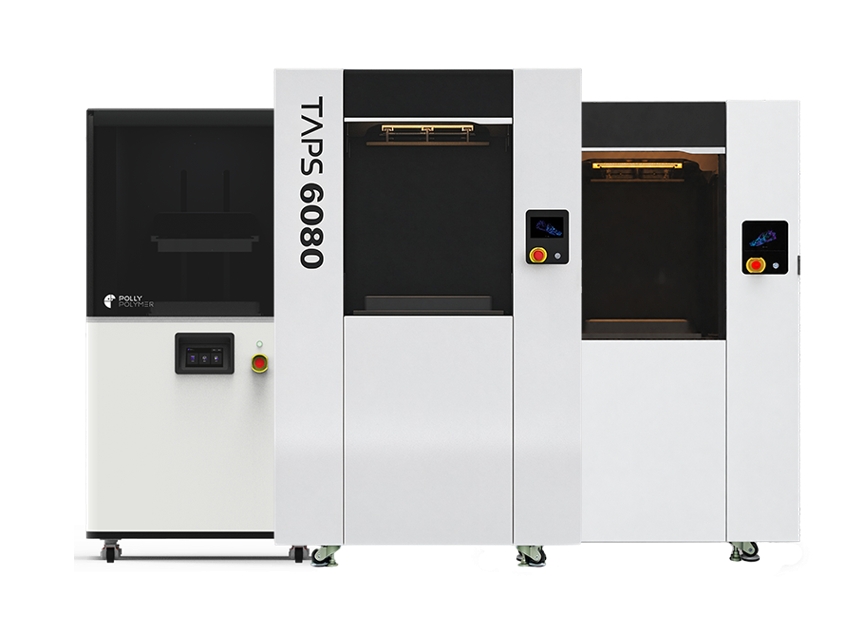
TAPS 6080
On October 15, 2026, at the 3rd TCT Shenzhen Exhibition, Polly Polymer launched the large-format model TAPS 6080, with a forming space of 603×339×800 mm (length × width × height), and the forming volume is about 4.9 times that of TAPS 400.
For continuously stressed structures such as bionic robot limbs, joint shells, and integrated chassis, segmented processing may introduce mechanical weak points at the splicing position. Relying on the large-size forming capability, some complex components can be integrally formed, reducing the splicing links, which helps to maintain the continuity of the structure and the load transmission capacity.
From single-piece forming to mass production of millions of pieces, the production process requires a complete closed-loop process control system. Any parameter drift of temperature, light intensity, material state, and multi-process beat will be continuously amplified in large-scale mass production.
In the past two years, Polly Polymer has continuously transferred the process variables that originally relied on manual monitoring to digital equipment for independent management and control. Through the unified scheduling of equipment by the PollyPilot central control system, the precise matching of process parameters and material systems is realized, the performance deviation of parts in the same batch is continuously narrowed, and the stability of batch delivery is improved.
On the production side, Polly Polymer has built the PollyWorks intelligent cloud factory. The five production bases rely on the PollyGrid system to uniformly schedule material and equipment resources, and cooperate with mobile AGVs and collaborative robots to realize automatic continuous production. Up to now, Polly Polymer has delivered more than 10 million end parts to customers in total, and the integrated forming of complex structures has entered normal production scheduling.
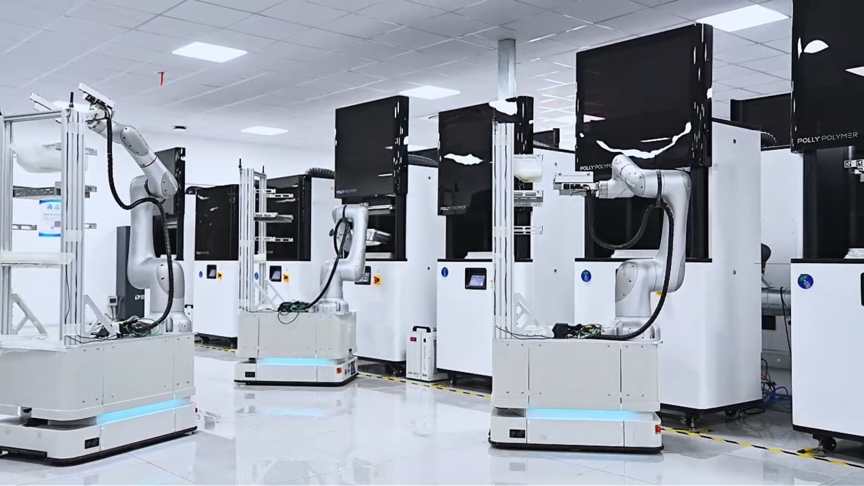
Intelligent cloud factory
From footwear mass production verification to multi-industry applications, commercial scenarios continue to expand
The footwear industry is a field where Polly Polymer has realized large-scale commercial applications earlier, and it is also a scenario that has high requirements for the comprehensive capability of the material system. Footwear products require materials to take into account properties such as breathability, shock absorption, rebound, flex resistance and wear resistance at the same time, and strictly control manufacturing costs, which puts forward comprehensive requirements for materials, equipment and process systems.
At present, Polly Polymer's business covers categories such as shoe accessories, functional midsoles, and integrally formed shoe styles. The application scenarios extend to fashion, sports, outdoor, safety protection and other fields, and it has established cooperation with more than 100 well-known domestic and foreign shoe enterprises and cutting-edge designer studios.
The large-scale mass production of footwear products puts forward higher requirements for material supply, production equipment and post-processing processes: materials need to maintain stable batch supply, production lines need to operate continuously, and post-processing processes also need to match the overall shipment rhythm. Whether a set of materials and processes can maintain stable performance in continuous production is an important test for 3D printed footwear products to achieve large-scale delivery.
On the consumer side, Polly Polymer has also begun to explore the combination of 3D printing technology and personalized retail. In October 2026, the PollyFab Shenzhen MixC retail flagship store officially opened, introducing 3D printed customized shoes into the offline retail scenario. The store collects consumer data through foot scanning, and connects to the cloud production system to realize the digital connection from personalized design to production and manufacturing, no need to open molds in advance, and is not limited by the minimum order quantity of traditional mass manufacturing.
In addition to the footwear industry, Polly Polymer's materials and manufacturing technologies have been gradually applied to exoskeletons, sports equipment, home furnishing, medical treatment, cultural and creative, education and other fields, and have achieved stable batch shipments in some scenarios. As of 2026, Polly Polymer has served more than 400 customers in total, and its business covers more than 30 countries and regions around the world.
Facing overseas markets, Polly Polymer has launched a turnkey factory solution with long-term material supply, rather than just selling standalone equipment. Customers get not only an independent printer, but also corresponding process capabilities and material supply support. At present, relevant factories have been launched in Vietnam, Southeast Asia; in Europe, projects have been launched or cooperation intentions have been reached in Italy, Spain, Belgium and other countries. This model integrates the material system, printing equipment, production process and management system into a complete manufacturing unit.
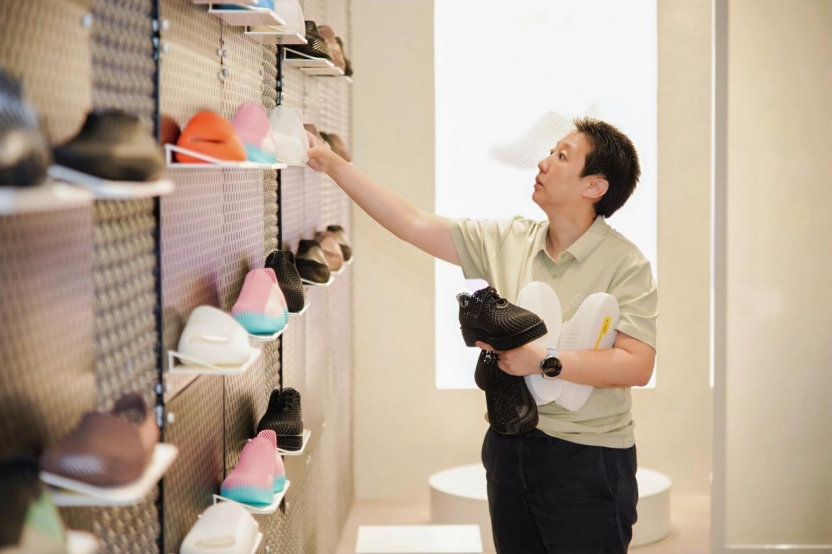
Offline store
Layout embodied intelligence, expand mass manufacturing of complex robot parts
With the development of the embodied intelligence industry, the manufacturing demand for robotic parts also presents new characteristics. Robot products usually need to frequently adjust the structural design in the R&D stage, and the specifications of parts between different models are different. At the same time, the requirements of robots in terms of lightweight, mechanical properties and human-computer interaction safety also put forward higher standards for materials and manufacturing processes.
Under the traditional manufacturing mode, complex structural parts often need to be produced through mold opening, machining and multi-component assembly. When product design is frequently iterated, mold development and tooling adjustment will also increase the R&D cycle and manufacturing cost. 3D printing does not require pre-opening molds, and can realize integrated forming of some complex structures, so it has certain advantages in the process of robot R&D and flexible manufacturing.
At the same time, Polly Polymer's production line can realize flexible collinear production of multiple models, and has been applied to the production of robotic parts at present. In January 2026, the number of equipment in Polly Polymer's intelligent cloud factory cluster exceeded 1,000, providing production capacity foundation for multi-variety production and large-scale delivery.
However, for the robot industry, whether parts can move from sample verification to stable batch supply still depends on comprehensive capabilities such as material performance, production efficiency, process stability and batch consistency.
At present, the products provided by Polly Polymer to robot customers include elastic parts such as bionic muscles (soft bodies), silent foot pads, and housing interference prevention parts, with the total delivery volume reaching tens of thousands of sets, covering dozens of robot enterprises in China and the United States, including Ubtech, Joyoung and others.
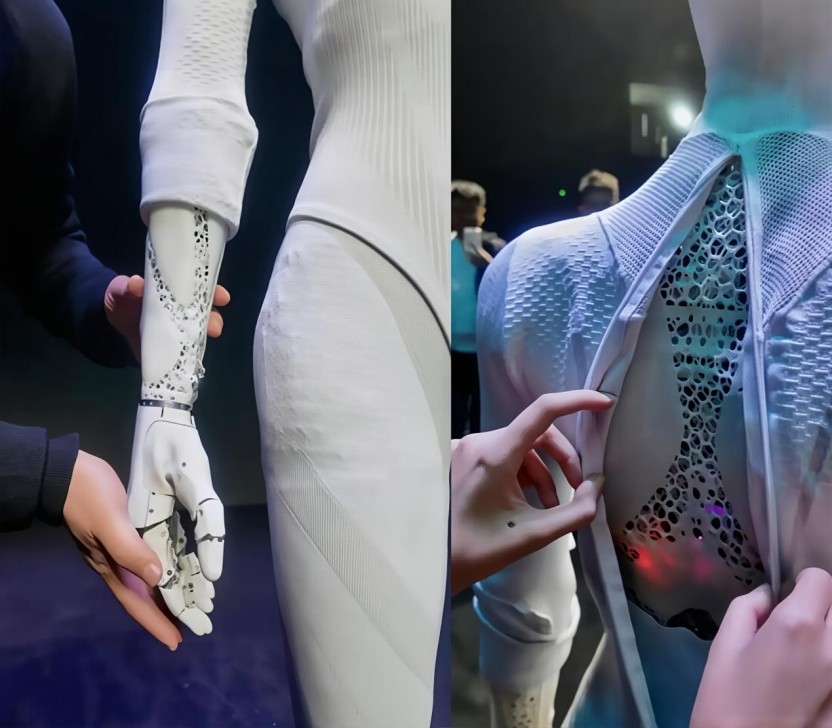
Bionic muscle and soft body structure
Such parts usually need to be customized according to the overall design of the robot. Among them, bionic muscles and soft body structures need to take into account both flexibility and mechanical properties; silent foot pads are mainly used to improve the noise performance of the robot during walking; housing interference prevention parts involve structural interference during robot movement and human-computer interaction safety.
From printed samples to stable supply, it relies on complete system capabilities, including customizable material formula libraries, highly reliable equipment, reusable process precipitation and full-link delivery guarantees. Compared with footwear products, robotic parts have more stringent requirements for lightweight, mechanical properties and batch consistency.
In August 2026, Polly Polymer officially released the RoboFab solution for the robot industry at Formnext Shenzhen Exhibition, opening up the full-link delivery of digital design, high-performance material system and ultra-high-speed cloud factory. After customers input their demands, Polly Polymer can complete material selection, process matching, production manufacturing and finished product delivery through a unified delivery interface, reducing the links for customers to connect with multiple suppliers separately.
From material R&D, equipment manufacturing to large-scale production and overseas production line delivery, from consumer-grade products to mass manufacturing of complex robotic parts, Polly Polymer is trying to transform its accumulated additive manufacturing technology and process capabilities into production solutions that can be replicated for different industries and regions.
Investor Views
Matrix Partners China said:
"The 3D printing industry has been keen to discuss individual technical parameters for many years, and our judgment standard has always been only one: can we deliver qualified products to customers stably and in batches. Polly Polymer vertically integrates materials, equipment and production line capabilities. In the past two years, Polly Polymer has turned this matter from a 'technical possibility' into normal production in multiple industries, which is more convincing than any single indicator."
GSR United Capital said:
"We have continued to invest in Polly Polymer since the Series A round and continuously increased our positions, and we are fundamentally optimistic about the company's deeply vertically integrated route: all materials, equipment and software are self-developed and self-sustained, without relying on external outsourcing. The reason why Chinese manufacturing is moving from product export to standard definition is precisely relying on such enterprises that master all core links of the whole chain. Polly Polymer is precipitating a forming process into a replicable and deliverable advanced production capacity."