Boundless Evolution has secured a Pre-A round of financing of more than 100 million RMB, reshaping the dry-wet closed loop in life science via "recursive scientific discovery" | Xinglian Portfolio Update
Today, INFevo, an AI for Science (AI4S) enterprise focused on virtual cell and recursive scientific discovery, announced the completion of a Pre-A financing round of over 100 million RMB, setting a new record for the single largest financing amount for a virtual cell enterprise in China. This round was jointly invested by institutions including Xinglian Capital, Prosperity7 Ventures, Huagai Capital, Huakong Fund and DT Capital, with existing shareholders Shunwei Capital, HSG and Songhe Capital continuing to make additional investments. This marks the company's second financing round within five months, following the completion of tens of millions of RMB in angel round financing in June 2026. The funds will accelerate the construction of the company's AI4S infrastructure, promote deep collaboration between cellular response prediction, scientific hypothesis testing and high-throughput automated experimental feedback, build a full-link AI biology platform covering "target discovery - virtual screening - clinical protocol optimization", and accelerate the translation of cutting-edge computing into precise disease intervention and innovative clinical therapies.
Unlocking the dual-drive closed loop of "large model + automated experiment" with "recursive scientific discovery"
The application of AI in the biomedical field is expanding from molecular design to dynamic research at the cellular and systems biology level, to more efficiently explore how interventions such as drugs and genes alter complex living systems. However, as the exploration space expands exponentially, there is a serious efficiency and throughput mismatch between the ability of the computational end to generate hypotheses and the verification capacity of traditional wet experiments.
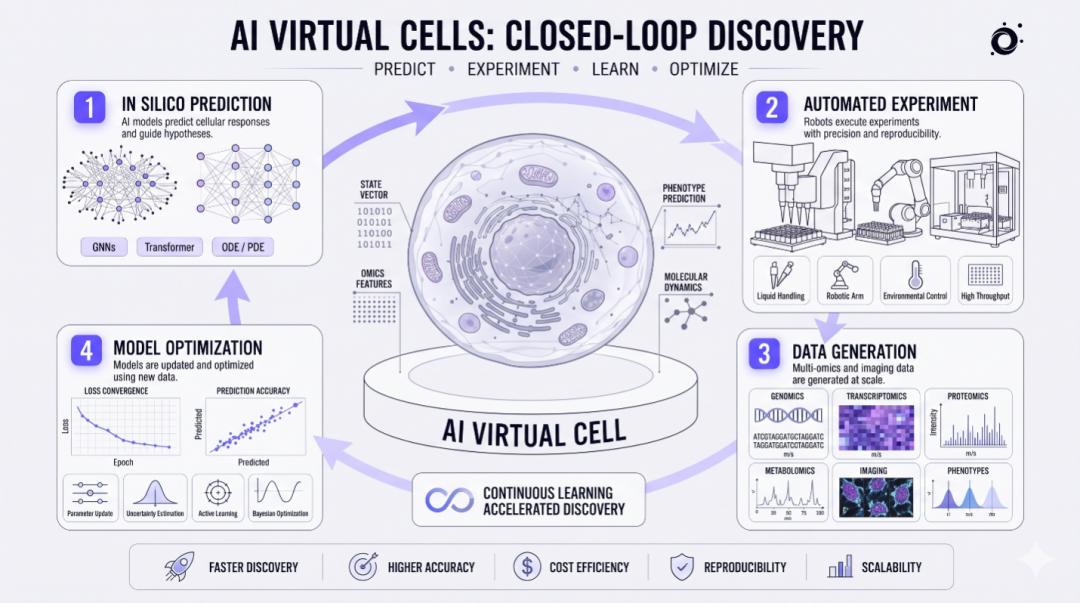
Facing the bottleneck of wet experimental verification, AI-driven virtual cell models and high-throughput automated laboratories are expected to become one of the key technologies to break the deadlock. The model can predict cellular changes caused by drug or gene interventions before experiments, and infer the effects of drugs in more complex biological systems, including animals and humans, helping researchers screen candidate molecules, compare potential targets, and prioritize experiments, so that limited experimental resources can be used to test more valuable directions, thereby greatly improving the translation efficiency of early discovery and accelerating the process of target discovery and biological mechanism analysis.
As AI and automation technologies drive the upgrading of R&D efficiency, the deep-seated bottlenecks of the scientific research system have become increasingly prominent: the knowledge, analytical methods and negative result experiences formed in the process of scientific discovery are often scattered and lost in isolated projects, making it difficult to precipitate into reusable organizational assets, leading to long-term inefficient repeated trial and error in scientific research exploration. How to make these intermediate research results break through the silos, achieve large-scale accumulation, and be continuously used for model iteration, hypothesis generation, experimental design and verification, has become the key for AI4S to move from single-point efficiency improvement to systematic discovery capability leap.
In response, INFevo puts forward the concept of Recursive Scientific Discovery (RSD). Recursive Self-Improvement (RSI) focuses on improving the capabilities of the AI system itself, while RSD extends continuous improvement to the entire process of scientific discovery. This system structurally stores, associates and reuses scientific problems, hypothesis deductions, analytical methods and experimental results, so that the recorded evidence and experience can continuously drive subsequent hypothesis generation, experimental design and candidate screening.
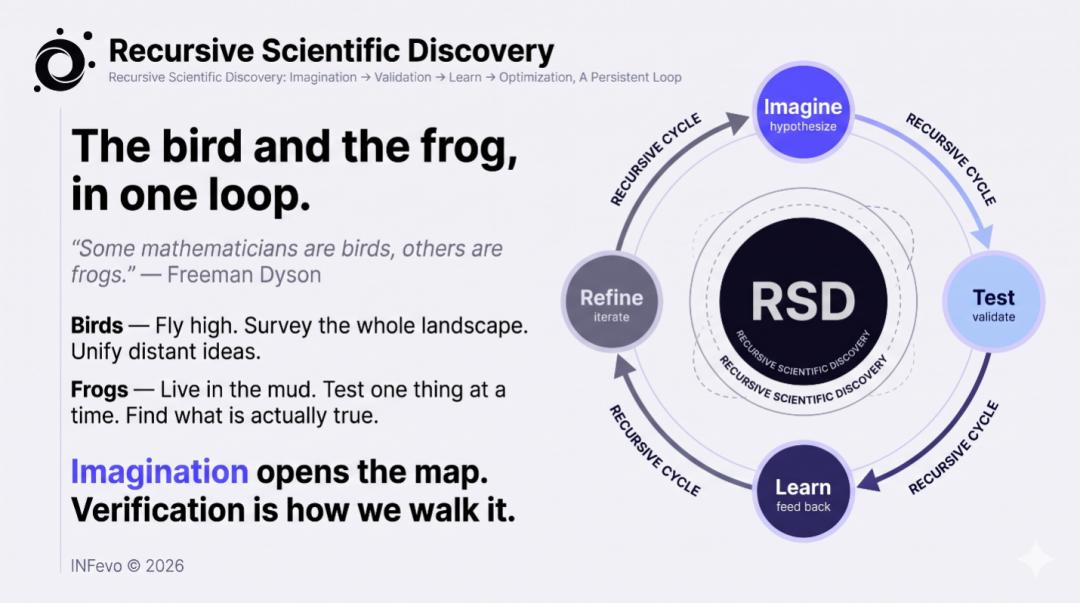
Based on the RSD framework, INFevo has built a dual-drive closed-loop system of "AI foundational large model + high-throughput automated experiment". One end of this system is the self-developed foundational large model OCOO covering cellular multi-omics, which is used to predict cellular responses caused by interventions such as drugs and genes; the other end is an automated wet experimental system covering cell culture, perturbation and multi-omics detection, which is used to verify key predictions and generate new data. The model assists in identifying more potential experimental directions, and the experimental results are used to verify predictions, improve the model, and guide subsequent research. The two are connected through a unified data and research product management mechanism, so that the evidence and experience accumulated in each exploration can be continuously used to improve the system's prediction and experimental design capabilities.
Both the foundational large model and the scientific research workbench have achieved SOTA performance
Relying on the above underlying architecture, INFevo has achieved leading results in core scenarios such as target discovery, virtual screening and preclinical evaluation within a few months of its establishment, promoting the relevant capabilities from model R&D to real research scenarios.
In terms of model R&D, the company has released OCOO-T, a virtual cell foundational model based on transcriptomic data in the OCOO series, which directly models the gene expression changes of cells under various perturbations. With a simple and scalable model architecture, it realizes unified modeling across perturbation types and leading prediction performance. In the same-condition evaluation of the three single-cell perturbation authoritative benchmarks - Tahoe100M, Replogle and PBMC, OCOO-T has achieved industry-leading performance, laying a solid foundation for it to be used to simulate real perturbation biology, support target discovery and early drug efficacy evaluation.
In terms of scientific research products, INFevo has launched The Popper Project (TPP), an autonomously iterable scientific hypothesis mining engine, named after Karl Popper, the philosopher who put forward the scientific "falsificationism". TPP integrates professional scientific research agents and multi-source professional databases to generate, question and refine testable hypotheses, and presents evidence, marks gaps and proposes experimental suggestions with a traceable reasoning chain. The platform supports scientists to jointly review and supplement evidence, promoting the continuous evolution of hypotheses with research feedback; in the future, it will also access virtual cell models to further connect hypothesis generation, computational deduction, independent review and wet experimental verification.
The Karl Workbench scientific research workbench equipped on the TPP platform has started internal testing, implementing the RSD concept for the first time as a daily research tool for scientists. Focusing on the five system capabilities of recording, accumulation, product, supervision and evolution, the workbench further connects scientific problems and hypotheses to the complete workflow of data, analysis, experiment and reproducible execution. Researchers can review evidence, examine key judgments and continue existing tasks. Task trajectories, research products and historical experience can continue to play a role beyond a single project task, enabling the research system of the entire scientific research team to have the ability to continuously learn and self-evolve from its own history.
In October, in the retest based on the scientific research agent benchmark SciAgentArena jointly released by Yale University, the Broad Institute, Harvard University, Stanford University and other institutions, Karl Workbench, equipped with the DeepSeek foundational model, ranked first in the comprehensive score in both single-cell omics and spatial omics scenarios, reaching the SOTA (state-of-the-art) level within the scope of this evaluation, outperforming similar systems equipped with cutting-edge large models such as Opus5 and GPT5.6, including Claude Code and Codex, demonstrating the industry-leading system-level performance of the system in scientific research tasks close to the actual research process.
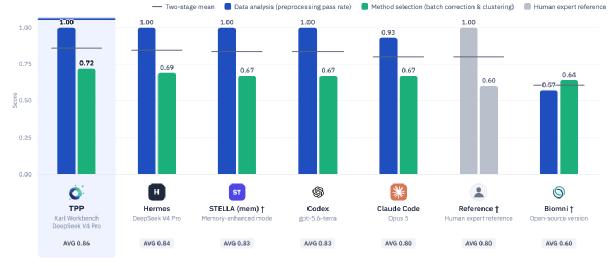
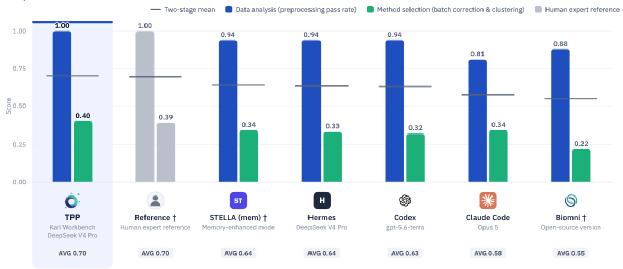
Figure: Karl Workbench ranks first in the scores of SciAgentArena single-cell omics and spatial omics evaluation
Connecting cutting-edge computing and real application scenarios: building an industrial-grade AI biology base
While opening up the "computation - tool - experiment" chain, INFevo continues to focus on real disease problems and drug R&D scenarios, and deeply participates in the co-construction of the "Beijing Key Laboratory of Hepatobiliary and Pancreatic Tumor Organoid Culture and Intelligent Diagnosis and Treatment" led by Peking University First Hospital. Driven by major clinical needs, this cooperation aims to build a research system of "clinical problems - organoid models - drug screening - AI analysis - clinical verification". As the core support of INFevo in the direction of artificial intelligence and virtual cell models in the laboratory, INFevo will systematically connect the capabilities of virtual cell models to real clinical samples from patients, promote two-way iteration between AI prediction and organoid experimental verification, and explore the application of cellular response prediction in front-line scenarios of clinical decision-making and new drug screening.
INFevo's ability to quickly cross the platform construction period of start-ups benefits from the profound industrial accumulation of its incubator XtalPi (2228.HK). XtalPi's more than ten years of accumulated underlying R&D experience, upstream and downstream ecology and global industrial network provide INFevo with a growth soil with both a high starting point and strong industrial landing genes. At the technical level, INFevo's virtual cells are highly synergistic and complementary to XtalPi's molecular design and automated synthesis capabilities spanning multiple drug modalities, which is expected to form a cross-scale closed loop of "molecule generation - cellular response prediction - wet experimental verification". XtalPi's incubation and ecological empowerment not only accelerates the construction of INFevo's technical system, but also makes the prediction model oriented to the real drug pipeline R&D needs and strict industrial-grade standards from the very beginning of R&D.
The funds raised in this round will be mainly used for INFevo's foundational large model R&D, expansion of the high-throughput automated dry-wet closed-loop system, and deepening construction of the industrial ecology. In the future, the company will work with global pharmaceutical companies, hospitals and scientific research institutions to promote its technologies and products into the front-line scenarios of daily scientific research and industrial R&D, analyze the intervention mechanisms of complex diseases, improve the baseline efficiency of new drug R&D, and jointly expand the boundaries of cognition and intervention in the field of life sciences.
Lai Lipeng, Co-founder and Chief Innovation Officer of XtalPi, Co-founder of INFevo, said:
"The scale of drug R&D lies not only in the precision of molecular engineering, but also in the depth of human understanding of complex life and disease mechanisms. When high-dimensional biological data intersects with cutting-edge AI technology, we are ushering in a critical inflection point for systematically deciphering the language of life and broadening the boundary of human self-cognition. INFevo is committed to deeply coupling massive biological data, large models and self-evolution methods to build a native AI biology base, internally opening up the capabilities of virtual cells, automated experiments and AI recursive scientific discovery, and externally fully empowering pharmaceutical companies, hospitals and scientific research institutes, and deeply collaborating with XtalPi and many ecological partners, so as to improve the certainty of global innovative drug R&D and enable more efficient therapies to reach patients faster."
Zhao Yalong, Co-founder of INFevo, said:
"Thanks to the trust and support of new and old shareholders. Relying on this round of financing, INFevo will continue to consolidate the dry-wet closed-loop infrastructure of "foundational large model + automated experiment", accelerate the construction of the Recursive Scientific Discovery (RSD) system, and let experimental data continuously promote the evolution of the model and the system. We look forward to working with scientific research and industrial partners to translate a deeper understanding of life into practical breakthroughs in drug innovation, accelerate the process from target discovery to clinical translation, and open up new therapeutic paths for diseases that have not yet been conquered."
Xinglian Capital said: "The deep integration of AI and life sciences will become an important wave of the next round of scientific and technological innovation. Biological systems have extremely high complexity, and also contain huge space for scientific discovery and industrial innovation. The INFevo team is committed to introducing the modeling and reasoning capabilities of artificial intelligence into life sciences, and exploring new paths for AI to understand life, predict life and promote life science research by combining multi-modal data, foundational models and experimental systems. This is a track full of challenges but with great long-term value. We are very pleased to support INFevo to continue its exploration, and look forward to the team promoting AI for Biology from scientific research breakthroughs to broader industrial applications with solid technical accumulation and continuous engineering innovation."
Prosperity7 Ventures said: "Cell-level simulation provides a further solution for AI drug design centered on molecules, which is expected to solve various problems in the process of translation from basic research to clinical outcomes. INFevo's artificial intelligence-based virtual cell system is built to promote the development of this path. We are very pleased to support the company to carry out technical R&D and finally realize the vision of virtual cells."
Huagai Capital said: "The real value of INFevo lies in opening up a new boundary of biological exploration with the help of the virtual cell system and The Popper Project (TPP), breaking through the unknown target discovery bottleneck that traditional R&D is difficult to reach, which is also the most challenging and most promising direction in the current AI pharmaceutical industry and even the entire pharmaceutical industry. We are very glad to participate in it and witness the unlimited evolution."
Songhe Capital said: "As 'low-hanging fruit' new targets are increasingly scarce, the industry urgently needs to transform from experience-driven to data and model-driven. The value of virtual cell model simulating this 'perturbation-response' system-level result lies not only in greatly shortening the R&D cycle and improving translation efficiency, but also in its potential to break the traditional cognitive boundary and dig out deeper biological mechanisms and potential associations from massive data. This will provide a revolutionary tool for discovering new targets and fundamentally improve the success rate of new drug development. We are very much looking forward to and supporting INFevo to continue to cultivate deeply in this cutting-edge track."