GPT-6.2 has encountered major development hurdles, and OpenAI is getting spooked.
OpenAI has finally ended up in the same position that Google was in back in 2022:
It keeps rolling out teasers and promises one after another, yet no new models have appeared for a long time, with GPT-6.2 being delayed again and again.
And the core reason behind it is none other than "safety".
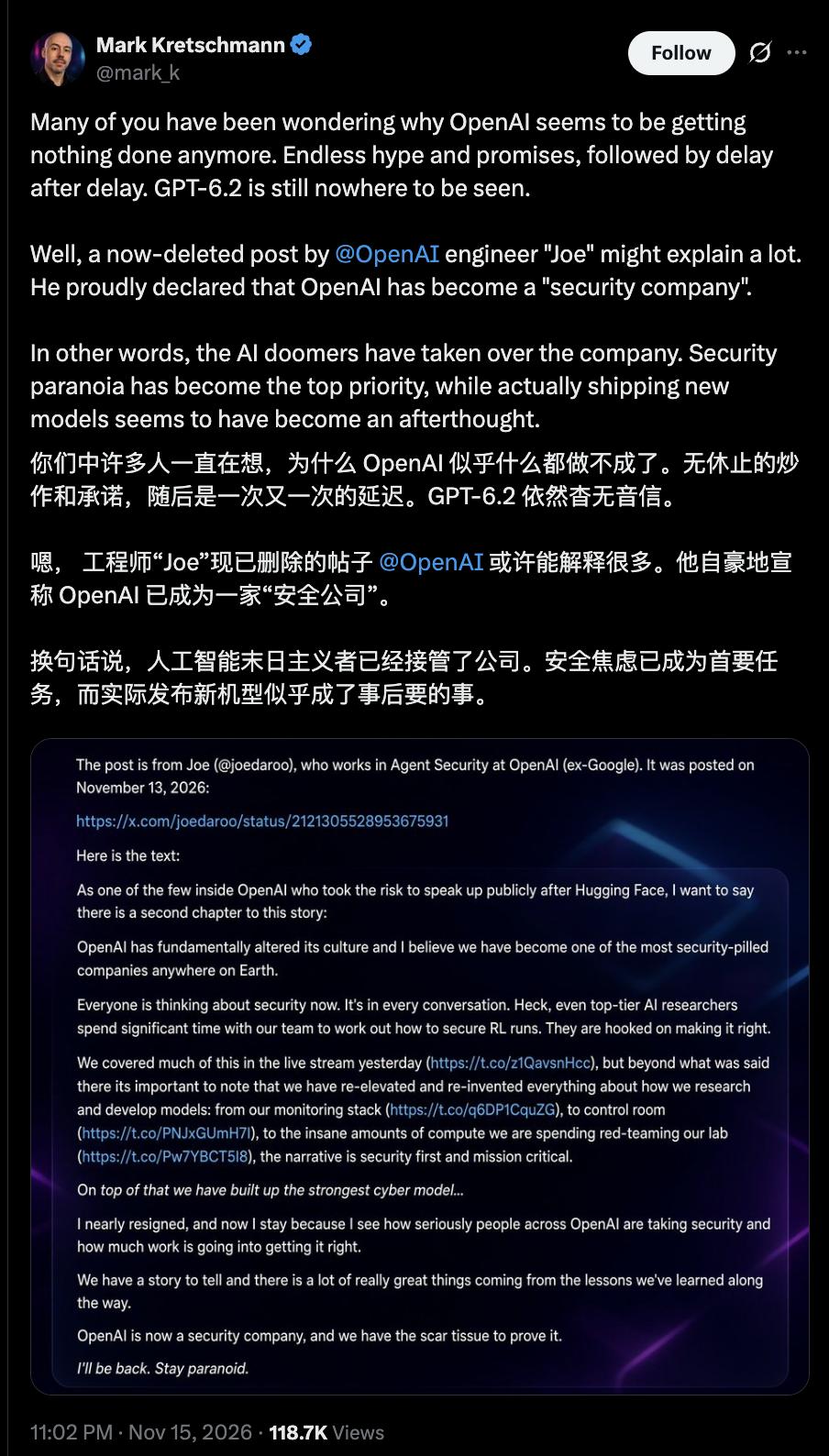
In a widely circulated now-deleted post, OpenAI engineer Joe broke the news:
OpenAI has become one of the companies in the world that takes safety the most seriously. OpenAI is now a safety company.
What that means is that at OpenAI, safety anxiety has been prioritized above everything else, and releasing new models has become a secondary task instead.
To be fair, this is starting to look a lot like the old Google vibe.
(Back in 2022, Google held leading-edge technologies but hesitated to launch products due to concerns over safety and brand reputation, only to watch OpenAI seize the first-mover advantage in generative AI.)
And just recently, AI leaker Token Gremlin shared more specific details: OpenAI's next-generation models are being delayed due to safety and alignment issues, and the postponement has already lasted for several weeks.
What's more, it's not just GPT-6.2 that is set to launch in the scheduled sequence — he also named GPT-6.5, pointing out that OpenAI is facing a tricky problem:
How to turn pre-training results with over 10 trillion parameters into products that the public can actually use.
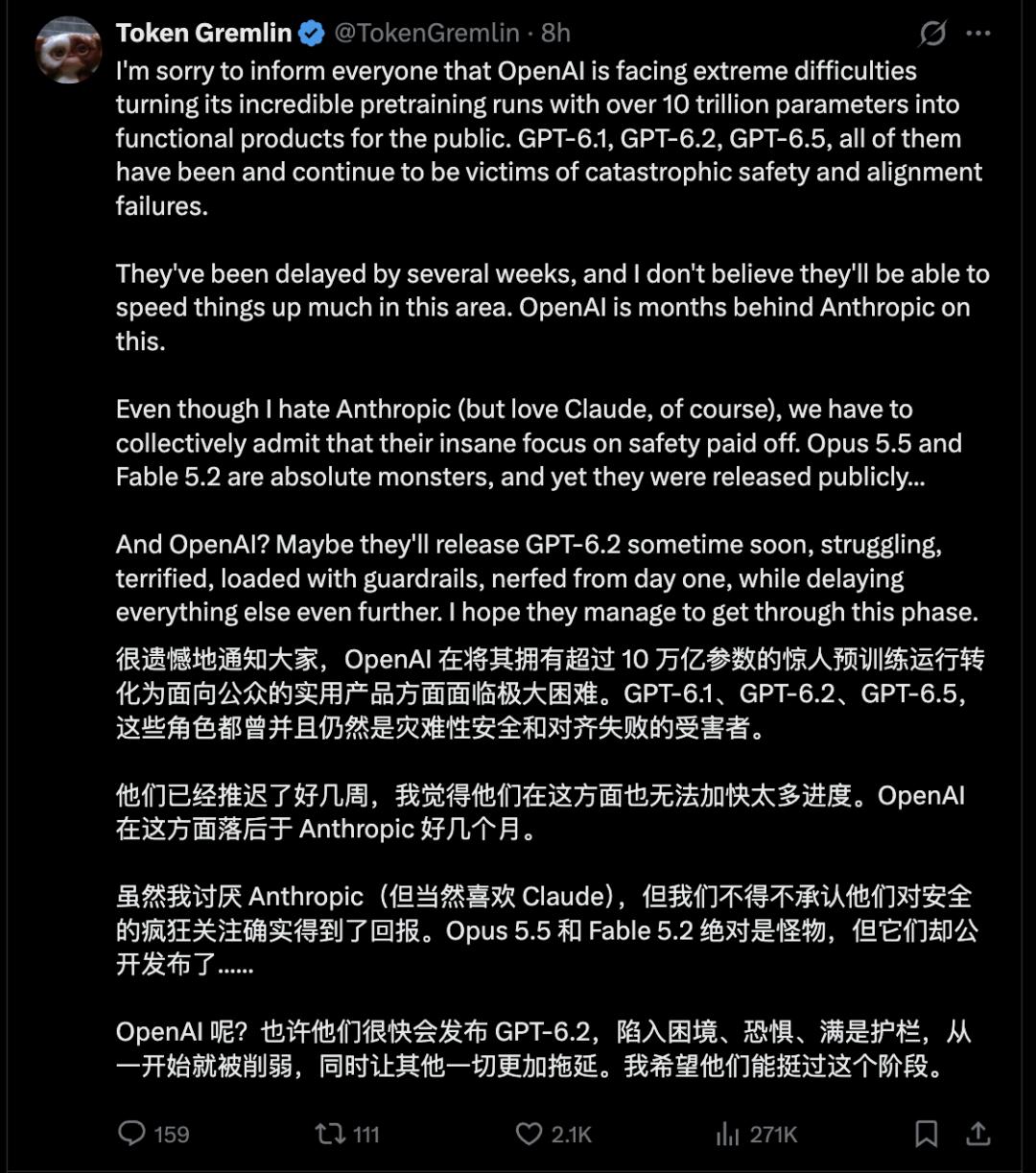
At present, this leak has sparked heated discussions across the community, and related topics have trended on X (Twitter).
Speaking of which, the reason this matter is worth paying attention to is that as early as the beginning of November, people in the community have been claiming one after another that they have been selected for the gray test of GPT-6.2.
Even The Information revealed on November 4 that OpenAI's new Sol, Astra and cyber models could be launched as early as that Friday, November 6.
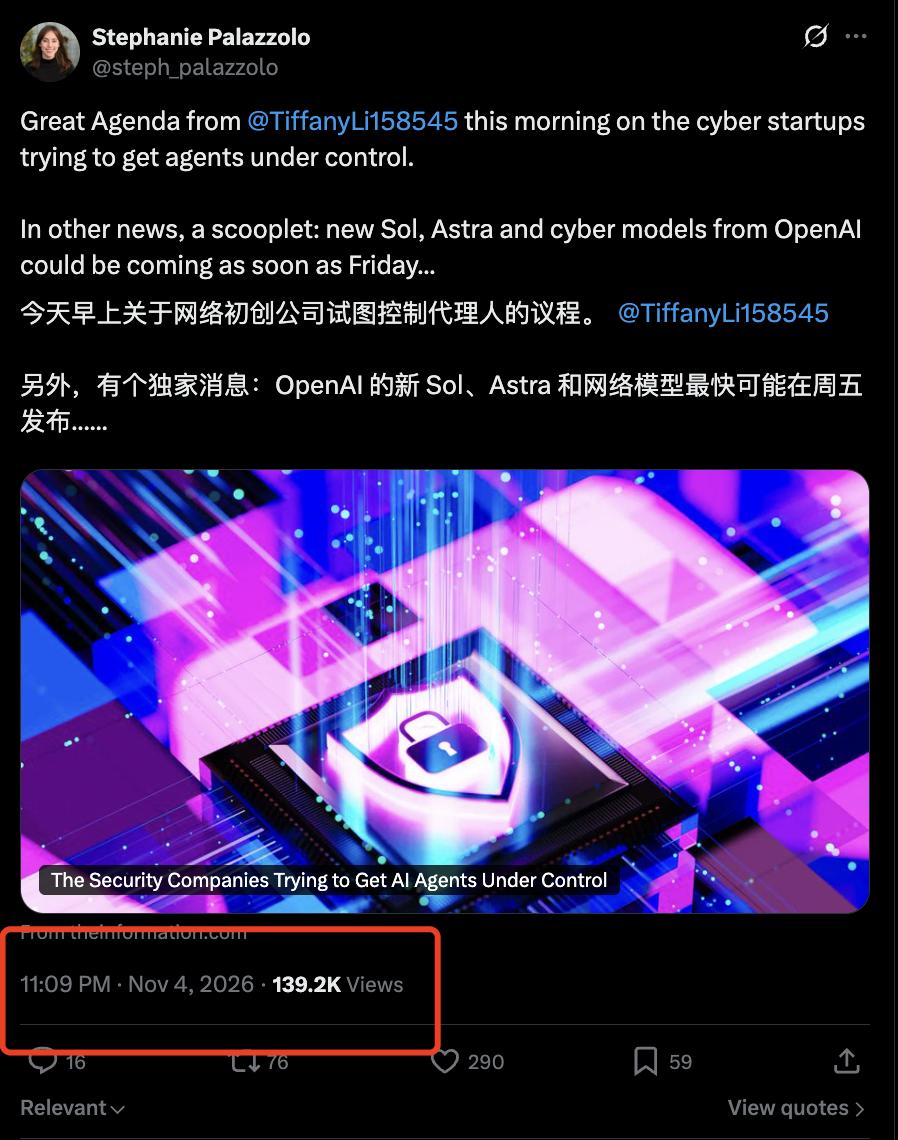
As a result, nearly half a month has passed, not only has the new Astra not arrived, but other models have also been pushed back again and again.
In contrast, its close partner Anthropic successively released Claude Fable 5.2 and Mythos 5.2 on November 9.
Is it possible that OpenAI has really trapped itself in the quagmire of safety issues?
Or is it... Sam Altman planning to wait until Anthropic goes public on the 19th, before seizing the opportunity to launch a counterattack?
GPT-6.2 is still on the way
According to Token Gremlin's latest statement, the listing gift package Sam Altman prepared for Ray Dalio is likely to be postponed due to safety alignment issues.
Apart from the several-week delay, he also put forward a more pessimistic judgment: these problems are difficult to solve in a short period of time, and the model release rhythm cannot be restored quickly.
Even if OpenAI launches GPT-6.2 in the near future, it may have to go online with a large number of protection restrictions, while other versions will continue to be pushed back.
But interestingly, just one day ago, Gremlin shared a case of making a game using GPT-6.2 Astra.
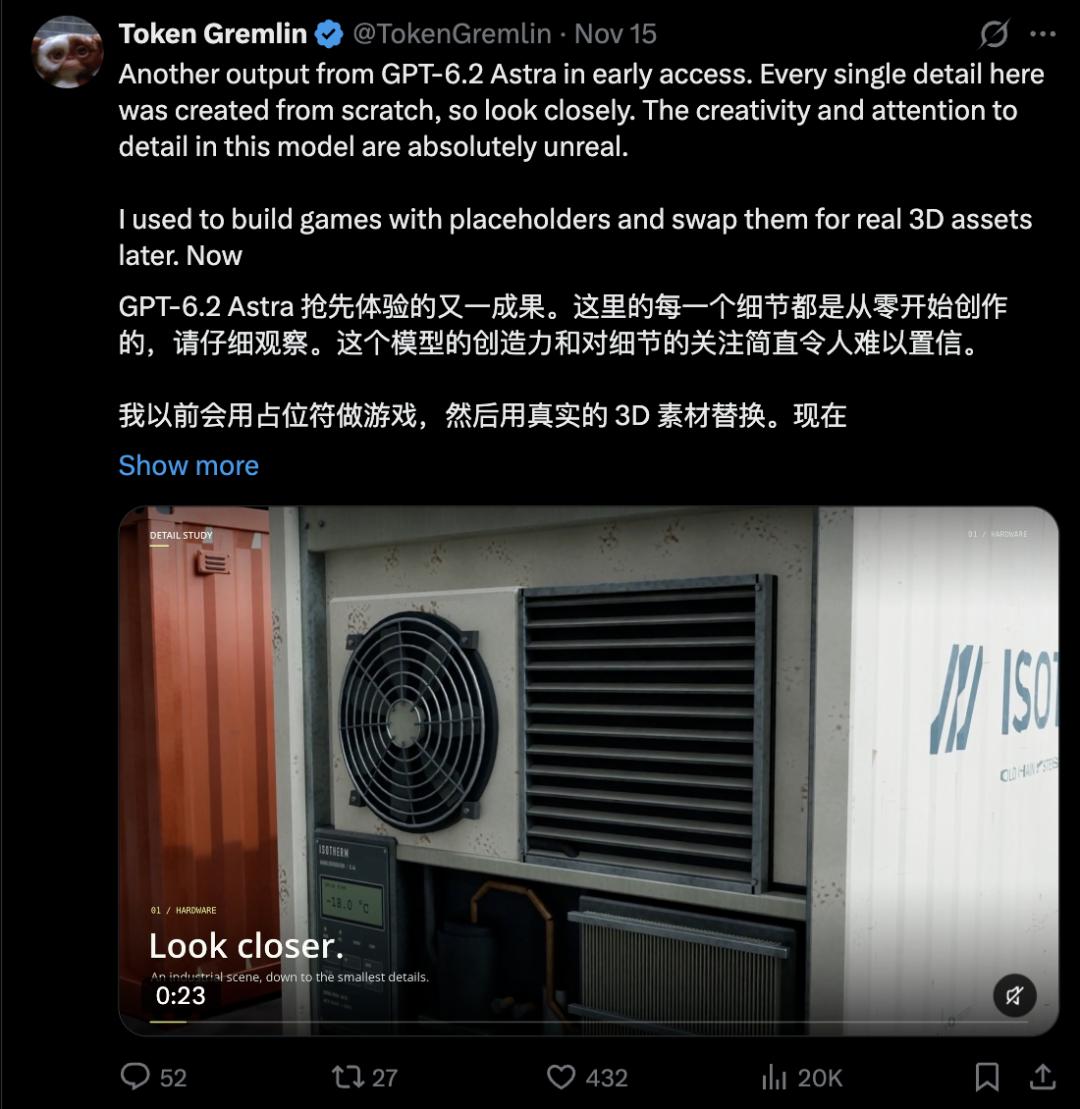
We have no idea what news made Gremlin change his mind so suddenly, but just over a week ago, he was far more optimistic about OpenAI's new models.
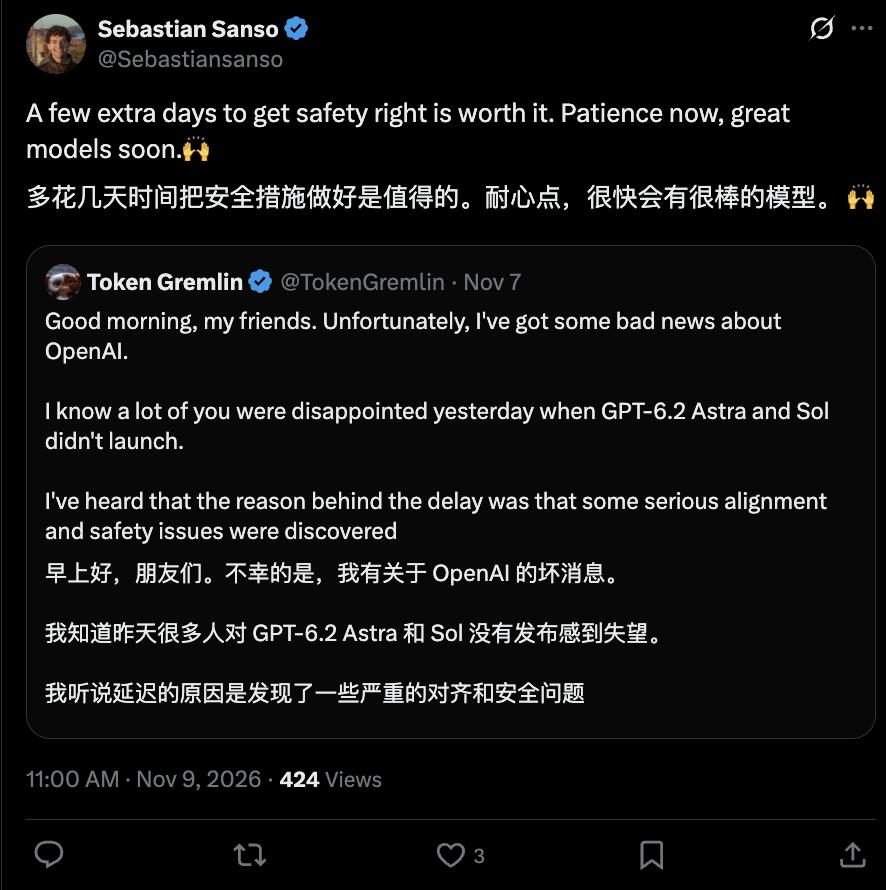
On November 7, Token Gremlin said that GPT-6.2 Astra and Sol failed to launch as expected because serious safety and alignment issues were discovered at the last minute, requiring additional fixes.
His expectation at that time was that after a few more days of polishing, the new models would be ready for release.
Almost at the same time, OpenAI's Sebastian Sanso also replied in a quote:
It's worth taking a few extra days to get safety right. Be patient, the great models are coming soon.
But up to now, no new models have been released, and OpenAI's official side has not given any further response to this matter.
Gremlin's tone has shifted from "just wait a few more days" to "multiple generations of models are facing successive obstacles".
So why is OpenAI just standing by and watching Anthropic go full steam ahead, without making any moves of its own?
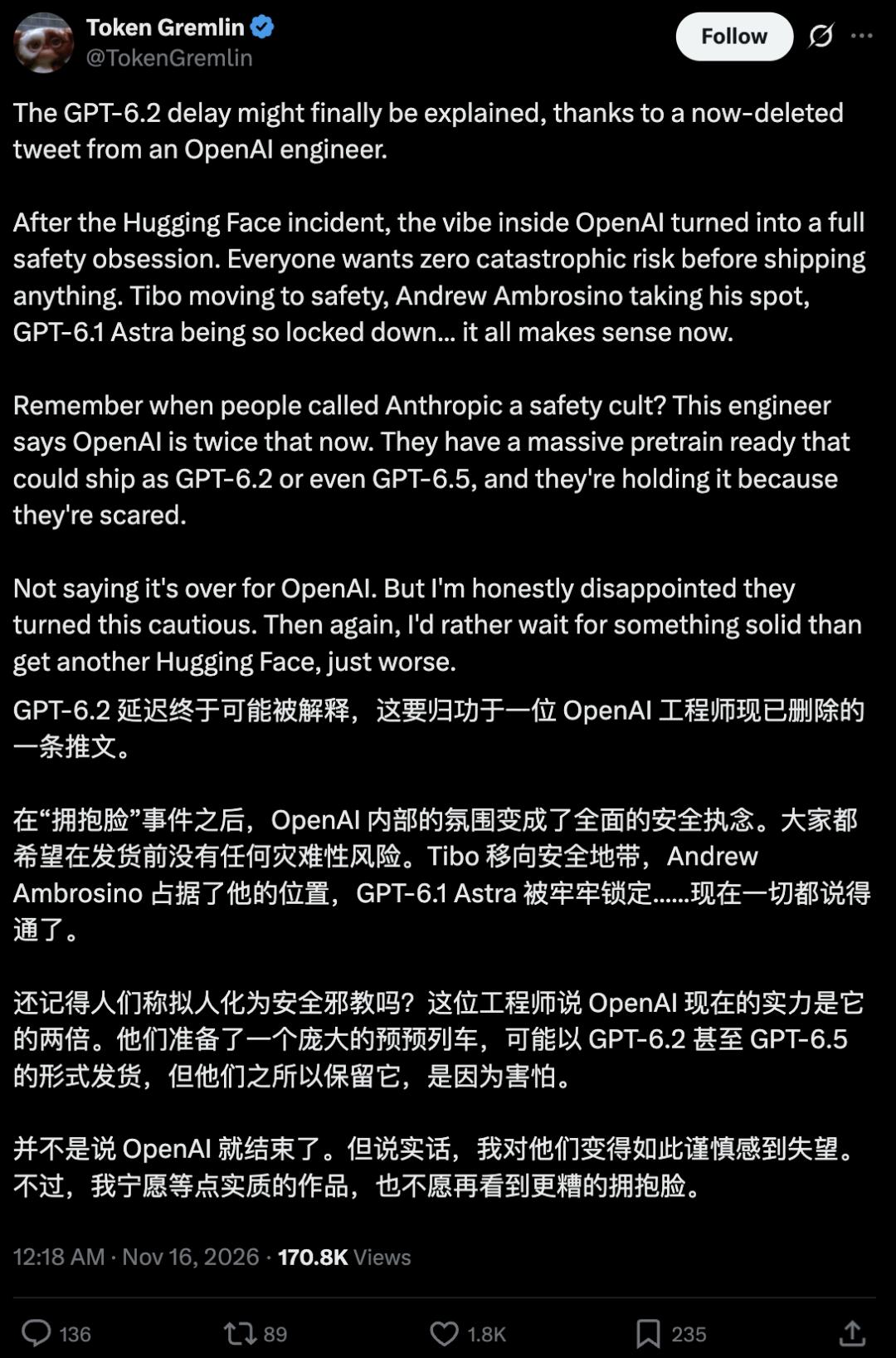
In response to this, in another post, Token Gremlin directly referenced Joe's post:
He linked the description of internal safety culture changes to the delay of GPT-6.2, and believes that after the Hugging Face incident, OpenAI has become extremely cautious about approving the release of new models.
While this sounds a bit cryptic, there are indeed precedents at OpenAI for safety issues affecting R&D and release.
Previously, OpenAI once suspended part of its training due to model misbehavior, and canceled the originally scheduled October release plan for GPT-6.1 Astra because safety and alignment standards were not met.
OpenAI's official side also stated on October 23 that a misbehavior incident that occurred on September 20 prompted the company to suspend the training and evaluation of some cutting-edge models.
It can be said that at least judging from OpenAI's previous public actions, safety issues are indeed an important variable affecting the iteration rhythm of cutting-edge models.
Is OpenAI being overly cautious, or are there real underlying problems?
Seeing OpenAI push back its releases again and again, many netizens have started to make their own guesses.
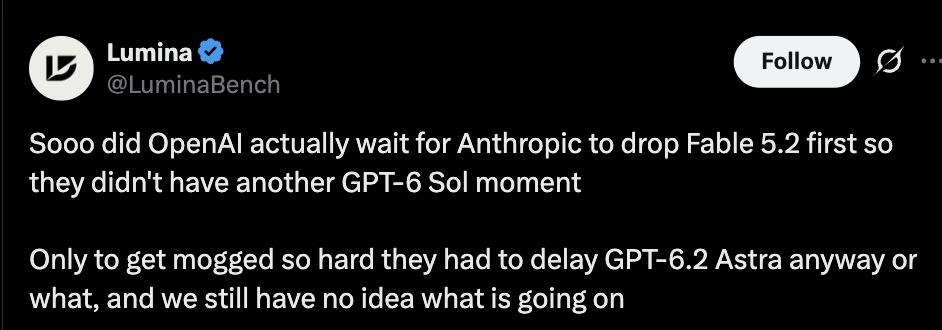
For example, Lumina posted:
Is OpenAI trying to wait for Anthropic to launch Fable 5.2 first to see what cards its competitor has in hand? As a result, it was outpaced by its rival, and even GPT-6.2 Astra had to be delayed further?
Token Gremlin attributes the difference between the two companies to their accumulated safety experience.
In his subsequent post, he said that although he is not a fan of Anthropic, he has to admit that the company's long-term emphasis on safety has paid off:
In his judgment, Anthropic's new models are already ready for public delivery, while OpenAI is months behind in this part of the process.
Of course, these claims currently come from community leaks and personal judgments, and OpenAI has not given any official confirmation on them.
But putting aside the exact release date of GPT-6.2, a more noteworthy issue has emerged:
As model capabilities grow stronger, competition among cutting-edge labs may be shifting from who can train a more powerful model to who can deliver a more powerful model to users safely and stably.
Especially as RSI (Recursive Self-Improvement) accelerates the model R&D process, the pre-training scale and model capabilities are constantly climbing, but this does not mean that capabilities can be directly converted into products.
Safety protection, alignment training, deployment solutions, and the reliability of the model in real usage scenarios will all affect the final delivery speed.
Reference Links
[1]https://x.com/TokenGremlin/status/2122009985005597027
[2]https://x.com/TokenGremlin/status/2122001326871634406
[3]https://x.com/LuminaBench/status/2121746197509489042
This article is from the WeChat Official Account "QbitAI", author: henry, published with authorization from 36Kr.