The major backer behind Luckin Coffee has entered the market, and Blue Bottle Coffee, which sells coffee at 58 yuan per cup, is expanding its store network.
Blue Bottle Coffee, whose most expensive drink is sold for 58 yuan per cup, is speeding up its store expansion.
Recently, some netizens shared on social platforms that construction enclosures of Blue Bottle Coffee have appeared in shopping malls in Beijing, Nanjing, Wuhan and other cities, with the iconic blue bottle logo standing out prominently. According to the sorting by Time Finance, at least 4 Blue Bottle Coffee stores are in the renovation enclosure stage recently, three of which are the first stores in their respective cities or even regions.
Having entered the Chinese market for four years, Blue Bottle Coffee has only opened 14 stores so far, and now it has clearly pressed the acceleration button for store opening.
At the same time, GridCoffee under Yuanfudao and Peet's Coffee are also opening new stores. These specialty coffee brands whose drinks usually cost 30 to 40 yuan per cup are ushering in a new round of expansion window.
14 stores in 4 years in China, Blue Bottle Coffee is about to speed up
Born in San Francisco, the United States in 2002, Blue Bottle Coffee focuses on premium handcrafted coffee. It is known as "the Apple in the coffee industry" for its high-end positioning, pursuit of minimalist style and distinct artistic tone.
Founded for more than 20 years, this coffee brand has expanded its store network at a relatively slow pace. In September 2017, Nestlé, a giant in the food industry, acquired 68% of Blue Bottle Coffee's shares for about 425 million US dollars, but Blue Bottle Coffee continues to operate as an independent entity.
In 2022, two years after entering Hong Kong, Blue Bottle Coffee opened its first mainland store in a two-story western-style house by the Suzhou Creek in Jing'an, Shanghai, when the total number of its global stores had just exceeded 100. According to reports at that time, on the opening day of the Shanghai store, due to the flow restriction measures taken by the store, some people even waited for 7 hours to get in, and some consumers queued up as early as 5 a.m.
In the following four years, Blue Bottle Coffee expanded slowly in the Chinese mainland, with most of its stores concentrated in Shanghai, and was even teased on social platforms that it "could not walk out of Jing'an District". Up to now, Blue Bottle Coffee has only 14 operating stores in China, located in Shanghai, Shenzhen and Hangzhou, with 10, 3 and 1 stores respectively.
The new batch of cities it enters this time, including Beijing, Nanjing and Wuhan, all host its first stores in the respective city. Time Finance noticed that "Wuhan" has appeared in the list of opened cities on the Blue Bottle Coffee mini-program.
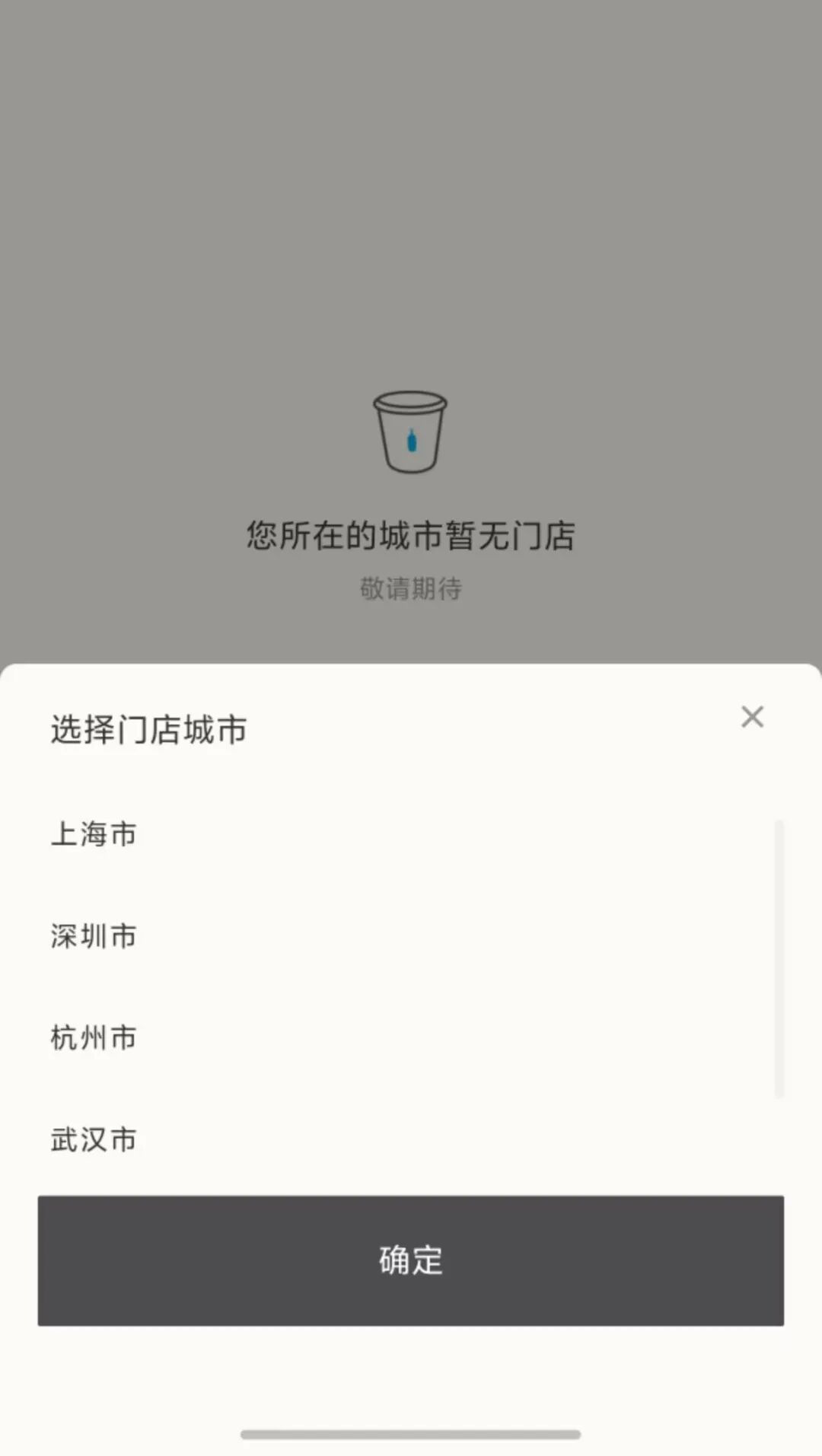
Blue Bottle Coffee mini-program
Not only has the pace of store opening accelerated, Blue Bottle Coffee has also changed its site selection style. In the past, this specialty coffee brand mostly chose stylish standalone buildings such as old factories, old warehouses, opera houses and museums. Its first mainland store in Shanghai is located in the cultural relics protection building that used to be the former residence of the prestigious Zhu family, a prominent family in old Shanghai; in Hangzhou and Shenzhen, it has settled in Mixc commercial complexes; its stores in Shanghai are located in landmarks including IFC, Zhang Garden, Kerry Centre and Mixc.
According to the latest location of the construction enclosure, Blue Bottle Coffee's store in Wushang MALL in Wuhan is a two-story street-facing store, which was originally the Starbucks store in Wushang MALL. Blue Bottle Coffee's first Nanjing store is located on the negative first floor of Deji Plaza, opposite the LV beauty store.
"In the early stage, Blue Bottle took the slow premium route, focusing on single-store experience and scarcity, and did not pay much attention to store opening speed and scale." Wang Hongdong, a catering analyst, pointed out to Time Finance. From the perspective of city selection, Blue Bottle Coffee has shifted from the previous very mature coffee markets to seizing core locations in core cities; its specific site selection also pays more attention to commercialization and profit considerations.
Zhi Dongliang, head of the Commercial and Retail Services Department of South China at Savills, also pointed out that the property cost and opportunity cost of standalone properties, historical buildings and properties in characteristic blocks are relatively high.
For brands that want to accelerate expansion, high-traffic shopping malls are more helpful to ensure their store opening efficiency. He revealed that at present, shopping malls in Guangzhou and other cities have a lot of negotiation demands for the Blue Bottle Coffee brand, and the market inquiry frequency is also relatively high. There was previous market news that Guangzhou Bai'etan Mixc might introduce Blue Bottle Coffee.
Are specialty coffee brands pushed to run faster by capital?
As a representative of niche high-end specialty coffee, Blue Bottle Coffee takes premium pour-over coffee as its core product, with the unit price of most drinks ranging from 30 to 50 yuan.
In the past few years, the specialty coffee market has been reshuffled by Luckin and Cotti. Fast coffee brands have launched a round of price wars and store expansion wars, which has quickly cultivated coffee consumption habits while bringing the unit price of freshly ground coffee down to 9.9 yuan. The report released by the World Association of Chinese Restaurant Entrepreneurs in January 2026 shows that the per customer transaction value of domestic chain coffee continued to decline from 2023 to 2025, dropping from the range of 32-42 yuan in 2023 to 25-27 yuan in 2025.
While the market scale is still growing, the per customer transaction value continues to decline. While this scissors gap appears, the pricing space and market share of specialty coffee are being squeezed.
In June this year, the operating entity of Seesaw, one of the earliest specialty coffee chain brands in China, entered bankruptcy liquidation, and the number of its stores shrank from 135 at its peak to 34. In addition, the store opening speed of M Stand has dropped sharply, and %Arabica has continued to shrink its business in China, gradually withdrawing from core cities.
But not all specialty coffee brands are scaling down.
In addition to Blue Bottle Coffee, Peet's Coffee has also taken intensive store opening actions this year, with its distribution cities extending from core cities to previously untapped markets such as Nanchang and Jinhua. According to the brand's statement, the maximum number of its stores in China will reach 400 this year. GridCoffee is also moving at a fast pace, and this young specialty coffee brand established five years ago may reach a store volume of 250-300 this year.
Starbucks, which was recently caught in the "mandatory in-store consumption" controversy, is accelerating its penetration into county-level markets in China. According to the management's disclosure on the conference call, Starbucks plans to add a net of about 1,100 coffee stores in its international markets in FY2027, about half of which will come from the Chinese market.
The collective acceleration of Blue Bottle, Peet's and Starbucks is no coincidence.
In March this year, Dazheng Capital officially signed an agreement with Nestlé, obtaining the global store operation rights of Blue Bottle Coffee; in April, the joint venture transaction between Starbucks and Boyu Investment was completed, and Starbucks China introduced Boyu Capital to restructure its joint venture structure; in June, Peet's Coffee entered a new capital system after its parent company JDE Peet's was acquired by KDP, a well-known American beverage company.
The entry of new capital means that the strategies and operation methods of these enterprises will inevitably be recalibrated according to the growth expectations and valuation logic of capital.
"The core reason for the accelerated store opening is the entry of Dazheng Capital." Wang Hongdong pointed out to Time Finance. Dazheng Capital's investment in Blue Bottle Coffee is not a simple financial investment, and its strategic intention and depth of operational intervention may be relatively deep. "The new owner wants to make some changes and achieve some results."
For Blue Bottle Coffee, Dazheng Capital obviously has great ambitions. In addition to accelerating the scale expansion, this coffee brand has also taken actions in organizational structure, product lines and other aspects this year. "All core management positions have been replaced with its own people." Wang Hongdong said.
Industrial and commercial information shows that in June this year, Blue Bottle Coffee (China) Co., Ltd. changed its director filing and senior management personnel, in which Chen Weihao, partner of Dazheng Capital and director of Luckin, served as chairman, and Li Mo, former general manager of Luckin Coffee Beijing Branch, served as general manager.
In China's investment circle, Dazheng Capital rose to fame for its investment in Luckin Coffee. After Luckin's accounting fraud scandal in 2020, Dazheng Capital led the restructuring of Luckin and eventually became the actual controller of Luckin; since then, Luckin has become the "No.1 coffee brand in China" by accelerating store expansion, building supply chain and operating digitalized stores.
Chen Weihao once mentioned in an interview that Dazheng Capital tends to make relatively controlling investments in each project. "If you don't have enough say in the enterprise, it is very difficult to truly help the enterprise." He also mentioned that in past investments, the management teams with little innovation will be replaced, "We ourselves act as the driver."
Time Finance noticed that many consumers on social platforms have questioned the changes of Blue Bottle Coffee, "All kinds of syrups, jams and milk bricks are added to the drinks. The number of products has increased, but the characteristics of the brand are gone." It is reported that Blue Bottle has accelerated the expansion of non-coffee light drinks and special mixed drinks this year. For example, the store in Shenzhen Mixc World has 12 non-coffee light drinks, which is similar to the product structure of Luckin.
After being wrapped in the coat of capital, specialty coffee is running faster in China, but how to balance large-scale operation and personalized characteristics may be the real problem.
This article is from the WeChat official account "Time Finance APP" (ID: tf-app), written by Lin Xinlin, authorized for release by 36Kr.