Single-person and two-person households account for nearly 60% of the total. How much longer can the boom of large-sized vehicles last?
Scaling up vehicle size has become a prevailing trend in China's automotive market.
Take the widely popular SUVs for example, the 5-meter full-size SUV segment has seen explosive growth. Statistics show that at this time last year, there were only 30 5-meter full-size SUVs on sale in the domestic market. As of today, the number of models in this category has doubled to more than 60. From mainstream independent brands to premium joint-venture brands, a flood of 5-meter large 5-seater and 6-seater SUVs have been launched, making the "rigid demand for large vehicles" the most mainstream consumer perception in the current automotive market.
A few days ago, Ola Källenius, CEO of Mercedes-Benz, also stated that "In China, cars need to be big, very big, astonishingly big." In the current domestic competitive environment, once the body size and space performance fail to keep up with the pace of competing products, the brand will be easily eliminated by the market. "Bigger is better" has long been the unspoken iron law of competition in China's automotive market.
However, forming an extreme paradox with this trend is the continuously shrinking family structure in China. According to the latest census data, the average number of people per household in China has kept declining over the past 25 years. In 2025, the average household size across the country was only 2.52 people, the 3-person family is no longer the mainstream, and the 2-person household has become the most common family form in society.
On one hand, the miniaturization and single-person orientation of families have become the new demographic normal; on the other hand, vehicle sizes keep expanding and the sales volume of large vehicles keeps rising. The smaller the family, the larger the vehicles are built, which is a counterintuitive contrast against common sense. So, will the boom of large vehicles continue like this forever?
China's automotive market has completely bid farewell to the era of traditional classification
Looking back at the changes in the automotive market over the past decade, a top-down revolution in vehicle body form has completely subverted the product pattern and competition system of domestic passenger vehicles.
According to data released by the China Passenger Car Association (CPCA), the average length of new domestic cars has climbed from 4.61 meters to 4.72 meters over the decade, with a cumulative increase of 11 centimeters. Within the physical framework of automobile manufacturing, this is a subversive size leap, marking that China has fully entered the "large vehicle era".
The A-segment, B-segment and C-segment wheelbase classification standards that have been commonly used in the industry for decades are now completely invalid. The traditional 4.5-4.8-meter golden size range for family cars continues to shrink, and oversize large vehicles longer than 4.8 meters fully dominate the mainstream market, while the share of traditional size models is continuously squeezed.
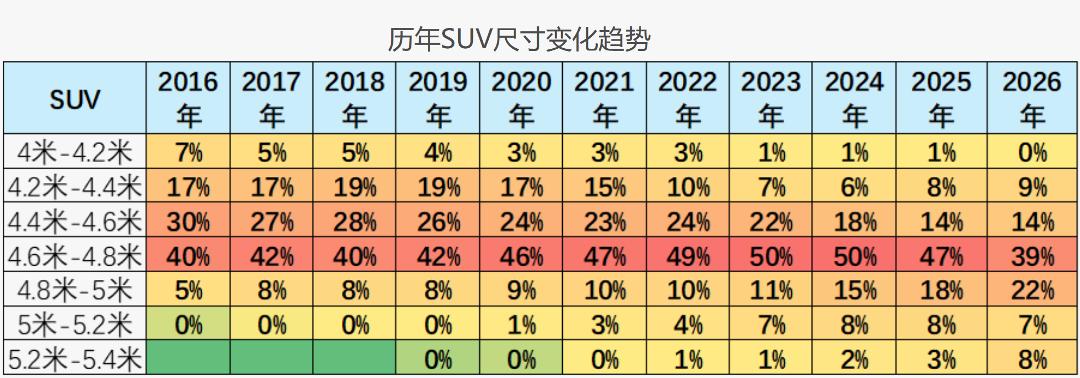
As the absolute mainstream segment at present, SUVs have seen more obvious iteration and upgrading. Over the decade, the SUV market share has skyrocketed from 38% to 56%, making it the largest segment in the automotive market. Small SUVs under 4.6 meters have continued to shrink sharply, and entry-level mobility SUVs that once occupied half of the market have gradually withdrawn from the mainstream. In contrast, mid-to-large and full-size SUVs over 4.8 meters have experienced strong explosive growth, the market share of extra-large SUVs over 5 meters has exceeded 15%, and SUVs with large space, multiple seats and high specifications have become the first choice for families to replace their vehicles.
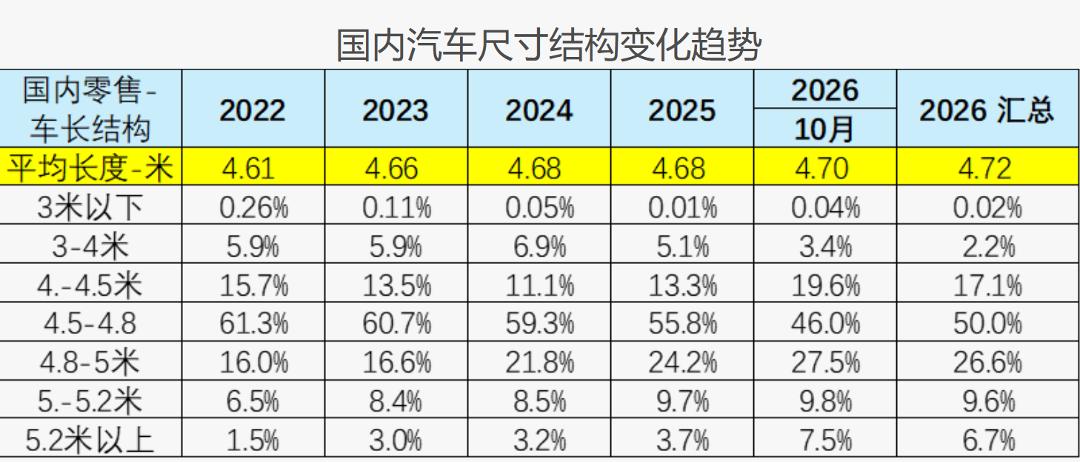
In the field where Chinese people once perceived "cars = three-box sedans", obvious divisions are also taking place inside. Traditional three-box sedans continue to retreat, their market share keeps shrinking, and the main size has fully moved upward. Mid-to-large sedans of 4.8-5.2 meters have become the absolute main force, and the moat of joint-venture B-segment sedans of 4.6-4.8 meters that once monopolized the market has been broken by domestic new energy oversize models.
At the same time, hatchback and crossover models have staged a comeback, with their share soaring from 15% in 2016 to 35% in 2026. Relying on the space advantage of short overhang and long wheelbase on pure electric platforms, this market segment has got rid of the inherent prejudice of "no trunk, no premium" in the fuel vehicle era.
The core driving force behind this nationwide size expansion comes from the dual support of technological innovation of pure electric platforms and the involution of automakers pursuing oversize positioning. New energy exclusive platforms break the structural shackles of fuel vehicles, short front overhang, long wheelbase and maximized cabin design have become standard configurations, and there is no need to worry about energy consumption after making the vehicle larger, allowing models of the same segment to achieve space beyond their class.
Involution competition further amplifies the size advantage. Nowadays, the space premium in the automotive market has long been unregulated. For entry-level models priced at 70,000 to 80,000 yuan, the wheelbase can also exceed 2800mm; for mainstream family cars priced at 100,000 to 150,000 yuan, the vehicle length generally reaches the 4.8-4.9 meter level; the 5-meter large 6-seater SUVs that used to cost 300,000 to 400,000 yuan are now offered by some brands at an affordable price range of 150,000 yuan.
Automakers have abandoned the traditional classification rules, taking "oversize space and extra-large cabin" as the core competitive focus, making the comprehensive experience of space and intelligence replace the wheelbase size, and become the core track of competition in the new era of the automotive market.
Li Shufu of Geely once publicly stated that the living area and body shape of the Chinese people are continuously improving, family cars cannot become more cramped, and large space is an inevitable trend of consumption upgrading. Based on this judgment, Geely has fully promoted the large-scale upgrading of its models, and the oversize iteration of product dimensions is clearly visible.
The iteration of the national popular car Emgrand is highly representative. The fourth-generation Emgrand has a vehicle length of 4638mm and a wheelbase of 2650mm, while the brand-new fifth-generation Emgrand has a vehicle length increased to 4815mm and a wheelbase upgraded to 2755mm. The vehicle length increased by 177mm in a single iteration, and the size directly spans to the entry-level B-segment sedan.
The transformation of consumers' car purchase logic further boosts the size involution. Nowadays, users no longer cling to the driving control experience and mechanical quality of the fuel vehicle era, but pay more attention to riding comfort, broad vision, luggage loading margin and scenario adaptability. Even if the current mainstream is small 2-person households, even mostly young couples and single users, they still prefer large-size models.
Take the Xpeng N90 series targeting young families as an example, its core audience is mainly young 2-person or 3-person families, who mostly use the car for daily commuting and short-distance trips, occasionally carry pets and a small amount of luggage, and have no rigid demand for multiple people. However, this large-size model quickly exceeded 10,000 monthly sales only two months after its launch. It fully proves that the current hot sales of large vehicles are never simply a rigid demand for large families, but a rigid demand for comfort, scenario and experience.
Families keep getting smaller, is there an upper limit for the involution of large vehicles?
In fact, the current industry trend of "proliferation of large vehicles" is only the result of phased involution. Automakers' collective move to develop large-size models is essentially a helpless choice under homogeneous competition. When intelligence, power and configurations tend to be homogeneous, larger size and more redundant space are the most intuitive, lowest-cost and most perceptible differentiated selling points.
Consumers' pursuit of large vehicles is more a psychological demand for experience upgrading, rather than a rigid demand related to population. For daily single or double-person commuting, they pursue a spacious cabin and stretched sitting posture; for self-driving camping and long-distance trips on holidays, they need sufficient loading space; even if the utilization rate is extremely low, users are willing to pay for "redundant space, high-end aura and comfortable experience".
However, when automakers all bet on the large vehicle era, a set of demographic data throws out the ultimate question of the industry: Chinese families have long bid farewell to the multi-person mode, and are continuing to become smaller and single-person oriented.
Over the past 25 years, the average permanent resident population of each family in China has decreased by one person, and the family structure has been completely reconstructed. The latest sample survey data shows that domestic one-person households account for 26.4%, two-person households account for 33.2%, and the total proportion of single-person and two-person small households is as high as 59%, close to 60%.
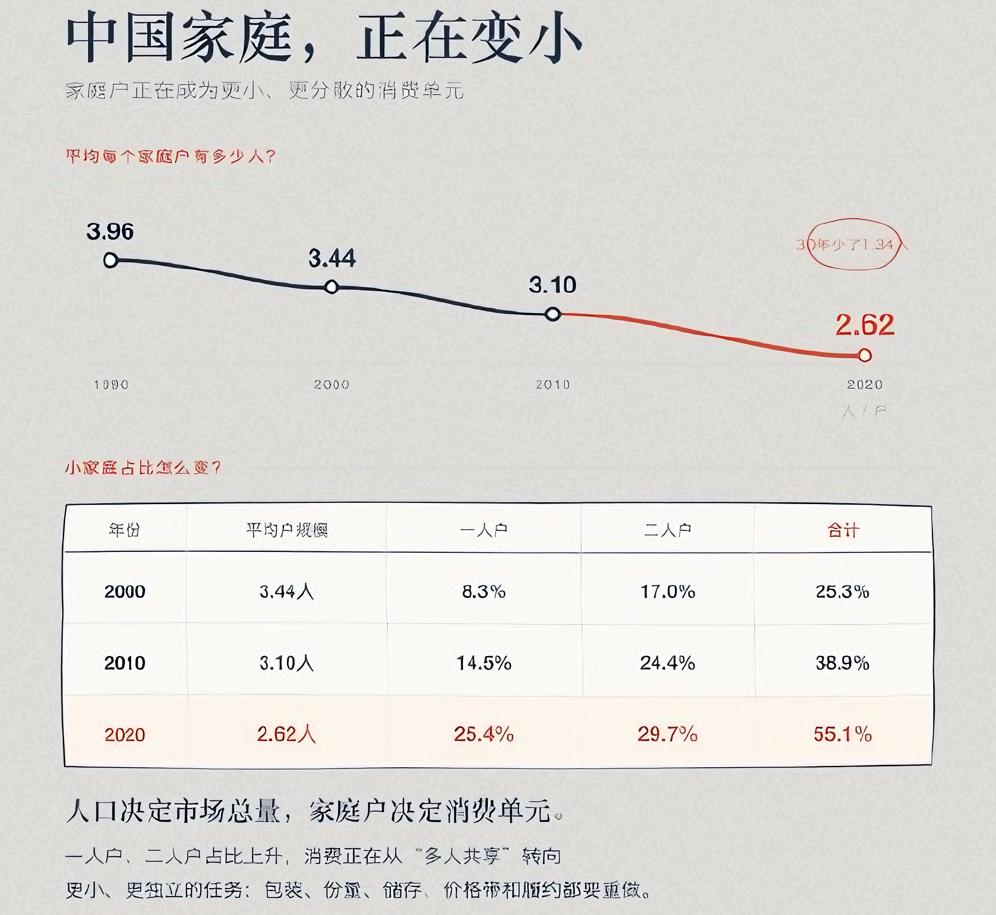
Adding the three-person households, the proportion of small households is close to 80%, and the large family mode of three generations or four generations living together is no longer the mainstream of society.
The reason is not difficult to find. First of all, the continuous deepening of low fertility rate, the decline of the birth rate of new-born babies, the increasing number of childless families and DINK families year by year, and the continuous reduction of traditional three-person families lead to the miniaturization of domestic families.
Secondly, the improvement of living conditions has disintegrated the multi-generation cohabitation mode. The older generation lives separately from their children, and one big family is split into multiple small families.
Another core factor is the normal flow of population. A large number of young people study, work and settle down in different places, breaking away from their original families and forming a huge number of independent single-person and two-person families.
Industry experts predict that the average number of people per household in China will continue to decline in the next five years, the scale of single-person households and childless families will continue to expand, and family miniaturization will become a long-term irreversible social norm.
Based on this change in demographic structure, changes that conform to this trend will also emerge at the consumer market level, giving birth to new tracks such as single-person meals, mini home appliances, small-sized residences, pet economy and one-person dining consumption.
Although cars are getting larger and larger now, according to the trend and change of demographic structure, in the competition of the automobile industry in the next 5-10 years, will this trend of fewer people or miniaturization form a new competitive trend for vehicle size and form?
Combined with the size structure analysis counted by CPCA, in addition to large vehicles, pure electric mobility cars under 4.5 meters have also become a very obvious trend, and always maintain strong resilience, becoming a non-negligible incremental segment in the market, forming the other end of the dumbbell-shaped market with large vehicles. The demand for miniaturized and single-person oriented models is quietly rising, forming a dual-track pattern of parallel development of large and small vehicles.
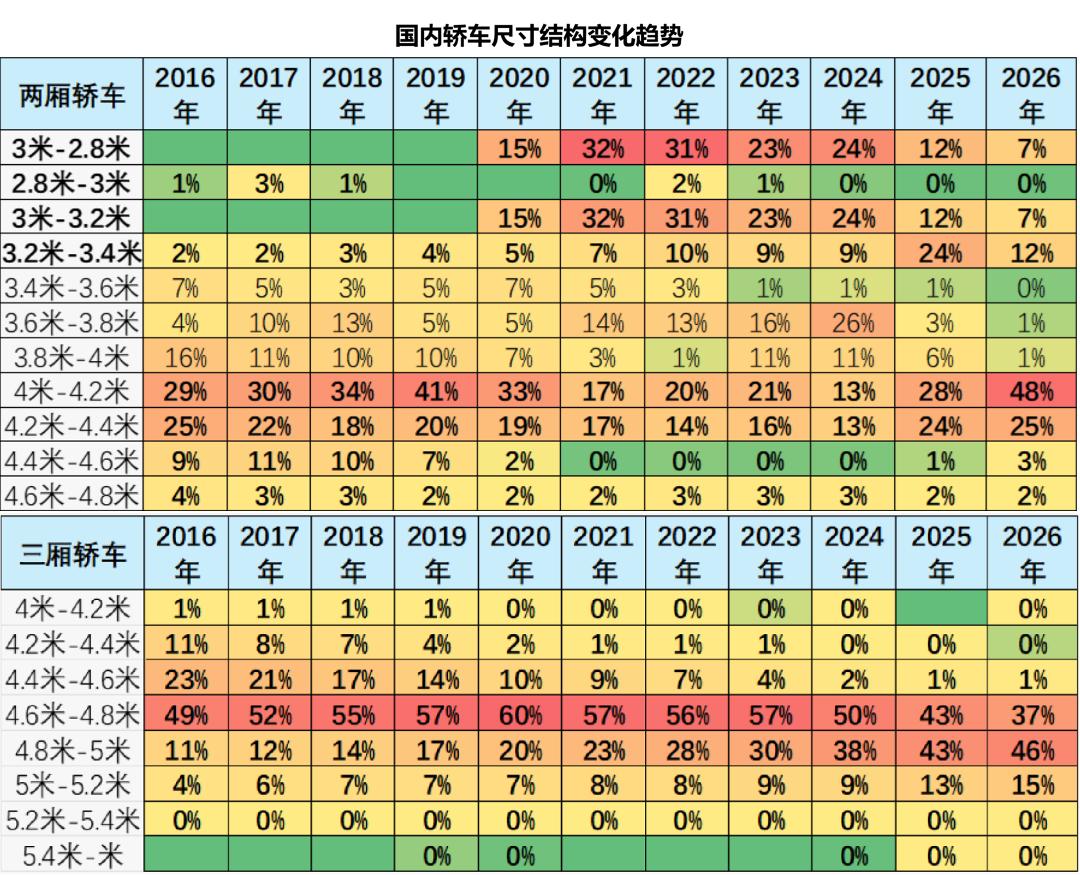
Statistics show that the share of 3.2-3.4 meter micro hatchbacks has increased from 2% ten years ago to 24%; the share of 4.0-4.2 meter small hatchback sedans has risen sharply, becoming the main force in the entry-level mobility market. Affordable pure electric small cars such as Seagull and Geely Xingyuan, as well as high-quality small cars like Nio Firefly, accurately adapt to the scenarios of single-person commuting and two-person mobility, and have long been ranked at the top of the sales list.
In addition, high-quality small cars and two-seater cars are returning to the market, breaking the monopoly pattern of large vehicles. For example, the newly launched Smart #2 abandons the label of cheap mobility car, with exquisite design, intelligent configurations and compact body, it accurately matches the travel needs of young single and two-person users, and lays out the future miniaturized consumption track in advance.
From the dual dimensions of demographic structure and industry reform, "bigger is better" will most likely not last forever. After all, the redundant extra-large body will bring problems such as difficult parking, high energy consumption, bulky handling and inconvenient urban travel. The single-track involution of large vehicles will eventually come to an end, and the dual-track pattern of high-end large vehicles and high-quality small vehicles will become the mainstream trend of China's automotive market in the next five to ten years.
The smaller the family structure is, it is an inevitable trend of social development; cars no longer blindly pursue large size, it is the only way for automobile consumption to return to rationality. After the extreme size involution, China's automotive market will eventually bid farewell to the extensive era of blindly stacking configurations, and step into a brand-new competition cycle of refinement, scenario orientation and personalization.
This article is from the WeChat official account "Auto Community" (ID: iAUTO2010), written by Du Yuxin, published with authorization from 36Kr.