Rampant scam: AI-generated junk papers fraudulently list prominent scholars as authors, with Hinton, Li Fei-Fei, LeCun, Andrew Ng and many other well-known figures being victimized.
One day, Alan Said, a professor of computer science at the University of Gothenburg, received a Google Scholar notification that a new paper of his had been published.
The paper, titled Intelligence Systems Supporting Sustainable Global Development, was published in a journal called the American International Journal of Research and Innovation (AIJRI). Its topic was aligned with his research focus on "AI and sustainability", and his name was indeed listed as the author.
The problem is: he did not write this paper.
"It wouldn't be strange for me to write a paper on this topic, but a quick look at the paper itself and its references makes it clear that it was AI-generated. It has no real content at all, it's just a bunch of slop," Said said in an interview with Times Higher Education (THE for short).
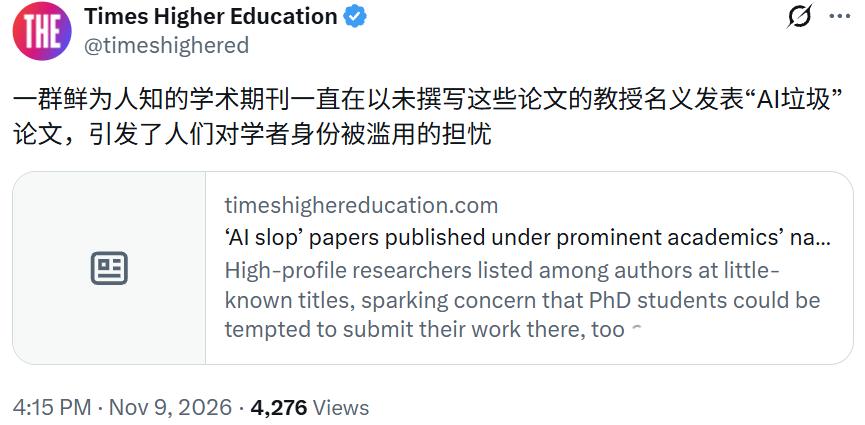
Following this paper, THE uncovered a much larger operation: a group of obscure journals are mass-publishing AI-generated junk papers under the names of top university professors from Stanford, UC Berkeley and other elite institutions. The people whose names were misattributed include many renowned researchers in the AI field, such as Geoffrey Hinton, Yann LeCun, Yoshua Bengio, Li Fei-Fei, Christopher Manning, Michael I. Jordan, Andrew Ng and Stuart Russell.
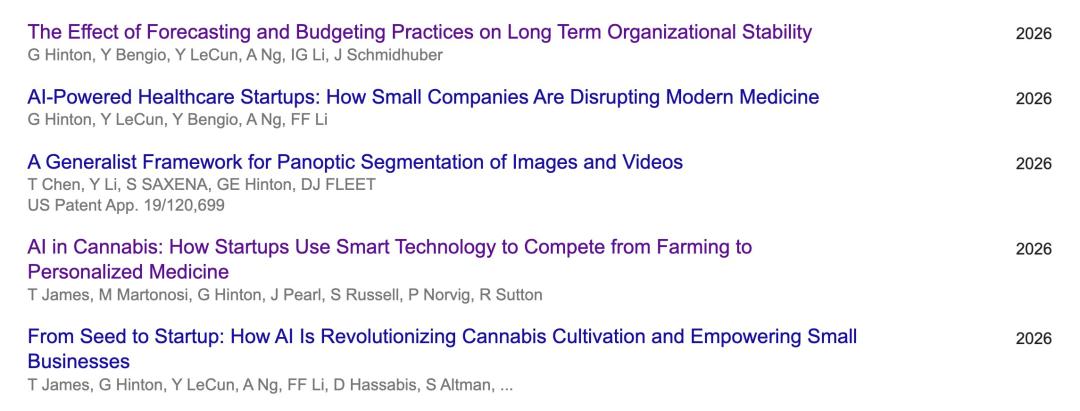
There are even AI-generated junk papers that pile the names of multiple well-known researchers together
Authors removed, papers remain, re-posted under new names
Said's first reaction was to file a complaint. He contacted the domain registrar of the journal, and the other party replied that the article had been deleted.
But the paper did not disappear, the author was only changed from Said to another person. According to the screenshots Said provided to THE, the author was changed again two days later. The exact same paper was posted under three different people's names one after another in this way.
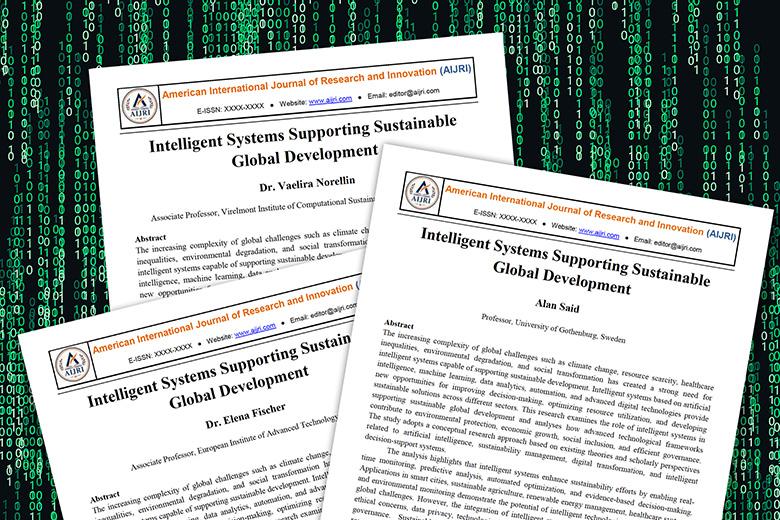
This detail speaks volumes: for this type of journal, the content of the paper does not matter at all, what matters are the names listed on it. The names can be replaced at any time, just like swapping a model photo on a product page.
Said later found two "sibling journals": the American Journal of Advanced Multidisciplinary Research and Innovation (AJAMRI) and the American Journal For Multidisciplinary Research (AJFMR). The three journals share a similar visual style, and have the same editor-in-chief and editorial board members.
Among them, AJAMRI has published dozens of papers signed by well-known scholars, whose list can be called an "all-star lineup" in the AI circle: Li Fei-Fei and Christopher Manning from Stanford, Michael I. Jordan and Stuart Russell from UC Berkeley.
Jure Leskovec, a professor of computer science at Stanford University, is also on the list. He made it clear to THE: "I can confirm that I did not write this paper, did not participate in its submission, and did not authorize the use of my name. I did not even know it existed before receiving your email. This is quite worrying."
Domains registered in 2026, with "back issues" from several years ago
If you take a closer look at these three journals, the flaws are not hard to find.
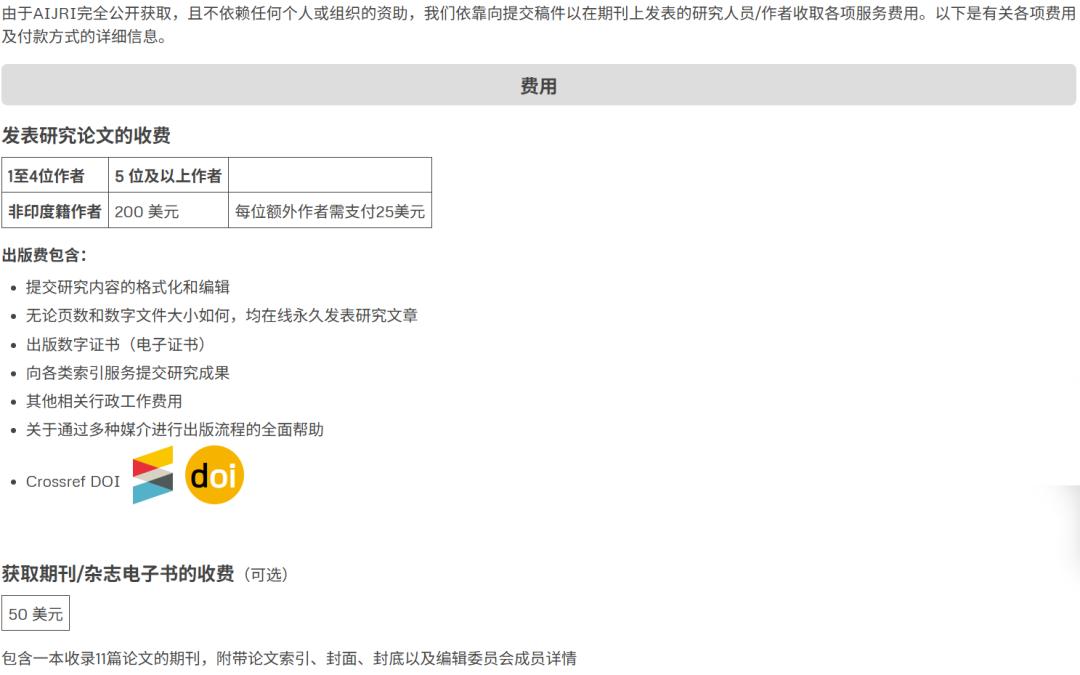
The domains of the three websites were all registered in 2026, but the websites host archives of papers published "several years ago". They all claim to be "peer-reviewed, open-access, multidisciplinary" journals, and charge explicit publication fees.
The charging rules are also worth noting. AIJRI and AJAMRI charge $200 for papers with "five or more non-Indian authors"; AJFMR charges $80 for papers with 1 to 4 authors, and only $10 for papers with 5 or more authors.
The editor-in-chief of all three journals is listed under the same name: Denish Brown. The contact information is a WhatsApp number with a US area code. The editorial board lists dozens of members, most of whom are from Indian universities.
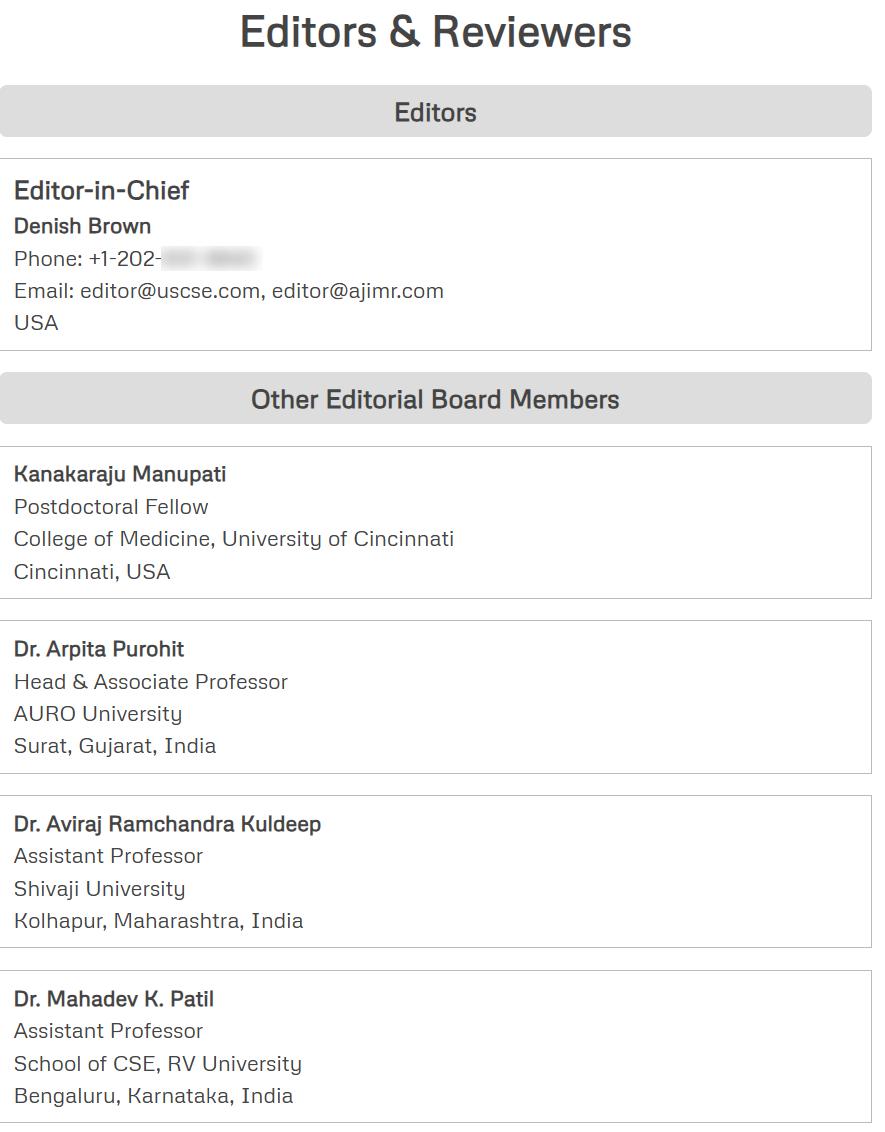
But this editorial board list also does not hold up to scrutiny. Kanakaraju Manupati, a postdoctoral fellow at Virginia Commonwealth University, is on the list. He told THE: "I had no idea this journal existed, and I have no affiliation with it. I just checked the journal website and was surprised to see my name on the editorial board."
In other words, from authors to editorial board members, the "academic endorsements" of these journals are very likely to be stolen as a complete set. THE contacted the three journals and received no response as of press time.
Manning: "This is a far worse scam"
After the report was released, the named Christopher Manning responded on X, saying that he had previously seen two fake papers "signed" under his name, published in the so-called International Journal of Computer Vision and AI Applications and International Journal of Clinical and Medical Sciences respectively.
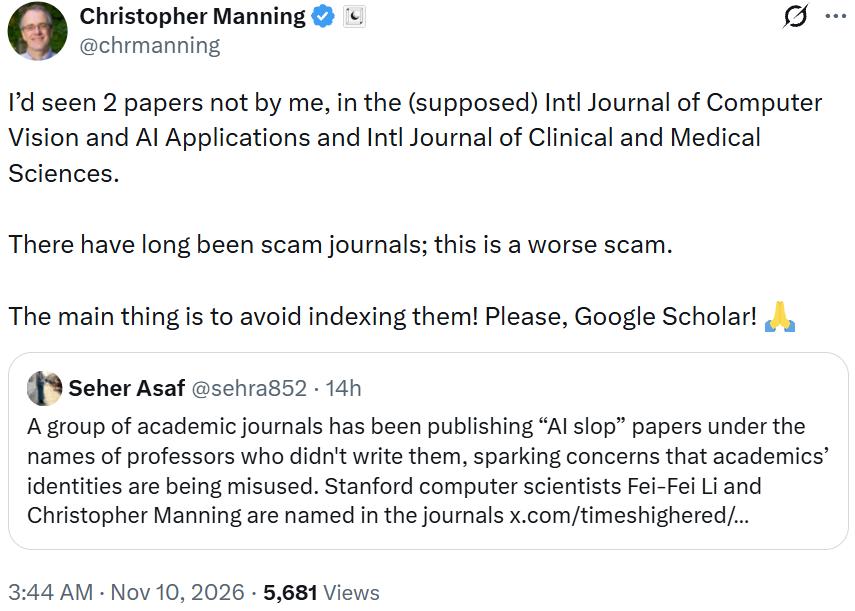
The former obviously rides on the popularity of the top computer vision journal IJCV (International Journal of Computer Vision); the latter is even more absurd, with an NLP scholar "publishing" in a clinical medicine journal. It is worth noting that these two journals are not among the three investigated by THE, which means that similar operations are likely to involve far more than one criminal group.
"Predatory journals have always existed; this is a far worse scam," Manning wrote. "The most important thing is to keep them from being indexed! Please, Google Scholar!"
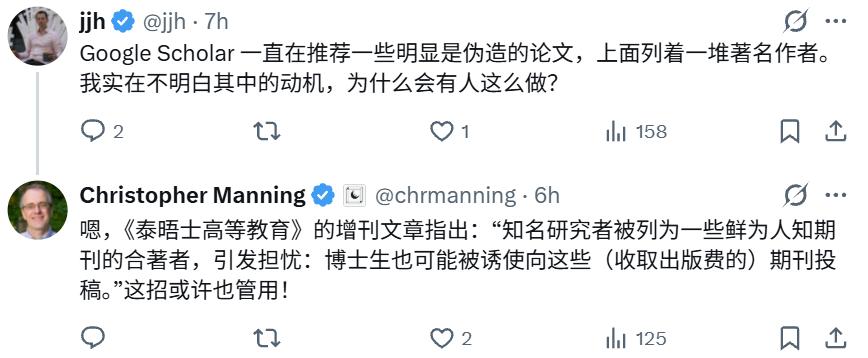
Some users in the comment section complained that Google Scholar has been constantly recommending obviously fake papers to them, with a bunch of big names listed in the author column, "I really can't figure out what the motivation is, why would someone do this?"
Manning's response pointed out the key: THE's report believes that these journals list well-known scholars as authors to attract doctoral students to submit papers, and these journals are pay-to-publish. He finally added: "It might actually work!"
The business of misattribution: using big names as billboards
This is exactly what Said is most worried about: "If a first-year doctoral student sees my name on this journal, he might think it's okay to submit here, and I really don't want that to happen."
Traditional predatory journals rely on "fast publication, all submissions accepted" to attract authors who are eager to pad their publication counts. But they generally have a shortcoming: they do not look like legitimate journals. Generative AI just fills this gap. It can mass-produce papers with standard formats, complete citations and seemingly substantial content in a few minutes. By adding the names of top scholars, a predatory journal can package decent back issues and a luxurious author lineup in just a few weeks.
This trick is not appearing for the first time. Diomidis Spinellis, a professor of software engineering at the Athens University of Economics and Business, encountered exactly the same thing in December 2023: a paper titled Global Business Strategies in the Digital Age was published under his name and affiliation in the Global International Journal of Innovative Research (GIJIR), with a valid DOI attached.
Spinellis did not stop at clarifying the situation. He crawled the entire GIJIR website for analysis, and published a case study in Research Integrity and Peer Review in 2025. Among the 53 articles with the lowest citation counts, at least 48 appeared to be AI-generated, and the Turnitin detection gave an AI probability as high as 100% for multiple papers. His conclusion is: this type of journal uses misattributed AI-generated papers on the one hand to boost its own status, and on the other hand to attract authors who want to pad their publication counts.
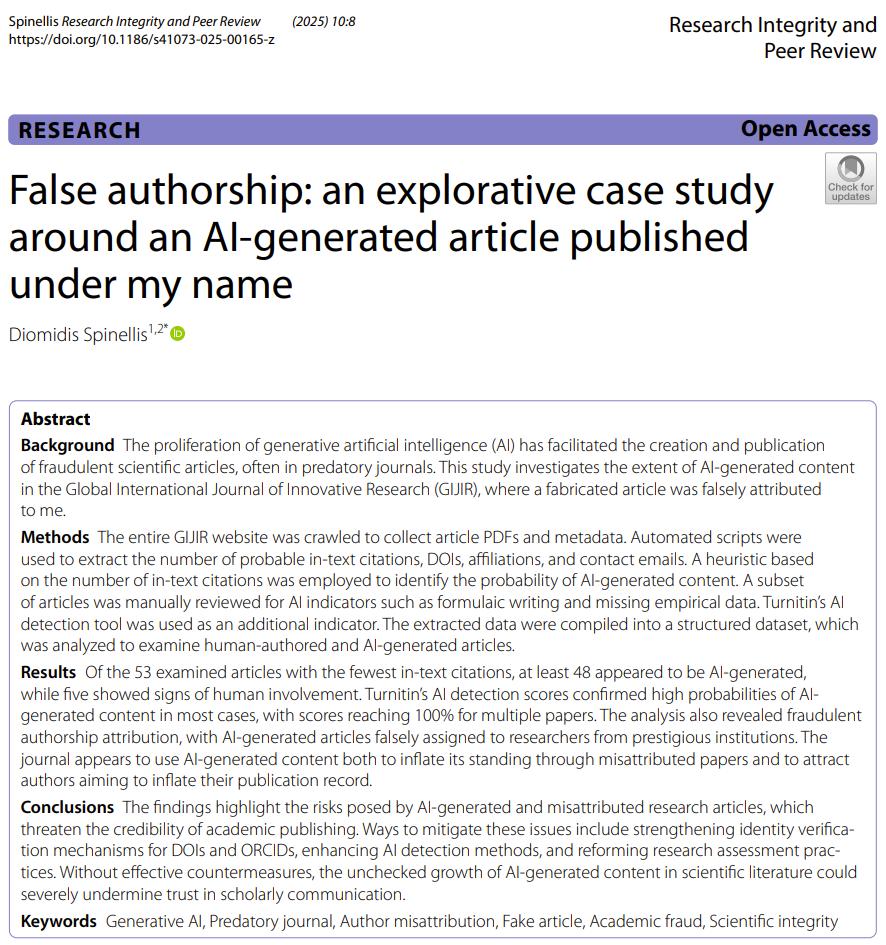
https://doi.org/10.1186/s41073-025-00165-z
According to a report from JMIR last June, Spinellis classified GIJIR's papers into three categories: the majority are "false attribution papers" generated by the journal itself using AI and misappropriating scholars' names; the second category is "purchased authorship papers" whose authors bought the publication slots; genuine research is in the minority.
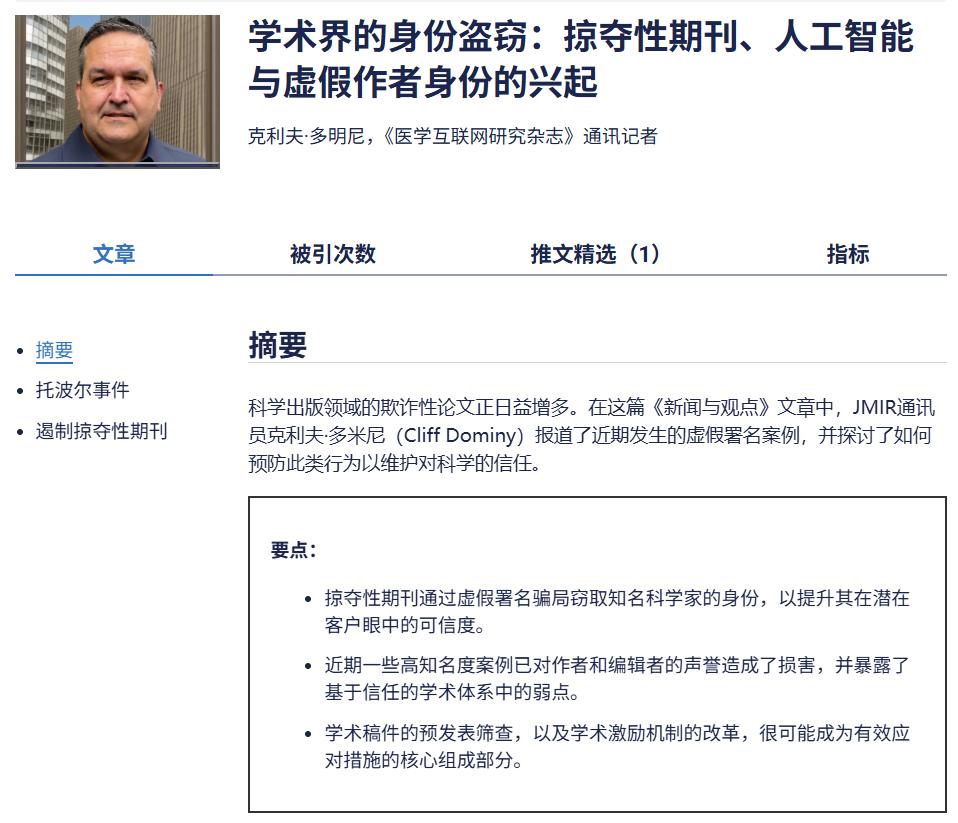
https://www.jmir.org/2026/1/e104934
Similar incidents have become significantly more frequent in 2026. Last April, renowned cardiologist Eric Topol discovered that his name was misappropriated by a digital health journal; in May, NBC News reported a fake journal network that had published hundreds of AI-generated papers, some of which also misappropriated the names of top university professors.
The real loophole lies downstream
If these papers only lie on an unnoticed website, the harm may be limited. But Manning's appeal points to the real crux of the problem: indexing.
The very reason Said found this paper is that Google Scholar added it to his personal homepage and actively pushed it to him. Once indexed by academic search engines, these papers will appear on scholars' personal homepages, enter search results, and even be cited by other papers. Spinellis's misattributed paper received 3 citations within a few months after publication.
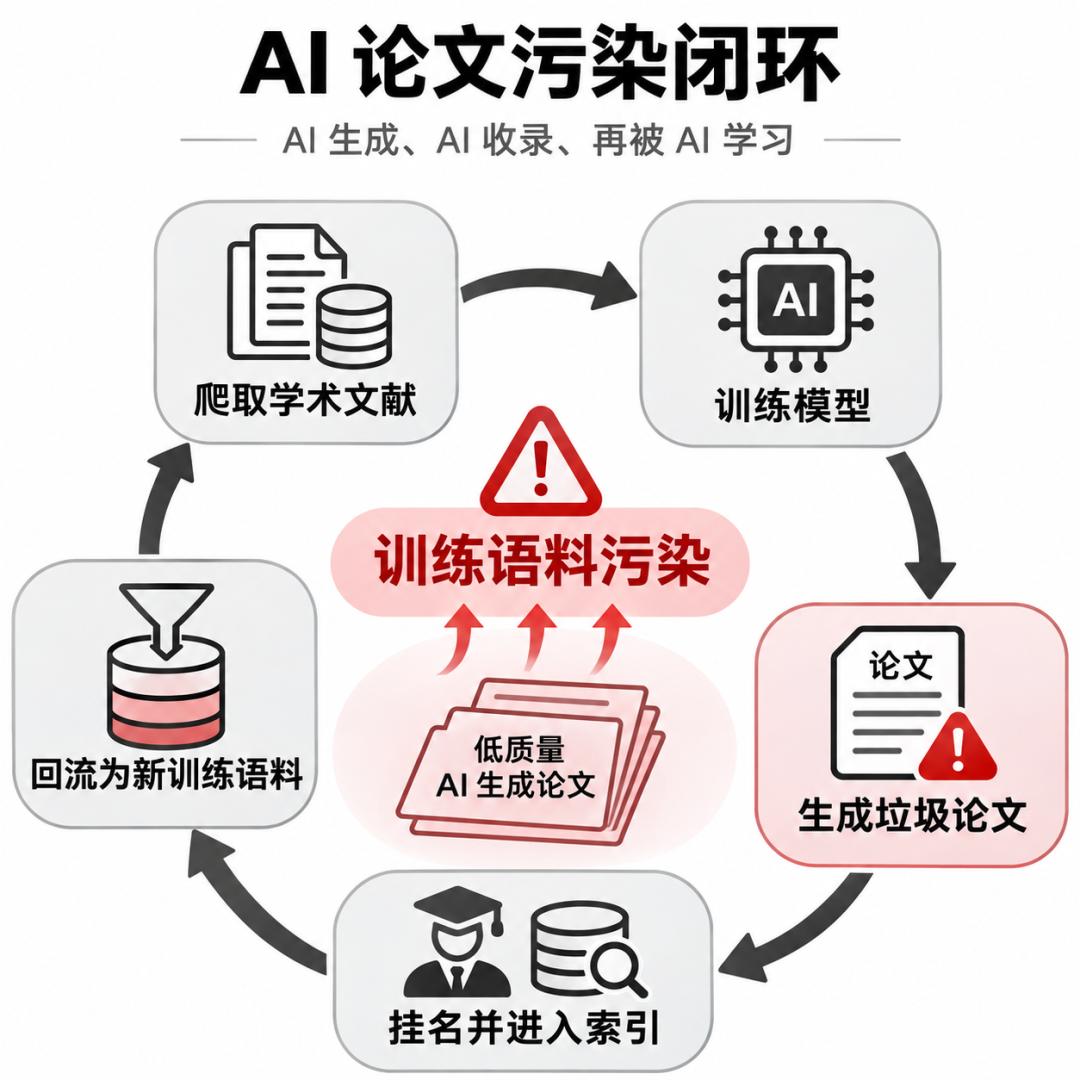
For the AI industry, there is another more hidden risk: a large amount of model training data comes from crawled academic literature. When AI-generated junk papers are attached with real scholars' names and enter the index, they may flow back into the training corpus of the next generation of models, forming a pollution closed loop of "AI generation, AI indexing, and AI re-learning".
Technically, this is not an unsolvable problem. The directions Spinellis proposed in his research include strengthening the identity verification mechanism of DOI and ORCID, improving AI content detection, and reforming the research evaluation system that focuses on publication quantity. The JMIR report also mentions that researchers can use checklists like Think.Check.Submit to verify the ISSN, DOI and independent indexing status of the journal before submission.
But all these measures cannot avoid a reality: the cost of generating a fake paper has approached zero, while the cost of clarifying a fake paper falls entirely on the victimized scholars. After Said filed a complaint, the paper was re-posted under a different author; Leskovec did not know he had "published" a paper until a reporter emailed him; Manupati had no idea that his name was listed on the editorial board.
So here comes the question: when names like Li Fei-Fei and Manning can be borrowed at will, to what extent can academic authorship itself still serve as a trust credential? In an era when AI makes "writing papers" extremely cheap, what the academic community needs to guard may no longer only be the authenticity of content, but also the authenticity of names.
Reference Links
https://www.timeshighereducation.com/news/ai-slop-papers-published-under-prominent-academics-names
https://www.nbcnews.com/tech/internet/fake-journals-using-real-professors-names-ai-generated-papers-rcna265479
This article is from the WeChat official account JIQIZHIXIN (ID: almosthuman2014), written by a contributor focusing on AI abuse, and authorized for release by 36Kr.