10 years is too slow. Gu Quanquan and his team challenge Dario: Compress the timeline for curing cancer to 4 years
Recently, Dario Amodei, CEO of Anthropic, made a statement:
AI will condense 50 to 100 years of human biological progress into 10 years — cancers, Alzheimer's disease, heart disease, all are expected to be conquered.
This is an extremely bold claim, but most people think it is nothing more than empty talk.
Until a scientist named Gu Quanquan stepped forward and said: 10 years is too slow, we will compress the drug R&D cycle to 4 years!
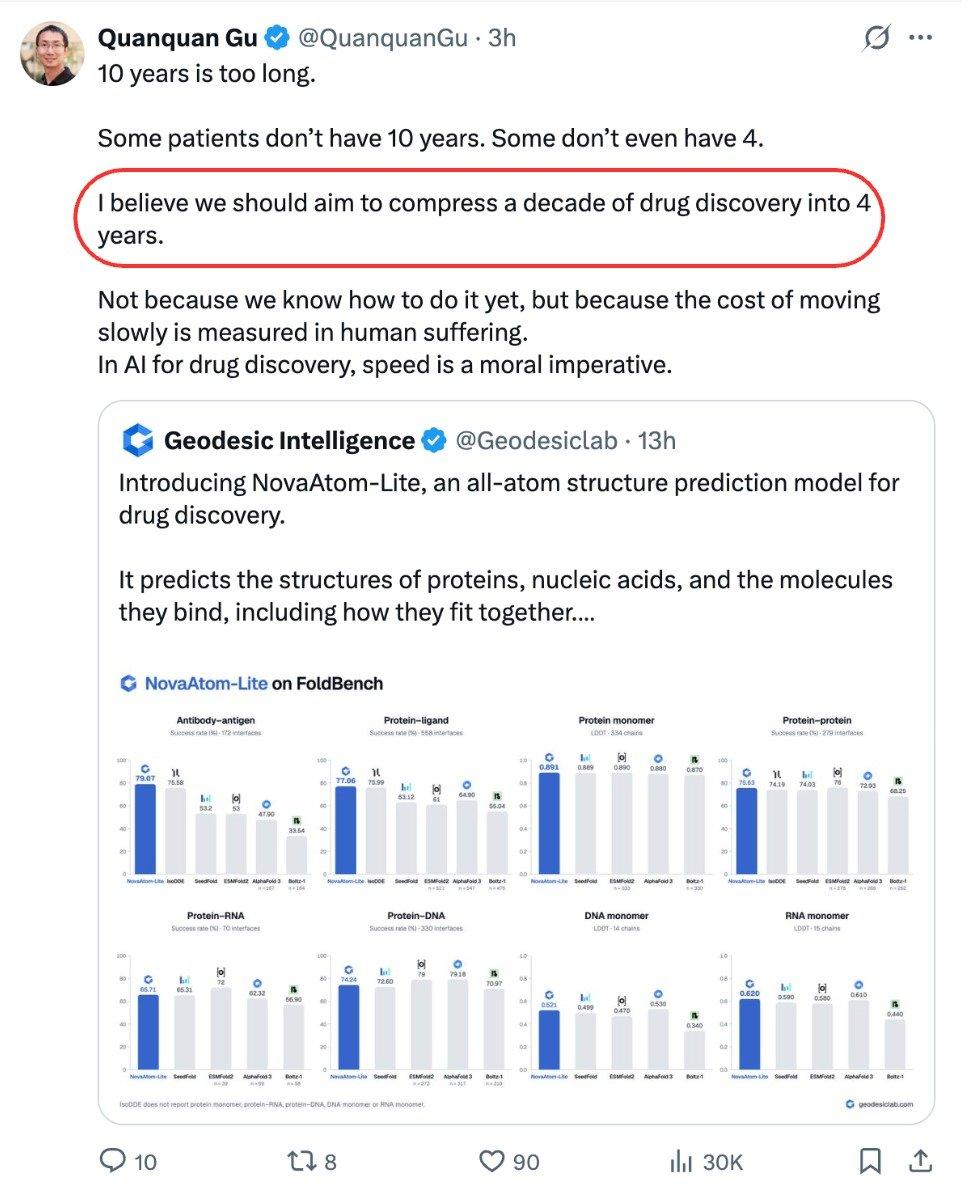
On November 10, Geodesic Intelligence, the company he founded only 5 months ago, released its full-atom structure prediction model NovaAtom-Lite.
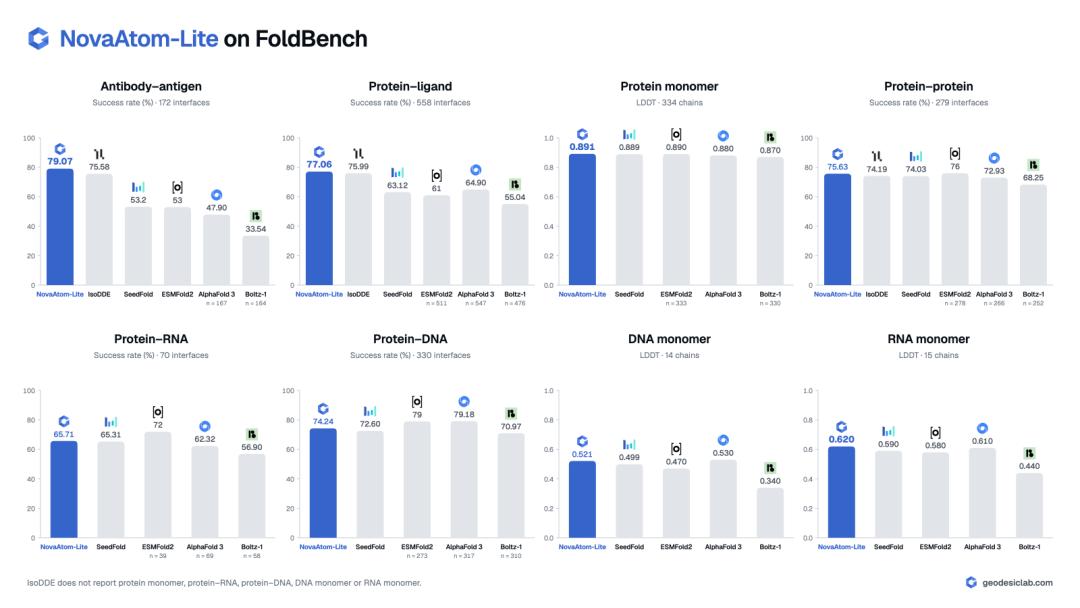
On FoldBench, the world's most stringent biomolecule prediction benchmark, NovaAtom-Lite directly dethroned IsoDDE, the flagship model of Google DeepMind's Isomorphic Labs.
It topped the leaderboards across a series of biopharmaceutical benchmark tests, taking multiple No. 1 spots!
Model card link: https://www.geodesiclab.com/news/introducing-novaatom-lite
A 15-person startup, a few hundred GPUs, 5 months. Its rival is Isomorphic Labs, which has raised a total of 2.7 billion U.S. dollars in financing and is negotiating a new round of financing at a valuation of 40 to 50 billion U.S. dollars.
The community on X exploded instantly.
Some people exclaimed: "Dario Amodei predicted that cancer will be conquered within 10 years, but the founder of NovaAtom says it only takes 4 years."
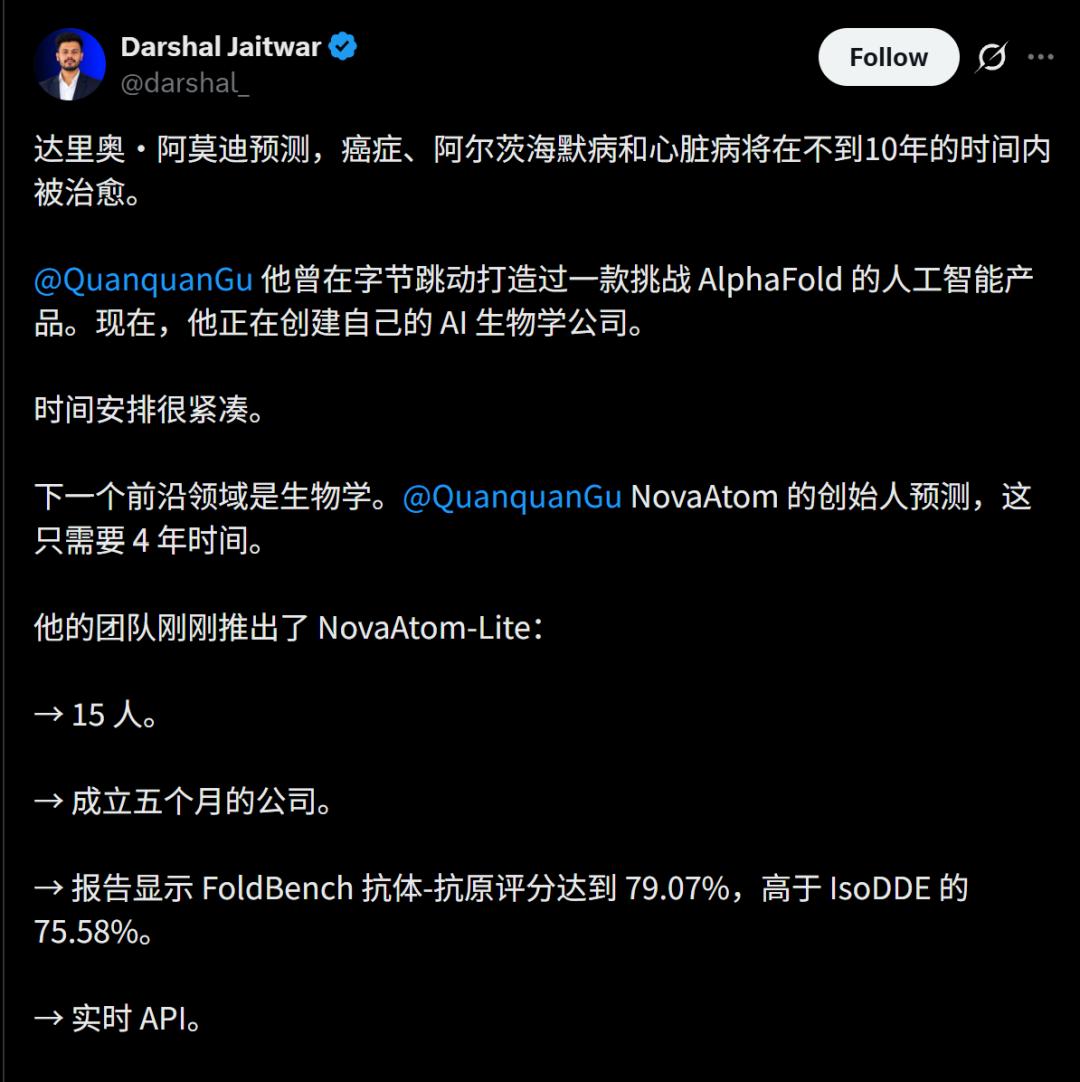
Some people did the math: "Google DeepMind spun out Isomorphic, which has burned billions of dollars and is valued at more than 40 billion U.S. dollars. But a UCLA professor leading a 15-person startup surpassed it in just 5 months."
Moreover, this is not the first time Gu Quanquan has achieved such a feat. Previously, he led the team at ByteDance to develop SeedFold — the world's first model that outperformed AlphaFold 3 on FoldBench.
The sudden emergence of SeedFold forced Isomorphic Labs to launch IsoDDE to retake the throne of structure prediction. This time, NovaAtom-Lite once again dethroned IsoDDE, and the throne changed hands again.
Even more impressively, according to information shared by Gu Quanquan on X, NovaAtom-Lite is just the appetizer, and a larger, more powerful NovaAtom-Pro is waiting in the wings.
That means even if Isomorphic Labs releases a stronger model soon to try to fight back, it may face another overwhelming breakthrough from NovaAtom-Pro.
In this battle for the throne of structure prediction, Gu Quanquan has won two consecutive rounds, and he still holds the trump card for the third round.
From now on, the timeline for humanity to conquer incurable diseases has been moved forward again!
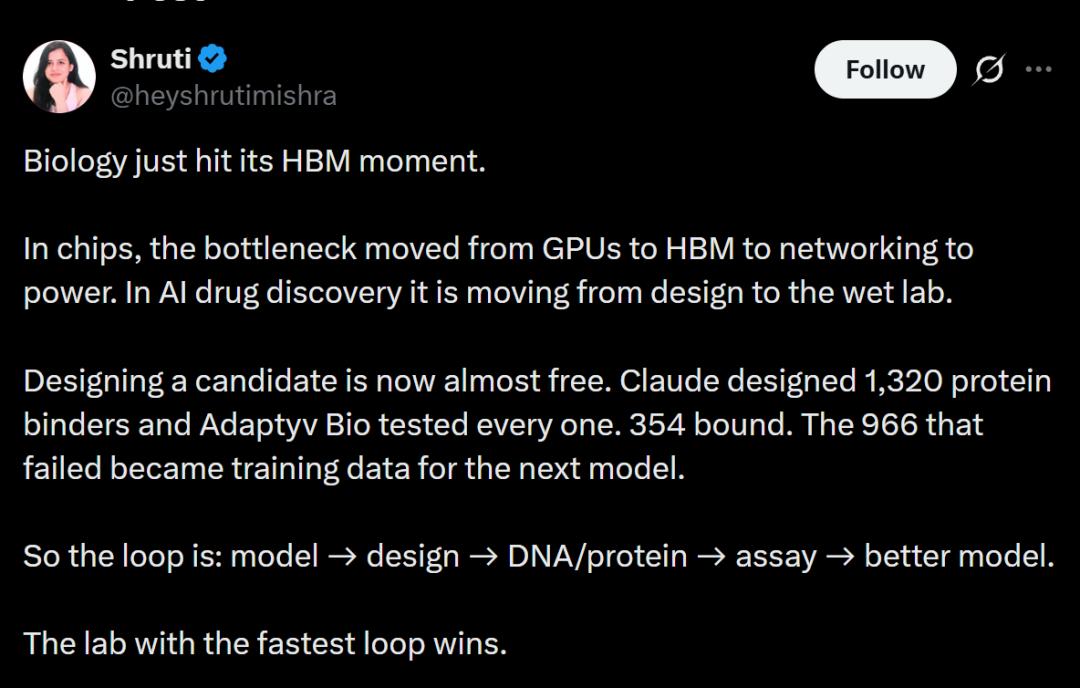
The biology industry has ushered in its "HBM explosion moment", investors remarked
What exactly does NovaAtom-Lite do?
Why is drug development so difficult?
Because the essence of a drug taking effect is to make one molecule precisely "bite" another molecule.
Antibodies need to bite antigens, and small-molecule drugs need to fit into the pocket of a protein.
This "biting" happens at the atomic scale — the angstrom (Å) level, where 1 angstrom equals one ten-billionth of a meter.
If there is even a tiny deviation, the drug will stop working.
Traditional methods rely on wet lab experiments to test one by one. On average, a new drug takes 13 years from lab to market, costs nearly 2 billion U.S. dollars, and has a success rate of less than 5%. The value of AI lies in: simulating this "biting" process first in the computer, greatly shortening the trial and error cycle.
This is exactly what NovaAtom-Lite does —
Input the sequences of proteins, DNA, RNA and the information of small-molecule ligands, and it can predict the 3D spatial coordinates of every heavy atom (atoms other than hydrogen) in the entire complex.
It is not a vague outline, but positions accurate to the atomic level.
Moreover, it is not a "rigid" calculator.
NovaAtom-Lite is equipped with a set of highly engineering-valuable "conditional constraint and prompting" features.
You can tell it: there is a covalent bond here, and there is a known binding pocket there. The model will treat this information as reference clues rather than rigid constraints, and make predictions flexibly like an "AI brain" that understands the laws of chemistry and physics.
What it outputs is not just a set of coordinates.
The model also returns the local structure confidence pLDDT, the expected inter-residue error PAE, and the interface reliability indicator ipTM — in short, it not only gives you the answer, but also tells you "how confident I am about this answer".
Two heavy punches: 79.07% and 77.06%
To evaluate how powerful a structure prediction model is, the pharmaceutical industry has two most critical touchstones: antibody-antigen binding prediction and protein-ligand binding prediction.
The former is the core of macromolecular drugs (such as anti-cancer antibodies) — you need to know how antibodies precisely "lock" the target; the latter is the key to small-molecule targeted drugs — the drug molecule must fit accurately into the protein's binding pocket.
The two directions are getting more and more difficult.
FoldBench is currently recognized as the strictest full-atom biomolecule prediction benchmark, containing 1522 complex structures. All data comes from new structures after the model training cutoff date, eliminating the possibility of "peeking at the answers in advance".
First punch: Antibody-Antigen. FoldBench includes 172 antibody-antigen binding interfaces.
The evaluation standard uses the DockQ score (it can be understood as how similar the predicted binding pose is to the real structure. A score above 0.23 counts as a successful prediction, and higher scores are better).
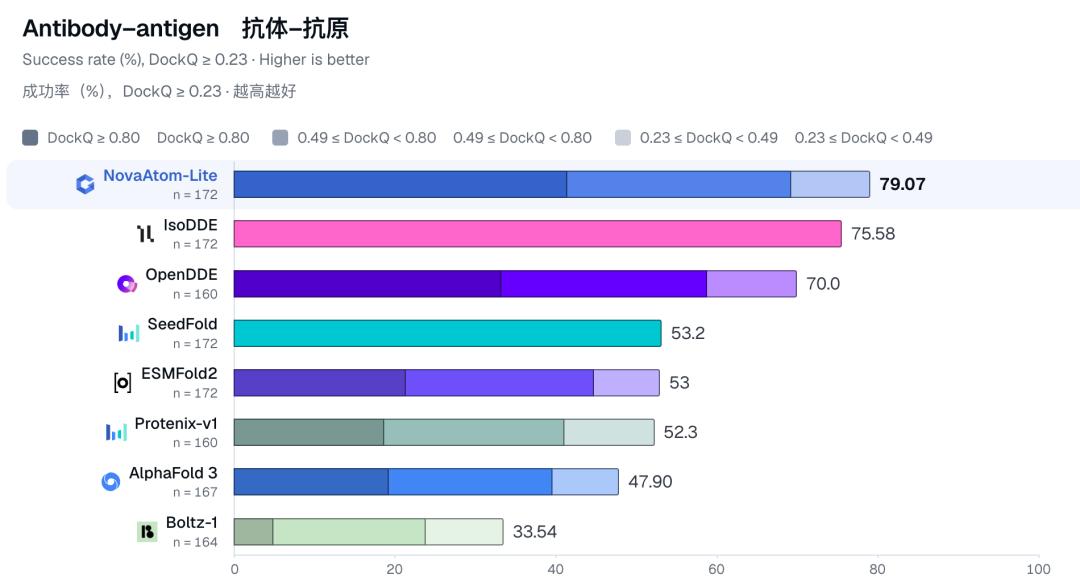
A 5-month-old startup outperforms AlphaFold 3 by 31 percentage points, and outperforms Isomorphic Labs, which has raised 2.7 billion U.S. dollars, by 3.5 percentage points.
Even more surprisingly, when the standard is raised to DockQ ≥ 0.80 (requiring extremely high-precision predictions), the success rate of NovaAtom-Lite is 2.2 times that of AlphaFold 3.
Second punch: Protein-Ligand. This test covers 558 binding interfaces, with stricter criteria: not only the deviation between the predicted position of the small molecule drug and the real position must be less than 2 angstroms (ligand RMSD < 2 Å), but also the contact details of the surrounding proteins must be highly consistent (LDDT-PLI > 0.8). Success is only achieved when both conditions are met at the same time.
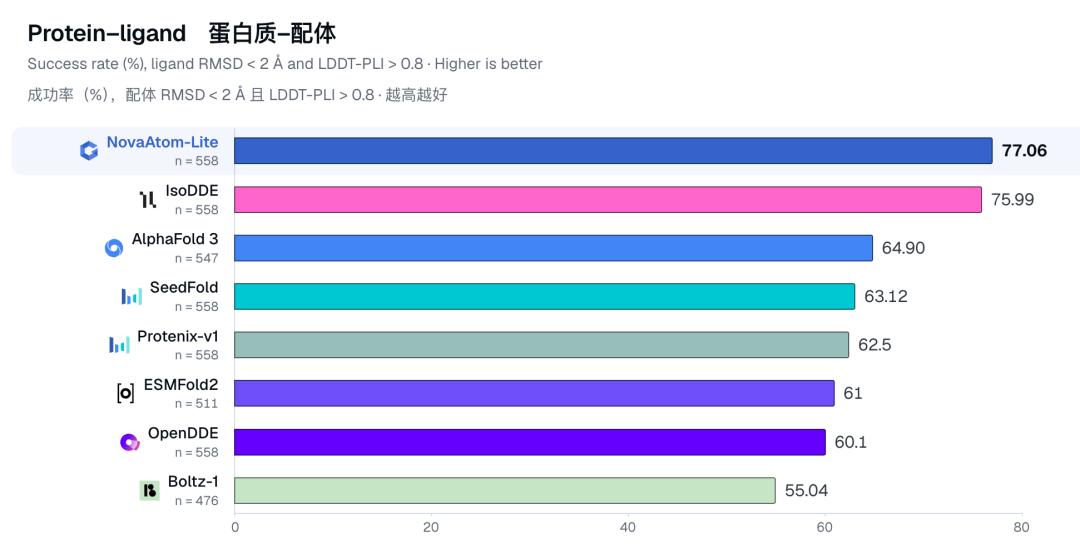
It ranks No.1 in both core metrics.
Does it really "understand" physics, or just memorize the answers?
Every time a model tops the benchmark leaderboard, the first reaction in the industry is: Did you peek at the answers?
This question is completely reasonable. The training data for structure prediction models is the known protein structure library. If the model only memorizes what it has seen, no matter how high its benchmark score is, it will be useless: on the front line of real drug R&D, all the molecules faced are new ones that have never been seen before.
There is a rigorous test in the industry specially designed to target "rote memorization" called Runs N' Poses. It divides the test samples into 8 groups according to their similarity to the training set, from "very similar" to "completely unfamiliar", to fully reveal the true performance of the model.
In the 0-20% lowest similarity group (63 ligands that have "no connection" with the training set, equivalent to completely out-of-syllabus questions in an exam), the performance of each model is as follows:
The success rate of AlphaFold 3 drops directly to 24%, while NovaAtom-Lite remains stable at 47.6%, almost twice that of the former.
In the 80-100% highest similarity group, the gap between the two narrows to 91.0% vs 88.2%.
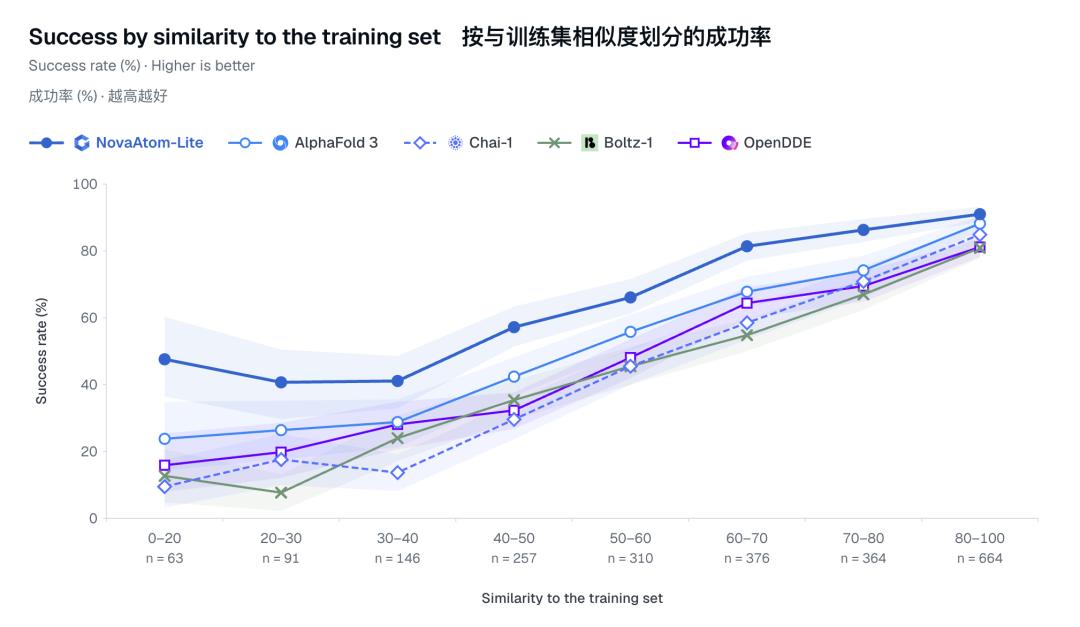
This shows that the more unfamiliar the molecule is, the greater the leading advantage of NovaAtom-Lite.
It is not memorizing textbooks, but has truly mastered the underlying physical laws of the microscopic atomic world, and has a set of transferable "reasoning engine".
Give it more time to think, and it will be smarter
People working in AI know a trend called Test-time Scaling — giving the model more computing power during the inference phase will lead to higher answer quality.
This has long been verified in the large language model field, and NovaAtom-Lite proves that this rule also applies to biomolecule prediction.
On the same set of 172 antibody-antigen interfaces, the team conducted a set of elegant experiments:
1 random seed (minimum computing power): 74.3% success rate
5 random seeds: 79.07%
25 random seeds: 81.7%
100 random seeds (in-depth reasoning): 83.1%
Oracle upper limit (select the optimal solution using experimental answers afterwards): 88.4%
From 74.3% to 83.1%, simply by increasing the number of samples, the success rate increased by nearly 9 percentage points.
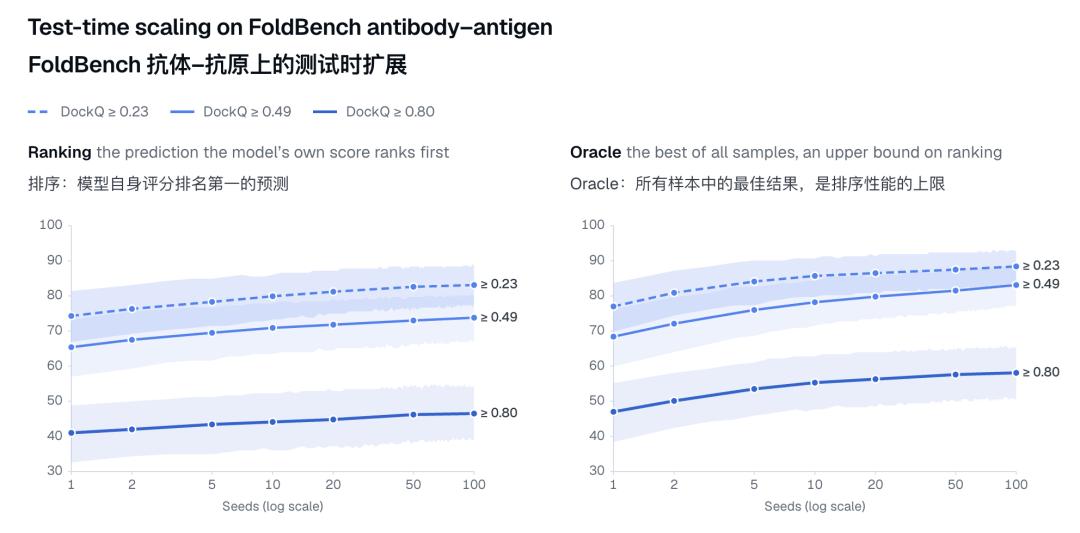
This means that this system has extremely strong "elasticity".
Startups with limited budgets can use a small amount of computing power for rapid trial and error, and still get good results. For large pharmaceutical giants, when a targeted drug is related to a tens of billions market and the lives of countless patients, you can go all out with computing power to squeeze every bit of precision — the upper limit of the model is far from being reached.
This is an extremely exciting scalability.
Give it a little hint, and it can take off
It is not enough to just calculate hard on its own.
In real drug R&D scenarios, scientists often already have some clues. For example, they roughly know where the antibody and antigen make contact, or roughly which pocket of the protein the small molecule fits into.
The question is: Can the model "understand" these hints and make good use of them?
NovaAtom-Lite's answer: Not only can it understand, but the effect is amazing.
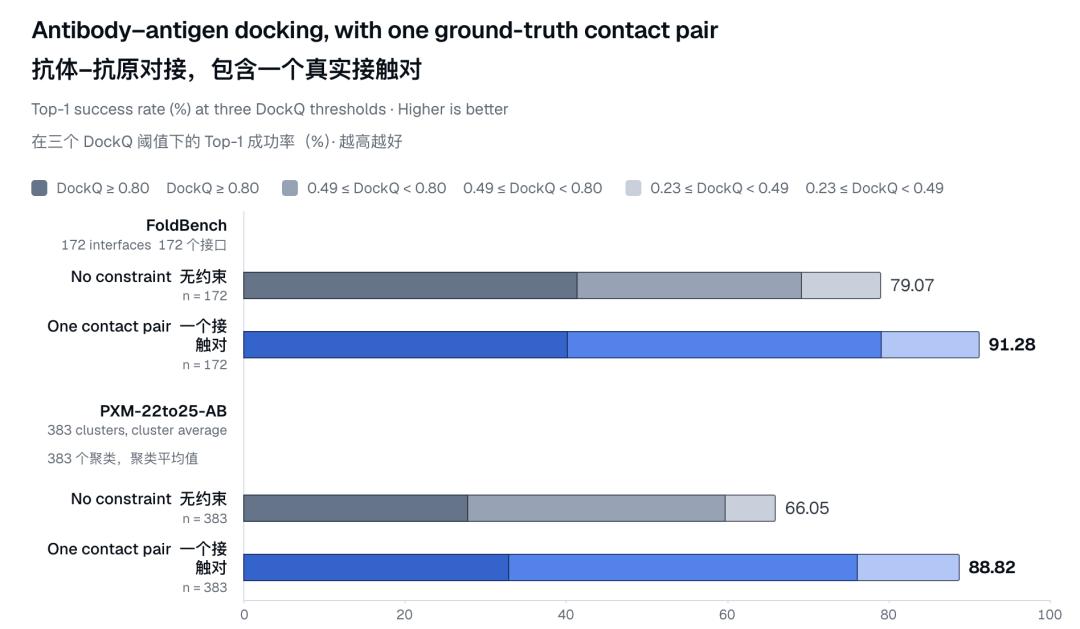
On the 172 antibody-antigen interfaces in FoldBench, the success rate is 79.07% when no hints are given. As long as you give the model one contact residue pair (equivalent to telling it that these two residues are very close), the success rate directly surges to 91.28%, an increase of 12 percentage points.
On another larger antibody-antigen test set PXM-22to25-AB (383 clusters), this improvement is even more dramatic: it jumps directly from 66.05% to 88.82%, an increase of nearly 23 percentage points.
What is more interesting is the protein-ligand direction.
On Runs N' Poses, the team tested four settings: no constraint, one contact pair, four pocket residues, and complete pocket, progressing step by step.