The most prestigious career for liberal arts majors dissuades young Chinese people from pursuing it.
Lawyers in TV dramas are always dressed in sharp suits, talking about M&A deals worth hundreds of millions the second they open their mouths; lawyers in short videos sit in front of the camera, and a single consultation video can get hundreds of thousands of likes.
It seems that a career in law is a stable, high-paying and respectable path. But to become a top lawyer, you not only have to burn the midnight oil memorizing legal provisions back in law school, fight your way through the crowded national bar exam, but also go through an internship even when you are half a foot in the legal industry.
Beyond the more than 800,000 licensed lawyers across the country, there exists a huge group of "prospective lawyers" — trainee lawyers. This group, more often than not, is the most easily overlooked existence under the glamorous facade of the legal profession.
How hard is it to become a lawyer? Bar exam candidates are already worn out
"The notorious law-breaker Zhang San released a dog to bite me. Instead of biting the dog back, I bit Zhang San. Does this count as legitimate defense?"
These absurd cases shared by famous bar exam tutors go viral from time to time, becoming casual after-dinner talks for ordinary people, but for candidates preparing for the bar exam, they are more like dark humor jokes — because such absurd, funny and weird cases are very likely to actually appear in the exam.
Unless they are determined to switch careers, most law students will take the National Unified Legal Professional Qualification Examination, commonly known as the "bar exam", at least once in their life. This exam, which Zhang Yaqi took five times but still failed to pass, is famously known as "the most difficult exam under heaven" with hell-level difficulty.
Previously, this exam was called the National Judicial Examination, referred to as the "judicial exam". It was an open exam for all with no professional background threshold: whether you are Zhang Hua admitted to Peking University or Li Ping who enrolled in a junior college, you could sign up for it.
In 2018, the judicial exam was restructured into the current bar exam. Basically, only people who hold a law-related degree or have been engaged in legal work for more than three years are eligible to take it, which theoretically should have made the exam more professional and more difficult.
However, in the first few years after the reform, possibly because the overall quality of candidates improved, or as rumored by the public, the Ministry of Justice was eager to see the number of legal talents grow, the passing rate was loosened and actually rose.
But even at its highest, the passing rate was only around 20%.
Yet in the past five years, the growth rate of the required number of lawyers specified in the Ministry of Justice's new plan is lower than that of the previous five-year period [1][2][3][4]. The bar exam's passing rate control has been tightened, and the passing percentage has plummeted to repeated record lows.
The bar exam passing rate was still 24% in 2021, but dropped to only 14% by 2025, and is now approaching the single-digit threshold.

Despite the difficulty of the bar exam, it is almost impossible to avoid taking the exam if you want to pursue a career in law, and the preparation process for the bar exam is usually long and grueling.
For candidates, the difficulty of the bar exam comes not only from the overwhelming number of competitors, but also from the endless stream of knowledge points. Some people joke that if a bar exam candidate gets stabbed, they can block the knife with the Civil Code, and the attacker will not even pierce the contract compilation section.
Faced with such a huge number of test points, many candidates who prepare carefully study for more than ten hours a day, saying goodbye to all kinds of entertainment. Full-time preparation takes as little as three months, but if you have to prepare for the exam while working, the suffering period will inevitably be extended.
And even if you have gone through all the textbooks and courses, you may still feel dizzy when you see the intricate cases in the exam room. As the saying goes, law does not rely solely on memorizing legal provisions, but on "legal thinking".
After finally fighting your way through the crowded single-plank bridge and getting the legal professional qualification certificate, you will find that there are still other thresholds to enter this industry.
Trainee lawyers: working for free or even paying out of pocket to fight for a future
If you want to become a judge or prosecutor, you have to take the corresponding civil service exam after passing the bar exam; if you want to become a lawyer, you have to go through a long and narrow entrance — the trainee lawyer stage.
This is not a simple probation period after onboarding. According to the Measures for the Administration of Lawyers' Practice issued by the Ministry of Justice, "one full year of internship at a law firm" is a necessary condition to apply for a practicing lawyer license, and the assessment of this internship has to be conducted by the local bar association [5].
This screening process is sometimes lengthy and cruel.
Although half of trainee lawyers are in roles related to legal work, they cannot handle cases independently at all, and can only follow the arrangements of their supervising lawyers.
Getting assigned a supervising lawyer is like opening a blind box: if you get a mentor who does not exploit you and is willing to teach you real skills, it is like getting a rare hidden prize. Most supervising lawyers only give you very limited guidance to avoid the situation where "once the apprentice learns all the skills, the master will starve", and worse ones may always assign you all kinds of dirty work.
Some of the dirty work is considered part of the job: mechanically producing bids that are impossible to win, scanning messy materials or case files that are years old, listening to dialect recordings for hours to transcribe them into text, making calls to courts or clients in a submissive tone...
Other dirty work falls entirely under the category of administrative or even personal assistant duties: helping the boss paste invoices for expense reimbursement, helping the boss send and pick up express packages, helping the boss make PPTs...
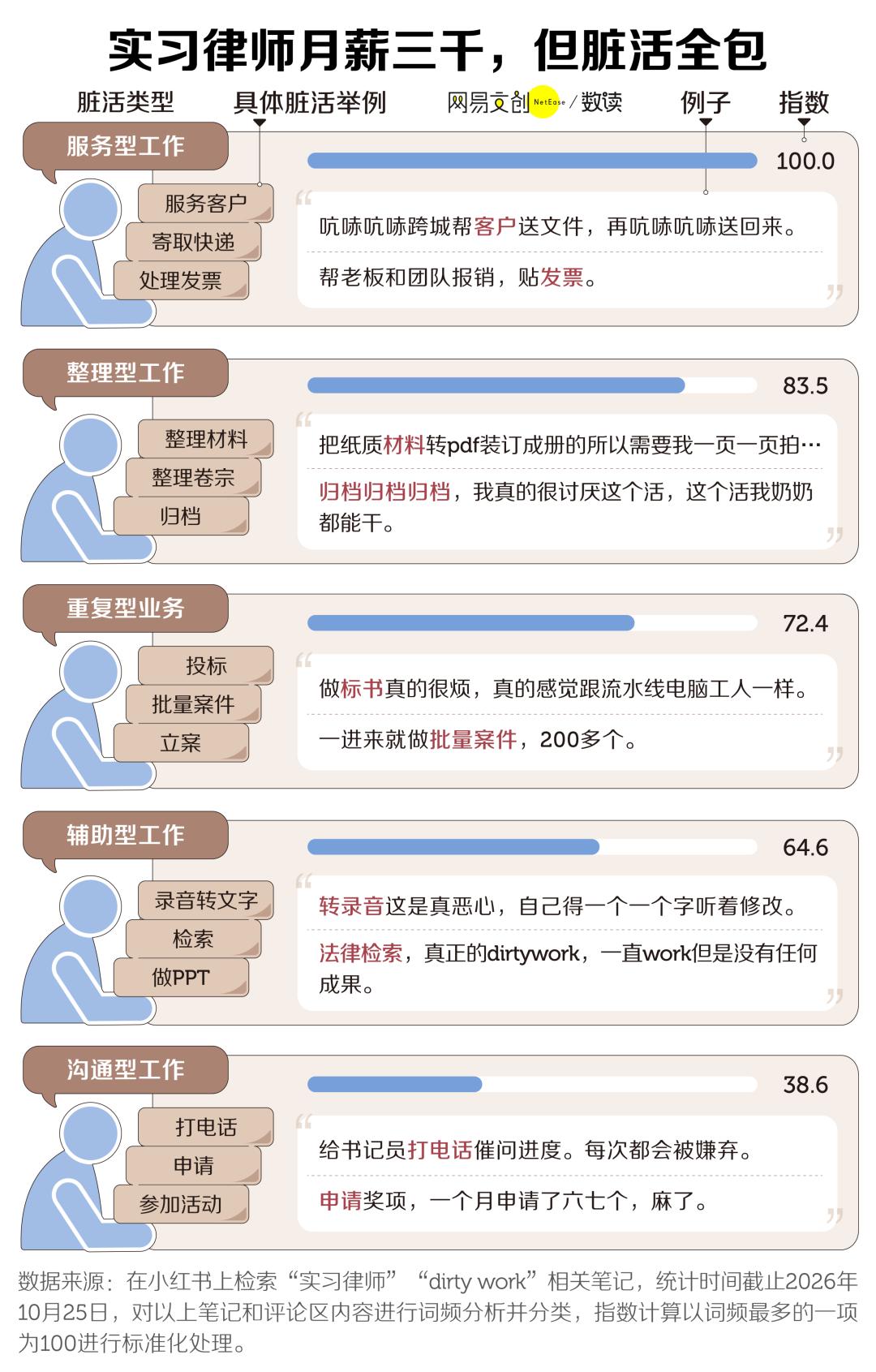
Apart from these common experiences, when we counted discussions about trainee lawyers' dirty work on social media platforms, we also saw some more bizarre experiences: trainee lawyers are expected to take care of everything for their boss's family, from the elderly to the kids, from social interactions to daily life needs:
Taking out trash and mopping tiles at the boss's new apartment that is under renovation, helping the boss prepare her PhD application materials, washing cups covered in soybean milk residue, picking up the boss's kid from school in the rain as a personal driver, taking the boss's parents to get a CT scan in the middle of the night...
During the trainee lawyer period, you cannot appear in court and argue cases as grandly as you imagined, and there is also a huge gap in salary expectations.
Lawyers at top-tier red circle law firms are well-dressed, walk with confidence, chat and laugh with clients, earn millions a year, and can live comfortably for three years with one big case. If you are lucky enough to get an internship at such a firm, your salary will be much higher than your peers.
But only a tiny minority can reach such a high position, and many trainee lawyers at small law firms live a far from satisfactory life. We filtered posts discussing trainee lawyers' salaries on social media platforms, and found that more than half of the sampled respondents earn less than 3000 yuan per month, while less than one fifth earn more than 5000 yuan per month.
What is worse, some people say they have unpaid internships, or even have to pay to work as an intern.
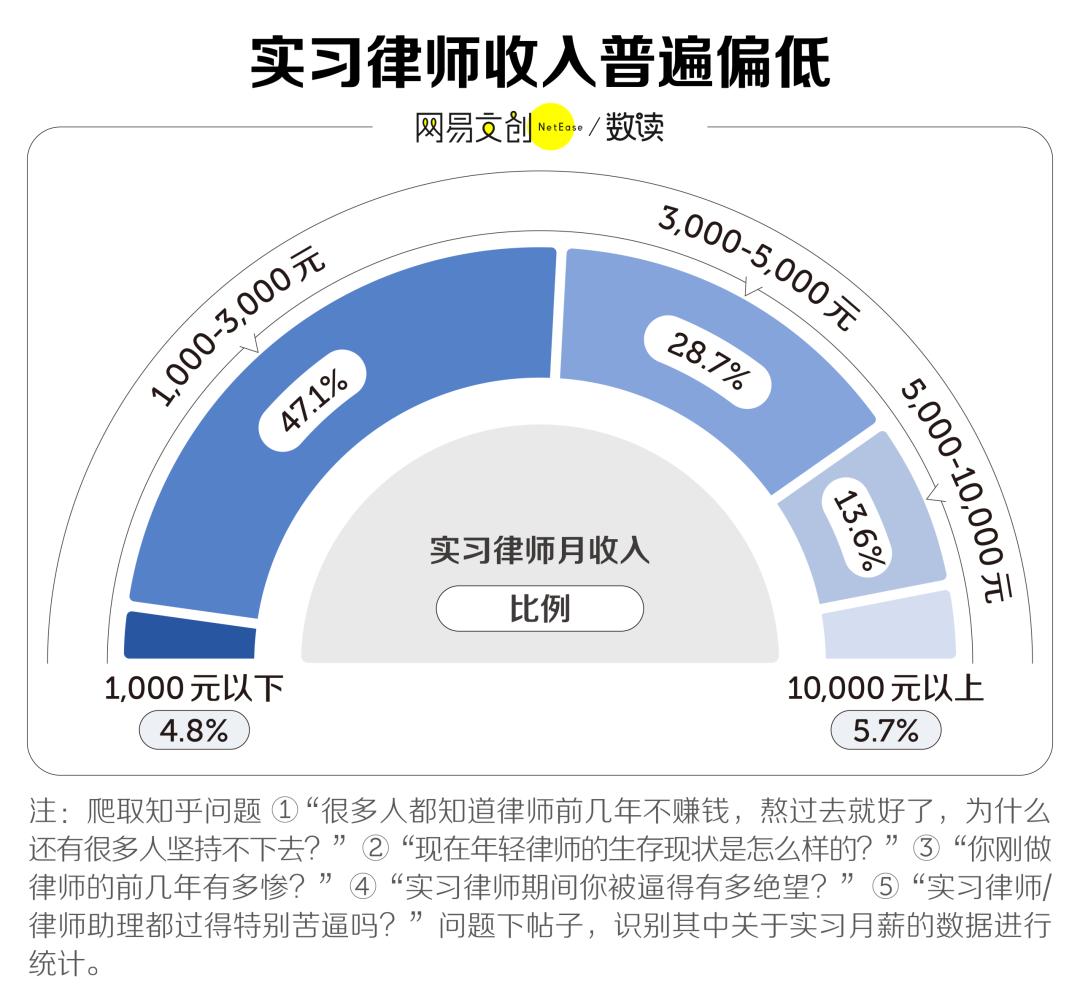
Reports on the development of young lawyers released by local bar associations show roughly the same situation. In Hangzhou in eastern China, while 4.8% of outstanding young talents earn millions a year, 32.32% of young lawyers under 40 years old still earn less than 100,000 yuan a year [6].
In Guizhou in western China, 39.1% of young lawyers earn less than the local average social wage, which means their monthly salary is less than 4000 yuan [7].
"3000 yuan can't hire a driver, but it can hire a trainee lawyer who can drive" — this is not just a joke, but the real pain of countless trainee lawyers.
Passed the internship assessment, there is still a second barrier
Most trainee lawyers can endure the hardship of internship because they have implicitly priced their future, dreaming of becoming the high-status, high-income elite that the public imagines.
The internship is tough, but it is not hard to pass, and local bar associations are willing to loosen the assessment standards. But once you become a licensed lawyer, the real difficult days are just beginning.
There is a famous saying in the workplace: the end of every career path is sales. To some extent, being a lawyer is essentially no different from selling insurance or working as a retail sales assistant at a department store. To thrive in this industry, you have to rely on your personal connections. And case sources are exactly the pain point for most lawyers.
Most people with ordinary backgrounds rely on their supervising lawyers to get involved in cases during their trainee period. After getting licensed, they become regular salaried lawyers waiting for the law firm to assign them cases. Being a lawyer becomes an ordinary 9-to-5 job with fixed pay, which is far from the public's imagination of a career that brings financial freedom.
In the bar association reports from Beijing, Shenzhen, Guizhou and Hangzhou, the top source of occupational stress for young lawyers is the lack of case sources.
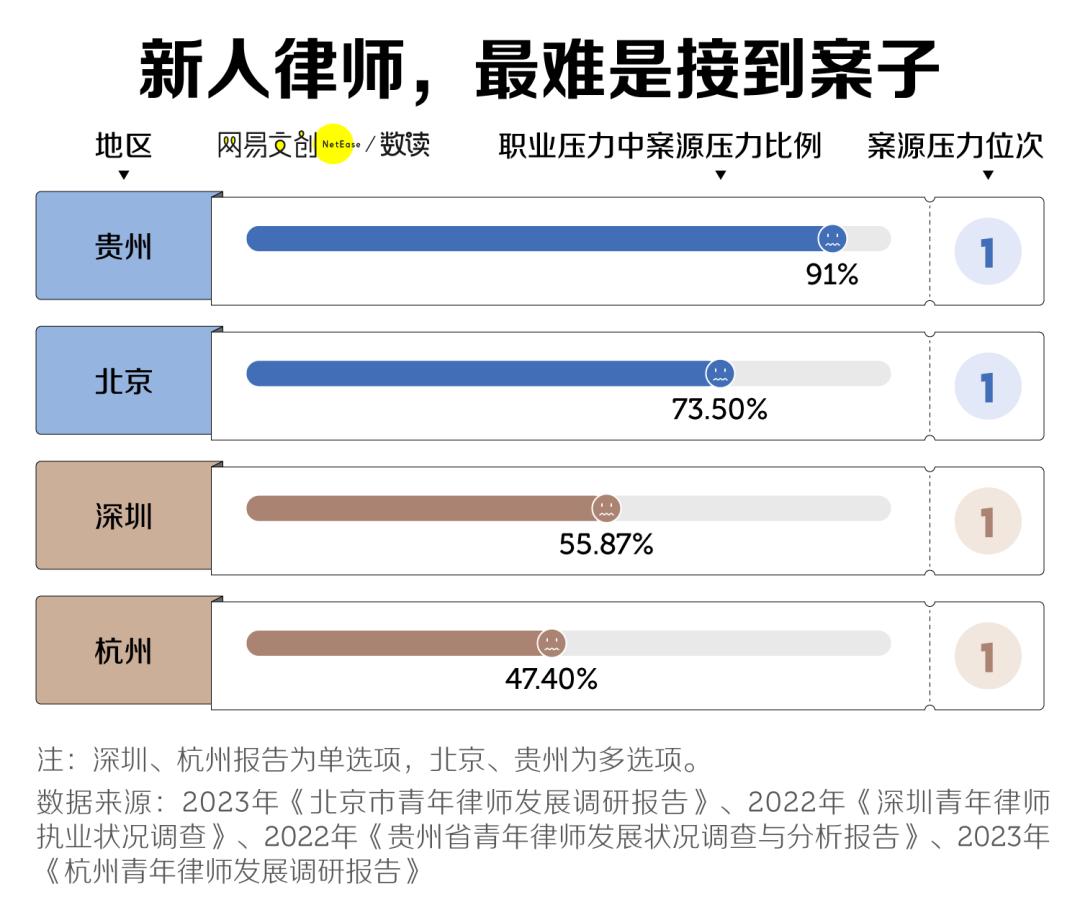
It is getting harder and harder to expand case sources. Some people use free simple consultations online to attract potential clients, some go door to door in hospital wards to look for business, and peers are always tight-lipped about their customer acquisition channels, for fear that other lawyers will take their clients away.
Even to grab business, some law firms and lawyers are trapped in cutthroat competition with maliciously low quotations. There was once a public security bureau legal service procurement project, and the final winning bidder quoted a price of only 1 yuan [8].
From the statistical data, it is true that there are too many lawyers but too few cases: the number of lawyers across the country has increased, from 570,000 in 2021 to 650,000 in 2022, but the growth rate of legal services handled by lawyers cannot keep up.

The number of lawyers is rising while the number of cases is hard to grow, possibly because the number of clients with the ability to pay for legal services has decreased. When encountering small disputes, many people now choose mediation to resolve the issues peacefully; it may also be due to competition from external players: more and more unqualified legal consulting companies are taking away small-ticket legal business [9].
Before you even get any business, a lawyer has to pay for a workstation seat fee to stay at a law firm, which is essentially a commission cut taken by the firm. At some law firms, lawyers even have to pay for their own social insurance and housing fund. If you don't have enough case sources, your monthly income can't even cover these costs.
Seeing that life after getting licensed is even harder than the internship period, many young lawyers resolutely switch careers. The proportion of young lawyers has indeed decreased in recent years. In big cities like Shenzhen, the proportion of lawyers under 30 years old dropped from 17.78% in 2024 to 16.6% in 2025.

Of course, the fading of the lawyer profession's glamorous reputation also has a lot to do with AI. Simple businesses such as contract review, document processing and basic consultation have become the hardest hit areas replaced by artificial intelligence. Just like most other industries, the legal industry is also experiencing a wave of elimination of junior positions.
In the past, senior lawyers in the industry would encourage newbies by saying that after surviving a few tough years, your career will keep rising after a few small setbacks. But it seems that from now on, the lawyer career path will be difficult at the beginning, and will remain difficult later on.
Ten years ago, most top law school graduates went to work at law firms, but ten years later, the proportion of graduates applying for positions in public security, procuratorate and courts, or entering state-owned enterprises has risen sharply [10][11].
Holding a stable public sector job means you can live a more secure life, at least during the period of industry recession when AI is advancing rapidly.
References
[1] Ministry of Justice. (2019). 2018 Statistical Analysis of Lawyers and Grassroots Legal Service Workers. Retrieved 9 November 2026 from https://www.moj.gov.cn/pub/sfbgw/zwxxgk/fdzdgknr/fdzdgknrtjxx/201903/t20190307_350047.html.
[2] Shao Ke, & Zhang Yu. (2019). Ministry of Justice Five-Year Reform Outline: 620,000 Lawyers in Four Years, National Lawyers College to Be Established. The Paper. Retrieved 9 November 2026 from https://www.thepaper.cn/newsDetail_forward_2921125 .
[3] Ministry of Justice. (2022). 2021 Statistical Analysis of Lawyers and Grassroots Legal Service Workers. Retrieved 9 November 2026 from https://www.moj.gov.cn/pub/sfbgwapp/zwgk/tjxxApp/202305/t20230509_478447.html.
[4] Ministry of Justice. (2022). Notice of the Ministry of Justice on Issuing the National Public Legal Service System Construction Plan (2021-2025). Retrieved 9 November 2026 from https://www.moj.gov.cn/pub/sfbgwapp/zwgk/appjhgh/202207/t20220722_460298.html.
[5] Ministry of Justice.