Jensen Huang wants to come back, but AI can never go back to the way it was.
"Whatever". "I don't care anymore".
At the final moment, Jensen Huang, CEO of NVIDIA, was utterly exhausted. The man who had always been endlessly energetic and signed off on behalf of AI, who once personally oversaw everything from supplier production capacity, customer financing to policy matters, became indifferent at the last minute.
Over the past three years, he explained technical routes for NVIDIA and the AI industry, confirmed the confidence in capacity expansion for upstream and downstream parties, and turned future demand of many companies into today's orders. What he handed over now is far more than just a position.
From the public board investigation to the official handover of power, it only took a few days. The 33-year-old company has cut ties with Jensen Huang. This move is also splitting the AI era into two halves.
In the past half month, major breaking news in the AI circle has come one after another. First, Anthropic publicly filed its prospectus, then its valuation was slashed sharply by the market. Then in the early November US midterm elections, voters who were overwhelmed by AI data centers joined forces with capital to "crash" the market value of AI companies. Now NVIDIA, regarded by the whole world as the base of AI computing power, has also lost the captain who has been leading the voyage from day one.
It may be easy to attribute all this turmoil in AI to the US capital struggle or insufficient confidence of capital in AI. But this completely ignores the real changes that have taken place.
The large AI model technology has not stagnated, and enterprise customers have not cancelled their AI budgets overnight. The latest performance of IREN shows that AI cloud revenue has increased significantly, and new contracts have been signed after the quarter, with the advance payment of some new contracts covering up to about 90% of GPU capital expenditure; Google announced a long-term $17 billion investment plan in Wyoming. All these point to the fact that demand is still expanding.
However, the industry's valuation standards have become completely chaotic. Wall Street used to be used to pricing model parameters, GPU quantities and cloud revenue. Now, electricity meters, transformers and ballots have also joined the pricing team.
In other words, what AI is experiencing now is the contradiction between leveraged AI expansion and physical delivery.
Technology continues to accelerate, but the certainty of organizing it is shrinking. Financial contracts can write the demand for the next ten years into today's orders, and Jensen Huang's technical strategy and "personal credibility" can gather a large number of dream-driven scientists.
When Jensen Huang left the center of AI, the market is selling off stocks while discussing: when the CEO leading the entire AI industrial chain is replaced, can those orders, guarantees, payment terms and capacity expansion plans tied to NVIDIA's credit still be reliable?
The focus of discussions on AI now has shifted from a technical possibility to the certainty of the future history of mankind.
What Jensen Huang Handed Over
Is Far More Than a Company
Back to the most critical question at the moment. How important is Jensen Huang's departure from NVIDIA to the entire AI industry?
We can temporarily put aside GPUs and CUDA, and understand NVIDIA from the perspective of AI implementation.
It can be confirmed from the financial report that NVIDIA holds considerable industrial power in the AI industry. As of July 26, 2026, NVIDIA's supply and capacity commitments rose from $119 billion in the previous quarter to $279 billion. For large data center purchases of some investment-grade customers, it can provide relatively long payment terms. NVIDIA also disclosed that the maximum total exposure of guarantees for AI cloud land, power and computer rooms, as well as guarantees related to SB Energy, reached $108.5 billion.
What do these figures mean? Taking the guarantee of SB Energy as an example, this part of the guarantee takes effect gradually with the phased construction of the project and the start of the lease, triggered by specific default events, and only covers the agreed lease and power payments. This means that as long as NVIDIA is willing to use its own credit, it can obtain project implementation and the exclusive adoption of NVIDIA architecture in the park at a very low risk.
The above case is just a lens that reflects NVIDIA's position in the AI industrial chain. It sells GPUs to customers, and also helps customers obtain the conditions to purchase GPUs through investment, payment terms, cloud service procurement and guarantees. The identities of supplier, shareholder, customer and guarantor overlap in the same company.
For a rapidly expanding industry, NVIDIA's role is crucial. Without long-term commitments, suppliers dare not expand production, and data centers find it difficult to obtain financing. The market almost converts these mutually supportive arrangements into certain growth.
One of the important prerequisites for this system to work is Jensen Huang.
NVIDIA is a company with an extremely flat organizational structure, and there is no real "second-in-command" in the true sense. More valuably, in the 33 years since Jensen Huang founded and led the company, every technical strategy of NVIDIA and every bet at the "life-and-death moment" of the company has been correct. In the AI era, Jensen Huang explained next-generation products to suppliers, proved the necessity of computing power investment to customers, described the long-term vision of AI to the capital market, and also fought for NVIDIA's qualification to continue selling in Washington.
Technical barriers make NVIDIA irreplaceable, and Jensen Huang makes the entire industrial chain believe that everyone is heading for the same future.
This trust reduces the coordination cost of AI. That's why every speech by Jensen Huang has a flavor of "selling" the future to the whole world.
Because many links do not need to re-verify the entire AI industry, they only need to confirm that Jensen Huang is still standing at the center of the stage. The product roadmap he shows at the press conference is often the production plan of suppliers for the next year; the cooperation he announces jointly with customers will also be regarded by the market as the secret signal of the next round of capital expenditure. The more complex an industrial chain is, the more it needs someone to align the timeline for different entities.
But now, the person in this position has handed over power, and the trust object of the industrial chain has changed.
All previous orders are still there, and the product roadmap will not change immediately. Who guarantees the orders, where the customer's money comes from, how long the payment term is, and under what circumstances the project can be renegotiated?

The same question falls to the newly appointed Colette Kress. As CFO, she once held reservations about the large-scale OpenAI underwriting plan led by Jensen Huang, promoted to reduce the initially discussed scale of about $2500 billion, and finally landed at about $1050 billion. Jensen Huang called her a "bookkeeper" in an internal meeting, like "a deer stunned in front of the car headlights".
Those demands that mainly rely on the credit of the chain leader will gradually be priced separately from independent and verifiable end-user demands. The same goes for the supply chain. In the past, who appeared around Jensen Huang and who was included in NVIDIA's product roadmap would affect the company's status.
Objectively speaking, the previous way of the AI industry may not be correct. It can improve efficiency, but it also concentrates a large amount of industrial trust on one person. It is a good thing that the way to evaluate AI returns to value, which is more stable and logical after all.
The problem is that this model switch happened unexpectedly.
At present, the AI industry must immediately conduct credit revaluation. When risks are uncertain, conservatism has become the most universal option. This can be seen from the market value game.
After the news of Jensen Huang's resignation was announced, AMD and Broadcom rose for a time, and the market quickly told the story of "when the whale falls, all things thrive". Some analysts pointed out that if you only look at the Philadelphia Semiconductor Index, the overall decline recently is not large, because rotation has occurred within the index, and the evaporated market value of NVIDIA has been offset by the rise of AMD and Broadcom.
But this is not the case at the absolute amount level.
As of November 13, NVIDIA's market value was about $3.92 trillion, a decrease of about $1.84 trillion from the close on October 6; from November 6 to 13, it decreased by about $573 billion. In the same period, the combined market value of AMD and Broadcom was about $2.51 trillion, accounting for about 64% of NVIDIA's.
From November 6 to 13, NVIDIA fell 12.75%, AMD and Broadcom rose 18.93% and 18.16% respectively, and the Philadelphia Semiconductor Index rose 8.05%. Alternative transactions did appear. But by November 13, AMD and Broadcom fell 8.75% and 4.76% respectively, indicating that this rotation is not stable.
Therefore, the decline of NVIDIA not only brings the imagination of market share, but also a revaluation of the chain leader's credit. Moreover, the fleeing funds have not fully returned to other core targets in the AI industrial chain.
As overseas hardware stocks fluctuate again, investors are beginning to realize that substitutes can get orders, but they may not be able to provide the same level of guarantees, payment terms and industrial confidence as NVIDIA.
Back to the entire AI industrial chain, Jensen Huang and his NVIDIA are really too special.

When it sinks, it takes away not only its own market value, but also the credit water level shared by the entire industrial chain. The entire AI industry will be affected accordingly, as a single move affects the whole body.
From this perspective, Jensen Huang's handover of power has pushed this ongoing structural adjustment to the forefront.
When Financial Speed "Circles" AI Implementation
A large part of the reason for this round of AI adjustment is credit.
Last autumn, the ultra-large-scale computing power cooperation promoted by OpenAI and partners such as Oracle brought AI investment to another level. At that time, the market was generally concerned about how large the orders were, how many GPUs there were, and which company got the ticket. But the real question worth caring about should be: How many times have these unearned revenues been used in advance?
In the previous article "OpenAI Wooed the 'Trillion Club' and Opened the 2.0 Era of AI Investment", we mentioned that the key change of this incident is that AI investment has moved from the income statement to the balance sheet.
The expected revenue of model companies supports long-term computing power procurement; computing power procurement supports new cloud and data center financing; NVIDIA participates in it through orders, investment, payment terms and guarantees; suppliers expand production accordingly; the capital market then converts these plans into valuations.
Every link is writing its own contingent future into a definite order for the next link. The same AI future has thus been repeatedly mortgaged in terms of credit.
In our interpretation of Anthropic's prospectus, we provided a clear profile for this chain. "Investors Who Can't Afford to Lose Should Not Read Anthropic's Prospectus"
In the first nine months of 2026, Anthropic achieved revenue of $33.2 billion, a year-on-year increase of 1206%. At the same time, its total committed expenditure for procurement commitments and lease agreements is about $900.9 billion, almost all of which is related to computing power and infrastructure. About $451.6 billion of this is expected to occur by the end of 2030, and about $70.7 billion of commitments will mature within 12 months after September 30, 2026.
Anthropic's revenue maintains the elasticity of the technology industry, but its expenditure can no longer be easily changed.
Here is the problem. As the player who ultimately "makes money" in the entire AI industrial chain, most of the revenue of model companies changes with customer calls. Demand may migrate with model capabilities, prices and open source ecosystems, and AI demand is still expanding.
But the "stacking" contract skips all intermediate verification stages. It organizes production capacity according to the assumption that "AI will continue to grow at a high speed", and arranges financing according to the assumption that "these leading companies will always win".
The most strange thing about this mutual trust is that orders, advance payments, capital expenditures, interest and losses can all grow at the same time.
Take CoreWeave (a company whose main business is renting computing power) as an example. In the third quarter, CoreWeave's revenue was $3.661 billion, and its revenue backlog was about $132.5 billion, but these backlogs still need to meet delivery and service availability requirements. The company also expects to receive about $9 billion in customer advance payments and deposits in the next three months. In the same period, the company's net interest expenditure reached $846 million, with a net loss of $709 million, and the 2026 capital expenditure guidance was as high as $37 billion to $39 billion.
The market used to be used to treating orders as revenue, revenue as cash flow, and then cash flow as solvency. But in the AI era, as long as every link continues to expand, the time difference in the conversion process will be temporarily covered by new contracts and financing, and then the whole system can rise spirally by stepping on its own feet.
But the future that capital can undertake has a capacity limit after all.
Sufficient trust in the AI prospect has instead created an illusion: because the future is huge enough, people assume that it can be advanced infinitely. What capital is taking back is exactly this right of infinite advancement.
Among them, "cloud computing" is probably the most successful spatial rhetoric in the technology industry, making data centers sound like weightless assets.
Take Nebius as an example. The company's revenue in the third quarter increased by 571% year-on-year. But the shareholder letter also disclosed that some third-party projects were delayed, and part of the 2026 revenue will be moved to early 2027. An engineering delay thus entered the income statement.
This delay proves that the "GW" of data centers is a misleading figure. There is a long gap of implementation and delivery nodes between planned capacity, approved capacity, capacity under construction, grid-connected capacity, delivered capacity, and the capacity that eventually generates revenue.
In China, at this year's WAIC, super nodes, liquid cooling and modular power supply and distribution have provided some solutions. These engineering innovations can indeed improve power density, reduce energy consumption, and compress part of the deployment time. But they solve the efficiency inside the cabinets and parks, and cannot take charge of grid expansion and transmission lines.
Moreover, design changes and delivery delays are very common in large-scale projects. But when equipment procurement has been advanced, financing has been in place, and stock valuations have long been arranged according to the production date, if the physical world is a few weeks late, financial capital will have to recalculate all the figures.
Looking further upstream, the pressure has also been "maxed out".
According to a report by the Financial Times, Anthropic took over the 1.7GW gas power generation equipment previously ordered by OnePWR from Caterpillar for about $3.4 billion, and incorporated the engineering and construction capabilities required for installation. A model company began to purchase power generation equipment directly, indicating that physical constraints have begun to reshape the asset structure of model companies.
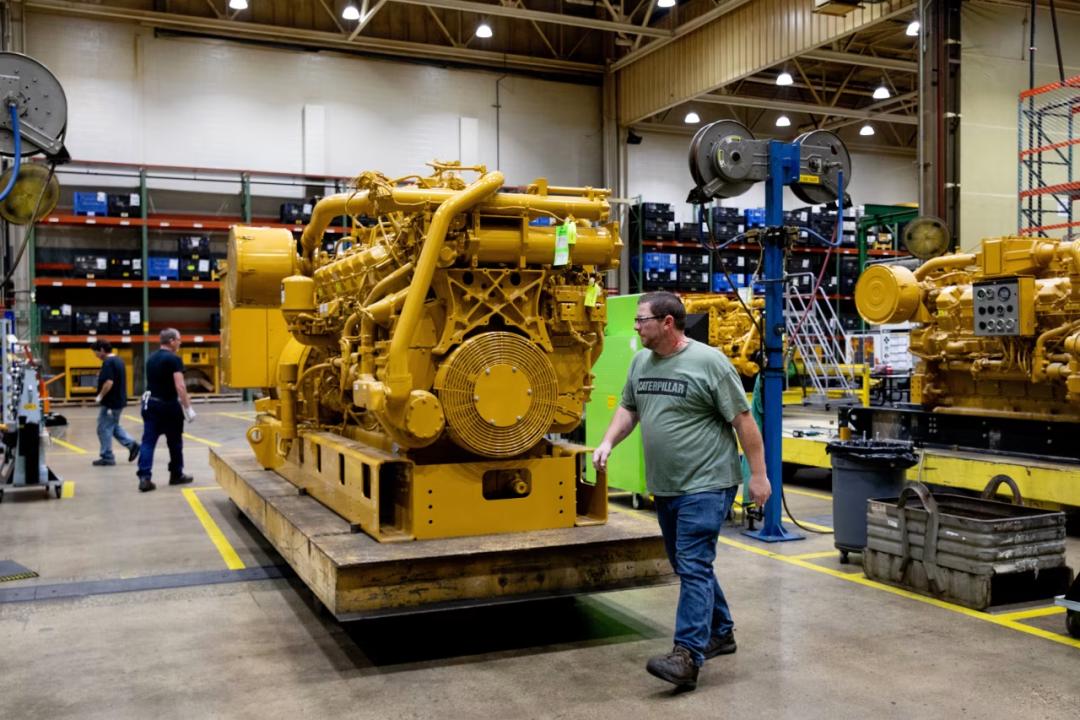
This is almost like a paradox. Anthropic once expanded relying on talents, algorithms and APIs, but now in order to obtain sufficient computing power, it also has to deal with generators, construction teams and land contracts. The more ungrounded AI is, the more it has to be grounded.