The second round of the AI office warfare has kicked off.
Recently, major domestic tech giants have shifted their focus from personal intelligence to organizational intelligence.
In mid-August, ByteDance renamed its Feishu Aily to Doubao WorkMate, then launched proactive work capabilities and reconstructed the underlying system along with Feishu 8.0. Tencent soon rolled out the joint suite of WorkBuddy Enterprise Edition and WeCom, using Buddy One to connect the scattered office ecosystem. At Baidu World 2026, Li Yanhong also proposed the concept of "intelligent organization" and launched a token metric system to measure the authenticity, quality and credibility of enterprise model services.
Various signs indicate that the focus of AI office is shifting from serving individuals to serving teams and organizations.
Meanwhile, the Agent capabilities that were previously mostly considered at the personal productivity level, including understanding context, invoking tools and delivering results, have also been incorporated into the measurement system of organizations.
Among all product paths, Alibaba's direction stands out. On the afternoon of November 9, Alibaba Qwen Office released its 2.0 version, launching capabilities such as multi-person collaboration, human-AI co-creation, data space, automatic tasks and three-terminal interconnection.
Over the past decade, the daily collaboration of Chinese enterprises has been highly dependent on IM group chats. Creating a group chat has almost been the starting point of all cross-departmental businesses, and group bots were also a common form for early office AI to enter IM scenarios.
But this time, Qwen Office tries to shift the focus, making organizational collaboration revolve around Agents. It allows users to directly create collaboration spaces within the client, and then associate multiple DingTalk groups, online documents, AI spreadsheets and business materials.
It can be seen that after AI enters real organizations, it does not quickly erase the boundaries of existing office software. Instead, it first relies on the accumulated resources of Feishu, WeCom and DingTalk over the past ten years, and rearranges the positions of Agents and IM within the old organizational order.
01 How can AI in organizations operate effectively?
"Context is all you need". More than a month ago, Chen Yusen, CEO of Qwen Office, put forward his core judgment on enterprise-level Agents at the Yunqi Conference.
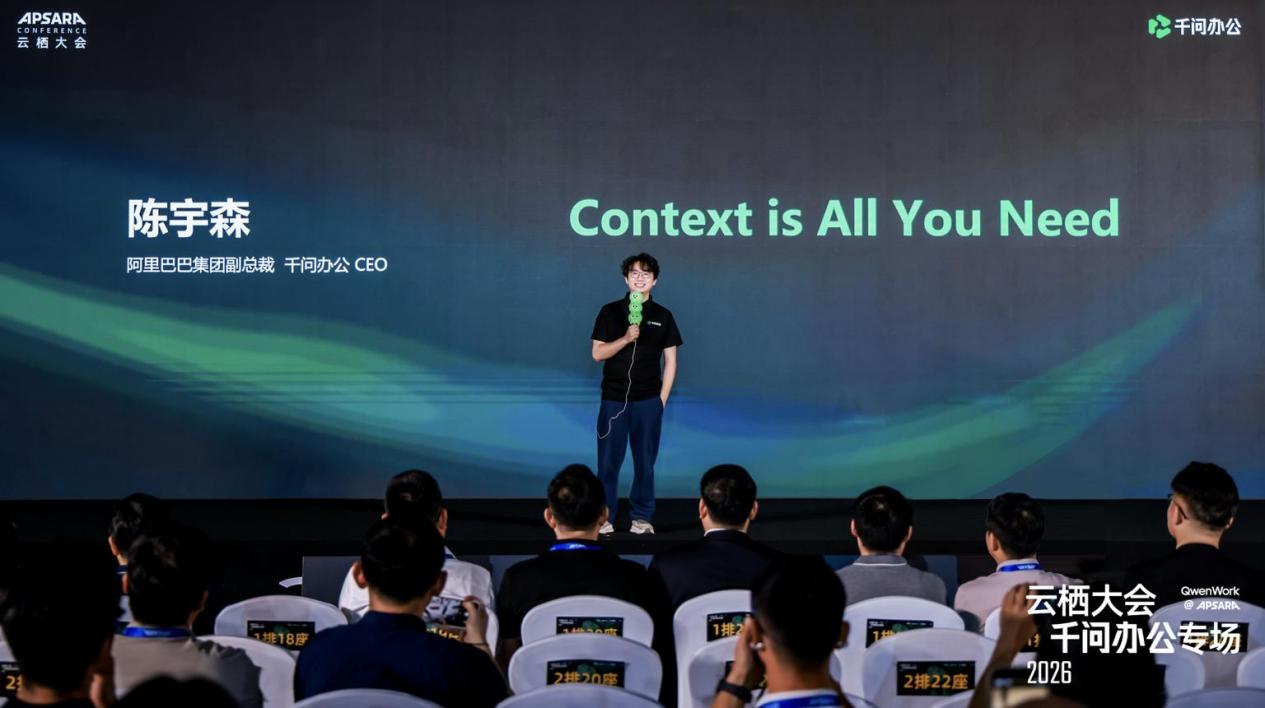
To deliver results at the organizational level, context is the basic condition that determines the availability of Agents.
However, in a real operating company, business context is never fed to AI out of thin air. In addition to various business systems established in the SaaS era such as ERP, CRM and emails, IM that pops up and scrolls day after day is also one of the important sources of organizational context.
For enterprises, the choice of IM often involves long-term organizational investment. The address book architecture, approval workflow, historical document permissions, and even the communication methods that employees are accustomed to are all precipitated on the platform.
Compared with the possibility of piloting single-point tools, the cost for enterprises to directly migrate the underlying IM is much higher. This means that when office Agents provide organizational intelligence services, moving forward along the platform endowments accumulated in their respective histories is the path with the least resistance.
At present, ByteDance, Tencent and Alibaba are all reconstructing the relationship between Agents and IM, not only deploying independent workbenches or client entrances, but also retaining native IM access capabilities.
ByteDance follows the knowledge and document density of Feishu, turning Agents into a type of organizational member in Feishu.
Since its inception, Feishu has emphasized information transparency, cloud document co-creation and multi-dimensional spreadsheet precipitation, gathering a large number of knowledge-intensive teams. Feishu 8.0 has reconstructed the data, tools and permission system around Agents.
Therefore, its office Agent product Doubao WorkMate, in addition to having an independent PC client and Doubao entrance, is specially embedded in Feishu group chat and document scenarios. Its core value lies in invoking the existing knowledge, comment records, meeting minutes and schedules within the scope of employees' permissions to jointly promote tasks with the team.
Looking at WorkBuddy, as one of the earliest office Agents that went online, its implementation path relies on multi-application ecology and connection advantages, using an independent workbench to connect information scattered everywhere.
Since its launch, WorkBuddy has been positioned as an independent desktop workbench, supporting access to communication tools such as WeCom, Feishu and DingTalk, and commercially providing two equity schemes: Buddy One Agent Suite and WeChat Work Joint Suite. The typical problem it solves is cross-application invocation, gathering materials originally scattered in different software windows and customer communications to complete end-to-end delivery.
Alibaba, relying on DingTalk, cuts into hierarchical processes, permissions and heavy business systems.
Over the past decade, DingTalk's deepest moat lies in moving the organizational structure, OA approval, attendance to-dos and business flows of Chinese enterprises online. As of the beginning of 2026, third-party monitoring shows that its MAU has remained stable at a scale of about 200 million.
The demand for hierarchical management has always been engraved in DingTalk's product genes. From the early strong reminder "Ding" function to the enterprise-level AI hardware DingTalk Real launched last year that can "physically power off", the underlying logic is to comply with top-down organizational control.
At this year's Yunqi Conference, Chen Yusen, CEO of Qwen Office, also expressed a similar idea: "Agents need to be implemented in real enterprise scenarios... Every task execution must have boundaries and be traceable."
The product design is in the same line, and the answer given by Qwen Office 2.0 is to allow Agents to participate in the actual execution of cross-departmental and cross-post tasks.
02 AI in the foreground, DingTalk in the background
For a long time in the past, employees needed to find the corresponding software entrance first when handling work, and switch back and forth between group chats, emails, documents, meetings and various business systems.
Agents are changing this set of rules. The natural language dialog box becomes the front end facing users, and business systems recede to the background to become capabilities.
When enterprise services were in their infancy, employees needed to open ERP and CRM respectively to handle work, and later these scattered entrances were taken over by IM. Now, Agents are also showing signs of swallowing the software entrances of the previous generation.
A similar tension also exists in the relationship between Qwen Office and DingTalk. If a team is already used to communicating and handling affairs in DingTalk groups, why take an extra step to create a new collaboration space in Qwen Office? Qwen Office provided the case of Intime Department Store as a sample at its press conference.
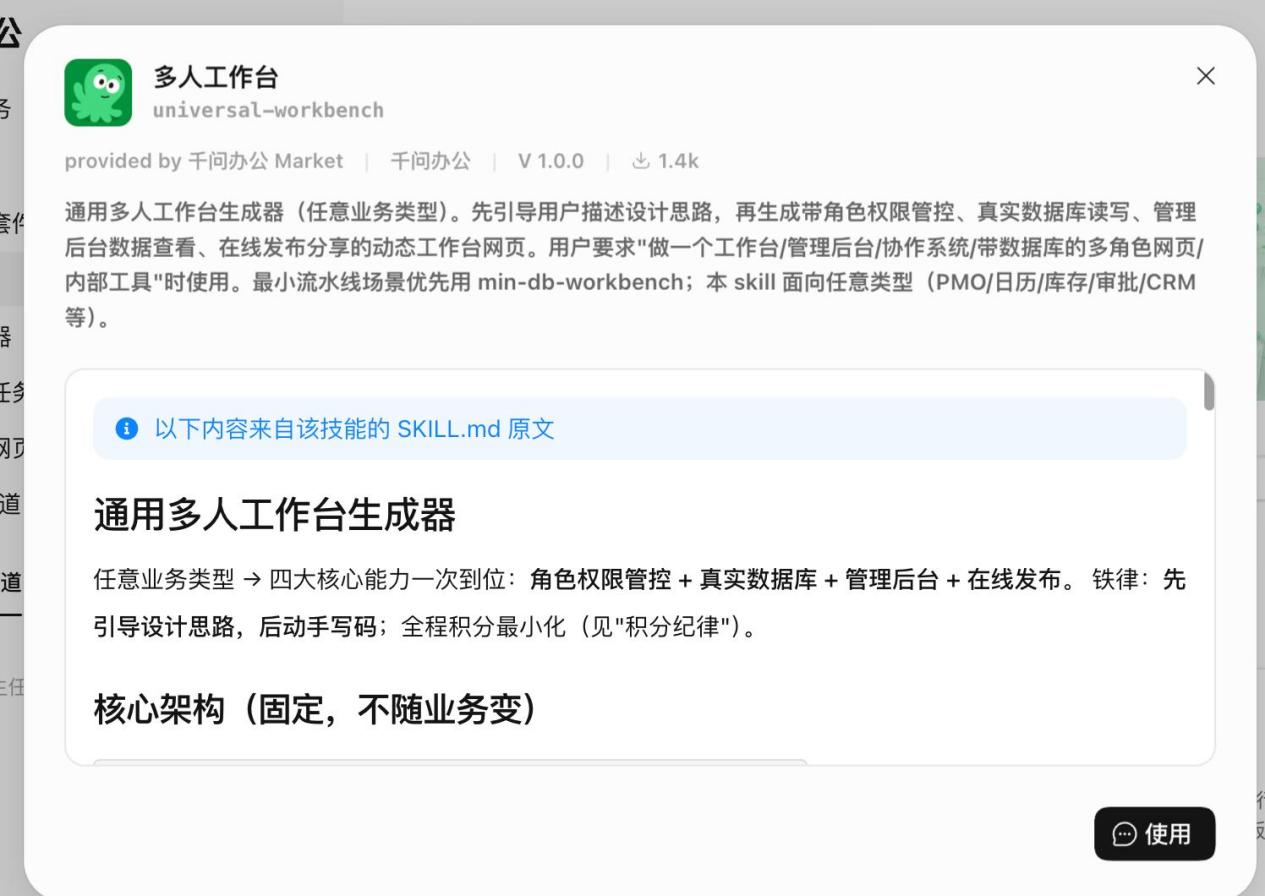
According to the press conference, live streaming coupon is a business of Intime Department Store with an annual transaction volume exceeding 200 million yuan, covering more than 62 stores and involving more than 200 collaborative personnel in total. However, the daily communication of organizational members is scattered in more than 60 DingTalk groups.
Under the original working method, to submit and launch a group-buying coupon, it is necessary to collect about 50 items of information such as name, price, validity period, applicable stores and materials. 5 operation personnel have to flip through messages in more than 60 groups every day, urge to complete the materials, and then manually summarize them into spreadsheets.
Group chat is essentially a single-column information stream designed for instant communication. Once the business expands to dozens of groups, AI Q&A in a single group can hardly help, and cross-group information verification and progress tracking are the real pain points.
In internal tests, Intime associated these more than 60 store groups and coupon AI spreadsheets into the collaboration space of Qwen Office, and the Agent summarized the progress of each group and updated the AI spreadsheet.
To achieve this kind of cross-group takeover, Qwen Office disassembles DingTalk's group chat messages, documents, AI note-taking and even Yida applications into directly schedulable atomic capabilities through command-line tools and protocols at the underlying layer.
In the past, people worked in DingTalk and called AI for assistance conveniently; Qwen Office 2.0 tries to reverse this, so that people focus on business results in the Agent space, and let DingTalk recede to the background, becoming a communication pipeline and database silently invoked by the agent.
Furthermore, Qwen Office not only heavily inherits DingTalk's ten-year accumulated understanding of organizational processes, but also tries to take over the task entrance of high-frequency businesses from DingTalk.
When Qwen Office can also create groups, collaboratively edit documents and manage tasks, will DingTalk be sidelined? At present, the official statement of Qwen Office is not a substitution narrative, but the caliber is relatively vague.
Organizationally, both Qwen Office and DingTalk are under the charge of Chen Yusen; at the product level, the two entrances exist at the same time.
Shu Junliang, Vice President and Head of Product R&D of Qwen Office, once said in an interview that traditional office software will not disappear, but will "retreat to become a data base and context base, precipitating those solidified business processes that cannot be generalized". The old software and AI should be in a cooperative relationship.
As for Qwen Office and DingTalk, he also retains an open judgment on the final product form. Qwen Office and DingTalk may eventually become one product, or each find its own ecological niche, all depending on the development of the times and customer needs.
03 Driving paid conversion with organizations as units
Whether it is making Agents parasitize in IM or sideline IM, the direction of developing organizational intelligence is very clear, that is, to break the growth ceiling of traditional enterprise software that sells seats by head count, and encourage enterprises to pay for organizational intelligence.
The aforementioned office Agents have already explored commercialization on the path of personal use and seat licensing, with business models of credit points and subscriptions. However, from the perspective of enterprise procurement, tools that only serve personal productivity are difficult to leverage organization-level budgets.
As for basic AI functions such as group chat summary, meeting minutes and search, they have also evolved into conventional capabilities of collaborative platforms. It is difficult for enterprises to continue to make large additional investments just because employees can write weekly reports faster.
Let personal scenarios belong to individuals and organizational scenarios belong to organizations, which seems to be a relatively reasonable solution at present.
Not long ago, before Qwen Office launched the 2.0 version, it cooperated with Taotian to let Li Jiaqi live stream and sell the first-month basic membership for 0.01 yuan. For individual users, improving efficiency does not seem to be a particularly urgent demand, and the entire personal productivity market is still in the stage of building public awareness.
To earn the large sum of money in the enterprise's account, major tech giants must come up with another set of solutions.
The enterprise version of Doubao WorkMate is billed by annual points; Tencent's WorkBuddy Enterprise Edition and WeCom Joint Suite introduce team shared points; Qwen Office 2.0 also presents a pricing scheme that combines seats and a shared points pool.
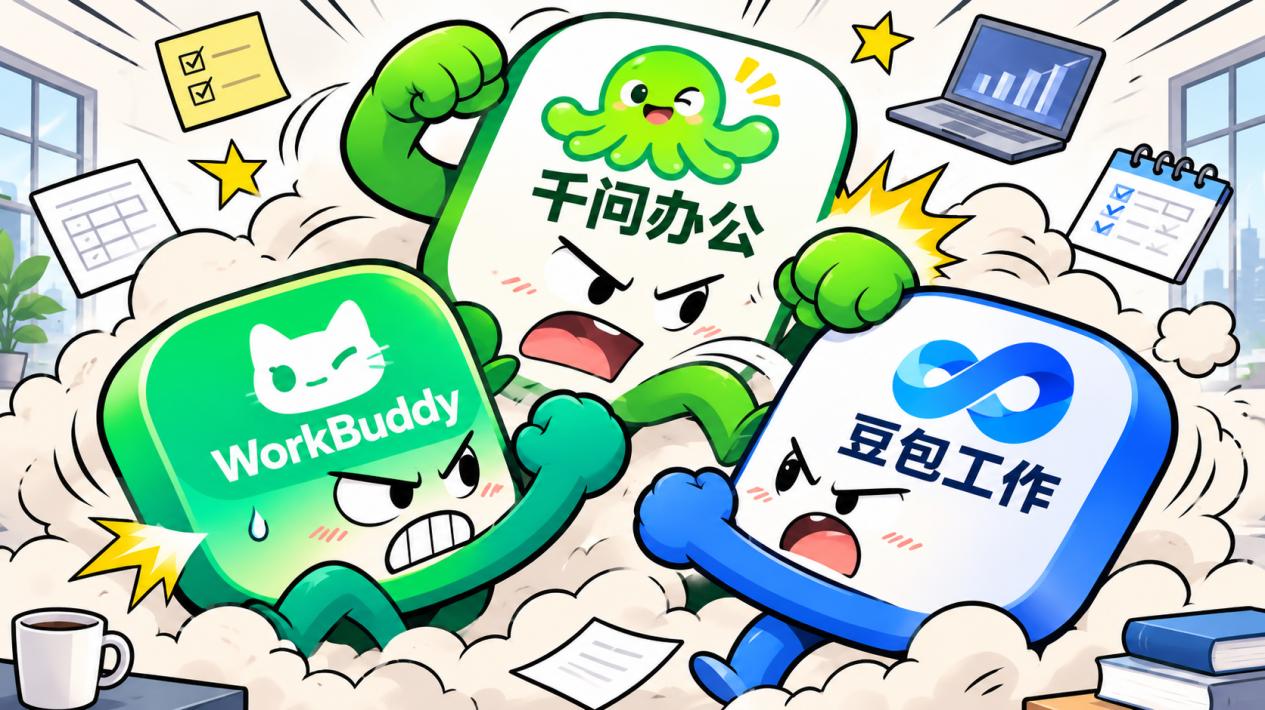
It is not difficult to find that all players are implementing the model of seats plus shared usage. In addition to functions, the charging method is also moving closer to enterprise organizations.
In the short term, due to the precipitation of organizational relationships and historical data, the IM base of Feishu, WeCom and DingTalk remains stable, and the additional purchases and renewals of existing customers are the primary battlefield for all parties. However, with the evolution of independent workbenches and cross-platform invocation capabilities, the enterprise budget at the Agent execution layer is opening up new competition space.
At present, various office Agents are still competing in their respective ecological territories, trying to achieve the conversion of additional purchases from existing customers. By next year, we may see more intense competition than the previous collaborative office war.
This article is from the WeChat official account "Bohu Finance", written by Qin Sanqian, and authorized for release by 36Kr.