Starship's 15th Test Flight: "Catching the Booster on the Vessel and Releasing the Starship" — The Major Thermal Protection Challenge Behind Its 26 Tbps Transmission Capacity
Early on the morning of November 15 Beijing time, at SpaceX's Boca Chica base in Texas, USA, Starship's 15th Integrated Flight Test (IFT-15) completed its final maneuver: the upper stage vehicle S42 made a vertical landing and was caught mid-air by the mechanical arms of Launch Tower 2.
Over the past 24 hours, a large number of news flashes claiming that "Starship has achieved full rocket recovery" have been circulating on the Chinese internet. This statement is not accurate.
Reviewing the entire flight profile, the actual result of IFT-15 is "capture the upper stage and splash down the booster". At 6:47 on November 14 Beijing time, the Starship stack consisting of the third-generation Super Heavy booster B22 and the upper stage vehicle S42 ignited and lifted off.
After the hot separation was completed, B22, which was originally planned to return to the launch tower for capture, triggered a low propellant remaining alarm. The flight control system immediately abandoned the return-to-tower procedure and guided the booster to make a controlled splashdown in the Gulf of Mexico.
The real breakthrough came 22.5 hours later. After orbiting the low-Earth orbit 14 times and releasing all its payloads, S42 re-entered the atmosphere, flew over the land of northern Mexico and southern Texas, and finally hovered precisely and latched onto the capture pins of the launch tower.
From the perspective of engineering verification weight, the difficulty of capturing the orbital stage vehicle is far higher than that of recovering the first-stage booster. After the steel mechanical arms of the launch tower closed, two hidden strengths SpaceX demonstrated in this mission are more noteworthy:
One is the commercial launch capacity that delivers 26 Tbps of communication bandwidth per single launch, and the other is the thermal protection system maintenance checklist that determines whether the full reusability economic model can be made viable.
01
Why was the harder S42 successfully captured while the mature B22 failed?
Before IFT-15 lifted off, the outside world generally focused on the "dual capture by one tower" scenario, where the launch tower would first catch the first-stage booster that returns 7 minutes after liftoff, and then catch the upper stage vehicle that returns the next day.
The final result of a failed first-stage recovery and successful upper-stage capture precisely reflects the real technical status of the third-generation Starship (V3) during its configuration transition period.
1. Engineering value of S42's tower capture
The flight trajectory of the first-stage booster is essentially a high-altitude parabola, with a separation speed of about 2 to 3 kilometers per second. It does not need to withstand severe aerodynamic heating, and its return path is entirely over the Gulf of Mexico.
The upper stage vehicle S42 faces a completely different set of physical boundaries. As an orbital spacecraft, S42 reached the first cosmic velocity of approximately 7.8 kilometers per second after entering orbit.
During its 22.5-hour in-orbit stay, dozens of tons of liquid oxygen and liquid methane propellant inside the vehicle are continuously exposed to space thermal radiation. The pressure control valves and settling thrusters of the propellant management system must operate with zero faults, otherwise engine shutdown caused by propellant cavitation is highly likely to occur during in-orbit deorbit ignition.
A more critical test lies in the re-entry corridor. To return to the Texas launch site, S42 directly crossed over the populated areas of northern Mexico and southern Texas during the glide phase after re-entering the atmosphere.
This requires extremely high levels of performance in the vehicle's angle of attack control, the servo mechanisms of its four aerodynamic flaps, and the anti-interference redundancy of its flight control software. Once the re-entry trajectory has a lateral deviation of several kilometers, the vehicle will not be able to align with the launch tower at the edge of the coastline, and may even endanger ground safety.
In the last few dozen seconds before landing, S42 completed the pitch-over-to-vertical maneuver, three sea-level Raptor 3 engines ignited to decelerate, and two capture pins on the side of the vehicle body precisely locked into the mechanical arm rails of Launch Tower 2.
Different from the hydraulic drive adopted by the earlier Tower 1, the mechanical arms of Tower 2 fully use an electromechanical drive system, which features faster response speed and higher position closed-loop control precision. For the first time in the history of human spaceflight, tower arm capture of an orbital stage spacecraft has been achieved.
2. The truth behind B22's splashdown
In contrast, B22's failure was not a severe hardware fault such as engine explosion, but a conservative evacuation caused by calibration deviation of aerodynamic characteristics and fuel margin of the new configuration.
B22 is one of the first batch of third-generation Super Heavy boosters that SpaceX has put into flight.
To reduce weight and adapt to the new capture force-bearing structure, SpaceX reduced the number of grid fins on the top of B22 from 4 (used in the previous four generations of products) to 3, while increasing the area of a single grid fin by 50% and rearranging its installation azimuth.
The reconstruction of the aerodynamic control surfaces directly changed the aerodynamic drag characteristics of the booster during the ascent phase and re-entry glide phase. After hot separation, before and after B22 executed the return ignition, the on-board sensors monitored that the total remaining propellant was lower than the safe capture threshold.
According to the preset flight safety logic, once the remaining propellant is insufficient to support attitude fine-tuning during the landing hover phase, the system will immediately lock the return-to-tower command and switch to execute the controlled offshore splashdown procedure, to avoid crashing the launch tower worth hundreds of millions of dollars due to fuel depletion.
While the V3 booster achieves weight reduction and efficiency improvement, its ascent phase energy consumption model and return thrust fuel boundary still need to be corrected through subsequent flight data.
02
Capacity dimensionality reduction strike of "one launch equals 10 Falcon 9 launches"
If you only focus on rocket recovery, it is easy to ignore another major event S42 completed in orbit: deploying 26 third-generation Starlink satellites (Starlink V3) in orbit.
Over the past few years, the global commercial space industry has been constantly discussing how Starship's near-Earth orbit launch capacity (100 to 150 ton class) will push down launch quotation.
During the IFT-15 mission, SpaceX used a set of communication bandwidth data to demonstrate the actual throughput after the heavy reusable rocket is combined with the new generation of high-throughput satellites.
The downlink transmission capacity of a single Starlink V3 satellite reaches 1 Tbps (1000 Gbps), which is 10 times that of the V2 Mini satellite (about 100 Gbps) launched in batches by Falcon 9 before.
The 26 satellites released by S42 in this launch directly added 26 Tbps of available downlink capacity to the Starlink network, equivalent to the total bandwidth that Falcon 9 can deliver only after more than 10 consecutive launches.
According to the technical roadmap disclosed by SpaceX, the 26 V3 satellites are currently still limited by the early-stage vehicle cargo hold structure and payload adapter design;
After the full-size cargo hold door is finalized, the number of V3 satellites carried by a single Starship launch will increase to more than 60, and the network capacity delivered by a single launch will exceed 50 Tbps.
The impact of this set of figures on the global satellite communication industry is direct:
First, the time cost of constellation networking has been greatly reduced.
Traditional LEO constellation operators (including OneWeb, Amazon Kuiper, and domestic Qianfan and GW constellations) still rely on medium-lift launch vehicles, with 18 to 36 satellites deployed in a single launch, and the communication capacity of a single satellite is generally at the level of dozens of Gbps.
When SpaceX starts to deliver Tbps-level satellites in batches via Starship, competitors will not only face disadvantages in launch cost per kilogram, but also face an order-of-magnitude lag in orbital capacity delivery efficiency per unit time.
Second, the commercialization of Very Low Earth Orbit (VLEO) is landing ahead of schedule.
Starlink V3 is designed to operate in the Very Low Earth Orbit below 350 km. The atmospheric drag at this altitude increases significantly, and the satellites must rely on high-thrust Hall electric propulsion systems to continuously offset the drag, so the platform volume and solar wing area have expanded significantly. Only an ultra-heavy rocket like Starship with a fairing diameter of 9 meters can achieve efficient stacked launch.
A lower orbital altitude means shorter signal round-trip delay, which directly supports the broadbandization of direct-to-cell satellite services.
In addition, Elon Musk reiterated during the mission the plan to build the "Starmind Space Data Center Constellation" based on the Starship platform.
The verification of S42's energy management and large-mass payload deployment during its 22.5-hour in-orbit stay objectively clears the transportation barriers for subsequent in-orbit deployment of high-power computing satellites.
03
The real critical line
After S42 was hoisted down from the tower and transported back to the High Bay general assembly plant at the Boca Chica base, the real tough battle has just begun.
The history of commercial spaceflight has repeatedly proved that "successful recovery" only solves the technical verification from 0 to 1, while "maintenance-free rapid reusability" determines the commercial closed loop from 1 to 100.
The core reason why the Falcon 9 first-stage booster can push the marginal cost of a single launch down to less than 20 million US dollars is that its turnaround cycle has been compressed to about 21 days. After landing, it does not need major disassembly and reassembly, and can be refueled and lifted off after cleaning carbon deposits and replacing a small number of wearing parts.
However, the maintenance difficulty of Starship upper stage vehicle is not at the same level as that of the Falcon 9 first stage. In the next two weeks, SpaceX's thermal protection system engineering team will disassemble and inspect S42 inch by inch, and there are three key checkpoints that directly determine the real operating cost of Starship:
1. The intact rate of tens of thousands of heat shield tiles and the man-hour cost per tile
About 18,000 hexagonal ceramic fiber heat shield tiles are laid on the windward side of S42. When re-entering the atmosphere, the stagnation temperature at the front of the vehicle and the flap hinge exceeds 1400 degrees Celsius.
In many previous test flights, heat shield tile shedding and high-temperature plasma entering the stainless steel rocket body through tile gaps have long been persistent problems plaguing SpaceX.
On S42, engineers replaced the curved edge areas of the vehicle body with customized special-shaped heat shield tiles, and added a new flexible anti-channeling barrier layer between the heat shield tiles and the stainless steel skin.
Judging from the on-site recovery footage, the windward side of S42 remains intact as a whole, with no large-area peeling, but there are still local white ablation traces and individual tile defects.
The engineering team next needs to compare the high-definition images of the tile surface taken by S42 in orbit with the physical objects after landing tile by tile, to see how many heat shield tiles have internal microcracks that are difficult to distinguish with the naked eye, and how many man-hours are required to replace a damaged heat shield tile and re-cure the adhesive.
If more than 10% of the heat shield tiles need to be replaced after each flight, a single maintenance will easily take more than 30 days, and the reusability economy of Starship will be greatly reduced.
2. Thermal load fatigue life of the Raptor 3 engine
The three sea-level Raptor 3 engines installed at the tail of S42 went through the full cycle of "ground ignition - high altitude vacuum exposure - re-entry high temperature baking - landing retrograde ignition" in IFT-15.
The biggest improvement of Raptor 3 compared with previous generations is that it cancels the complicated external heat insulation shrouds, and integrates the cooling channels directly inside the engine casting. This design greatly reduces the tail weight, but also exposes the main body of the engine directly to the residual heat of the re-entry airflow.
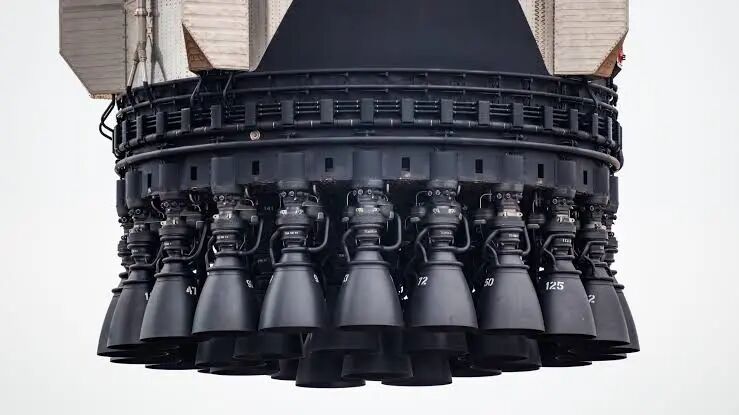
The new-generation Raptor 3 engine removes a large number of external heat insulation shrouds
After landing, engineers must use an endoscope to check whether there are thermal fatigue microcracks in the turbopump blades and the cooling channels of the main combustion chamber.
Only when the engine can achieve direct reflight without disassembly and inspection, can the high-frequency operation target of "456 launches per year from a single launch site" that SpaceX applies for from the Federal Aviation Administration (FAA) have a physical foundation.
3. Sealing durability of aerodynamic flap hinges
Starship's four large aerodynamic flaps need to swing frequently to maintain attitude during re-entry, and their hinge gaps are the most vulnerable part of the entire vehicle's thermal protection system.
After the hinge seals of S42 go through a complete orbital re-entry, their elastic attenuation degree and thermal protection coating peeling condition will directly determine whether the design life of this key moving part is "one set replaced after each flight" or can support more than ten consecutive reuses.
04
How much time window is left for China's commercial space industry?
When Starship on the other side of the ocean has crossed the threshold of orbital stage tower capture and started to fill the low-orbit space at a speed of 26 Tbps per single launch, the domestic commercial space industrial chain must face this objective reality: The generation gap between China and the United States in heavy reusable launch vehicles and low-orbit communication capacity is transforming from a "solution generation gap" to an "operation scale generation gap".
At present, all leading domestic commercial rocket companies have pushed their liquid oxygen methane reusable rockets to the key nodes of first flight and hundred-kilometer-level vertical takeoff and vertical landing (VTVL) verification.
But objectively speaking, the domestic first echelon is currently focusing on the "Falcon 9-class" first-stage booster vertical recovery, and has not yet entered the engineering development cycle of 100-ton class ultra-heavy rockets and full reusability of upper stage vehicles;
On the satellite side, the mainstream domestic low-orbit constellations currently still feature 18 satellites launched in one rocket, and the communication capacity of a single satellite is at the level of dozens of Gbps.
Facing this gap, it is unrealistic to copy Starship entirely. In the next 24 to 36 months, domestic commercial rockets should focus on realizing the first-stage recovery of medium-sized liquid oxygen methane rockets in the first half of 2027, compress the turnaround cycle to less than 15 days, and achieve positive cash flow relying on the networking orders of the Qianfan and GW constellations first;
The satellite supply chain should take advantage of the period before Starship fully opens low-cost launches, reduce the cost of a single satellite to less than 10 million RMB through pulse production line transformation, and accelerate the iteration of high-throughput payloads.
The closing of the tower arms is only a milestone. How many days S42 will stay in the plant next and how many heat shield tiles it will disassemble and replace are the real indicators that determine Starship's pricing power.