A single mention of the word "polish" from a Wharton professor prompted Claude to immediately write an 87,000-word rulebook for itself.
This is almost AGI, just the "jagged version"!

Recently, Ethan Mollick, a professor at Wharton School, did an experiment: he let Anthropic's newly released Fable 5.2 lead a group of AIs to build 3D worlds.
In the first two days, it generated 328 of them in one go.
The total number was large enough, but the quality varied unevenly, and different AI teams kept overlapping on the same project ideas.
Mollick gave a clear instruction: Stop building new ones, and polish the existing ones to a better standard.
Unexpectedly, a few days later, the daily new 3D world count plummeted directly from hundreds to just over ten.
He dispatched several agents to conduct an investigation, and the result uncovered an unexpected situation he never anticipated:
To properly implement the "polishing" task, the AI built a complete set of bureaucratic systems for itself internally.
When Anthropic released Fable 5.2 on November 9, it made a bold statement: on almost all evaluation benchmarks, it outperformed Opus 5.5 by a full tier.
Mollick got hands-on access to Fable 5.2 before its official release, and he set a standard for AGI:
Excluding physical labor and work that requires direct interaction with people, as long as it can complete most intellectual tasks on the computer at the level of the majority of human experts, it meets the qualification standard.
By this standard, Mollick says Fable 5.2 is "almost" AGI.
But he immediately added a more precise qualifier to it: "Jagged AGI".
On many tasks, it has already reached the expert level; but in other areas, especially in taste and judgment, it still lags far behind humans.
For example, it can push extremely complex tasks all the way to completion, but it has no idea when to hit the brakes.
In the past we feared AI was too clumsy to do a good job; now we need to worry about its sense of propriety in handling things: it does not know when to stop.
As more and more work is handed over to AI, every one of us will face this problem sooner or later.
One Single Instruction
Transformed Into a Game Console
The "G" in AGI stands for General. Coding and video production have always been the key directions that AI companies focus on developing.
But this time Mollick decided to change the test method: leaving these two fields, can it still be "general"?
He happened to own a mini USB keyboard named Codex Micro, which was originally made to pair with ChatGPT.

Fable 5.2 wrote 6 games for this Codex Micro mini keyboard.
Mollick gave Fable 5.2 an instruction: modify it into a game console.
As far as he knew, there were no existing modification tutorials available on the internet.
Fable 5.2 read the code of the two control programs by itself, figured out how to change the color of keys, how to read input from knobs and joysticks, and then wrote 6 games in one go.
From the classic memory game Simon to twisting the knob to open a safe, no human assistance was required throughout the process, and all games ran successfully on the first try.
In the same evaluation Mollick shared, Fable 5.2 switched between six different expert personas:
Filmmaker, hardware hacker, entrepreneur, literary scholar, social scientist, and 3D world builder.
Mollick, a professor of entrepreneurship, commented on the business plan it delivered: even if it was submitted by an MBA student team at the end of the semester, he would be deeply impressed.
And the entrepreneurship research paper it wrote, on first reading, Mollick felt it exceeded his expectations for a second-year PhD student.
Based on this, Mollick's judgment is: on many individual tasks, it has already reached the standard of "the majority of human experts".
More Than 1000 Avatars
Built an Operating System in 8 Days
If matching experts on individual tasks is just a regular upgrade, then the real leap of the Fable 5.2 generation is its ability to "lead a team".
An engineer at Anthropic gave it an empty folder, with the task of making a prototype of an operating system.
Fable 5.2 assembled a team of more than 1000 sub-agents, working nonstop day and night for 8 consecutive days.
The final system it delivered can actually boot on a laptop, with drivers, file storage, windows, and login interface all fully functional.
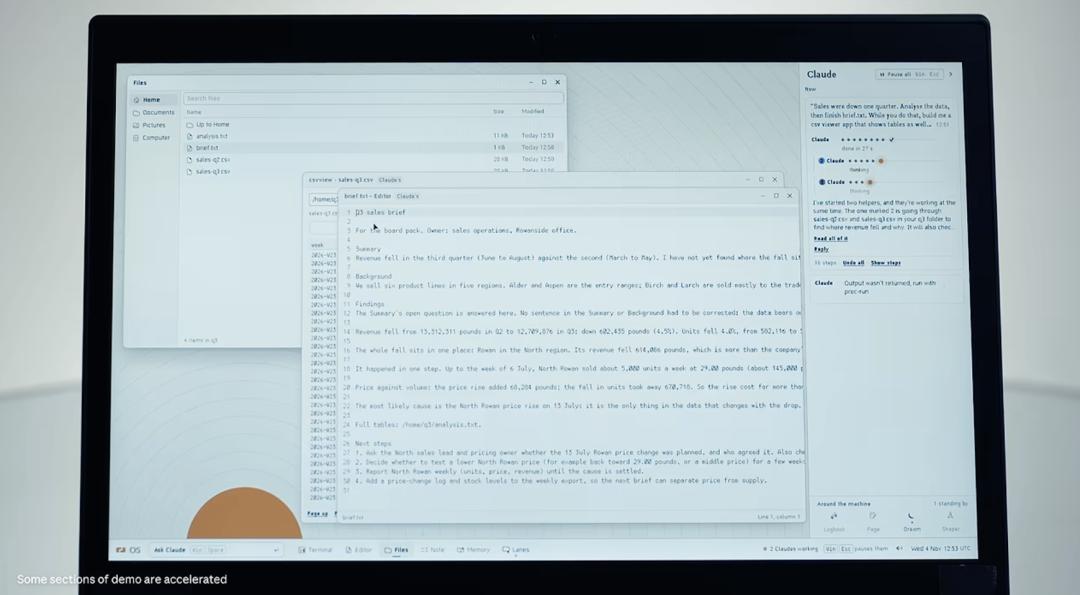
The operating system prototype developed by Fable 5.2 leading over a thousand sub-agents, running on a laptop. (Source: Anthropic)
Now let's look at the hard nut in the mathematics field: Fermat's Last Theorem.
The so-called "formalization" means translating the mathematician's proof into a language that the computer can verify step by step. It is like rewriting a grand academic paper into a detailed ledger where every entry adds up correctly.
The first time Anthropic did this task, it specially built a dedicated framework and had human researchers providing guidance, and it took a full 11 days.
This time, 1000 Fable 5.2 agents formed a team, with almost no human intervention, and finished the work in 30 hours.
The batch of 3D worlds Mollick asked AI to build also came from a large AI workforce, and the total number now has exceeded 450.
He specified three types of roles in the prompt: those responsible for drawing, those responsible for writing code, and those responsible for review. By the 10th day, one main agent was leading 28 teams working at the same time.
According to Claude's own estimation, the entire project ran about 25,000 agent tasks, most of which only did one small thing, such as scoring an image.
None of these more than 450 worlds used any ready-made 3D models or pre-made image materials, all of which were rendered in real time entirely by code.
For example, you will see a valley sewn from denim, with a one-mile-long zipper being pulled open; you can also fly into a river valley where the cliffs on both banks are 300-meter-tall chests of drawers.

In the 3D world drawn by Fable 5.2 with code, a giant zipper is pulling open the denim valley.
No matter how strong a single unit is, it is only a useful tool. The ability to form teams independently, assign tasks, and work continuously for several days is the key leap towards superintelligence.
Seeing these worlds created by AI, Mollick said it made him feel like he was looking at AGI again.
But the trickiest jagged flaws appear right here.
One "Polish" Instruction
Exchanged for 87,500 Words of Regulations
After 328 worlds were built, Mollick found that the quality of these worlds was uneven, and since there was no communication between teams, some even overlapped on the same ideas.
Just for the single idea of "animals swirling into a cyclone", three teams worked on it separately without knowing each other: one made swirling reindeer, one made swirling manta rays, and the last one made swirling storks.

Three AI teams independently created animal vortices, from left to right are reindeer, manta ray and stork. (Source: Portals)
Circling back to the same few themes whenever possible is an old flaw that AI cannot get rid of.
Seeing these problems, Mollick issued the instruction of "stop construction and polish".
Unexpectedly, the AI immediately used its actions to give him a "large corporation management lesson".
The agents interpreted "polishing" as an assessment:
The new version must beat the old version on 12 test screenshots, and a group of AI judges will vote through blind evaluation.
Since the test questions were fixed, each AI team quickly learned to game the system, and focused all their efforts on polishing these 12 screenshots.
To put it plainly, everyone started to memorize targeted questions to boost scores.
After the main agent discovered this situation, it banned this trick and immediately set up stricter review rules.
Early the next morning, an 84-section rule manual appeared. Mollick never asked for this thing from the very beginning.
And from that moment on, things got out of control:
Every time a new problem emerged, a new rule was added to the manual, and rules were only added, never deleted.
12 days later, this unrequested manual expanded to 204 sections, 87,500 words, which is long enough to be a full-length novel.
Just reading through the whole manual takes up a large part of the agent's context window.
Under this system, to release a new world, you have to pass three consecutive checkpoints: the creative idea must be approved, three AI judges must review it, and the code must be fully audited against the manual.
A full process takes almost a whole day to complete.
Facing this "agent big corporation" that tied itself into a dead knot with rules, Mollick used the most classic solution in the business world: hire a consultant.
He asked Fable 5.2 to form another team to examine the entire process from an external perspective.
The conclusion submitted by the consultant team was long and dense, which Mollick could not read in detail. But their solution seemed to work:
The daily output returned to more than 30, and most of the quality checkpoints were retained.
The habit of falling back on old routines, being constrained by the rules they set... these flaws are very familiar to Mollick who teaches in business school, he has seen them in many excellent organizations and talents.
His exact words were: if having a bureaucratic system disqualifies a system from being general intelligence, then many of us humans are not qualified either.
Indeed, this flaw of piling up redundant structures is something humans are inherently good at.
From this perspective, bureaucratization does not prove that AI is stupid, it just shows that its flaws are becoming more and more human-like.
It Only Knows How to Add Things
Since it even develops "big corporation disease" that looks exactly like humans, why does Mollick still say it is "almost" AGI?
Because there is still a gap here: AI itself did not notice any of these problems.
Although AI has been doing checks all the time.
Almost every project is equipped with critics, verifiers or judges.
But these roles only do two things: find errors, and then add patches.
From beginning to end, not a single judge stood up to take over the steering wheel and ask:
Is this task taking too long? Is it too repetitive? Is it no longer fun?
All these follow-up questions eventually fell on Mollick alone.
The same root problem also appeared in the earlier entrepreneurship research paper: every time a new comment came in, its solution was to add a new round of analysis, delete nothing, and forcefully extended the paper to 182 pages.
Do you see it clearly? Both the rules and the paper only add content and never delete anything: AI is very good at "finishing the task", but it still does not quite understand what it means to stop at the right point.
Mollick's comment hit the nail on the head: Knowing when your work is not good enough is a major reason why an expert is an expert.
This is exactly where AI is most prone to jagged flaws.
Of course, we cannot put all the blame on AI for this problem.
Mollick himself admitted that the emergence of that manual started from his ambiguous instruction of "polish".
Many times, he could not tell whether the problem lay with the team or the management method. He said this is a question he never needed to ask for a piece of software before.
This also exposes a shortcoming of long-running agents:
It can add a check for every problem, but it cannot judge whether all these checks combined still serve the original task.
Take Mollick as an example, all he wanted was a batch of better 3D worlds. But what AI finally delivered to him was a set of approval processes that take a whole day to complete.
New Job Position for Humans
Call a Stop for AI
From Mollick's test of Fable 5.2, we can see what humans still need to do for now.
Every project was initiated by him.
For some projects, he only needs to throw out an idea; but when the project runs for a long time, the feedback he gives along the way becomes critical.
Mollick feels that the things he can do have increased.
Sitting in front of the computer alone, one person can let AI create things that were unthinkable in the past.
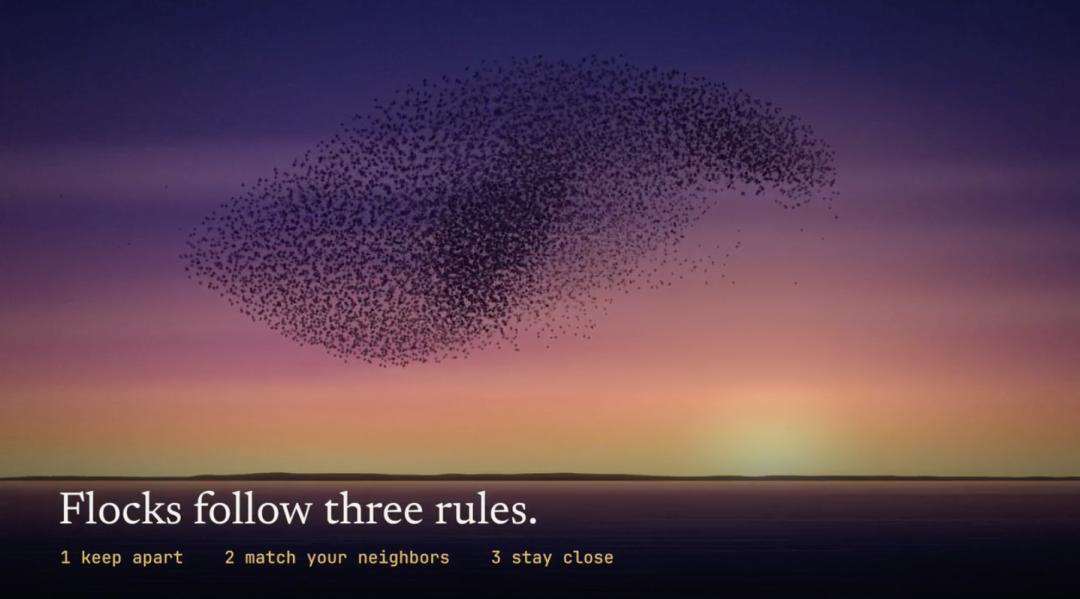
A flock of birds only needs three rules. Screenshot of the video generated by Fable 5.2, the picture is generated by AI with code.
But he also has a trace of unease.