The AI search war has broken out, and the tech giants are vying for far more than just answers.
In the AI era, the search business has once again become a fiercely contested battleground.

Image source: Yuanbao Search
On November 11, 2026, on the 28th anniversary of the company's founding, Tencent launched a brand-new search product "Yuanbao Search" with an independent web page. Users can also upgrade QQ Browser to the latest version and select "Yuanbao Search" in the engine settings option.
Not only Tencent, but recently internet companies including Alibaba and ByteDance, as well as AI enterprises such as DeepSeek and Moonshot AI, are all making intensive layouts for the AI search business.
As one of the earliest product forms in the internet industry, after years of development, the search market has long entered an oligopoly era with a relatively stable pattern. Nowadays, a large number of technology companies are extending their reach to the search market once again, largely because AI technology has brought new changes. Under the influence of AI technology, the competition pattern and business model of the search industry may all usher in earth-shaking changes.
01
In the AI era, search has once again become the focus of competition
Different from the PC internet era when search was the core strategic entry, after the rise of the mobile internet, specific demands are undertaken by closed platforms, and the recommendation mechanism can accurately distribute part of the information that originally required active retrieval, leading to the decline of general search engines.
In response to this, in April 2017, in an interview with the media, Wang Xiaochuan, then CEO of Sogou, said, "On the PC side, the center of search is the entry of traffic and the core of all applications. On the wireless side, it is indeed not in the most central position, it is just one of many applications and services. This is the reality, and you have to accept this reality."
Precisely because search began to deviate from the central position, mobile internet enterprises no longer compete for search entries, nor build products around search, but carry out vertical exploration in combination with user demands accordingly. Correspondingly, users have also adapted to the isolated mobile internet ecosystem at the same time, meeting their needs for shopping, entertainment, audio and video through isolated Apps one by one.
Against the background of the gradual maturity of AI technology, search has once again become the focus of attention of technology enterprises. This round of competition not only includes the upgrading of traditional search products, but also the improvement of the retrieval capability of AI assistants, and further extends to search services for developers.

Image source: Baidu
Traditional search companies such as Baidu are committed to reconstructing their existing search business on the existing retrieval and distribution system; AI assistants such as Yuanbao, Qianwen and Doubao organize content and services relying on large models; companies such as Tencent, DeepSeek and ByteDance open their retrieval capabilities to developers to serve more AI applications. These layouts often happen at the same time, and search has further evolved from a product for C-end users to a basic capability for AI products to connect external information.
On the whole, although there are differences in the layouts of technology companies, their strategic orientations all point to the battle for information entry in the AI era. AI enables search to extend from presenting information to understanding demands and organizing answers, and also makes it possible for users' long-formed search habits to be rewritten.
For traditional search companies, AI search is a defensive battle to hold on to user and distribution advantages; for new players, it is an opportunity to redefine the starting point for users to obtain information. The key to competition has shifted from who can provide more results to who can make users think of themselves first when they want to ask questions.
02
AI targets the new generation of entry, and its reliability needs to be improved urgently
The reason why technology companies have laid out AI search one after another is largely because AI tools have the potential to become a new generation of entry.
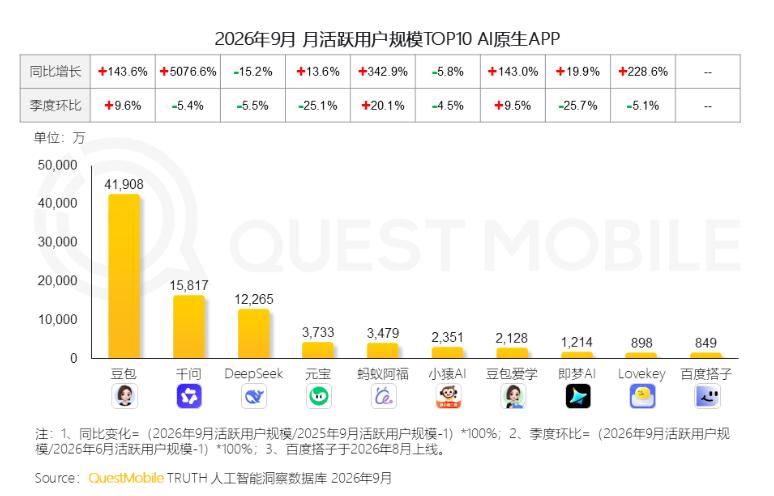
Image source: QuestMobile
Data disclosed by QuestMobile shows that in September 2026, the top three AI-native Apps in terms of monthly active users are Doubao, Qianwen and DeepSeek, with monthly active users of 419 million, 158 million and 123 million respectively, representing a year-on-year increase of 143.6%, 5076.6% and a decrease of 15.2% respectively.
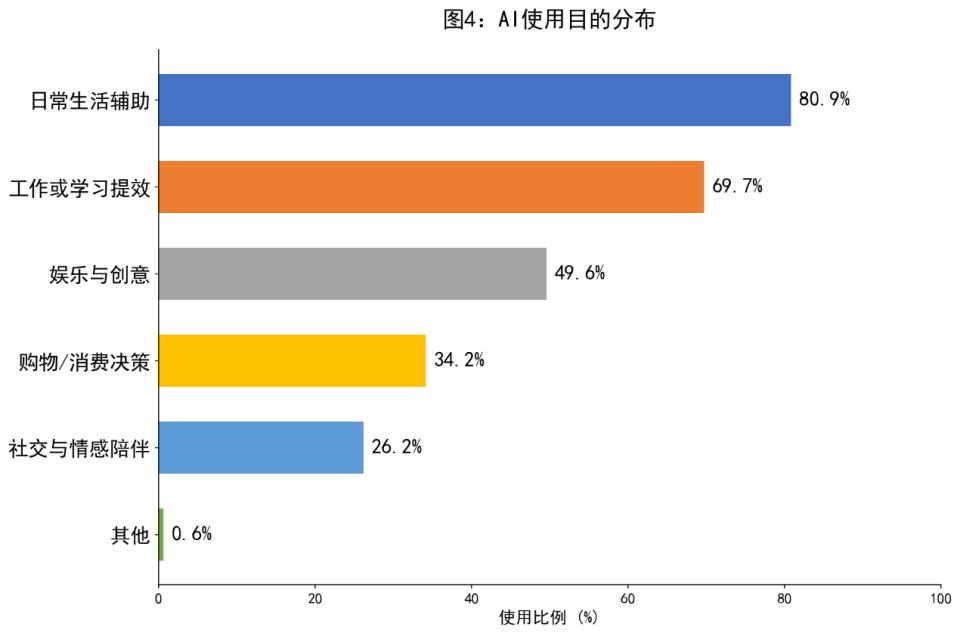
Image source: Tencent Research Institute
Due to the strong task understanding and feedback capabilities of large models, more and more users regard AI assistants as "intelligent secretaries" to solve daily life problems. Survey data from Tencent Research Institute shows that 95.6% of respondents have used large AI models in the last 3 months, of which 80.9% of users regard AI as the preferred tool to solve daily problems, using services such as information query, itinerary planning, and answering questions.
As more and more users' retrieval demands shift to AI tools, the problems of knowledge lag and hallucination of large models have gradually been exposed. The knowledge of large models comes from training data, and the weights are fixed after training is completed, so it is difficult to provide the latest information. In addition, guessing answers based on the fuzzy memory of model weights will also lead to hallucinations in large models.
The recent rush of technology companies to lay out AI search is to solve the above problems. After introducing the web search function, large models can retrieve information across the entire network in real time, make up for outdated knowledge, and reduce hallucinations based on external reference texts.
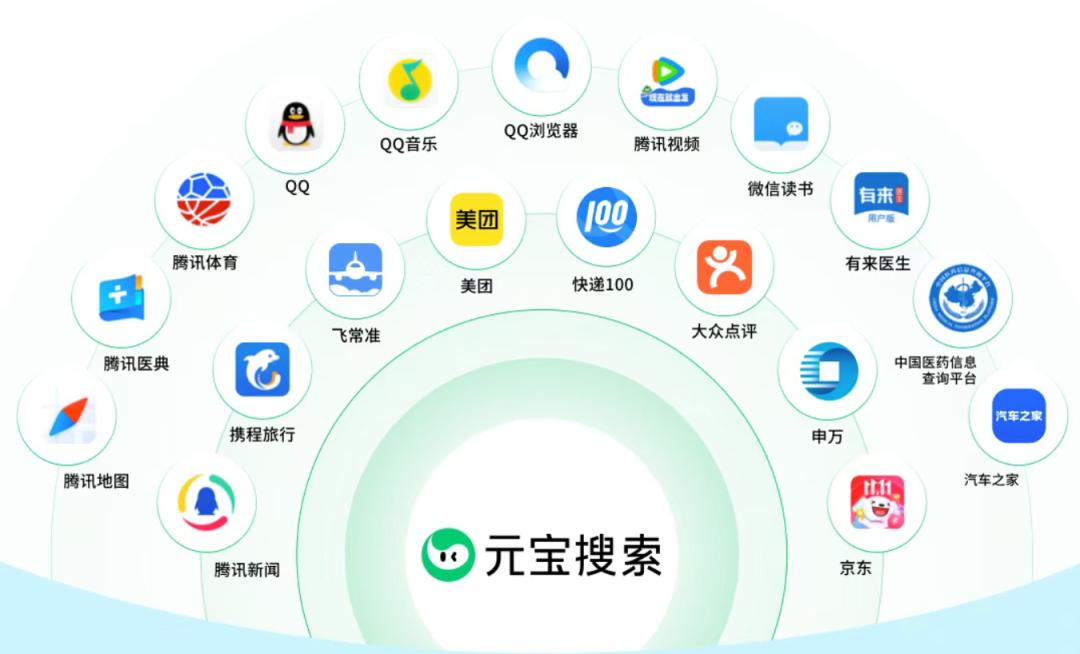
Image source: Tencent
Taking Yuanbao Search as an example, it supports high-timeliness content retrieval and can obtain the latest information such as policy updates, news trends, weather changes, and stock market quotes in real time. In addition, the product also connects Tencent's high-quality content ecosystem, covering content resources such as Tencent News, Sogou Encyclopedia, and Penguin Account.
Search helps AI evolve from a conversational tool to an information service entry that can be used repeatedly. However, the status of the entry does not depend on whether it can answer a certain question, but on how to continuously reduce the cost for users to obtain and judge information. When all AI tools have the ability to access the internet, competition will further extend to aspects such as content coverage, source quality, and answer credibility.
It is foreseeable that AI products that can significantly reduce users' screening costs and provide reliable feedback are more likely to become the winners of this round of search competition.
03
After finding the answer, how to achieve commercialization?
After the revolutionary AI technology matures, it not only brings a brand-new search experience, but also subverts the existing business model of search engines.
An important source of revenue for traditional search engines is search advertising. After users enter keywords, the platform displays commercial results in combination with factors such as ad bidding and relevance, and charges advertisers by click and other methods. The clear search intent makes search an important channel connecting users and merchants.
When AI starts to organize information directly and give answers, users no longer need to click on specific web pages and ad links, and the display positions and conversion links of traditional ads are facing the challenge of failure.
In response to this, at the end of 2024, Zhou Hongyi, founder of 360 Group, said, "In fact, we are also very distressed when doing AI search. We are also subverting ourselves, and there is no place to put ads temporarily."
Therefore, for AI search players, efficiently meeting user demands is only the first step. The bigger challenge is how to achieve commercialization after providing answers.
At this stage, AI assistant products are exploring revenue sources such as membership subscription, transaction channel fees, and providing retrieval services to developers. Among them, connecting transactions and opening up retrieval capabilities represent two different monetization ideas for AI search.
Taking Doubao as an example, it is trying to guide users' life service demands to transactions, and then draw commissions from them.
In August 2026, some hotel orders completed through the Doubao channel began to implement independent rates, with a software service fee of 11.4% and an additional 0.6% payment processing fee, resulting in a comprehensive rate of 12%. Doubao responded that merchants only pay channel service fees after orders are completed, and cannot influence recommendations or rankings through payment.
However, whether user scale can be converted into revenue sufficient to cover costs is still a question that AI assistants need to answer. According to the calculation of *LatePost* combined with the public API price of Volcano Engine, in May 2026, Doubao spent tens of millions of yuan every day, while in the first half of the year, the product earned less than one million yuan per day, mainly from e-commerce commissions.
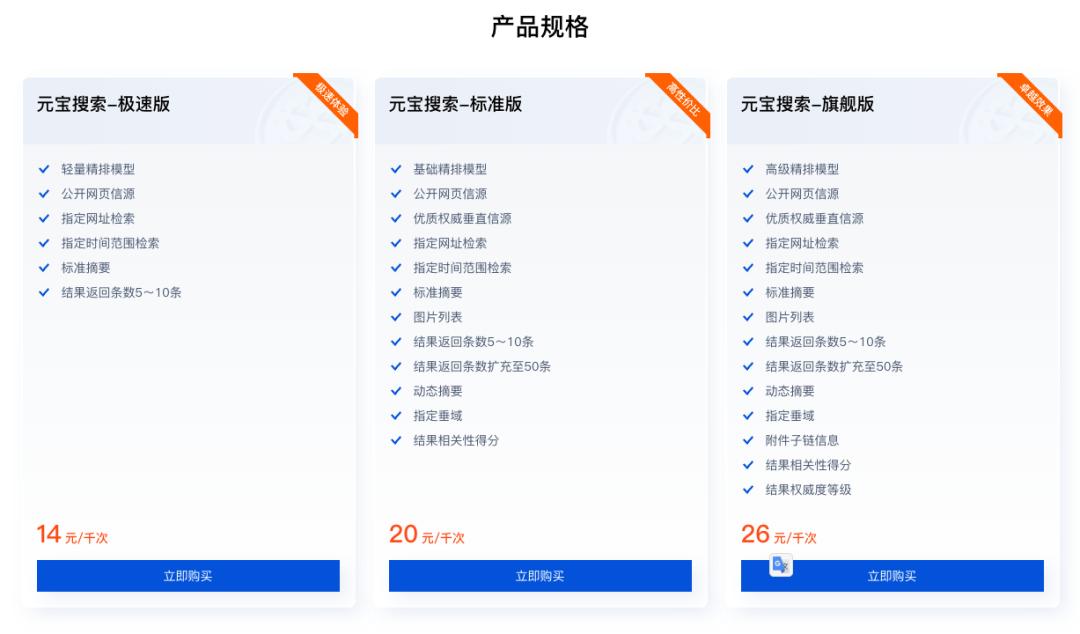
Image source: Tencent Cloud
Parallel to the commercialization of consumer-oriented products, Tencent is also selling search capabilities as developer services. In October 2026, Yuanbao Search began to open to the public through Tencent Cloud. At present, the prices of the extreme speed version, standard version and flagship version listed on the Tencent Cloud product page are 14 yuan, 20 yuan and 26 yuan per thousand times respectively. For Tencent, search can not only directly serve users, but also become a basic capability called by other AI applications.
From charging for transaction channels to opening up retrieval services, the value of search is extending in different directions: for users, it has the opportunity to participate in consumption decisions and connect information demands to actual transactions; for developers, it is committed to becoming a basic capability that AI applications call on demand. The two paths mean that the revenue sources of search are expected to be further broadened.
However, the increase in revenue sources does not mean that the profit problem has been solved. Transactions need to prove that they can bring incremental orders to merchants, and retrieval services need to find a balance between quality, response speed and cost. The competition in the next stage of AI search will pay more attention to whether each demand can bring sustainable returns, rather than simply expanding the scale of users and calls.
For internet giants such as Tencent, Alibaba and ByteDance, AI search has a deeper meaning: whoever understands user demands first will have more opportunities to distribute content, goods and services. Demands that were previously undertaken by different Apps separately may be handed over to AI for judgment first in the future, and then connected to corresponding services by it. Therefore, the change of search entry may bring redistribution of distribution rights and transaction opportunities between platforms.
However, how many application boundaries AI can cross still depends on content authorization, service access and performance capabilities. Giants have ecological resources, but they also need to face the questioning of whether recommendations are overly biased towards their own businesses; new players can redo interactive experiences, but still need to supplement links such as content supply, transactions and after-sales. Model capabilities will affect the quality of answers, and whether it can connect reliable services determines how far it can go after giving answers.
Compared with the winner, what is more noteworthy in this round of competition is how the platform maintains the balance between the two when AI not only helps users make judgments, but also obtains revenue from recommendations and transactions. What users hand over is not only a search request, but also their trust in information screening and consumption advice.
Platforms that maintain user trust in the process of commercialization are more likely to turn short-term usage popularity into lasting entry advantages.
This article is from the WeChat official account "Farsight", written by Haotian, and published with authorization from 36Kr.