Global Panorama of AI Unicorns: 30 Companies Valued at Over 10 Billion US Dollars, Chinese Companies Break Into the Top 10
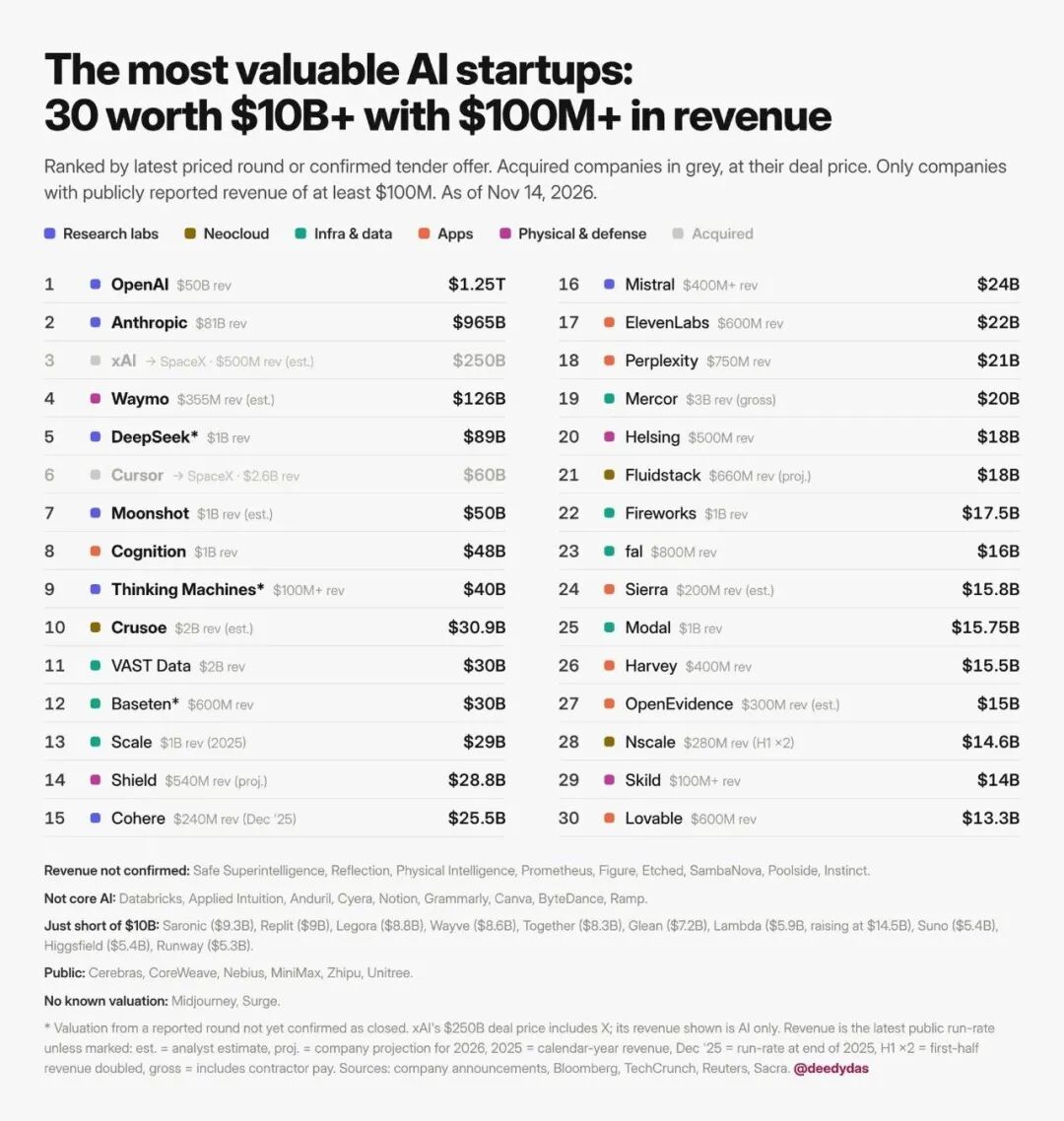
On November 15, Deedy Das (@deedydas), partner of the long-established Silicon Valley venture capital firm Menlo Ventures, posted a global ranking of AI companies by valuation and revenue on social media platforms.
Founded in 1976, Menlo Ventures is one of the oldest venture capital institutions in Silicon Valley, having invested in well-known tech companies such as Uber and Chime. In recent years, the firm has taken AI as its key investment direction, with its investment portfolio covering companies including Anthropic, Lovable, and Modal.
Menlo Ventures is also an early investor of Anthropic. It participated in Anthropic's Series C financing back in 2023, and jointly established a $100 million AI investment fund with Anthropic in 2024.
This ranking counts unlisted AI companies across the globe that have a valuation of over 10 billion U.S. dollars and publicly disclosed annualized revenue of more than 100 million U.S. dollars as of November 14. There are already 30 companies that meet both of these two criteria.
The fault effect of the leading "duopoly" at the top has further widened: OpenAI continues to lead with a valuation of approximately 1.25 trillion U.S. dollars, followed closely by Anthropic with around 965 billion U.S. dollars, and the two companies have opened a considerable gap with other competitors.
However, when ranked by annualized revenue, the positions of the two companies have been reversed: Anthropic has surpassed OpenAI. The two companies have distanced themselves from other competitors in terms of valuation, while new changes have emerged in their revenue competition.
Among Chinese companies, DeepSeek and Moonshot have entered the global top 10. DeepSeek ranks fifth with a valuation of 89 billion U.S. dollars, and Moonshot ranks seventh with a valuation of 50 billion U.S. dollars. According to the data disclosed in the ranking, the annualized revenue of both companies has reached the order of 1 billion U.S. dollars.
Nevertheless, looking at the entire ranking, the United States still holds an absolute advantage. Among the 30 companies, 23 are from the United States, whose businesses cover multiple fields such as foundation models, AI programming, and computing power cloud services. 2 Chinese companies are shortlisted, and the remaining 5 are from Canada, France, Germany, the United Kingdom and Sweden respectively.
01
Duopoly Leads by a Wide Margin
If we turn the clock back to a year ago, OpenAI was still "far ahead".
At the end of 2025, OpenAI's annualized revenue had reached approximately 20 billion U.S. dollars, while Anthropic only had 9 billion U.S. dollars. At that time, there was a revenue gap of more than double between the two companies.
But entering 2026, Anthropic's growth rate has significantly outpaced OpenAI. As of the end of September this year, OpenAI's annualized revenue was about 50 billion U.S. dollars; by the end of October, Anthropic had surged to 81 billion U.S. dollars. In just ten months, Anthropic's annualized revenue scale has increased by roughly 8 times, while OpenAI has grown by about 1.5 times over the same period. The once lagging follower has now overtaken its rival in terms of revenue.
From the perspective of actual revenue, this change is equally obvious. In the third quarter of this year, Anthropic recorded revenue of approximately 17 billion U.S. dollars, while OpenAI reached about 10 billion U.S. dollars. Although there are still differences in how the two sides calculate revenue from cloud platforms, Anthropic's growth momentum this year is already astonishing enough.
The leading position of the two companies remains stable. The top-tier competition in the global foundation model market has entered the stage of trillion-dollar valuations.
What is more noteworthy is that Anthropic is seizing this growth momentum to sprint for its IPO.
On November 10, Anthropic announced its IPO offering price range of 70 to 78 U.S. dollars per share, and is expected to list on the NASDAQ on November 19 under the stock ticker "ANT". If calculated at the upper limit of the offering price, its fully diluted valuation may reach approximately 1.4 trillion U.S. dollars, a major step forward from its private placement valuation of 965 billion U.S. dollars in May this year.
OpenAI has made a different choice. Previously, OpenAI has stated that it will not go public in 2026, and has postponed its IPO plan to 2027. On November 6, OpenAI completed the first tranche of approximately 110 billion U.S. dollars in a new round of financing, with its valuation reaching 1.25 trillion U.S. dollars, and the total size of this financing round may hit 200 billion U.S. dollars.
A year ago, OpenAI still held obvious advantages in the model market, user scale and commercial revenue. Now, Anthropic has taken the lead in overtaking in revenue growth, and is preparing to go public earlier.
02
Chinese Companies Break Through
Chinese AI companies have also successfully made their way onto this global ranking of high-valuation AI companies.
DeepSeek ranks fifth with a valuation of 89 billion U.S. dollars and revenue of about 1 billion U.S. dollars; Moonshot ranks seventh with a valuation of 50 billion U.S. dollars and revenue of around 1 billion U.S. dollars as well. Both companies have entered the top 10 of the ranking, and have become representatives of Chinese AI enterprises in the foundation model sector.
Although DeepSeek and Moonshot have the same annualized revenue of approximately 1 billion U.S. dollars, their corresponding dynamic price-earnings ratios against the valuations are 89 times and 50 times respectively, which means that the capital market's pricing for the two companies does not only depend on their current revenue, but also includes expectations for their model capabilities, technical routes and future commercialization space.
Apart from U.S. and Chinese enterprises, Canada's Cohere has a valuation of 25.5 billion U.S. dollars with annualized revenue of roughly 240 million U.S. dollars; France's Mistral has a valuation of 24 billion U.S. dollars with annualized revenue exceeding 400 million U.S. dollars.
German defense AI enterprise Helsing ranks 20th with a valuation of 18 billion U.S. dollars and annualized revenue of about 500 million U.S. dollars; British computing power infrastructure provider Nscale ranks 28th with a valuation of 14.6 billion U.S. dollars and annualized revenue of roughly 280 million U.S. dollars; Sweden's AI development platform Lovable just squeezes into the 30th place with a valuation of 13.3 billion U.S. dollars and annualized revenue reaching 600 million U.S. dollars.
03
Super Mergers and Acquisitions Kick Off
The two companies marked in gray in the ranking are particularly eye-catching: xAI and Cursor.
The two companies have transaction valuations of 250 billion U.S. dollars and 60 billion U.S. dollars respectively, and both are marked as integrated into the SpaceX system. Among them, the 250-billion-U.S.-dollar transaction valuation of xAI includes the value of the social platform X, but the 500-million-U.S.-dollar revenue listed in the ranking only counts its AI business.
The other acquired company, Cursor, is an AI programming tool enterprise that has grown rapidly in recent years. Its transaction valuation reaches 60 billion U.S. dollars, with revenue of about 2.6 billion U.S. dollars. According to the data from the ranking, Cursor's revenue scale has surpassed many foundation model companies with higher valuations.
These two transactions involve foundation models and AI application products respectively, showing that leading enterprises are expanding their business boundaries through capital integration. The connections between model R&D, application products and commercialization channels have been further strengthened, and competition in the AI industry has extended from single product and technical capabilities to a larger-scale business ecosystem.
04
"Selling Shovels" is the Most Profitable
Although foundation model companies occupy the top positions of the valuation ranking, another group of noteworthy enterprises are infrastructure companies that provide computing power, data and inference services for the entire AI industry. As the demand for model training and application deployment grows, the revenue of these companies has also begun to form a considerable scale.
The first category is enterprises that directly provide computing power.
Crusoe is mainly engaged in AI data center construction and cloud computing services, with a valuation of 30.9 billion U.S. dollars and revenue of about 2 billion U.S. dollars. Fluidstack provides computing power for AI enterprises through GPU computing power resources and cloud services, with a valuation of 18 billion U.S. dollars and estimated revenue of roughly 660 million U.S. dollars.
The business of such enterprises shares similarities with traditional cloud computing vendors, but they build infrastructure around the needs of AI training and inference, requiring continuous large capital investment to purchase GPUs, construct data centers, and secure long-term customer contracts.
The second category is data infrastructure companies.
VAST Data has a valuation of 30 billion U.S. dollars and revenue of roughly 2 billion U.S. dollars, mainly providing large-scale data storage and management services for enterprises. Scale AI has a valuation of 29 billion U.S. dollars, with revenue of about 1 billion U.S. dollars in 2025, and its business focuses on fields such as AI training data, data labeling and model evaluation.
As AI models keep evolving towards complex inference, multimodality and agents, the quality of training data, data processing efficiency and the importance of model evaluation are also on the rise. VAST Data and Scale AI seize business opportunities from the two links of data storage management and data production and processing respectively.
The third category is model inference service platforms that have grown rapidly in recent years.
Baseten has a valuation of 30 billion U.S. dollars and revenue of around 600 million U.S. dollars; Fireworks AI has a valuation of 17.5 billion U.S. dollars and revenue of roughly 1 billion U.S. dollars; Modal has a valuation of 15.75 billion U.S. dollars and revenue of about 1 billion U.S. dollars; fal has a valuation of 16 billion U.S. dollars and revenue of around 800 million U.S. dollars.
These companies mainly help developers and enterprises deploy and run AI models, reduce inference costs, and improve operating efficiency. Among them, fal particularly focuses on inference services for generative AI models such as images and videos.
Compared with large model companies, these infrastructure enterprises can serve multiple model and application vendors at the same time, and can also support different technical routes. As more and more AI applications enter the actual operation stage, the model call volume, computing power consumption and data processing demand are all expected to keep growing.
However, this does not mean that the infrastructure business is necessarily more stable. Computing power service providers face high capital expenditure, and inference service platforms need to cope with the continuously falling model call prices as well as competition from large cloud vendors. Whether the demand growth can eventually be converted into profits remains a challenge that these enterprises are about to face.
05
Application Differentiation Intensifies
Compared with foundation models and computing power infrastructure, the AI application layer presents a different competitive landscape: although the valuations of these companies are generally lower than top-tier model enterprises, the revenue growth and valuation multiples of some application companies are already quite astonishing.
Among them, the first ones to achieve considerable scale are high-frequency applications such as AI programming, speech and search.
Cognition, relying on its AI programming agent Devin, has a valuation of 48 billion U.S. dollars and annualized revenue of about 1 billion U.S. dollars; ElevenLabs has obtained a valuation of 22 billion U.S. dollars with its speech generation and speech agent business, with annualized revenue exceeding 600 million U.S. dollars; AI search company Perplexity has a valuation of 21 billion U.S. dollars, with estimated annualized revenue of roughly 750 million U.S. dollars.
Founded in 2024, Lovable focuses on enabling ordinary people without programming experience to develop software through natural language. It has reached a valuation of 13.3 billion U.S. dollars, with annualized revenue of around 600 million U.S. dollars.
But the more noteworthy changes are taking place in vertical industries such as law, healthcare and enterprise services.
Legal AI company Harvey has a valuation of 15.5 billion U.S. dollars, with annualized revenue exceeding 400 million U.S. dollars. It has entered 80% of the top 100 large law firms in the United States, helping lawyers complete work such as contract review, legal research and due diligence.
Enterprise customer service agent company Sierra has a valuation of 15.8 billion U.S. dollars. Its business model is also very representative: customers can pay according to the problems actually solved by AI, for example, paying after a after-sales consultation is successfully processed, instead of simply paying for software accounts or Token call volume. At the end of October this year, Sierra announced that its annualized recurring revenue has exceeded 400 million U.S. dollars, doubling within five months.
Medical AI platform OpenEvidence provides certified doctors with free access to clinical research and medical information retrieval services, and generates revenue through advertisements targeting the pharmaceutical industry. According to the estimation from Sacra, its annualized revenue has reached approximately 300 million U.S. dollars, with a valuation of 15 billion U.S. dollars.
The common point of these enterprises is that they have begun to enter the work links that were originally completed by professionals such as lawyers, doctors and customer service staff. Compared with simply providing an AI chat tool, they need to understand industry rules, connect to the existing systems of enterprises, and even redesign customers' workflows.
This also makes the valuation logic of the application layer more interesting. A simple calculation based on the ranking shows that the valuation of some vertical AI application companies reaches dozens of times their annualized revenue, even higher than many computing power infrastructure enterprises. What investors value is no longer just how many software subscriptions can be sold, but also the scale of the professional service market that these companies can undertake in the future.
This trend also appears in other research. On November 11, the "2026 AI 100" report released by the investment institution Leonis Capital shows that the number of vertical industry AI companies on the list has increased from 28 last year to 40, covering sectors including healthcare, law and finance.
The AI application market is accelerating differentiation. As the capabilities of foundation models keep improving, the functional advantages of general AI applications are getting easier to replicate, and products that are simply packaged with model capabilities can hardly maintain high valuations for a long time.
In contrast, the capital market has begun to favor enterprises that take root in vertical industries and have unique data and professional barriers. Such enterprises usually need to accumulate industry experience, customer trust and business processes for a long time. Once they go deep into the core business, the migration cost for customers will also be higher.
Under the nightmare that models devour everything, for AI startups, the opportunities in the application layer may lie exactly here.
This article is from the WeChat official account "Tencent Tech", author: Xiao Jing, editor: Xu Qingyang, published with authorization from 36Kr.