Behind the U.S. nationwide ground stop: the air traffic control system has been in service for 50 years, and its spare parts are procured via overseas cross-border online shopping.
On November 13, the U.S. Federal Aviation Administration (FAA) issued a nationwide ground stop order citing "exceptional circumstances and safety reasons". The incident caused more than 10,000 flights to be delayed or canceled, making it one of the most far-reaching grounding incidents in U.S. aviation history in recent years. The ground stop order took effect at 3:53 p.m. Eastern Time, triggered by a communication system failure affecting all U.S. Air Route Traffic Control Centers.
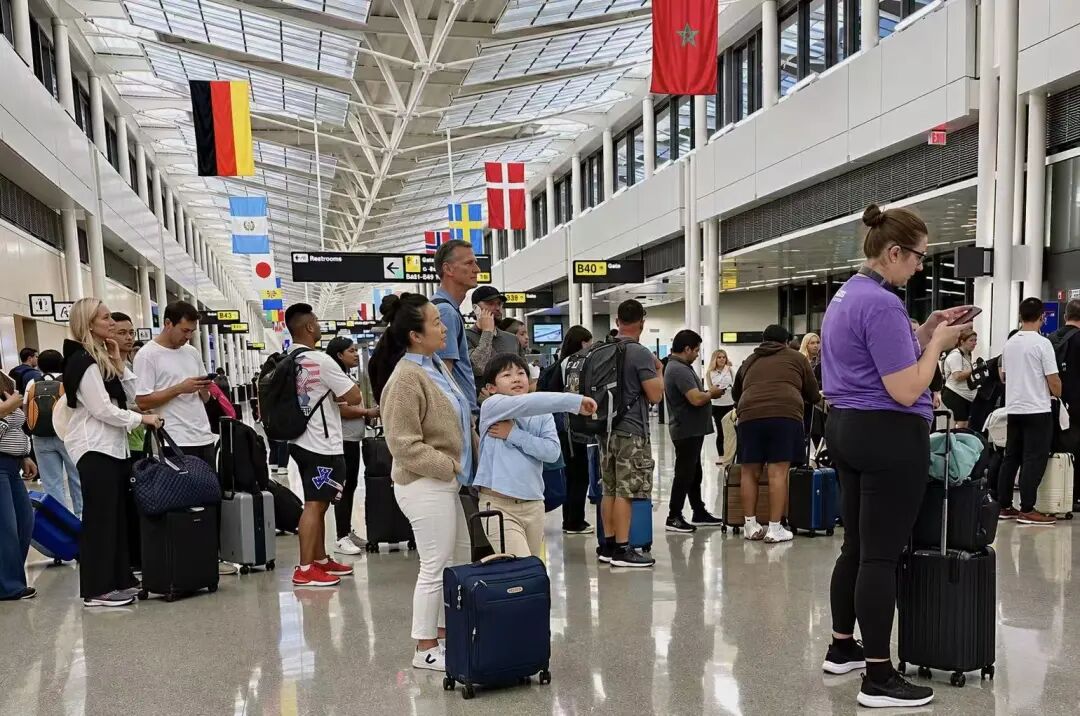
The ground stop order quickly sparked chaos at major airports. Photo by Jin Yan
U.S. Secretary of Transportation Sean Duffy confirmed on social media that the failure affected all Air Route Traffic Control Centers, which are responsible for air traffic control within their respective jurisdictions. Duffy stated at a White House press briefing on the evening of the 13th that starting at 3:36 p.m. that day, anomalies occurred at multiple air traffic control facilities across the United States, with inconsistent data returned by radars and problems in communications between controllers and aircraft. The FAA subsequently issued the ground stop order to ensure flight safety. He said the FAA still uses the outdated Time Division Multiplexing (TDM) communication system, whose switches and routers began transmitting inconsistent data due to data overload. After technicians took measures to reduce the load on the equipment, the control facilities resumed operation. The upgraded new IP devices did not experience the same problem. Duffy said there is no guarantee that such incidents will not happen again in the future.
As early as September 2024, the U.S. Government Accountability Office (GAO) issued a stern warning in its audit report: 51 of the 138 air traffic control systems managed by the FAA were rated "unsustainable", accounting for 37%; some key systems have been in operation for 30 to 40 years, and some even for half a century. Some air traffic control facilities still rely on floppy disks, paper flight progress strips and old copper cables to operate to this day. Spare parts for some old equipment even have to be found on second-hand trading platforms such as eBay.
Starting at 3:36 p.m. on the 13th, radar data and communications at multiple route control centers and terminal radar approach control facilities began to become unstable. The failure affected 22 regional route control centers across the United States. These centers undertake route control for aircraft flying between airports, are responsible for coordinating flight tracks and maintaining safe separation, and are key hubs of the U.S. air traffic network. Flight operations at major airports such as Washington Ronald Reagan National Airport, New York LaGuardia Airport and New Jersey Newark Liberty International Airport were subsequently disrupted. Duffy emphasized that radars and communications were not completely interrupted, but the instability of data and contact was sufficient to constitute an unacceptable safety risk.
Data from flight tracking website FlightAware showed that as of 6:40 p.m. that day, more than 3,300 flights across the United States had been canceled, and more than 10,200 others had been delayed; at the same time, major airlines had begun to cut weekend flights, and more than 300 flights had been canceled on Saturday. The nationwide ground stop order was lifted at 8:15 p.m. on the 13th. Airlines are currently facing the challenge of resuming flight schedules. As airlines redeploy aircraft and crew members to their designated positions, the impact of delays and cancellations may continue to spread throughout the entire air transportation system. This air traffic interruption that lasted for more than four hours once again exposed the long-term aging of critical U.S. infrastructure, lagging technological updates, and the systemic risks faced by highly interconnected communication networks.
U.S. Secretary of Homeland Security Alejandro Mayorkas said at the White House that the incident was a telecommunication system outage, and he said, "There is currently no indication that this is a malicious attack against us", and emphasized that "this is not another 9/11 incident". The ripple effect of this ground stop order is expected to continue to spread. Data from aviation analysis firm Cirium showed that as of 4 p.m. that day, about 11,000 flights were still scheduled to take off from various U.S. airports. A large number of aircraft and crew members were unable to be in place as a result, which could trigger cascading scheduling chaos throughout the weekend.
Washington resident Flor told *Caijing* that the 13th was an important wedding anniversary for her family, but due to the sudden ground stop, her plane was forced to turn back to the gate while taxiing, passengers were asked to disembark, and the crew informed that the delay could last for several hours. She had no choice but to cancel all arrangements for that night. Many passengers were trapped at the airport, and the boarding gates were overcrowded.
People familiar with the matter said the failure appeared to involve a telecommunications network managed by L3Harris Technologies, which is responsible for transmitting critical radio communications between controllers and pilots. Multiple unnamed sources quoted by media outlets said that a network update triggered a system restart, and the system then crashed, causing communication interruptions. This specific trigger process had not been officially confirmed at that time. L3Harris also did not immediately respond to media requests for comment.
Sean Duffy said the U.S. air traffic control system is "extremely old" and relies on analog systems that are already overloaded. "This is an emergency," he said, calling on Congress to provide emergency funding for upgrades and renovations, which is estimated to cost 50 billion U.S. dollars. Previously, the Modern Skies Act proposed an additional investment of 30 billion U.S. dollars, covering digital architecture upgrades, renovation of old facilities and airport construction.
The deeper problem is that capital investment is also constrained by project management capabilities. A 2026 September audit by the U.S. Government Accountability Office found that the FAA has not yet established a reliable full-lifecycle cost estimate for the new round of air traffic control modernization plan, nor has a unified master schedule to coordinate various projects, with more than 10,000 project schedules scattered and disconnected. Without such overall planning, even if appropriations increase, the project may still fall into cost overruns, construction delays and operational disruptions. Whether public investment can be transformed into reliable air traffic control capabilities depends on whether procurement, construction, system integration and safety verification can be continuously advanced under the same set of plans.
Even if Congress quickly approves the appropriation, such a large-scale transformation will take several years to complete. The air traffic control network must be gradually updated while maintaining daily operations. The parallel operation of old and new systems, equipment compatibility and personnel training have all increased the implementation difficulty. There is therefore a long transition period between the approval of appropriations and the elimination of risks. During this period, old facilities will still undertake key tasks, and maintenance support and emergency response capabilities must also be maintained simultaneously.
The nationwide ground stop in November 2026 is the third such incident in U.S. history. The previous two occurred after the 9/11 attacks in 2001, and when a key system of the U.S. Federal Aviation Administration failed in January 2023. The first two incidents were more than 20 years apart, while the latter two were only more than three years apart, both triggered by system failures.
Behind technical debt and the dilemma of congressional appropriations, there is also a game of interests centered on cost sharing. Scott Kirby, CEO of United Airlines, viewed private jet lobbying groups as an important resistance to air traffic control reform in an interview. The funding for the U.S. aviation system mainly comes from the Airport and Airway Trust Fund, of which the largest part of tax revenue is related to passenger transport, borne by passengers through ticket taxes, segment taxes and other fees; private and business jets for personal use mainly pay through fuel taxes. A business jet carrying only a few people also requires route coordination, safety separation and approach guidance, and the required control services do not decrease proportionally with the reduction in the number of passengers. In busy airspace, this asymmetry between resource occupation and payment methods continues to trigger distribution disputes between commercial aviation and private aviation.
This dispute also concerns the control of the air traffic control system. Commercial airlines hope to accelerate equipment updates and improve operational efficiency through institutional restructuring and stable financing; organizations such as the National Business Aviation Association and the Aircraft Owners and Pilots Association are worried that the new charging mechanism will increase flight costs, and that large airlines will occupy an advantage in the governing body, squeezing the use space of general aviation and small airports. Even if some reform plans grant general aviation user fee exemptions, this kind of concern has not been eliminated. In 2017, the Trump administration promoted the transfer of air traffic control operations to an independent non-profit organization, which was strongly opposed by relevant groups and ultimately failed to pass in Congress. Technological updates have thus been involved in more difficult-to-reconcile political negotiations: how to change the financing method, how to allocate decision-making power, and how to protect the interests of different users.
This conflict of interests has increased the coordination cost of reform, and made it more difficult to obtain continuous and stable support for multi-year infrastructure renewal. Although Congress allocated an additional 12.5 billion U.S. dollars for air traffic control modernization in 2025, there is still a long implementation process between the arrival of appropriations, equipment deployment and the decommissioning of old systems. Kirby's criticism reveals a dilemma in U.S. infrastructure governance: the public benefits of upgrades take many years to materialize, while the redistribution of costs and power will immediately touch organized interests; the risks accumulated by delayed reform will eventually be borne by the entire aviation network and its passengers.
This article is from the WeChat official account "Caijing Magazine", author: Jin Yan, editor: Su Qi, published by 36Kr with authorization.