The most profit-savvy boss in Suzhou posted a quarterly loss of 400 million yuan, and his 68-year-old wife has stepped up to take charge.
At the end of October, Canadian Solar, long known as a "top student", released a fragmented performance report: in the third quarter of 2026, its single-quarter revenue reached 5.863 billion yuan, down 42.63% year on year; the net profit attributable to shareholders was a loss of 395 million yuan, down 253% year on year.
In the "winter" period of the photovoltaic industry, this figure is not surprising, but it is particularly eye-catching for Canadian Solar. Just a year ago, when the whole industry suffered widespread losses, it made a profit of 1.016 billion yuan against the trend; one year earlier, it earned even more — 2.247 billion yuan, making it one of the rare "counter-cyclical profit-making samples" in the photovoltaic industry.
Source: Visual China
Its past experience is easy to sum up: it made early layout in energy storage and bet on the high-margin U.S. photovoltaic module market, which has also become a major trend for photovoltaic enterprises in recent years. The difference is that Canadian Solar can always turn around in advance when making profits to lay out the next profit point.
This time, an investor's comment on Xueqiu is very straightforward: even the "good student" has fallen. But some voices say this is a positive financial report: the net inflow of operating cash flow in the third quarter was 775 million yuan, while it was negative in the second quarter; the non-recurring loss narrowed by about 17% month on month; the gross profit margin in a single quarter rose instead of falling.
The official attribution is very simple: the growth of the energy storage business is not enough to offset the reduction in the volume of the photovoltaic module business. To put it plainly, the photovoltaic module business is losing blood, and the energy storage business is making up for it, but the speed of making up cannot catch up with the speed of loss. This tug-of-war is Canadian Solar's current situation, and it has been trying to level the gap between the two.
What appeared earlier than the financial report problems was the personnel change.
In September, Zhuang Yan, the president of the company, "retired upon reaching the age limit", and his original term of office was due to expire on December 19, 2026. His successor is Zhang Hanbing, co-founder of the company, 68 years old and the wife of Qu Xiaohua, chairman of Canadian Solar. Zhang Hanbing did not play the role of "chairman's wife" in the past, and her resume is highly related to keywords such as capital, globalization, and internal control; Zhuang Yan did not leave, but transferred to the chairman of Shenzhen Wencu Technology, a subsidiary, to develop residential energy storage business.
Some media gave a straightforward conclusion: after the top-level design of the organizational structure was transformed, power was obviously concentrated in the founder's family, and energy storage has changed from the "second growth curve" to the "main force".
In every business cycle, whenever the founder couple takes back power, the market will always sense a certain signal. But in the business context, this is not a simple power take-back, but more like a "helpless move" in the adjustment period. To put it plainly, Canadian Solar is facing a large number of problems — the realization rhythm of the U.S. joint venture model, the maintenance of energy storage gross profit margin, the stop-loss boundary of photovoltaic module contraction... It is not difficult to understand that every card to be played next requires the risk-bearing capacity at the founder level, as the couple are pushed to the front stage.
Since October, Qu Xiaohua and Zhang Hanbing have received more than 70 institutions one after another, stating that they "are confident in the steady recovery in 2027" and will stick to the three bottom lines of cash flow, risk control and quality. *China Entrepreneur* contacted Canadian Solar regarding the above actions, but as of press time, no reply had been received.
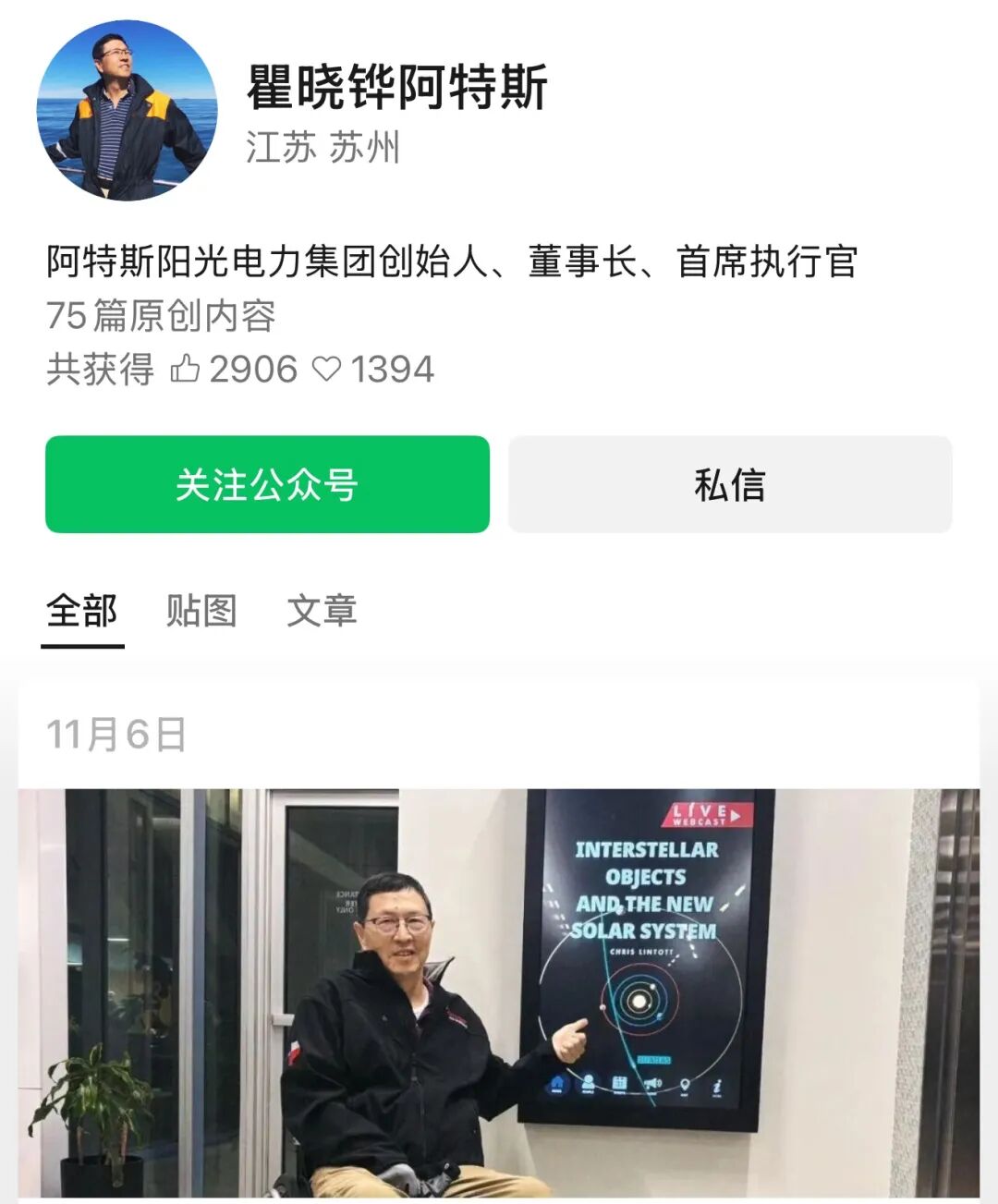
In the past two years, Qu Xiaohua in the public view has been low-key. He rarely accepts media interviews or appears in industry forums, but his "sense of presence" has never been broken, and his personal WeChat official account "Qu Xiaohua Canadian Solar" keeps updating.
Source: Screenshot of WeChat Official Account
In the past, Canadian Solar was used to playing "dislocation" battles, the most typical of which was turning to energy storage when photovoltaic modules were still highly profitable, and the performance of this move was not reflected in the financial statements until 6 years later. Zhang Hanbing's first move after taking office also follows this "dormant" strategy, for example, selling idle land, plants and equipment in Thailand to two companies under the controlling shareholder to withdraw cash for the listed entity.
People who have successfully gone through several cycles know very well that in the winter survival stage, cash is more important than scale. And this time, in addition to cash, speed is also crucial.
01
"Dislocation"
Qu Xiaohua's ancestral home is Changshu, Suzhou, and the label of "fighter" was attached to him in 2019. That year, he was in a car accident and suffered high paraplegia. 8 months after being injured, he returned to the company again. He said: Since this disaster is destined to happen, I will treat it with an ordinary mind.
At this time, Canadian Solar was already an established company. In November 2006, it was listed on NASDAQ, becoming the first photovoltaic enterprise listed on NASDAQ, earlier than JinkoSolar and JA Solar Technology. In June 2023, Canadian Solar returned to the A-share market. On the listing day, Qu Xiaohua got up slowly from his wheelchair and struck the gong. Since then, words like "willpower" and "Iron Man" have often been associated with him.
But in terms of strategy, Canadian Solar has a completely different style: it never fights hand-to-hand in the most crowded track, and thinks more about "what not to do".
In the early years, Qu Xiaohua once said: Canadian Solar does not want to be the leader, but only wants to be the last surviving photovoltaic enterprise. There are similar remarks: do not pursue the first place, only pursue first-class performance. Some industry media call this realism, while others say he has extremely strong self-discipline.
Source: Visual China
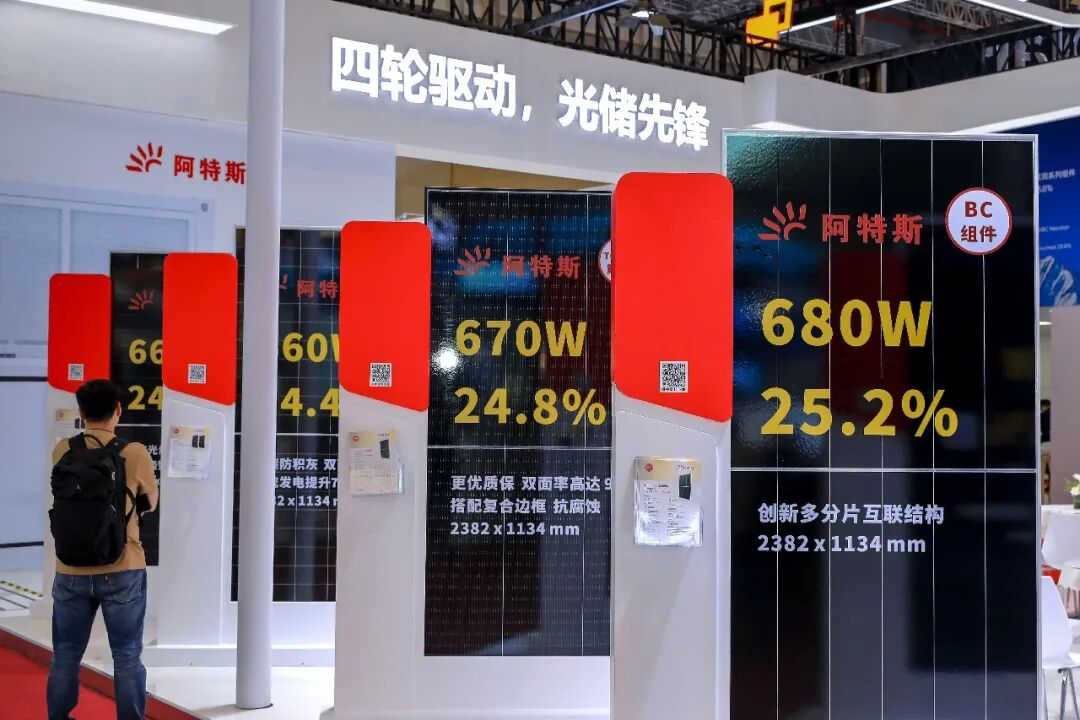
The most typical example is the latest cycle, when the whole industry was pouring money into expanding TOPCon (Tunnel Oxide Passivated Contact) production capacity and transforming to BC (Back Contact Cell) technology, Canadian Solar stepped on the brake. For the whole year of 2025, its module shipment volume was 24.3GW, a sharp drop from 31.1GW in 2024. The management stated bluntly in the report: adhere to the principle of profit priority, actively compress shipment volume and optimize shipment rhythm.
During the same period, the energy storage business grew rapidly — the large-scale energy storage business achieved sales of 7.8GWh, a year-on-year increase of 20%, with a gross profit margin significantly higher than that of the photovoltaic module business, becoming an important profit source of the company. By the first quarter of 2026, the trend became more obvious, and the large-scale energy storage shipment reached 2.6GWh, a year-on-year increase of 206%.
Canadian Solar seized the favorable position. When several leading photovoltaic companies suffered large losses, Canadian Solar made a profit of more than 500 million yuan. Some media interpreted this as the main business losing blood and the second growth curve being forced to make up for it, but this kind of "dislocation" is exactly the most familiar playing method for Canadian Solar.
In the first prosperous development period of the photovoltaic industry, the mainstream logic was "silicon is king". Enterprises queued up to set up silicon companies, signed 10-year long orders, and bet all their assets on the upstream industry.
But Qu Xiaohua chose the opposite direction. His logic is very simple: for enterprises to survive and develop, profitability is the key. Photovoltaic products are energy products, and energy must be cheap first to enter the market. Obtaining raw materials at excessively high costs violates this basic rule, "we can't take opium for temporary pleasure".
Therefore, at that stage, he restricted the procurement of silicon materials, arranged the production capacity only according to the consumption of one to two months, always kept cash on the books, postponed infrastructure projects, and paid off loans in advance. As a result, he escaped the disaster. A few months later, the price of polysilicon plummeted, enterprises that bet on the upstream were crushed by long orders and inventory, and Suntech Power eventually went bankrupt. Canadian Solar was not seriously injured and became the first among the major photovoltaic enterprises to turn losses into profits.
Subsequently, Europe and the United States launched "dual anti" (anti-dumping, anti-subsidy) investigations against China's photovoltaic industry, and Canadian Solar once again chose to "take a detour".
At that time, its industrial structure was an "inverted triangle", with less production capacity in the more upstream links. Zhuang Yan, then Senior Vice President of Global Sales and Marketing of Canadian Solar, put it very plainly: the company's module production capacity exceeded 2GW, while the cell production capacity was only 1.4GW, and the rest of the parts needed to be purchased externally.
Moreover, the externally purchased parts were not from China, but all transported to Canadian Solar's factory in Ontario, Canada for assembly, in order to get closer to the end market. Canadian Solar was not the only one adopting this strategy, but it took one more step than other peers, and the step was towards the downstream industry.
In 2009, it set up a subsidiary in Canada to develop power stations; in March 2015, it acquired Recurrent Energy, a solar business subsidiary of Sharp, for 1.656 billion yuan, becoming the world's second largest photovoltaic power station developer and operator; in October of the same year, it spent 270 million Canadian dollars to buy three grid-connected power stations owned by KKR in Ontario, with a total capacity of 59.8MW.
It changed from selling modules to selling power stations. It earns three streams of revenue at the same time: "equipment sales + premium from resource development + EPC (Engineering, Procurement and Construction)". The gross profit margin of this business is much higher than that of the manufacturing industry.
Even though this set of strategies never made Canadian Solar occupy the top position in the industry, it survived every round of big reshuffle. For a long time, it ranked steadily among the top 5 in global shipment volume, and even outperformed LONGi Green Energy, the later "photovoltaic king", before 2018.
But this does not mean "invincible". In 2021, the comprehensive gross profit margin of LONGi Green Energy, Trina Solar, JA Solar Technology and JinkoSolar was all above 13%, while that of Canadian Solar was only 9.26%, down 9.21 percentage points year on year. Canadian Solar suffered a loss of 411 million yuan after deducting non-recurring gains and losses, making it the only loss-making one among the five giants in the photovoltaic module industry.
Qu Xiaohua later reviewed the situation very straightforwardly: "This 'inverted triangle' model made us suffer losses. But Canadian Solar is not a bookish enterprise after all, we also adjust according to the situation."
In those two years, Canadian Solar made great efforts to expand upstream. It expanded production capacity of ingot pulling, wafer slicing and cell production, changing the "inverted triangle" into a "trapezoid", where the downstream production capacity is still more than the upstream, but the level of integration has been significantly improved. In 2022, the company's non-recurring net profit returned to 2.062 billion yuan, filling the loss pit in just one year.
However, the cost is obvious. When upstream prices rose, Canadian Solar was passive everywhere in that period, and its ranking in global shipment volume declined in the overall industry expansion. In 2025, its global shipment ranking fell out of the top 5. But in that year, it made a profit of 1.016 billion yuan, still adhering to the principle of profit priority.
The ranking fell, but the profit remained, which is Canadian Solar's choice. Qu Xiaohua once said: Everyone has limited energy, so you have to make trade-offs.
02
Taking the Stage
Structural reversal is one of the most important narratives of Canadian Solar in the first half of 2026.
The sales of large-scale energy storage systems reached 6.1GWh, a year-on-year increase of 103.3%; the revenue of energy storage business accounted for 44.26%, exceeding the revenue of photovoltaic modules for the first time in history; in the same period, the revenue of modules fell by 73.59% year on year. The total revenue is shrinking, but the energy storage business ensures that the company is still profitable. The market began to re-examine Canadian Solar's "retreat" in recent years, and the energy storage layout was made as early as 2017.
When photovoltaic modules were still highly profitable, Qu Xiaohua took the lead in setting up the energy storage department. At that time, the commercialization of energy storage was far from being realized, the domestic energy storage demonstration projects driven by "abandoned wind and photovoltaic power" had just started, and the overseas large-scale energy storage market had not even taken shape. This department existed "quietly" inside the company for six years.
It was not until 2023 that the first batch of energy storage system products rolled off the production line. At the off-line ceremony, Qu Xiaohua called it the "second growth curve".
This is different from the rhythm of the photovoltaic industry. The generational cycle of a photovoltaic cell is only 2 to 3 years, and one step slower means more risk of being eliminated. The cycle of energy storage projects is much longer, 5 years is already a fast speed from technology reserve, production line construction, certification to customer verification.
Therefore, when the demand for energy storage really exploded and the whole industry swarmed in, Canadian Solar already had production lines and orders in hand. In the first quarter of 2026, this structure realized performance for the first time: the shipment of large-scale energy storage reached 2.6GWh, a year-on-year increase of 206%.
Source: Visual China
While the new business is making up for the gap, personnel adjustments are also carried out under this background.
In May 2026, Qu Xiaohua said he had resigned as CEO of the U.S. listed group, and served as chairman and chief technology officer, focusing on the transformation of technology from concept to product. In September, at the main body of the listed company, Zhang Hanbing took over as president. The two moves are conventional arrangements when viewed separately, but when combined, the decision-making power is being taken back from professional managers to the founder's family.
Zhang Hanbing is not a sudden appointment, but a person who has been pushed to the front stage. She once worked as a stock trader at Canadian brokerage TD Waterhouse, and from 2005 to