A thief reports another thief to the police? AI is driving honest people to a dead end.
Guys, I've seen it all after all these years.
Old Fox has been in this industry for years, I've seen people copying code, stealing art assets, and even those who take an entire existing game, slap a new skin on it, and dare to sell it for money.
But just a couple of days ago, a bizarre incident happened on Steam that blew everyone's mind — two counterfeit game developers, the two fake impostors, actually got into a fight right in front of Valve's office over who copied whose work.
01
Impostor Reports Impostor
Here's what happened. Some time ago, a game called "Needle in a Haystack Simulator" went viral. Its gameplay is simply looking for a single needle in a haystack, which attracted a horde of copycats that smelled the profit.
A quick search on Steam can find at least 5 or 6 similar plagiarized games of this type.
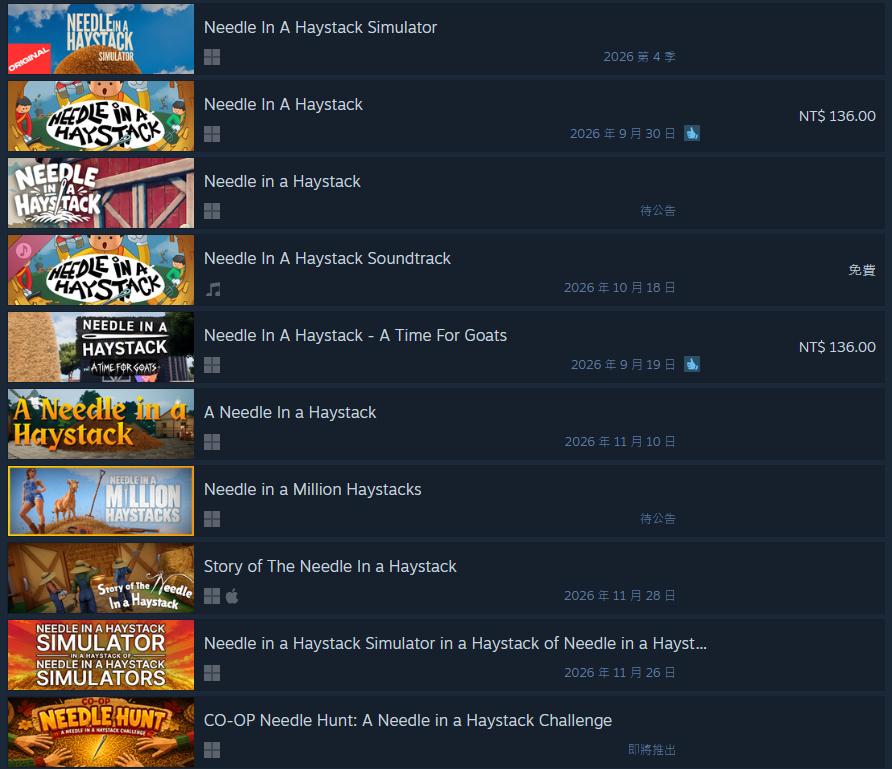
These people don't just leech off the original creator, after a while they find that their peers' works are even easier to copy, so something even more absurd happened.
One of the plagiarists, named No Glyph, is quite interesting. He stormed off to submit a copyright complaint to Valve, accusing another peer game called "A Game About Needle In A Haystack" of plagiarizing his work.
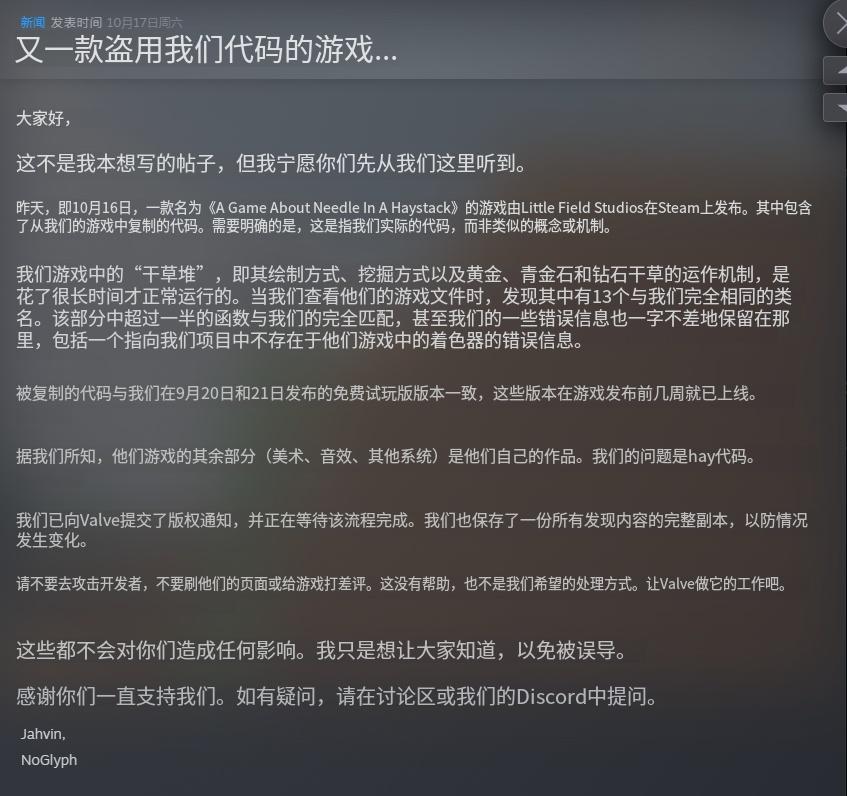
Why is that so ridiculous? Because in the other party's code, there are at least 13 classes that share the exact same name as his, even the error prompts are completely identical.
This is the legendary situation where someone copies homework so thoroughly that they even copy the name and typos from the original.
Do you think that's absurd enough? No, this is just the appetizer for the wild drama that's unfolding in the gaming industry this year.
With the help of AI, game plagiarism has now evolved to a chilling level.
If the "Impostor reports Impostor" incident is just a funny show for onlookers, the next case is a completely unprovoked disaster for independent developers.
A small two-person team from Lithuania called Lazy Flock spent years developing a cozy game named "Haunted Paws", which sets two little puppies venturing through a haunted house to find their owner. On October 28 this year, the game finally made its debut on the Nintendo Indie World Showcase, and launched a demo version on eShop.
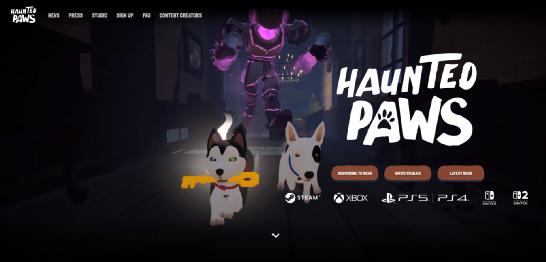
However, when players excitedly searched for the game name online, they were completely stunned.
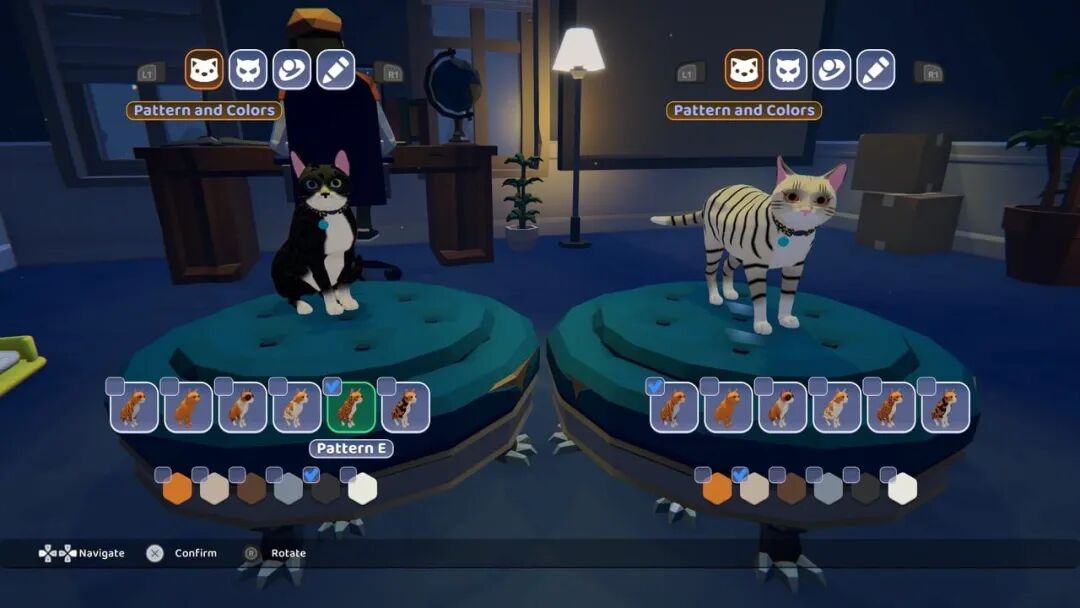
At the top of the search results was a game called "Ghostly Whiskers". It has the exact same gameplay: two characters go on an adventure in a haunted house to find their owner, except the two puppies are replaced by two little cats.
What's the most crushing part of this whole thing?
The official legitimate "Haunted Paws" won't be fully completed and released until May 2027, but this counterfeit "cat version" was already put on sale back in September this year!
There is still more than half a year before the official version is released, but the knockoff has been out for a long time. What's worse, the plagiarists don't even bother to pretend, they even copied the game cover blatantly.
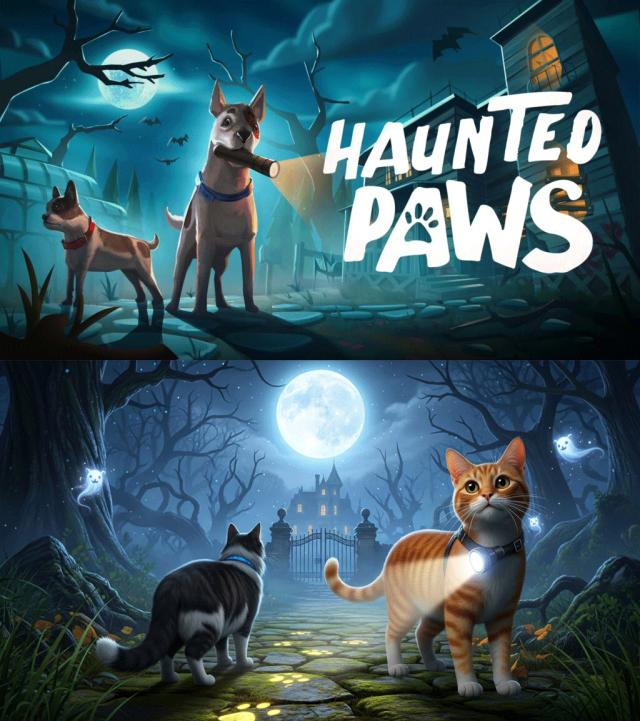
The game made by plagiarists may not be better than the official final version in the end, but they never expect to make a better product than you. On the contrary, what they want is precise positioning: they rush to launch their copy when your promotion is at its peak, and intercept all the traffic, search keywords and the first batch of curious players that should have belonged to you in advance.
What's even more suffocating is that these people are no longer satisfied with sneaking ahead. Some of them have directly turned this into a business of extortion.
At the Busan Steam Indie Connect conference on October 27, a developer directly poured out his grievances to the Valve representative: some people in the industry have received threatening emails, the other party tells you clearly — "Transfer 200 US dollars to me immediately, otherwise I will use AI to replicate your game, and launch it on the platform before you do."
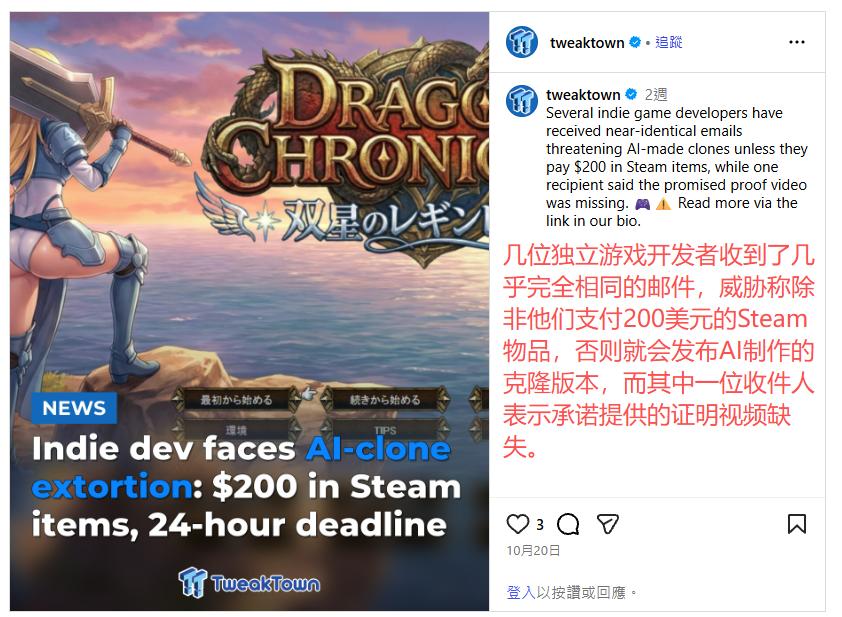
200 US dollars is equivalent to only more than 1,400 RMB. The amount is not large, but it is extremely insulting and intimidating. Even the well-informed Valve representative Tom Giardino was stunned after listening, saying "I have never heard of such an operation in my life", and finally he could only advise developers not to submit platform complaints, but to call the police directly as a criminal case.
02
Is no one going to stop this?
Seeing this, many of you may feel the same as Old Fox, getting furious: Wait, are AI counterfeits this rampant now? Shouldn't the law step in and manage this?
Ah, you hit the nail on the head. The most desperate part of this matter is exactly that the law really can't do much about it.
Legally, the logic of copyright laws around the world is actually the same: copyright only protects the specific "expression", specifically your code or the original art you drew, but it does not protect "ideas". In the context of games, that refers to gameplay, rules, core mechanics and so on.
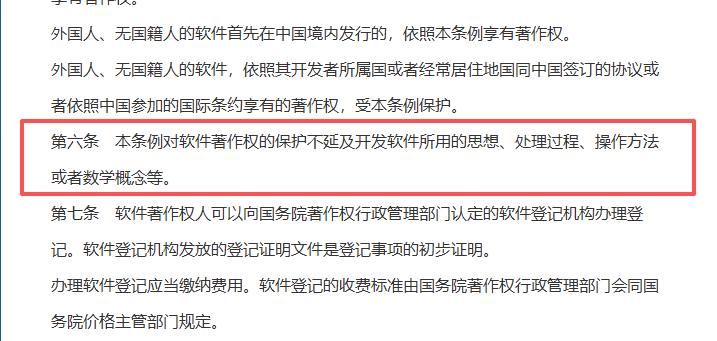
Correspondingly, today's AI, in a sense, has completely destroyed the "physical moat".
In the past, an independent developer dared to post their daily development updates and gameplay demos on social platforms, because they had full confidence.
Even if someone takes a fancy to his idea and wants to write code, draw art assets and adjust the game feel from scratch, it will take at least three to five months. This time difference is the moat for the official game, the original creator can always launch faster than the pirated version, which gives them a strong sense of security.
But what about now?
You post a 15-second demo video this morning, in the afternoon others can use a multimodal large model to analyze it, AI automatically generates code, AI generates a full set of art textures, and in the evening the counterfeit version is already packaged and uploaded to Steam. The cost of plagiarism has been infinitely compressed.
This is not alarmist talk. Around March this year, a similar incident happened to the Japanese indie game "Typing Magician".
The original creator kept posting project progress videos on YouTube.
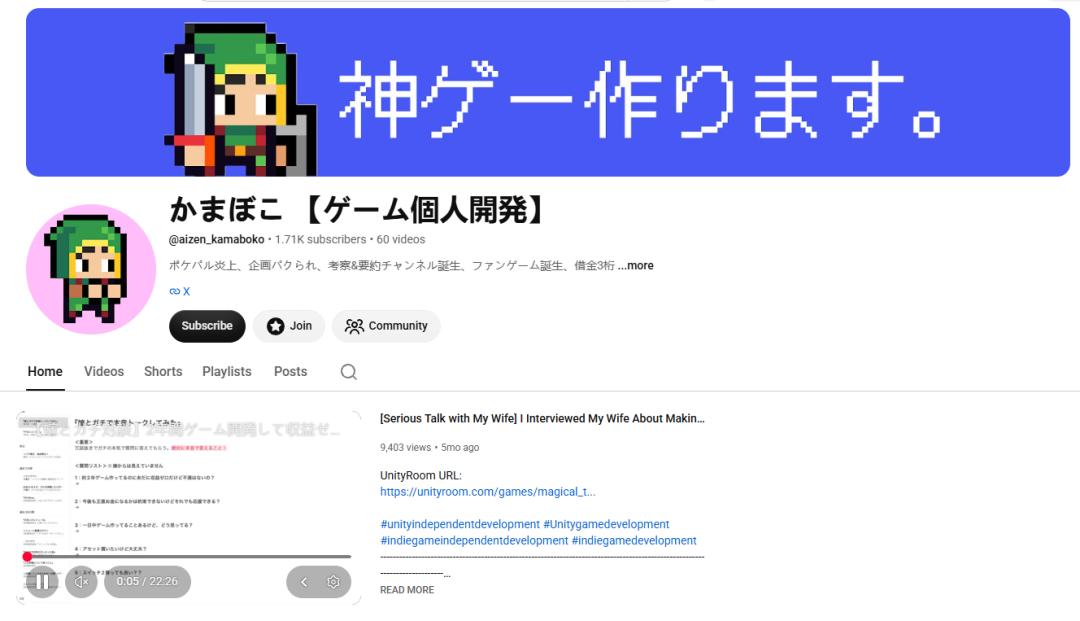
They also introduced the existing development functions and plans of the game in detail, and showed the game footage. This is very normal for many indie game developers, it can not only promote the work, but also absorb feedback from the community and record the development process.
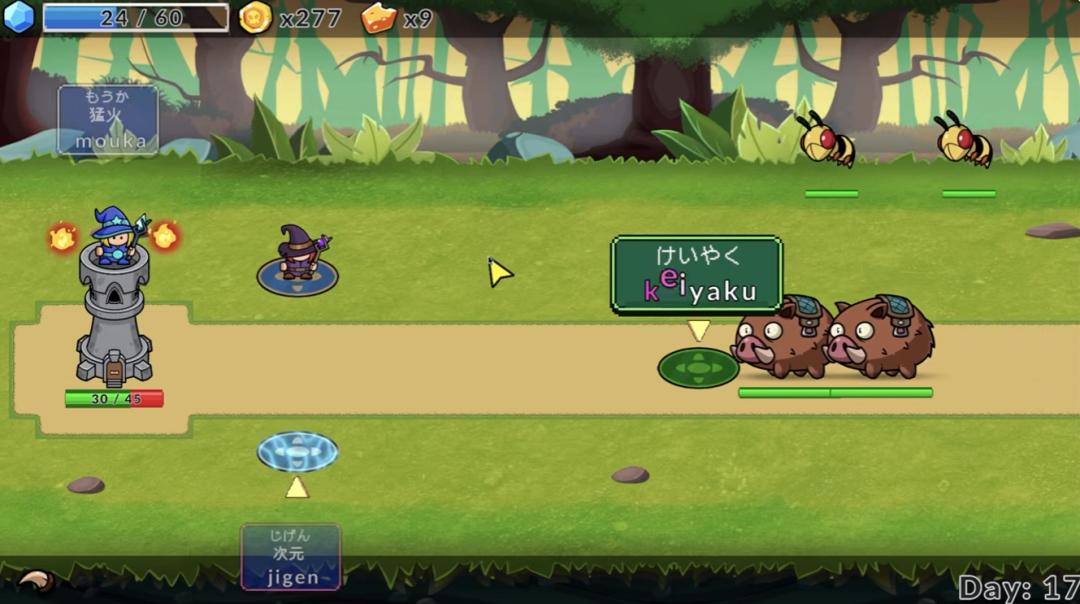
However, soon after, their indie game was plagiarized.
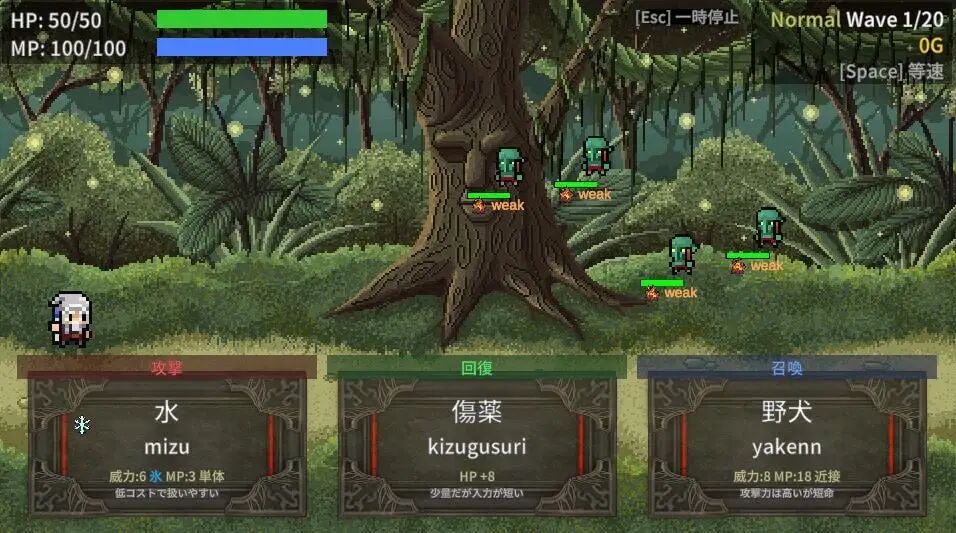
The most interesting part is that the plagiarists themselves admitted: by inputting the development progress demonstration video into the AI model, they only spent 2 hours to make this counterfeit game.
At the same time, they realized that now "game development has become extremely simple", and "the required skill level is about the same as working part-time at a convenience store".
03
Indiscriminate AI Strike
Of course, you don't think only the unlucky people in the gaming industry are going through this, right? Broaden your horizons. When it comes to AI lowering the threshold for malicious activities, no industry is innocent.
The AI plagiarism wave in the gaming industry has just emerged, while the adjacent hacking industry has already completed a vigorous "industrial upgrading" with the help of AI.
According to the October data just released by Japan MM Research Institute, from January to September 2026, there were as many as 454 publicly disclosed cyber attack information leakage incidents in Japan, a year-on-year surge of 49%.
As of October 13, this number has risen to 485, breaking the full-year record of 432 incidents set in 2025 more than two months in advance.

Many well-known big companies are among the victims:
Car sharing giant Times Car had 6.6 million account information leaked; the super popular chain barbecue restaurant "Yakiniku King" had more than 10.78 million member information exposed; just on October 28, Japan Airlines (JAL) also suffered a loss: due to unauthorized access to the outsourced passenger system, the names, flight information and even passport numbers of about 92,000 passengers were all accessed by external personnel.
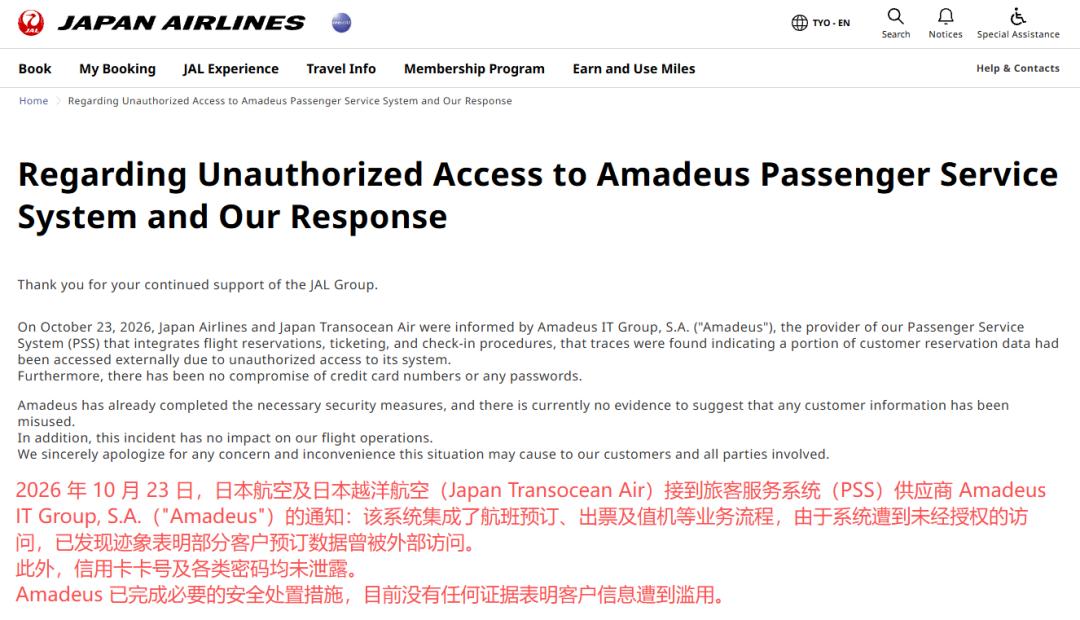
The reason is exactly the same as that in the gaming industry.
In the past, top hackers were all skilled craftsmen, they had to review code line by line, find system vulnerabilities, write exclusive attack scripts, and spend weeks testing and penetrating, the threshold was high and the work was time-consuming and laborious.
But now? AI has become a super cheat tool for hackers.
Analyzing code, locating vulnerabilities, generating attack scripts, and even screening attack targets on a large scale can all be completed automatically by AI. The dirty work that used to take a team several weeks to finish can now be done by one person in a few hours while drinking coffee.
At the end of the day, technology itself has no inherent good or evil, but technology is always a magnifying glass.
Whether it is the indie game developer who spent years of hard work only to have their work intercepted by AI in a few hours, or the corporate defense line that is vulnerable to fully automatic hacking scripts,
All these are sounding the alarm for us, but it doesn't seem to work. AI is still advancing at a speed that we can't predict or even stop.
And we have to admit that AI never picks its owner. While it helps us save the effort of repetitive work, it is also opening a door of efficiency that was never imagined for illegal gray industries.
This article is from the WeChat Official Account "Tech Fox" (ID: kejihutv), author: ZJ, published with authorization from 36Kr.