The virtual cell company incubated by XtalPi has completed its Pre-A round of financing, raising more than 100 million RMB from investors including Hua Capital, HSG and Xinglian | 36Kr Exclusive
Written by Hu Xiangyun
Edited by Hai Ruojing
36Kr has learned that virtual cell firm Boundary Evolution has completed a Pre-A round of financing exceeding 100 million yuan. This round of financing is jointly invested by institutions including Starlink Capital, Prosperity7, Harvest Capital, Huakong Fund and DT Capital Partners, with additional investment from existing shareholders Shunwei Capital, HSG and Songhe Capital. This is also the second round of financing completed by the company within half a year.
According to Boundary Evolution, the funds from this round will be used to promote the deep collaboration of cell response prediction, scientific hypothesis testing and high-throughput automated experimental feedback, and build an AI biology platform covering "target discovery - virtual screening - clinical protocol optimization".
Since 2026, the concept of virtual cells has moved from academic papers to the capital market. Statistics from Artery Think Tank show that the total financing amount in the global virtual cell sector has exceeded 3 billion U.S. dollars. The reason why capital is rapidly concentrated in this track is not complicated. In the past few years, the progress of AI pharmaceutical research has mainly focused on the molecular level, and algorithms for generating compounds that can bind to targets have been relatively mature, but what happens after molecules enter cells still requires experimental verification. Virtual cells are designed to fill this gap, helping researchers judge which directions are more worthy of investment before conducting experiments.
However, for predictions to be credible, the premise is that the model has seen sufficient high-quality cell perturbation data, which is exactly the bottleneck recognized by the whole industry. According to estimates from a research report, the currently available high-quality, labeled perturbation data is about 1000 times less than the demand for model training, and negative results are particularly scarce because failed experiments are rarely published, and internal data of pharmaceutical companies will not be shared externally. However, the continuous and standardized production of experimentally significant data with causal meaning takes time, so the focus of competition among enterprises has also shifted from "whose model is smarter" to "who can send predictions back to wet lab verification faster".
Boundary Evolution was incubated by Jingtai Technology (02228.HK), and its core asset is the OCOO series of virtual cell foundation models covering cellular multi-omics. It has released OCOO-T, a virtual cell foundation model trained based on transcriptome data, which can directly model gene expression changes of cells under perturbation. In layman's terms, after entering "what drug to use, which gene to knock out, and how long the effect lasts", the model will try to output "how the transcriptome of this batch of cells will change".
In the same-condition evaluation of three authoritative single-cell perturbation benchmarks including Tahoe100M, Replogle and PBMC, OCOO-T has achieved leading performance. Although such predictions cannot replace animal experiments or clinical trials yet, they can help researchers avoid detours in the stages of project initiation, target comparison and experiment prioritization.
Source: Boundary Evolution
However, only building models is no longer a new story in today's AI4S track. Boundary Evolution has proposed a mechanism called "Recursive Scientific Discovery (RSD)". It draws on the idea of "Recursive Self-Improvement (RSI)" in the AI field, but expands the improvement object from the model itself to the entire scientific research process. For example, how scientific research questions are raised, how hypotheses are deduced, how analyses are conducted, and what is left behind by successful and failed experiments... All of these will be continuously recorded, associated and reused.
At present, Boundary Evolution has launched two products based on this mechanism. The first is the hypothesis mining engine The Popper Project (TPP). By connecting to scientific research agents and multi-source databases, it will generate, question and refine testable hypotheses, and mark evidence and gaps with traceable reasoning chains. The other is the Karl Workbench scientific research workbench, which aims to make recording, accumulation, output, supervision and evolution part of the daily research process, and has now entered the internal testing stage.
According to information provided by Boundary Evolution, in October this year, in the retest of SciAgentArena, a scientific research Agent benchmark jointly released by Yale University, the Broad Institute and other institutions, Karl Workbench equipped with the DeepSeek foundation model "ranked first in both the single-cell omics and spatial omics scenarios".
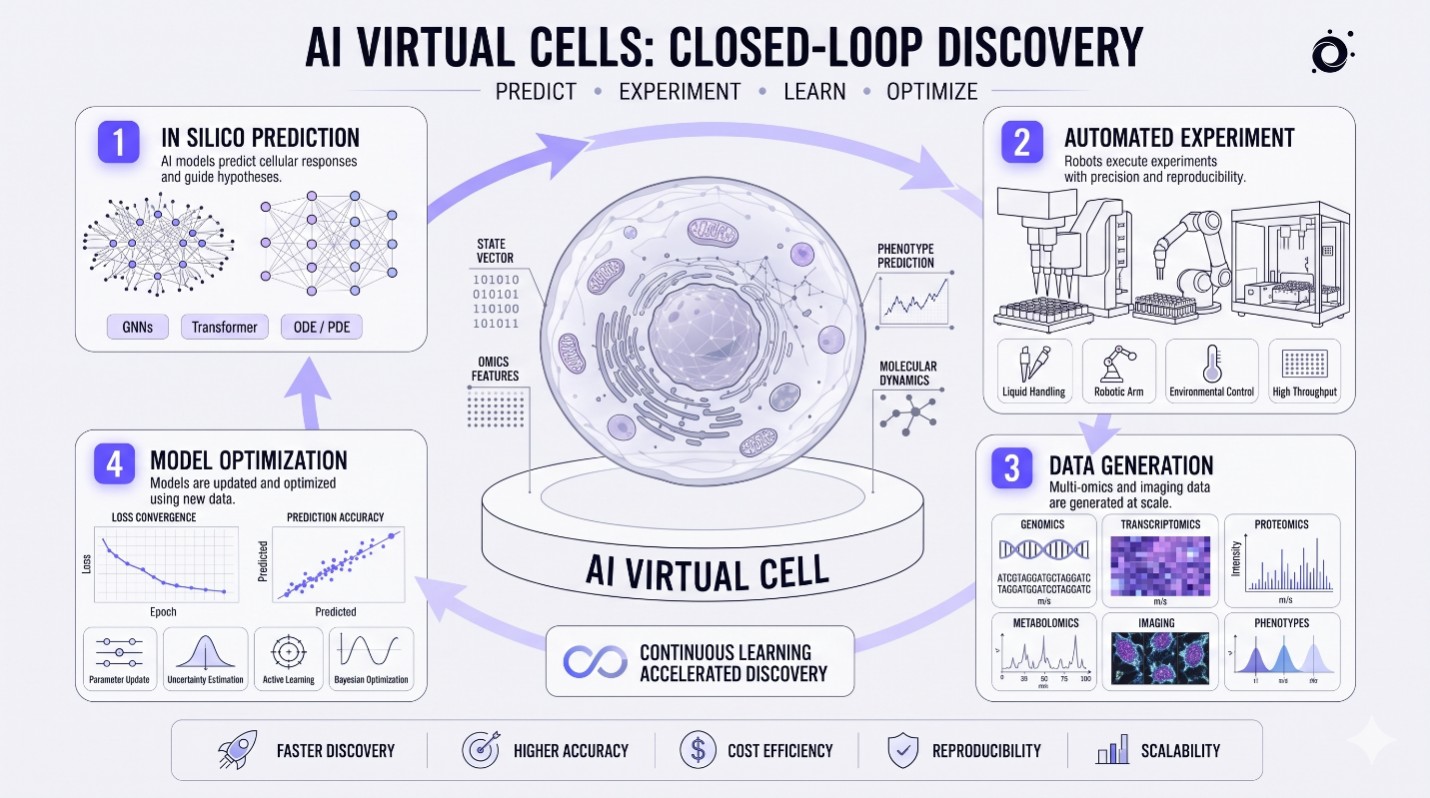
At the same time, no matter how accurate the model prediction is and how complete the hypothesis deduction is, the final result must return to evidence. Therefore, the other half of Boundary Evolution's "solution" is on the experimental bench. The company has built an automated experimental system covering cell culture, perturbation and multi-omics detection. After the model selects directions that are more worthy of verification, completes experimental verification of predictions and generates new data, the new data will be used to improve the model again.
This is actually the "dry-wet closed loop" repeatedly mentioned by AI4S enterprises. The difficulty lies in making it operate stably, because if any link including experimental throughput and data standardization goes wrong, the model may fail to achieve the expected results. In response, Boundary Evolution's solution is to develop both the experimental system and data management: using automated equipment to increase throughput at the front end, adopting a unified data and research output management mechanism at the back end, and feeding the results of each experiment back to the model.
In addition, clinical scenarios are a more "rigorous" verification method. According to Boundary Evolution, the company has participated in the co-construction of the "Beijing Key Laboratory of Hepatobiliary and Pancreatic Tumor Organoid Culture and Intelligent Diagnosis and Treatment" led by Peking University First Hospital, hoping to integrate virtual cell capabilities into patient-derived organoid samples, so that AI predictions and experimental results on real samples can correct each other. "This may be slower than scoring high on public datasets, but it is the only way for virtual cells to enter the front line of drug R&D," said Boundary Evolution.
According to other introductions, the industrial background of Jingtai Technology will provide another layer of support for Boundary Evolution. The former's accumulation in molecular design, automated synthesis and drug pipelines makes it possible to connect "molecule generation - cell response prediction - wet experiment verification" in the same system, and also allows the model to face real pipelines from the early stage of R&D, rather than only public benchmarks.
"The scale of drug R&D lies not only in the precision of molecular engineering, but also in the depth of human understanding of complex life and disease mechanisms. We hope to couple massive biological data, large models and self-evolution methods to improve the certainty of innovative drug R&D. Co-founder Zhao Yalong also mentioned that this round of financing will be mainly used for foundation large model R&D, expansion of the high-throughput automated dry-wet closed-loop system and industrial ecosystem construction," said Lai Lipeng, co-founder of Boundary Evolution.