The 3.5-trillion-yuan national medical insurance fund will pay for these new drugs next year.
By Hu Xiangyun
Edited by Hai Ruojing
Anti-cancer CAR-T therapy priced at millions of yuan per dose that can cure patients with one injection, "miracle flu drug" that only requires one tablet for the entire treatment course, and the wildly popular GLP-1 hypoglycemic agents... A new batch of new drugs are now eligible for reimbursement under China's national basic medical insurance program.
On November 14, 2026, the 2026 version of the National Reimbursement Drug List (NRDL) was officially released, adding 107 new drugs including 51 Class 1 innovative drugs. After adjustment, the total number of drugs in the list has increased to 3331.
The dynamic adjustment of the NRDL has entered its 9th year, with the basic rule of "replacing old products with new ones, allowing both entry and exit" long established. However, behind the annual list adjustment that determines the usage of the 3.5-trillion-yuan medical insurance fund, the game remains complex: some new drugs have high public demand, but are blocked by the implicit threshold of "no negotiation below 500,000 yuan, no admission below 300,000 yuan"; some other drugs with outstanding clinical value have long failed to reach patients due to difficulties in hospital admission or fund pressure.
Even so, this year's new version of the list still delivers several better-than-expected outcomes.
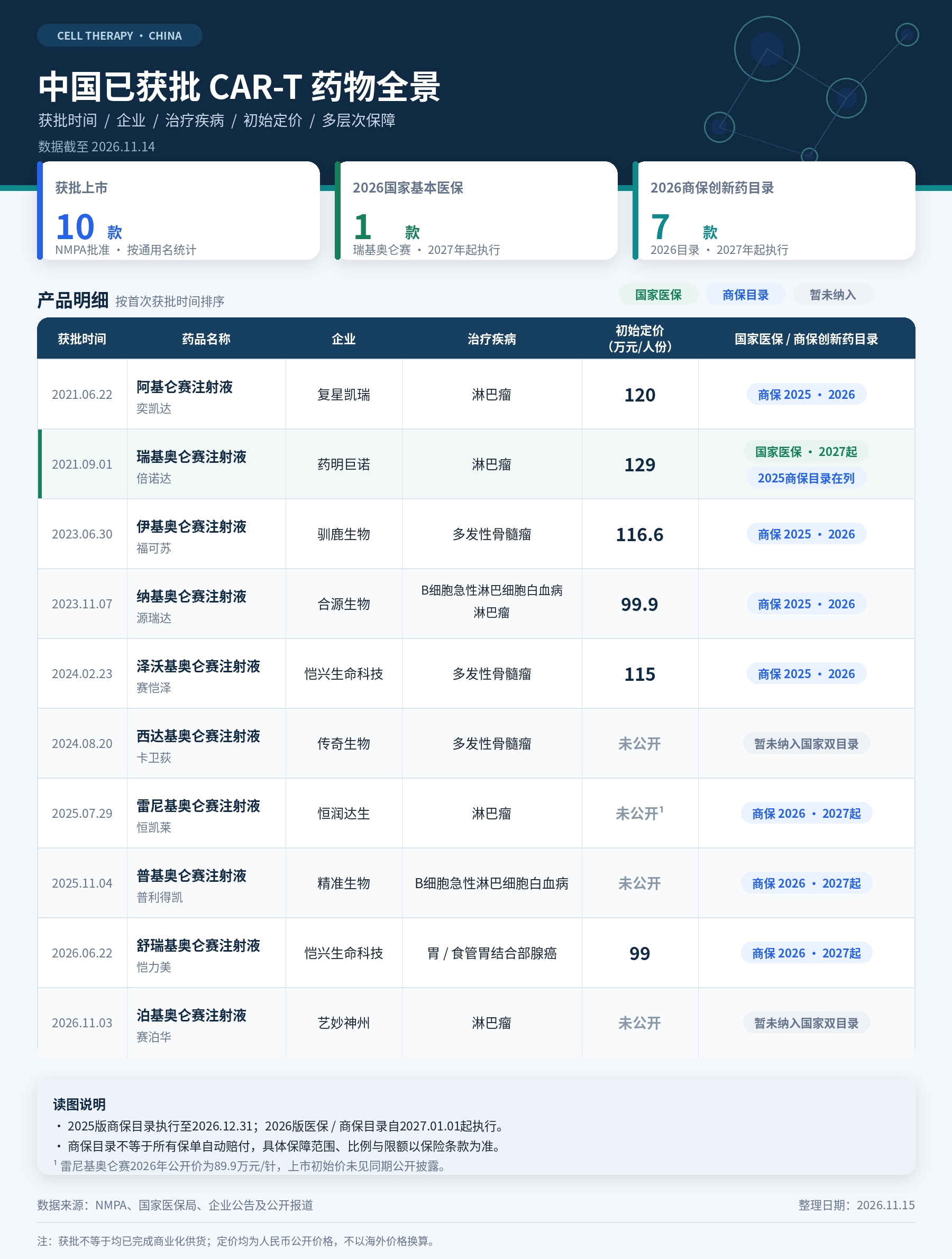
The most representative product is the "anti-cancer injection" CAR-T. Since the first domestic CAR-T therapy was launched in China in 2021, after 5 years of waiting for reimbursement eligibility, Relmacabtagene Autoleucel from JW Therapeutics, which was once priced at 1.29 million yuan per dose, has been included in the NRDL for the first time, becoming the only CAR-T product currently eligible for medical insurance reimbursement.
The NRDL-negotiated price of Relmacabtagene Autoleucel is 288,600 yuan. Calculated based on the average 70% reimbursement rate for inpatient expenses under resident medical insurance, the out-of-pocket cost for patients will drop below 100,000 yuan starting next year. The National Healthcare Security Administration also emphasized that this product will continue to enjoy the preferential "three exemptions" policy for a certain period, which means the difficulty of its admission to medical institutions will be reduced.
In addition, many "star products" in disease fields with high-incidence major conditions such as oncology, metabolism, and respiratory system have also been included. In terms of anti-tumor drugs, the bispecific antibody ADC Lenkaprilontamab from Baili Tianheng and the bispecific lymphoma drug Epcoritamab from AbbVie are both included in the NRDL for the first time; the GLP-1 hypoglycemic agent segment sees a major breakthrough, with 4 products including Masi duotide from Innovent Biologics and Insulin Ecol + Semaglutide from Novo Nordisk all being selected.
The 1.29 million-yuan CAR-T has seen its price cut to 290,000 yuan
"CAR-T has carried out its own volume-based procurement," a practitioner in the cell and gene therapy (CGT) field joked after seeing the new NRDL. However, he believes that the inclusion of Relmacabtagene Autoleucel in the medical insurance list is a good thing, no matter from the perspective of patient benefits or capital recognition of the CGT track.
Ma Jun from Harbin Hematology and Oncology Institute told *Economic Observer* that up to now, only about 9,200 patients in China have received CAR-T treatment. In contrast, a large number of patients who meet the CAR-T treatment criteria cannot receive the therapy due to its high price. Tian Feng, Chairman and CEO of JW Therapeutics, said that every year, less than 4% of patients who meet the treatment indications receive CAR-T therapy.
In 2021, Relmacabtagene Autoleucel became the second CAR-T product launched in China, with its initial pricing of 1.29 million yuan per dose being the highest among the 10 approved CAR-T products in China. In the 5 years since its launch, Relmacabtagene Autoleucel has only treated more than 1,200 patients in total.
"I believe that only when the overall pricing of CGT products drops below 500,000 yuan or even 300,000 yuan, can this treatment option have practical significance. This will change patients' decision-making logic: the vast majority of Chinese patients will give up treatment once hearing the price of 1 million yuan, but when the price is within an affordable range, they will not delay the treatment until they have no other options, which avoids missing the treatment window, or the decline in cell preparation quality and reduced therapeutic effect caused by repeated chemotherapy. On the other hand, the increased willingness of patients to use CAR-T will also expand the growth space of the CGT market," judged Liu Liang, a CGT entrepreneur who used to be a doctor before starting his business.
Reducing the price of CAR-T has therefore become the common goal of CGT enterprises in the past few years.
Graphic by 36Kr
On the payment side, exploring various commercial insurance, inclusive health insurance, and outcome-based payment models are common practices. Last year, the National Healthcare Security Administration established the innovative drug list for commercial insurance for the first time to alleviate the problem that high-priced innovative drugs cannot be included in ordinary basic medical insurance, and provided the preferential "three exemptions" policy. CAR-T products from 5 enterprises including JW Therapeutics and Fosun Kite were selected collectively.
Information obtained by 36Kr from the National Healthcare Security Administration shows that after the implementation of this list this year, Relmacabtagene Autoleucel has recorded the highest growth rate in procurement amount and usage volume among the 5 CAR-T products. This is probably one of the reasons why JW Therapeutics took the lead in making a radical price cut to enter the NRDL.
However, relying solely on preferential payment policies cannot solve the fundamental problem. Liu Xiao, Vice President of Business at Xingcheng Bio, believes that the "simplest but most solid" path to make CAR-T products accessible to the public is to reduce manufacturing costs. He introduced that limited by the highly customized "one-to-one" preparation process, the production cost of a single dose of early CAR-T therapy reached 400,000 to 600,000 yuan.
In particular, when the CAR-T products of Fosun Kite and JW Therapeutics were launched, they were developed based on overseas introduced technologies. At that time, China's CGT industrial chain was not mature, with raw materials and equipment highly dependent on imports, leading to production costs of over 500,000 yuan for most products. Combined with early R&D investment and later marketing expenses, the industry generally believes that the price of millions of yuan per dose does not include excessive premium.
However, as the CGT industry continues to mature, it has become realistic to reduce the price of CAR-T. The "personalization" of CAR-T is mainly reflected in the links of patient T cell collection, in vitro transfection, expansion and reinfusion; while upstream raw materials and equipment such as lentiviral vectors, plasmids, and testing reagents can be produced in standardized prefabrication mode, and a localized supply chain has been formed.
Some insiders believe that considering the R&D and marketing expenses, to make profit from a CAR-T product priced at around 300,000 yuan, its production cost must be lower than 100,000 yuan.
According to 36Kr, for CAR-T enterprises whose products were launched in the past two years or are in the application stage, it will be relatively easier to control costs if they rely on the localized supply chain from the very beginning, and some enterprises have already achieved this goal. Some enterprises whose products are still under approval, such as Huada Bio, have even publicly claimed that their CAR-T products will be priced at 230,000 to 250,000 yuan.
However, for enterprises such as Fosun Kite, JW Therapeutics, and Legend Biotech (whose products are not actually on sale), switching to localized production means major process changes, which will also incur high costs. "It is not as complicated as the new drug marketing application, but it still requires a very formal approval process."
After the NRDL was released, Tian Feng also said that the price cut for medical insurance inclusion is mainly due to the localization of core raw materials such as lentiviral vectors.
A number of interviewees agreed that this price cut will directly enhance the market competitiveness of Relmacabtagene Autoleucel, and set a new pricing reference for other CAR-T products targeting the same indication, making subsequent price cuts an irresistible trend. However, this may bring certain pressure to enterprises that develop universal CAR-T and in-vivo CAR-T as alternatives to autologous CAR-T. "Autologous CAR-T has mature curative effect and better safety. Its only shortcoming used to be the high price, but now the shortcoming is gone, and its advantages are overwhelming."
Flu, migraine, dry eye disease...
New drugs for these common diseases are also covered by medical insurance
If high-value innovative anti-tumor drugs such as CAR-T solve the "life-saving" problem and reflect the original intention of the national medical insurance system to ensure that patients can access drugs with clear clinical value and reduce catastrophic medical expenditure, the supply of new drugs for chronic diseases and common diseases that are more closely related to ordinary people's health is also continuously enriched.
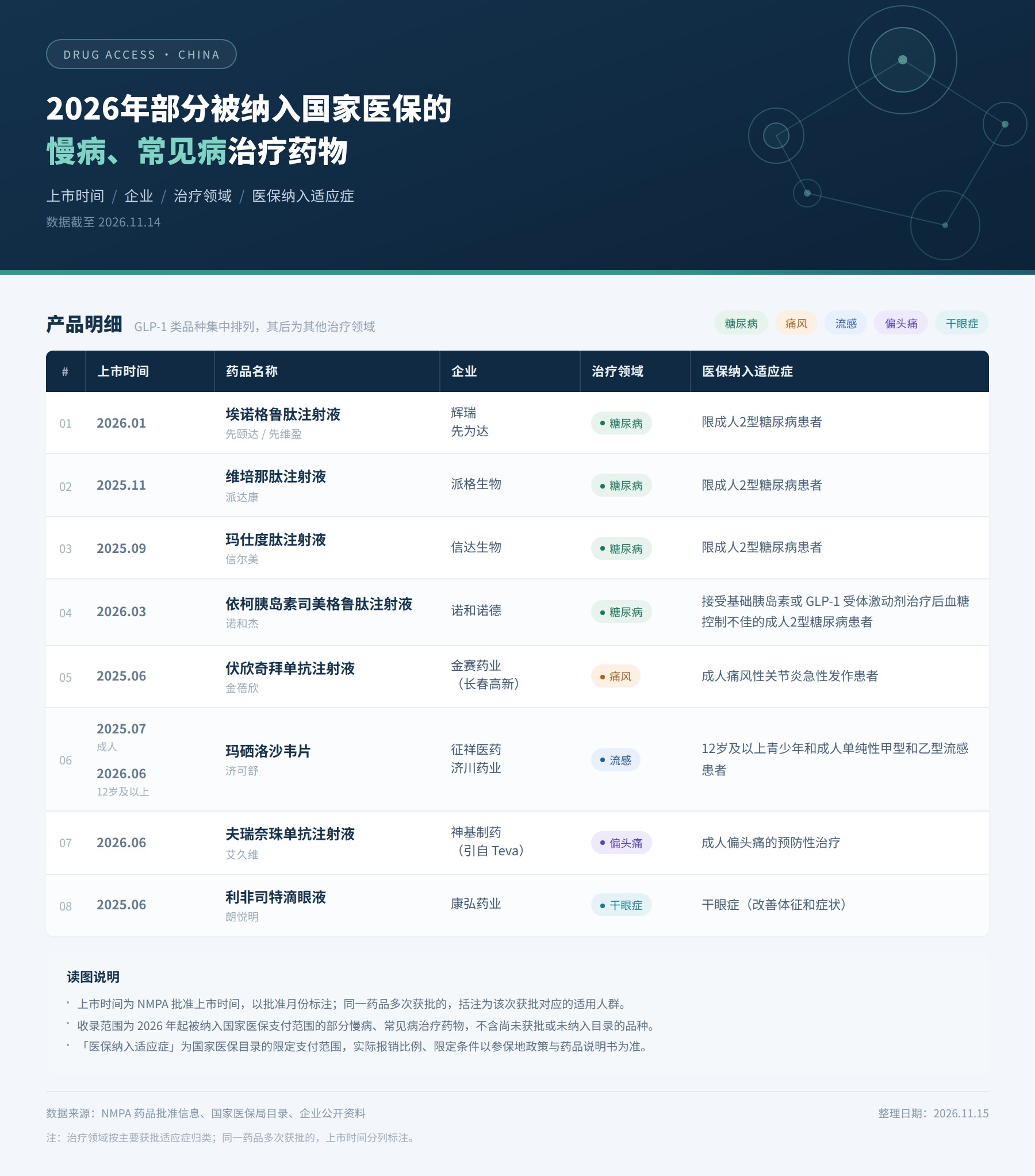
36Kr noticed that new drugs with better clinical value for basic chronic diseases such as diabetes and gout, as well as common diseases with high incidence in recent years such as flu, migraine and dry eye disease, have been included in the list this year.
Graphic by 36Kr
The iteration of "old drugs" that provide patients with treatment plans with better curative effect and higher safety through new mechanisms of action is the common highlight of these disease fields.
Take diabetes as an example. This year, 4 GLP-1 products from Innovent Biologics, Novo Nordisk, Pfizer/Sinopharm A-STAR, and PeptideGene Biotech have been included in the list. Traditional drugs such as metformin and insulin can effectively lower blood sugar, but can hardly improve accompanying problems such as weight gain and cardiovascular risks at the same time. GLP-1 drugs have changed this situation, and have thus become "blockbuster products" in the pharmaceutical market in recent years.
Previously, Tirzepatide from Eli Lilly and Semaglutide from Novo Nordisk were the two main hypoglycemic drugs under medical insurance. The several new products added to the NRDL this year provide more options such as dual-target and compound formulations, with their clinical positioning shifting from general treatment plans to more segmented scenarios. For example, Insulin Ecol + Semaglutide from Novo Nordisk provides a combination plan of "once-weekly basal insulin + GLP-1" for patients in late-line intensive treatment who need to use insulin but are worried about weight gain.
Gout is another typical case. In the past, acute gout attacks were mainly controlled by drugs such as colchicine, whose mechanism of action is to broadly inhibit the downstream links of inflammatory response, and patients need to take the drug every day, which brings burden to the liver and kidney. Vunakizumab from Jinsai Pharmaceutical, which is included in the NRDL this year, blocks IL-1β at the source of inflammation, realizing a long-acting effect of "one injection every six months".
At the same time, the treatment plans for some common diseases with continuously growing patient base in recent years have also been updated. These diseases may not be life-threatening, but their onset will significantly affect patients' quality of life.
Migraine is one of the typical cases. Under the pressure from work, migraine is becoming more and more prevalent among young office workers. In the past, patients mostly used ibuprofen and triptans for emergency pain relief, which have many side effects and are not suitable for long-term use. Fremanezumab from Shenji Pharmaceutical is a migraine preventive monoclonal antibody targeting the CGRP pathway, which is injected once a month or once a quarter, reducing the burden of long-term disease management.
Another example is flu. After the "old drug" Oseltamivir, the core competitive focus of new PA-target flu drugs in this round is "one single dose for the whole course of treatment". The first one launched was Baloxavir Marboxil ("Xofluza") from Roche. Since last year, domestic new drugs with the same mechanism have been approved one after another, but they failed to meet the medical insurance admission requirements in their first year on the market, so they mainly expanded the market of out-of-hospital pharmacies. At that time, some practitioners told 36Kr that entering the medical insurance list and obtaining the "admission ticket" to hospitals will become the core issue for new flu drugs in 2026.
This year, Mariboxavir from Jumpcan Pharmaceutical took the lead in being included in the NRDL, becoming the first domestic PA-target flu drug eligible for medical insurance reimbursement. Whether other domestic enterprises will follow up and at what pace will, to a certain extent, determine who can become the "domestic version of Xofluza".
It is also worth noting that some drugs with high clinical demand have not been included in the NRDL. For example, the "Leorex" series of anti-insomnia drugs: this year, Lemborexant from Eisai, Daridorexant from Simcere Pharmaceutical, and Fazanorexant from Yangtze River Pharmaceutical all applied for the medical insurance negotiation, but none of them were finally selected.
The "Leorex" series of insomnia drugs were successively launched in 2025. Their "non-controlled psychotropic" positioning has enabled them to gain certain sales volume in the self-paid market and enjoy high pricing. For example, Simcere Pharmaceutical's sales expectation for Daridorexant this year has reached 700 million yuan. Therefore, enterprises may have relatively limited willingness to achieve sales growth through substantial price cuts in the short term.
(Liu Liang is a pseudonym)