A trend that deserves vigilance: "account farming gangs" are laying siege to offline brick-and-mortar businesses.
The real far-reaching harm of the "account farming groups" lies in that they do not just fabricate plots for public entertainment, but use real offline merchants as actors and physically operating stores as scenarios, distributing content on the "Nearby" page of short video platforms — a real store, a real store owner, and a pre-designed conflict. The store owner is not forced to do so; they pay people to perform the scenes.
This makes viewers easily mistake the plots designed by MCNs for the real experiences of merchants, and they are guided to piece together fragmented performances into complete events, thus simplifying complex issues into a binary opposition between good and evil.
This is no longer simple "content falsification". When MCNs collude with merchants to turn physical stores into traffic props and turn consumers' emotions into monetization chips, the mass-produced "toxic traffic" is spreading wildly across short video platforms.
If left unchecked, it will not only be catering merchants that are targeted, but all physical industries.
1
Online MCNs Begin to Hunt Down Physical Merchants
Recently when browsing short videos, one scene keeps popping up repeatedly:
Some people hold up red banners with the slogan "Cancel food delivery, shut down live streaming, restore the prosperity of brick-and-mortar businesses" at the entrance of restaurants. Some videos only show the slogan with total silence throughout, while others add extra plots, for example, the store owner wears a plastic bag over the head and is "escorted" by the store staff.
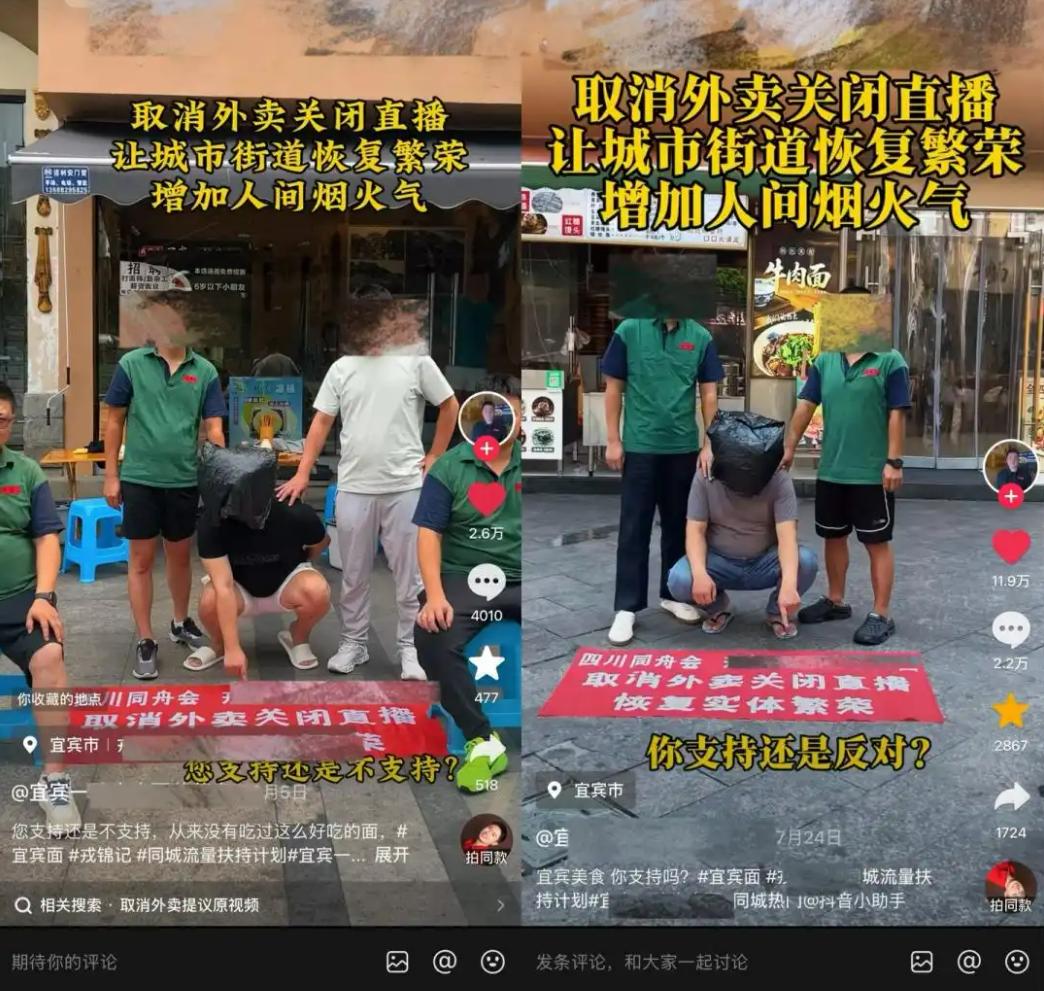
Short videos shot using the "Cancel food delivery, shut down live streaming" template.
If you only come across one such video, you may take it as an emotional expression from a catering merchant, and many netizens will even show sympathy. However, when almost identical red banners, highly similar plots and copywriting appear in batches, things are far from that simple.
China Central Television News recently conducted an investigative report on this phenomenon, finding that some merchants who posted such videos did not remove their food delivery services, some never even launched food delivery services, and some are not even catering merchants at all. The videos were all staged by MCN institutions. Related hashtags such as #CCTVExposedStagedShortVideosOfCancelingFoodDelivery# quickly became trending topics.
Coincidentally, a series of videos about "customers blackmailing merchants" also appeared in large numbers on short video platforms some time ago. Although these videos came from different cities and different accounts, their plots were highly similar:
After finishing the meal, a customer calls the waiter over to pay the bill, claiming to be a "LV8 user on Dianping" and demanding a free order, otherwise they will leave a bad review.
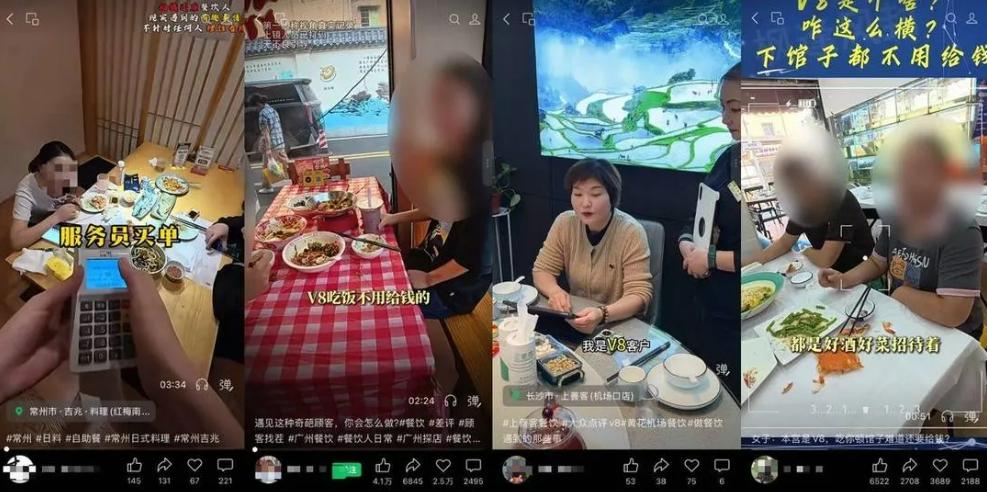
Staged traffic-driving video of "customers blackmailing merchants" on short video platforms
The arrogant and unreasonable customer who dines and dashes, paired with the helpless and angry merchant, instantly pushes the dramatic conflict to the extreme, igniting the anger of a large number of netizens, and making such videos gain massive attention on social media
Some well-meaning merchants even came up with tips for other store owners, telling them to keep evidence, report to the platform, and the platform will handle it properly.
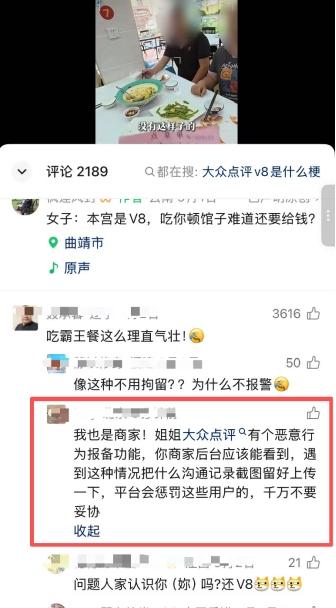
But many netizens have spotted the trick behind it. For example, someone pointed out, "Which merchant would hold a camera to film the customer when checking out? Is that normal?"
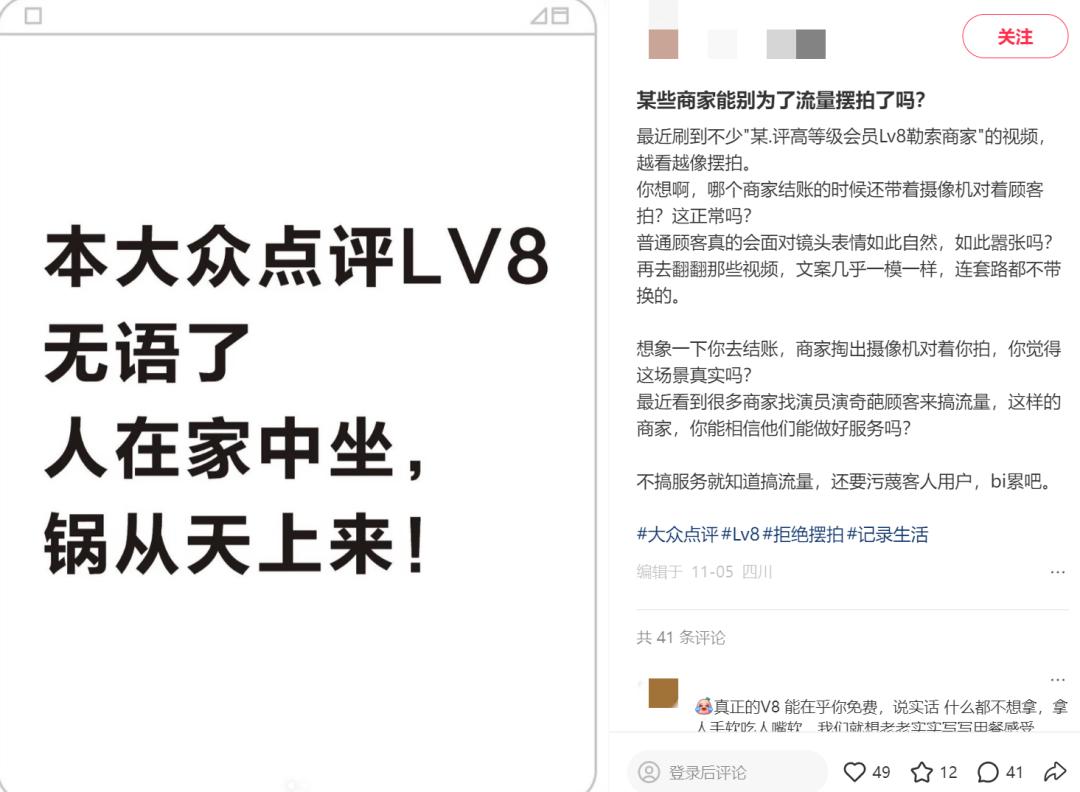
Dianping customer service once tried to contact the "blackmailed" merchant in the video on social media, but received no response.
At the same time, Dianping made it clear that its review rules have always been treated equally. The weight of reviews posted by newly registered users or LV8 users is not affected by their user levels. The only factors that affect the weight are the content itself and whether it helps more users make decisions. In addition, the platform firmly cracks down on all malicious bad review behaviors, especially those involving extortion, which are strictly prohibited as the platform's high-voltage line.
Sure enough, an undercover investigation by the media found that all such videos are also staged, and in some videos, the person playing the customer is none other than the store owner himself. Behind all this, there are still MCN institutions operating the whole thing.
The tentacles of MCNs have long extended far beyond the catering industry.
A few days ago, another report from China Central Television News stated that some MCN institutions have joined hands with offline pharmacies to set up traps that "cheat the elderly":
They first use AI to synthesize fake news, give away free therapeutic devices and other means to attract the elderly to scan QR codes; then use corporate WeChat accounts such as "Hunan Taiyang Pharmacy" to pull the elderly into private WeChat groups in batches. After entering the group, the group owner pushes "health preservation live streams" every day, gradually inducing the elderly to buy overpriced medicines and draining their retirement savings.
All these incidents point to a trend worth guarding against: Online MCNs treat offline merchants as actors and their stores as "trust endorsements", and are systematically targeting offline physical businesses as traffic materials and monetization channels.
2
Behind "Public Opinion Equals Traffic": The Clearly Priced Collaborative Performance
Following the clues from media reports, we can basically restore the operation logic of MCN institutions in these incidents.
As we all know, the cost of online traffic has gradually risen over the years. Some MCN institutions that originally operated self-media businesses have turned to look for business opportunities offline, and they have found two things available for exploitation from offline physical businesses:
The first is the money of the merchants, and the second is the real identity of the merchants that can be used as trust endorsement.
Some physical merchants, especially catering merchants facing extremely fierce industry competition, are under considerable customer acquisition pressure and traffic anxiety. MCN institutions have captured this point, and the first thing they need to do is to gain the trust of merchants.
The most direct way to gain trust is to reveal some "inside information" to the other party, which can not only narrow the distance with the other party, but also make themselves look experienced.
Of course, these "inside information" are fabricated by them using the information gap between the platform and merchants, and it is difficult to be falsified in a short time. For example, "ten positive reviews offset one negative review", "reviews from LV7 and LV8 users have higher weight", "the drop of store star rating must be caused by negative reviews" and other wrong "operation formulas".
Although Meituan official has refuted rumors on Dianping's review rules for many times, the lies fabricated by MCN institutions still misled a considerable number of catering merchants.
Some catering merchants once mentioned that "high-level LV user reviews on Dianping have higher weight, and differentiated treatment in the store has almost become a 'consensus' in the circle". A restaurant owner with 13 years of experience admitted, "I always thought that positive reviews and negative reviews can offset each other".
MCN institutions use a series of counterintuitive industry knowledge to make catering owners mistakenly think that they are professionals who know the business, and then promote services such as agency operation, paid courses, and store intermediary services.
Among them, the agency operation service is to operate short video accounts for catering merchants. In CCTV's investigative report, an MCN institution named "Sichuan Tongzhouhui" participated in the planning of the "Cancel food delivery" short videos. They promised catering merchants "Let the owner spend the least time and the least money to get the maximum traffic!", charging 3800 yuan per month to produce 15 videos, one video every 2 days on average, and being responsible for all planning, content creation and editing.
For these catering owners, this cost is not high, and it is worth a try. They did the math: spending a not-so-high sum of money to buy a seemingly "real" hit video, betting that local traffic can bring in customers. They selectively ignore the falsity of the content, and also selectively ignore the possible consequences.
However, "Sichuan Tongzhouhui" will not really spend costs to obtain traffic by planning high-quality content. They can only use some "unorthodox methods" to "grow accounts rapidly with high returns". The "Cancel food delivery, shut down live streaming" plan is a universal template that they have personally tested to be effective, can trigger strong public opinion response, and thus obtain traffic, which is therefore copied in large quantities.
They ask merchants to cooperate to appear on camera, and deliberately make the videos simple and crude with low quality, which makes netizens feel that they are real.
MCNs are well aware of the traffic anxiety of merchants, and merchants are also willing to cooperate in the performance — each takes what they need, and they hit it off immediately.
As for whether merchants really "cancel food delivery and shut down live streaming", it is not what "Sichuan Tongzhouhui" and its likes care about. A staff member said frankly that among the nearly 20 physical merchants whose short video accounts are operated on their behalf, many are still doing food delivery and running live streams, and some merchants belong to non-catering industries such as home decoration and hairdressing. It does not matter whether their words are consistent with their deeds.
In fact, before this wave of "Cancel food delivery" videos appeared intensively, batches of oral broadcast videos of "Remove from food delivery platforms" also appeared on short video platforms, with highly consistent copywriting — "I call on our peers to remove from the platforms as soon as possible and move to formal channels. We need to work together to resist online business, and not be greedy for petty gains..."
After tracing the source of these accounts, the media found that these video operators are not catering merchants, let alone running food delivery services. The traffic brought by the videos eventually leads to paid training courses and store intermediary services of an institution named "Fuyuan Zhaopu".
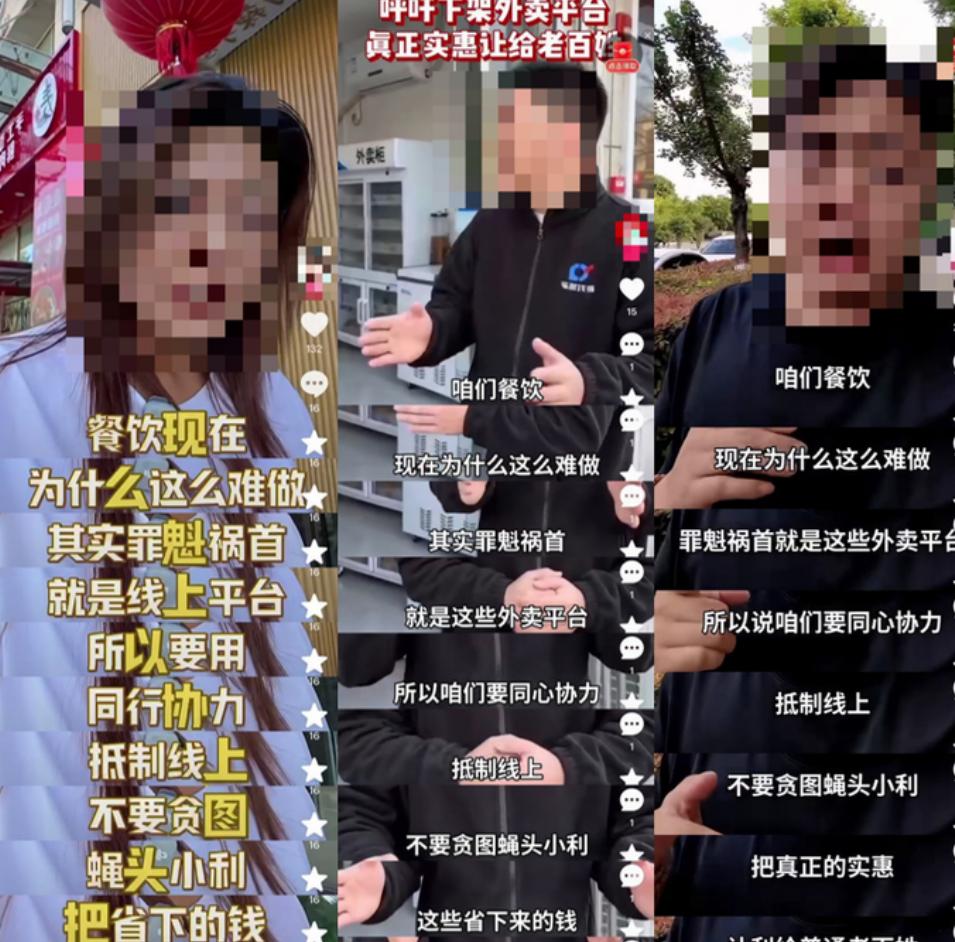
Multiple "Fuyuan Zhaopu" city partner accounts posted videos of "Removing from food delivery platforms"
"Fuyuan Zhaopu" claims that it "focuses on physical site selection and short video empowerment for physical stores, and incubates founders' business IP". Its business covers more than 420 cities. The main operation method is to recruit "city partners" around the country to carry out paid training, and drive traffic for offline businesses through short videos.
In this model, the account matrix is not only a communication channel, but also a tool to undertake commercial conversion.
Similarly, a large number of "account farming groups" are also among the accounts participating in the release of "customers blackmailing merchants" videos. Their home pages are full of introductions such as "have helped more than 1000 bosses build personal IP" and "good at 7-second local hit short videos", and some have even posted "Remove from food delivery platforms" videos before.
For merchants, even if they accept the services provided by "account farming groups", although they may obtain considerable traffic in the short term, it is unsustainable and there is a risk of account ban. More seriously, it damages the credibility that merchants have accumulated over time.
Many consumers have posted on social media, complaining that "we need to be alert to merchants who love staged performances to drive traffic", believing that if catering operators spend too much time on staged marketing to grab traffic, it will definitely take up the time to improve product and service quality, resulting in damage to the real experience of customers who come to the store.
It can be seen that false staged performances have caused damage to all parties in the catering ecosystem:
Merchants cannot get sustainable traffic even after spending money, and they also face the risk of platform punishment and loss of real reputation, which is not worth the loss, and also squeezes the space for honest operation of the whole industry; netizens' emotions are exploited and their trust is consumed; the relationship between the platform, merchants and consumers is provoked, and more explanation cost and governance cost are required.
This has seriously disrupted the healthy development of the catering ecosystem and even the entire offline physical commercial ecosystem.
3
The "Poisoning" of Social Trust
The "toxicity" of this traffic does not only lie in the falsity of the content. Its real "toxicity" lies in endorsing false narratives with real identities and taking public emotions as fuel.
Walter Lippmann, the founder of communication studies, once wrote in "Public Opinion":
"The range of space, time and things our opinions involve goes beyond the scope of our direct observation. Therefore, we have to piece them together based on the statements of others and our own imagination."
In other words, the statements of others become part of the reality we perceive.
The real far-reaching harm of "account farming groups" lies in that they do not just fabricate plots for public entertainment, but use real offline merchants as actors and physically operating stores as scenarios, and distribute content on the "Nearby" page of short video platforms — many netizens who come across these videos may have seen these merchants and stores in real life, so they will mistake the plots designed by MCNs for the real experiences of merchants, and are guided to piece together fragmented performances into complete events, thus more easily simplifying complex issues into a binary opposition between good and evil.
This is no longer simple "content falsification", but batch injection of "toxin" into real social trust.
If this organized and planned "poisoning" extends further from commercial topics to social topics, making more people unable to distinguish whether what they see is a real event or a planned traffic business, forming serious misunderstandings and prejudices about the real world, then it is not only merchants that are targeted, but all of us.
For the general public, today they are ignited with anger towards platforms by "Cancel food delivery", tomorrow they are ignited with hostility towards consumers by "customers blackmailing merchants", and the day after tomorrow they are ignited with distrust towards offline stores by "pharmacies cheating the elderly".
For merchants who operate honestly, when "staged performance + traffic" becomes an obvious shortcut, merchants who focus on making good products and providing good services will appear to be "not good at operation". When traffic distribution is distorted by false content, honest operators become the losers instead.
In this regard, MCN institutions that fabricate rumors and mass-produce scripts, and participating merchants who cooperate in staged performances, undoubtedly deserve severe punishment. In addition, short video platforms should also face up to their responsibilities. In September this year, the "Regulations on the Administration of Multi-channel Distribution Services for Internet Information Content" came into effect, in which behaviors such as "inciting netizens' emotions, provoking group confrontation and regional discrimination", fabricating backgrounds, plots and personal settings, and carrying out false or misleading marketing are explicitly prohibited.
Staged content of the