Founded by the team from Harbin Institute of Technology and backed by Li Zexiang, the AR diving mask company has raised tens of millions of yuan in financing | 36Kr Exclusive
Written by | Huang Nan
Edited by | Yuan Silai
Hard Krypton learned that Starfield Blue (Shenzhen) Technology Co., Ltd. (hereinafter referred to as "Starfield Blue") has recently completed tens of millions of yuan in Angel+ round financing, with Hunan Caixin as the investor of this round. Previous seed round and angel round investors include Innoangel Fund, West Summit Capital, and Hong Kong X Tech Fund. The funds will be mainly invested in the technical iteration of core optical modules and underwater reliability systems, improve the supporting hardware ecosystem of the AR diving interconnection system, and accelerate global channel layout and large-scale mass production and delivery.
Founded in 2025, Starfield Blue focuses on the underwater intelligent AR equipment track, and specializes in the R&D and manufacturing of optical waveguide optical systems, diving computing algorithms and highly reliable underwater hardware in extreme water environments. The company has launched AREX ONE, the world's first AR diving computer mask, which currently mainly targets scuba diving scenarios and covers different needs such as recreational diving and technical diving. Since the product was launched on Kickstarter for crowdfunding, it has raised more than HKD 7 million in total, and is scheduled to officially start global delivery in 2027.
The core team has an interdisciplinary background integrating robotics, AI+AR technology and in-depth diving. Wang Jingpan, founder and CEO, graduated from Harbin Institute of Technology, participated in the RoboMaster competition, and has a background in robot hardware development. A number of hardware solutions he led have achieved industrial application; Chen Rui, co-founder and product lead, holds dual master's degrees from Southeast University and Monash University, with research focusing on AR human-computer interaction and AI application implementation. The two were teammates in high school and once participated in world-class robotics competitions together. CMO Max is a senior diving practitioner from France, with more than 8,000 diving practice experiences and professional underwater image production experience. Many core members of the company hold CCR Closed Circuit Rebreather diving qualifications, and can complete real machine dive verification at a depth of 100 meters level.
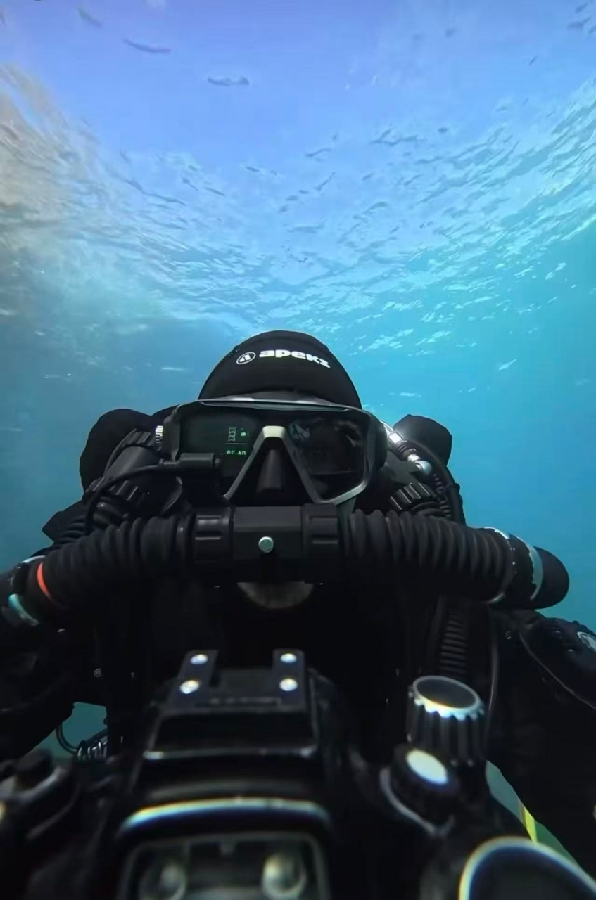
French colleague Max tests the product in Semporna (Photo credit/Enterprise)
The process of Max joining the team is also a microcosm of the product being recognized by professional diving users. Wang Jingpan introduced to Hard Krypton that Max first came into contact with AREX as a test user, and made three special trips to China to participate in product actual tests, and chose to officially join the team after the third test. He can not only output first-line underwater practical experience, but also rely on his own resources in overseas diving communities to assist the team in continuously verifying product solutions and calibrating design trade-offs in real scenarios.
Diving hardware has long been a category with relatively slow technological evolution. Take the representative diving computer as an example. As the main tool for divers to obtain depth, time and decompression information, it has been dominated by the watch form for decades.
This form brings natural interaction shortcomings: during the diving process, users need to frequently raise their wrists and lower their heads to view data. Especially in scenarios with extremely high information density requirements such as technical diving, repeatedly checking the watch will continuously distract the diver's attention. Diving is a sport with extremely high requirements for safety redundancy. Indicators such as depth, no-decompression time, remaining gas, and ascent rate are directly related to life safety. Whether data can be obtained by divers in a timely and intuitive manner is the underlying foundation of underwater safety experience.
Although there are clear demands for experience and safety upgrades, to achieve breakthrough innovation, it is impossible to avoid the dual engineering challenges brought by underwater scenarios.
On the one hand, traditional optical solutions cannot maintain reliable display in extreme underwater environments, and ordinary AR optical waveguide modules may fail due to pressure at more than ten meters underwater; on the other hand, the test of diving scenarios is far higher than that of ordinary consumer electronics. The superposition of multiple extreme conditions such as seawater salt spray corrosion, severe cold and heat temperature difference, and continuous high pressure environment poses extremely high challenges to the overall hardware engineering design.
"At that time, some voices in the market once believed that the basic technology of optical waveguides was maturing, and the AR glasses industry might usher in an industrial inflection point similar to the iPhone moment. But after rigorous research, we found that this is not the case," Wang Jingpan, founder of Starfield Blue, told Hard Krypton. Consumer-grade AR glasses generally face the "impossible triangle" of difficulty in balancing weight, power consumption and computing power at the same time, resulting in poor wearing experience and high return rates.
Moreover, "Even if the basic optical waveguide solution is verified on land, it does not mean that it can be directly reused in the underwater environment, which will put forward completely different requirements for the optical structure. This is exactly the opportunity we see," Wang Jingpan said.
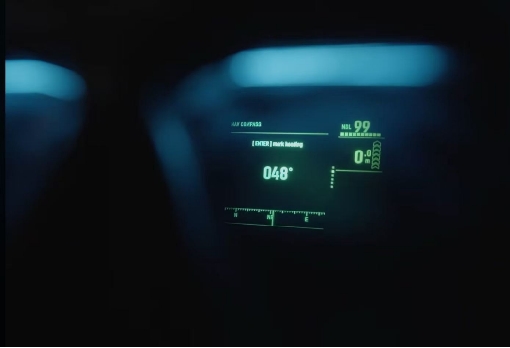
Underwater optical waveguide display (Photo credit/Enterprise)
Personal diving experience, user research and changes in technical conditions have gradually made the team clarify the product entry point. In Wang Jingpan's view, this scenario just avoids several sets of contradictions that are the most difficult to solve for land AR glasses. First, divers' demand for key data such as depth, time and remaining gas is almost all the time, which is different from the "occasional call" usage frequency of ordinary smart glasses. Once the data is delayed or missing, it is directly related to the user's life safety. In this scenario, whether key information can be read timely and clearly provides a clear application demand for near-eye display.
Secondly, underwater buoyancy naturally offsets the weight burden of the device. Compared with ordinary AR glasses where every increase in computing power requires repeated trade-offs in grams, underwater buoyancy allows the device to carry stronger computing power and richer display capabilities, which just releases space for the AR experience to play.
Third, the diving population has the consumption characteristics of high net worth and high unit price. At present, there are more than 30 million certified divers around the world. This group has much higher willingness and ability to pay for professional equipment than ordinary consumer electronics users, which is enough to support an innovative category to complete the commercial closed loop in the early stage when the supply chain is not mature and the cost is relatively high.
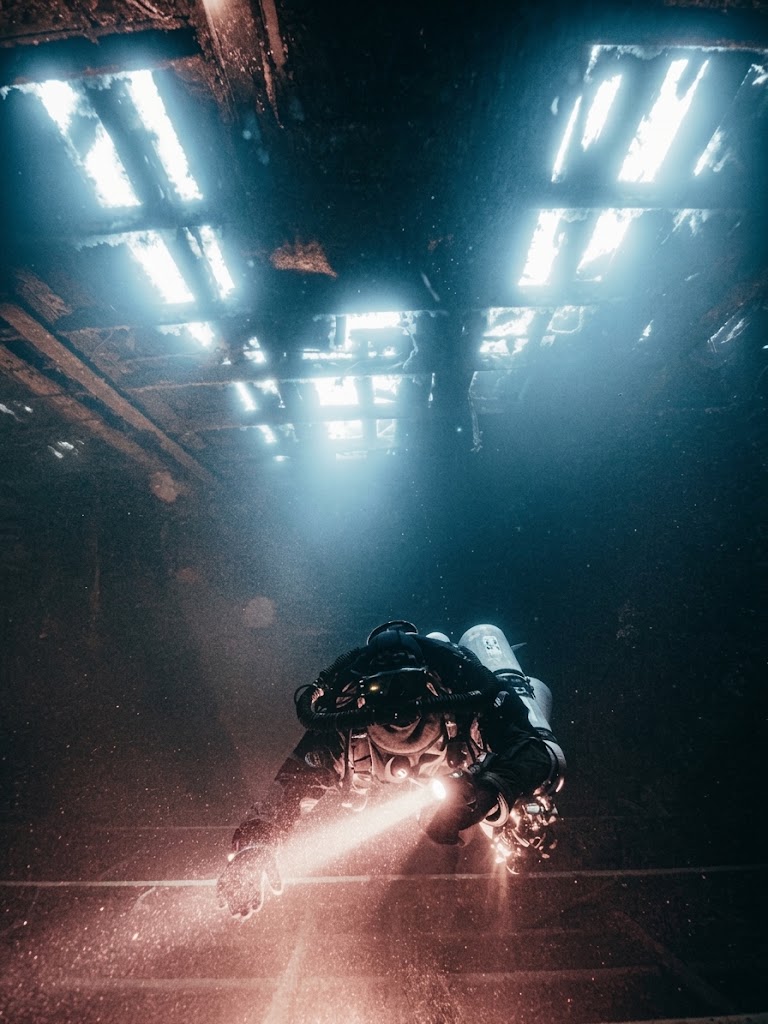
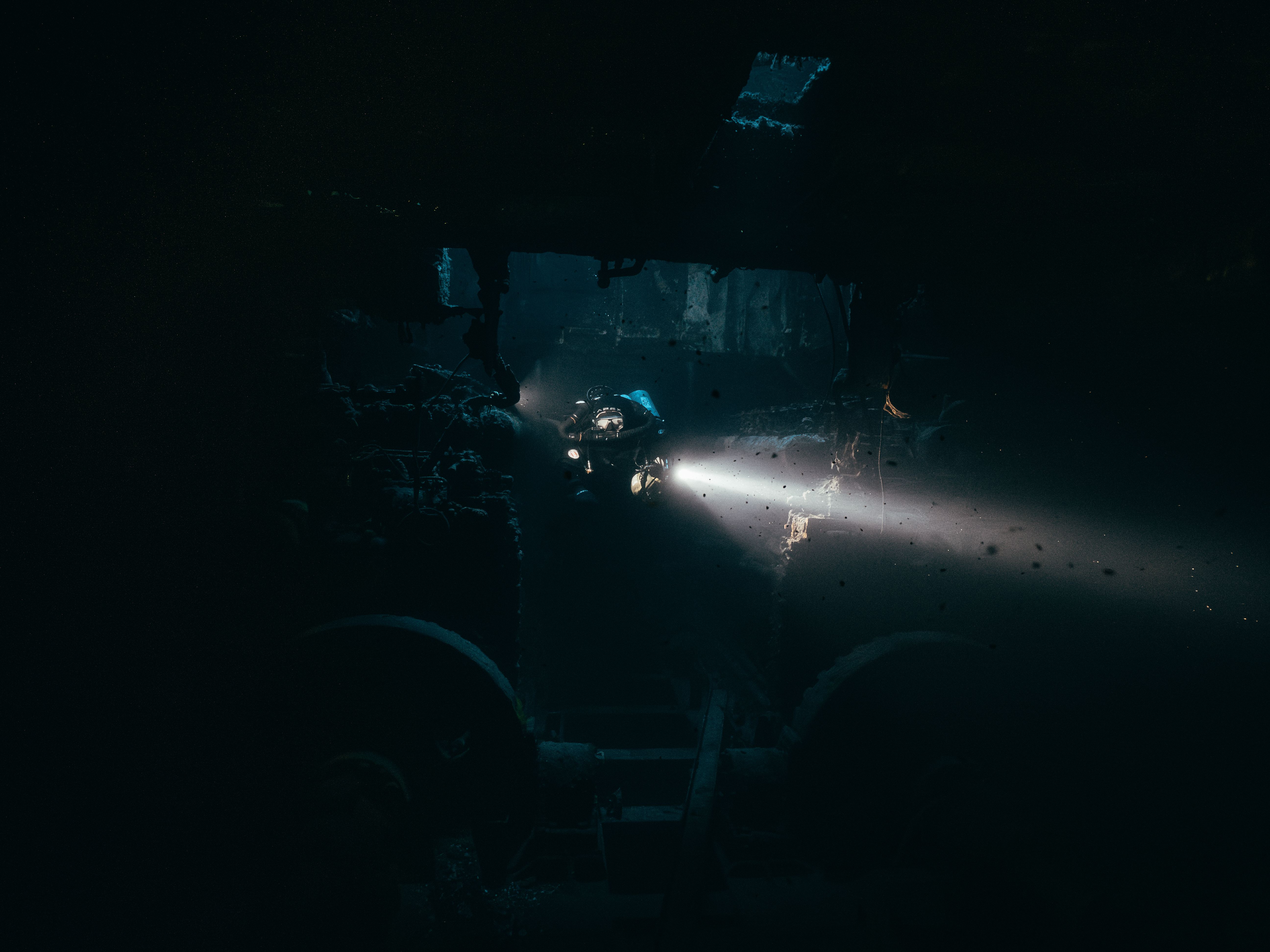
The team uses AR diving glasses to explore the sunken ship (Photo credit/Enterprise)
Specifically at the product end, the core breakthrough of AREX ONE lies in the integration of a complete diving computer system and AR display module into the mask form.
The significance of this form change is not only "moving the data to the eyes", but also changing the way users read information underwater, presenting key data in the field of view continuously, allowing divers to obtain information without interrupting the observation of the outside world, reducing the distraction caused by shifting the line of sight.
But Wang Jingpan also pointed out that the core contradiction of underwater information interaction is never simply stacking data, but how to output effective information matching the current scenario at the right time. In the underwater environment, information overload and information loss will also bring safety risks.
Based on this judgment, AREX ONE has done scenario-based layered adaptation on the display logic. For recreational diving, the interface is prioritized to converge to the most critical safety indicators such as depth, no-decompression time, and ascent rate to minimize visual interference; when the user switches to technical diving mode, the device will call up a full set of professional parameters based on the ZHL-16C algorithm, including tissue nitrogen load, partial pressure of oxygen (PPO₂), estimated time to surface, etc., to support divers to complete key decisions such as depth stop and gas source switching. In addition to the preset mode, the product also allows users to adjust the display position and priority of various data fields through the supporting App.
This layered design does not stop at the software interface. The core product idea of AREX ONE is to take the diving mask itself as the basic computing and display terminal, and then rely on the modular interconnection system to allow users to expand their capabilities on demand according to their own diving scenarios.
In addition to the mask body, the entire interconnection system includes a number of optional accessories that can be superimposed with modules such as gas monitoring, biometrics, and lighting. For example, the air integrated transmitter can collect the remaining data of multiple gas cylinders at the same time, which is suitable for technical diving scenarios of side mount diving and frequent gas source switching; Sync adaptive diving light realizes hands-free lighting, and the light beam follows the user's field of view; the AI marine life recognition module supports underwater video recording at the same time, and can automatically generate marine life illustrated book and diving site map after diving.
In addition to recording diving logs, the App can also retain the discoveries during diving. The marine life illustrated book can help users understand these creatures and gradually accumulate their own exploration records.
In order to withstand extreme working conditions such as underwater high pressure and salt spray corrosion, targeted engineering design has also been made at the hardware level, mainly focusing on the reliability of extreme underwater environments to meet the needs of multi-day continuous diving and offshore scenarios. According to the team's design idea, optics, structure and software need to be considered collaboratively: not only to protect the precision optical elements under the environment of water pressure, temperature difference and seawater, but also to judge whether the information is clear and suitable for appearing at that time by combining the ambient light, water body conditions and divers' observation habits.
At present, AREX ONE is accelerating the optimization of mass production process and reliability verification. According to the team, the product has completed the water pressure test at a depth of 120 meters. Team members and internal test KOLs have also carried the equipment to complex underwater environments such as Slovenian caves, Florida underground cave systems, and Maltese submarine wrecks, and completed many 100-meter-level real scenario dive tests.
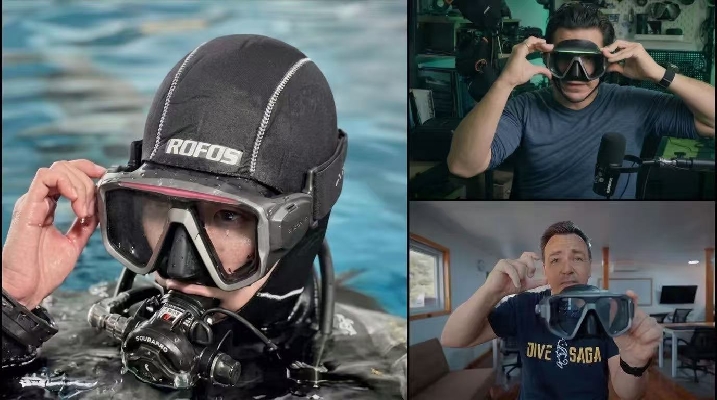
Diving KOLs across Asia, Europe and the United States have reviewed AREX ONE (Photo credit/Youtube&Ins)
Water pressure test at a depth of 120 meters has been completed (Photo credit/Enterprise)
According to the plan, AREX ONE will start global delivery in 2027, and gradually launch larger-scale market operations. At present, the team will prioritize completing the verification, mass production and delivery of diving products, and bring the continuous usage feedback of the first batch of users back to R&D. In the longer term, near-eye display and edge-side AI may also be extended to other outdoor sports scenarios, but they still need to be verified one by one around the actual needs of different sports.
Starfield Blue is based on underwater optical waveguide technology, with an expandable modular hardware ecosystem, promoting the upgrade of diving computers from the traditional watch form to AI-driven underwater intelligent interactive terminals.
The following is an excerpt from the interview between Hard Krypton and Wang Jingpan, founder of Starfield Blue (slightly edited):
Hard Krypton: AR/VR glasses have been developing in the consumer market for many years, and have also experienced the "hundred glasses war". Why did AR products for diving scenarios only attract entrepreneurial teams in recent years? What is the reason behind it?
Wang Jingpan: The strong demand for real-time underwater data in diving scenarios has long existed objectively, and its demand rigidity is much higher than most land AR usage scenarios.
Under the traditional equipment system, divers can only rely on raising their wrists to check the watch-style diving computer to obtain key safety data such as depth, no-decompression time, and remaining gas. In operating scenarios with complex environments and higher risk levels such as technical diving, wreck penetration, and cave diving, divers need to continuously observe the surrounding underwater environment. Even if they only briefly shift their sight from the environment to their wrists, they may ignore surrounding risks and lay hidden safety hazards.
It is precisely because of this that the idea of directly projecting key diving data into the field of view of the diving mask to get rid of the interaction limitation of repeatedly raising the wrist to check the watch has been discussed and tried in the global diving industry for more than ten years. However, limited by the shortcomings of optical hardware solutions, the early technical path is difficult to solve the problem of field of view occlusion. Most of the past prototype products used opaque screens and ordinary prism solutions, and the digital display would occupy the real scene field of view, which would bring significant safety risks underwater and was difficult to put into practical use.
It was not until the past two or three years that consumer-grade optical waveguide technology gradually matured. Its core feature is transparent display, which can make the real scene environment and digital information coexist in the same field of view. Users can observe the real underwater world while reading the superimposed diving data without splitting the field of view.
However, it should also be distinguished that maturity at the consumer end does not mean it is available underwater. The general optical waveguide modules on the market are designed according to the land normal pressure environment, and will have structural damage, optical offset and other problems when facing underwater high pressure, salt spray corrosion, and severe cold and heat shock. We entered the market at the window when the optical waveguide technology moved from the laboratory to industrialization, and on this basis, we recompleted the transformation and adaptation at the optical, structural and material levels. Without the maturity of optical waveguide technology as a foundation, this set of AR masks for real diving use would not have been possible to land two years ago.
Hard Krypton: Diving is a field with extremely high thresholds for safety and brand trust, and equipment reliability is directly related to underwater life safety. As a new entrepreneurial brand in the industry, how to build trust among professional diving groups?
Wang Jingpan: Diving is a typical track with high trust cost. Different from ordinary consumer electronics, diving equipment is a safety-critical device. Professional diving users judge an emerging hardware brand, and they will not only look at how innovative the product concept is. Compared with functional parameters, they care more about three things: whether the product can be delivered stably as planned, whether the entrepreneurial team can operate continuously for a long time, and whether the publicly announced performance data and underwater actual measurement results are true and credible. Once any of the above links is in doubt, even if the product solution sounds very bright, it is difficult to be accepted by professional groups.
Therefore, we have set very strict standards for external content output. Some products on the market will use AI-generated images to show product effects, but diving equipment cannot do this. All the underwater real shot images and deep-sea test images we released externally retain complete original shooting files and test records. Each demonstration material comes from real diving tests to avoid conveying wrong product expectations to divers.
Another source of trust comes from the team's in-depth understanding of diving scenarios and practical verification. Many core members of the Starfield Blue team are themselves certified advanced divers, many of whom hold CCR Closed Circuit Rebreather diving qualifications, and can complete real machine dive verification at a depth of 100 meters level, and can understand various risks that the equipment will encounter in the real underwater from the perspective of users. From the laboratory pressure test to the actual dive verification in complex high-risk environments such as caves and sunken ships, many tests were completed by team members carrying the prototype themselves.
In the vertical industry with strong circle attributes such as diving, it is difficult to build credibility only by marketing and publicity.