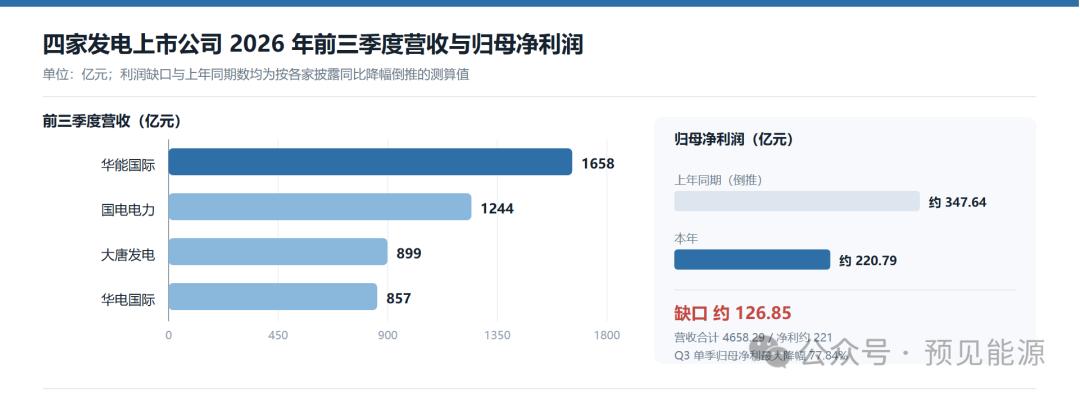
On the one hand, sweeping restructuring is underway at the headquarters of central state-owned energy enterprises, on the other hand, power generation companies have recorded a total profit decline of 12.7 billion yuan in the same period, and state-owned enterprises are taking back the investment decision-making power.
Five central state-owned energy enterprises have taken back accounting and disposal authority to improve capital efficiency in response to price signals.
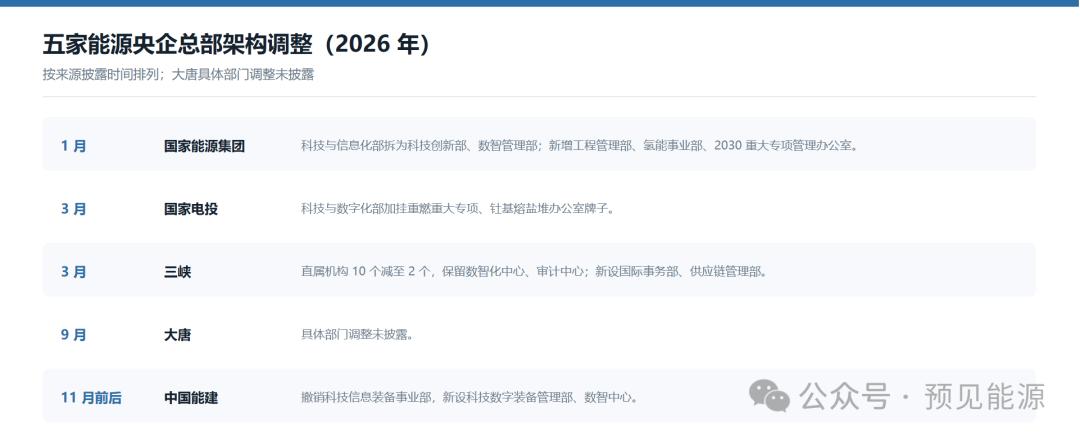
Foresee Energy Market Intelligence reveals that China Energy Investment Corporation revised its official website and updated the "Organizational Structure" information in January, State Power Investment Corporation and China Three Gorges Corporation completed their adjustments in March, China Datang Corporation finished its adjustment in September, and the adjustment of China Energy Engineering Corporation was reported around November.
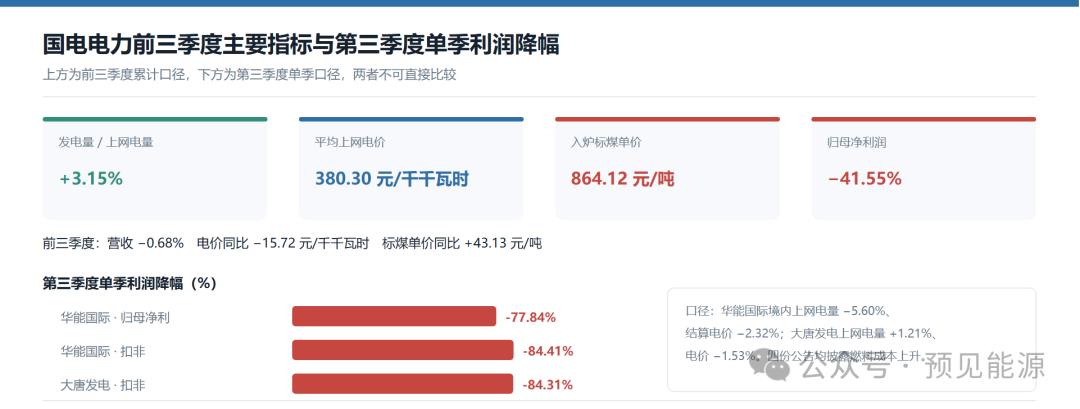
According to the 2026 Q3 financial reports, the revenue decline in the four statements is generally smaller than the profit decline, while the decline of non-recurring profit and loss deducted is larger than the net profit decline, indicating that non-recurring gains and losses are underpinning earnings. For Guodian Power Development Co., Ltd., power generation increased but revenue decreased, the unit price of standard coal rose while the on-grid tariff fell, leading to simultaneous occurrence of higher volume, lower price, rising cost and shrinking profit, which breaks the elasticity of profit to power generation in this set of data.
The adjustments of the five enterprises took place from January to November. The Party Committee of the State-owned Assets Supervision and Administration Commission put forward in April 2026 to promote flat transformation and intelligent management in an orderly manner. In the same signed article, "value enhancement" is listed as the top of the "Five Key Campaigns", requiring to abandon the pursuit of excessive scale and blind expansion, improve the allocation and operation efficiency of state-owned capital, and raise the quality of listed companies under their control.
For central power generation enterprises, the direction is to rank investments by return rate and make dynamic adjustments to stock assets. The No.136 Document, No.1501 Document and No.114 Document revised the price formation mechanism, and organizational requirements and price rules do not come from the same document.
01
The common feature of the five enterprises is the centralization of investment accounting authority
When overlapping the organizational charts of the five enterprises, the only common point is that the income measurement of project investment, the caliber of cost and quotation, and the disposal decision of post-investment assets, which were originally scattered in project companies and subsidiaries at all levels, are all taken back to the group headquarters this time.
China Energy Engineering Corporation describes the reform as a comprehensive transformation from business operation-oriented to strategic control-oriented, while China Three Gorges Corporation reduced its directly affiliated institutions from 10 to 2, both of which mean that the decision-making level is raised by one tier. Previously, the return was calculated once based on the approved tariff at the project approval stage. After the tariff changes with provincial bidding and time-of-use curves, the return of the same project needs to be recalculated repeatedly, and decentralized measurement cannot keep up with the pace of price changes.
At the department level, the adjustments are divided into three categories by function: centralizing data, setting up separate accounts for new businesses, and centralizing cost and quotation management. State Power Investment Corporation added a special office under its Science, Technology and Digitalization Department. China Energy Engineering Corporation abolished its original business divisions and newly established the Science and Technology Digital Equipment Management Department and the Intelligent Digital Center. The specific adjustments of China Datang Corporation and the functional boundaries of its new departments have not been disclosed.
Before the release of No.136 Document, by locking the construction cost, utilization hours and financing interest rate, a stable internal rate of return can be calculated before construction starts, and the guaranteed power is settled at the benchmark coal-fired tariff to underpin the bottom line of earnings.
After full access to the market, earnings are split into mechanism-based power and market-based power, and the surplus part follows market prices. The return of the same project changes with provincial bidding and mid-day spot market curves, shifting from one-time calculation before construction to real-time recalculation. The Intelligent Digital Center and the Supply Chain Management Department are exactly responsible for this set of parameters that change every day.
Enterprises under the groups moved earlier than the headquarters. Changyuan Power under China Energy Investment Corporation reduced three photovoltaic projects, and set the minimum capital return rate threshold for new wind and solar projects at no less than 6.5%. Guodian Power Development Co., Ltd. still saw new installed capacity growth in the first three quarters, showing that investment is being centralized while installed capacity is still expanding. Most of these actions took place before the headquarters adjustments, return rate screening has been implemented at the project end first, and the headquarters reform is to unify the measurement caliber across the whole group.
02
Performance and new moves of listed subsidiaries
Coal prices follow market trends, while electricity tariffs are constrained by both market and policies. Guosen Securities' research report judges that the decline in fuel cost is smaller than the decline in electricity tariff, leading to continuous gross margin compression, while new energy private placements further push down trading electricity tariffs. The "mechanism-based tariff" in No.136 Document is the reference price for price difference settlement, and there is no channel to transmit cost pressure to downstream users.
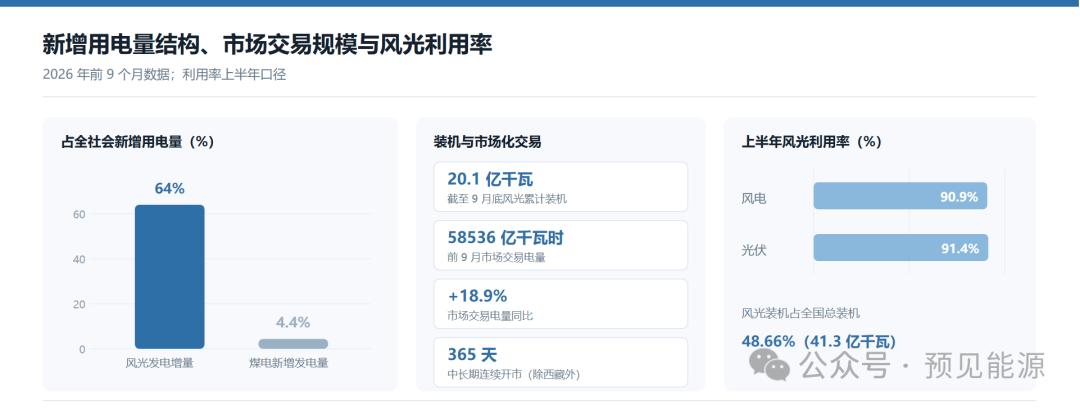
New energy and hydropower are squeezing the power generation space, on-grid power volume and coal-fired power generation volume are declining simultaneously, while coal-fired installed capacity still kept growing in 2025. With growing installed capacity and shrinking power generation volume, depreciation, maintenance and labor costs will not decrease synchronously, leading to a passive rise in non-coal cost per kWh. Wind and solar incremental power accounts for 64% of the newly added electricity consumption in the first 9 months, while the newly added coal-fired power generation only accounts for 4.4%.
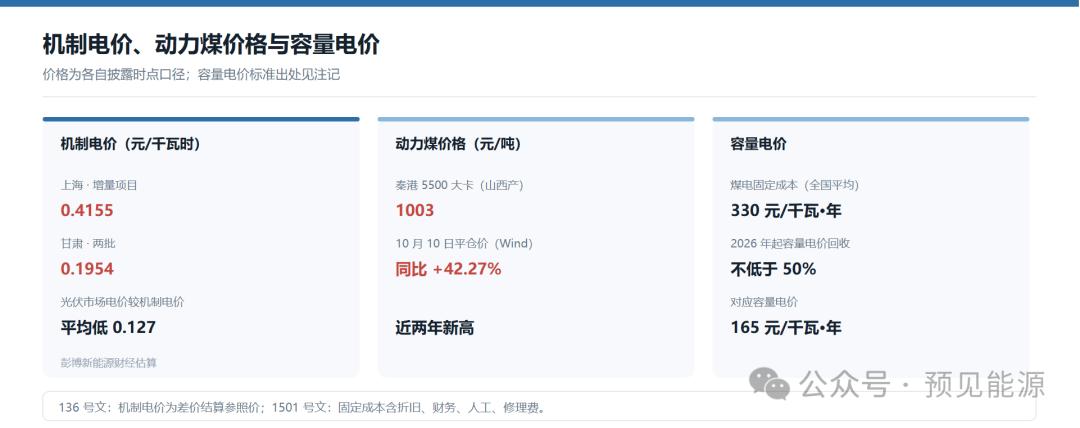
Capacity tariff is designed to compensate for the standby status of generating units. In 2023, No.1501 Document set the national average fixed cost of coal-fired power at 330 yuan/kW·year, and the recovery rate has been raised to no less than 50% since 2026, which equals 165 yuan/kW·year; the National Development and Reform Commission's Price Document [2026] No.114 only specifies "no less than 50%".
The remaining 50% comes from energy tariff and auxiliary services. The former is declining along with the market, while the latter has made peak regulation, standby and ramp-up paid services with corresponding price mechanisms, and the connection between them is still under improvement.
The power volume yielded by coal-fired power, as well as the regulation and transformation investment it undertakes, do not have corresponding income accounts yet. Except for Xizang, medium and long-term trading has achieved 365-day continuous trading, and the utilization rate of wind and solar power and the scale of market-based trading are still climbing.
12.7 billion yuan is the estimated value calculated by reversing from the respective decline rates based on the same period of last year's 34.764 billion yuan. The four announcements do not split the proportion of base figure, price difference and cost respectively. According to Xinhua Finance, the downward shift of coal price center in 2025 pushed up profits, and the high base magnified the year-on-year decline. The equity transfer of Huadian New Energy and the restructuring of China Shenhua changed asset ownership, and their impact on the current income statement was not separately disclosed in the Q3 reports.
The starting point is price. No.136 Document pushed new energy power into the market, the energy tariff of coal-fired power fluctuates with the market, while its regulation value is still mainly priced by policies, and there is a lack of connection between the two price systems. The assets deployed in previous years based on approved tariffs need to be recalculated according to this year's market prices, which breaks the elasticity of profit to power volume, and the gap in the Q3 reports comes exactly from this part.
The recalculation must be faster than price changes, which quarterly reports and multi-level approval processes cannot support. The value enhancement campaign aims to allocate capital by return rate and realize dynamic adjustment of stock assets. The five enterprises set up departments at the headquarters to centralize data and calculate returns, and at the same time raise the property right hierarchy, so that the calculated results can be implemented on actual assets.
The pricing right is handed over to the market, while the accounting right and asset allocation right are taken back by the group, the headquarters is aiming to shorten the distance between price signals and asset-related actions.
03
"Profit calculation before investment" and asset centralization
The centralization of property right hierarchy and the capital moves of listed subsidiaries are two sides of the same thing. Equity transfer solves who has the right to dispose of assets, while share increase, asset injection and dividend distribution solve how capital returns to shareholders.
Huadian New Energy transferred 29% of its shares from Huadian Furui to China Huadian for free, upgrading from a third-tier subsidiary to a second-tier subsidiary, becoming the only integration platform for the group's new energy business. China Shenhua plans to acquire assets from its controlling shareholder at a valuation of 133.598 billion yuan, and has obtained the registration approval from the China Securities Regulatory Commission. Zhou Lisha, researcher of China Enterprise Reform and Development Research Association, once stated that an excessively long property right chain will lead to gradual attenuation of information transmission.
At the performance briefing on November 6, Zhao Shibin, Director, General Manager and Deputy Party Secretary of Guodian Power Development Co., Ltd., emphasized "profit calculation before investment" when talking about the return measurement of new projects. "Profit calculation before investment" means measuring the return rate of projects based on prudent principles before investment, only making investment when profitability can be confirmed, and rejecting projects that cannot meet the threshold, shifting the investment basis from installed capacity scale to return measurement.
Liu Chunfeng, Party Committee Member, Deputy General Manager, Chief Accountant and Board Secretary, proposed to control investment pace as needed, advance consumption risk assessment, strictly adhere to the return rate threshold, and dynamically withdraw from low-efficiency projects when answering questions about balancing investment pace and return, extending the principle from project approval to post-investment exit.
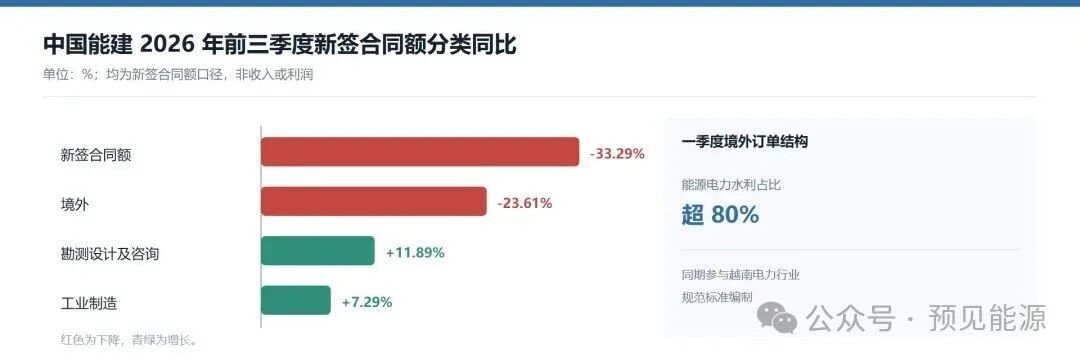
China Energy Engineering Corporation saw an overall decline in newly signed contracts in the first three quarters, and growth was concentrated in survey, design, consulting and industrial manufacturing. The official statement of China Energy Engineering Corporation on its headquarters reform is a comprehensive transformation from business operation-oriented to strategic control-oriented.
Looking at the moves of the five enterprises together, the common point is that investment accounting authority is raised from project level to group level, and the trend can already be observed from the listed subsidiaries: new projects must first pass the return rate threshold, stock assets are disposed of uniformly by second-tier platforms, and dividend distribution, share increase and asset injection are written into operation commitments.
The direction was given by the SASAC's deployment in April. The value enhancement campaign requires abandoning the pursuit of excessive scale, improving the allocation and operation efficiency of state-owned capital, and raising the quality of controlled listed companies, while the pricing tools are specified in documents including No.136 Document and No.114 Document.
Price rules are set by external documents, while the group takes back accounting and disposal authority. The headquarters can improve decision-making speed and clarify asset ownership, aiming to reallocate capital within the group based on return rate.
Measured by the disclosed moves, the chain from price signals to asset actions is being connected.
Guodian Power's "profit calculation before investment", Changyuan Power's minimum 6.5% capital return rate threshold, and Huadian New Energy's upgrade to a second-tier platform correspond to the three links of project approval, screening and disposal respectively, and investment discipline has been tightened at the enterprise end.
Whether this chain can be fully completed depends on whether the newly established departments obtain the right to reject projects, and whether the transferred platforms withdraw low-efficiency assets. The responsibilities of new departments and cross-department data access permissions of China Three Gorges Corporation and China Datang Corporation have not been specified in public materials.
Coal prices and on-grid tariffs are not determined by the headquarters, and the recovery of the income statement also does not depend on the organizational chart. What the headquarters can change is the time lag for price signals to be transmitted back to investment decisions, and taking accounting and disposal authority back to the group level is exactly to eliminate this time lag.
This article is from the WeChat Official Account "Foresee Energy", written by Zhao Jianan, and authorized for release by 36Kr.