VCs bet on China's version of Starship
China's Voyage.
A milestone breakthrough in the history of human spaceflight.
The 15th flight of SpaceX Starship has drawn global attention. After the second-stage spacecraft successfully entered orbit and deployed satellites, it was successfully captured by the launch tower. This marks the first time in human history that an orbital-class second-stage spacecraft has been recovered through capture by a tower-mounted robotic arm, signifying the closure of the full reusable launch vehicle system loop, which will completely reshape the pattern of space transportation in the future.
Domestically, the Chinese aerospace industry is also closely watching this moment. Over the past decade of China's commercial aerospace development, the core technical keywords in the rocket field have almost all centered on first-stage recovery. This step must be taken, but it only solves half of the recovery problem of the entire rocket. What truly determines whether rocket transportation capacity can operate in a flight schedule mode similar to civil aviation is the second stage that has been completely burned up up to now.
In an office in Yizhuang, Beijing, Tang Jibin, founder of Space Origin, is also closely following this launch. As a scientist who has been rooted in the aerospace industry for 20 years, after witnessing the leading momentum of Starship, he resolutely stepped into the commercial aerospace rocket track, and founded Space Origin in March this year together with a group of like-minded partners.
What Space Origin chooses to do is exactly skip the crowded narrative of first-stage recovery, and directly tackle second-stage recovery — the most difficult and no longer ignorable stage in the "Chinese version of Starship".
Tackling Second-stage Recovery Backed by National Aerospace Team
The first impression most investors have of Space Origin is its distinct "national team" background.
Looking through Tang Jibin's resume, it can be regarded as the standard path taken by Chinese aerospace practitioners: he completed his undergraduate and master's studies at Northwestern Polytechnical University, one of the "Seven Institutes of National Defense", majored in aircraft design engineering during his undergraduate years, and participated in the research and development of hypersonic technology during his postgraduate period. After graduation, he joined the overall design department of the aerospace system, went through the full development process of major national projects, and later pursued his doctorate at the School of Aerospace Engineering of Tsinghua University. This is a typical growth path for aerospace scientists, which also made him accustomed to solving problems with the systems engineering approach.
Recalling every bit of his time in the aerospace system, Tang Jibin still remembers it vividly. There, he understood the rigorous spirit of aerospace engineering that "must be safe, reliable and foolproof", mastered the complete methodology of model development, especially the experience of moving from following, keeping pace to leading the world in cutting-edge fields, which built up his strong technical confidence.
What really made Tang Jibin make up his mind to start a business was Musk's breakthrough on Starship.
He used a word he rarely wanted to use — "generational gap": the gradual maturity of SpaceX in the full reusable space transportation system will quickly widen the gap with China's space transportation capacity and cost. As a Chinese aerospace practitioner, a sense of urgency arose spontaneously — China needs a commercial aerospace enterprise with underlying technical capabilities in this field to quickly follow up future-oriented technical routes such as full reusability, large transportation capacity, low cost and high frequency.
The whole industry is waiting, waiting for completing first-stage recovery before moving on to second-stage recovery. But who are they waiting for? He decided not to wait any longer. In March this year, Space Origin came into being. "Our team's accumulation in the 'Tengyun Project', 'Qinghang No.3' and reusable rocket projects made us feel that the time is ripe. We have the ability and responsibility to take on the hard nut of full reusable rockets through market-oriented approaches."
Space Origin seems a little "alternative" among a large number of commercial aerospace companies. They did not take the repeated old path, but directly started with the most difficult second-stage rocket recovery. Tang Jibin emphasized that this decision was not brought about by a sudden event, but a systematic thinking that gradually settled down after years of model development and repeated deduction of the full-link cost model of reusable rockets. For an aerospace practitioner who has been engaged in model development for a long time, the direction is not chosen arbitrarily, but deduced from underlying capabilities, cost models, technical boundaries and engineering rhythms.
He agrees with the industry consensus: first-stage rocket recovery is the first step that must be crossed, which has huge commercial value and is the premise of cost reduction. But the realistic problem is in front of us — in the long run, after the first-stage rocket is reused, the cost proportion of the second-stage rocket will rise to about 70%. Relying only on first-stage recovery, the cost curve will eventually hit a ceiling. Obviously, to truly achieve the "low-cost, high-frequency, large-scale access to space" like Starship, second-stage reusability is the key variable to break through the ceiling.
Tang Jibin said frankly, "Taking the lead in laying out second-stage recovery is essentially to pursue differentiated development for the end state of the next-generation reusable space transportation system. While the first-stage recovery is about to be realized, we will simultaneously tackle the more difficult second-stage recovery technology." In other words, first-stage rocket recovery is the only way to go, and second-stage rocket recovery is the key step leading to low-cost space round trips.
For Space Origin, the biggest confidence comes from its team. It is understood that the core team of Space Origin comes from the national aerospace team, from the chief designer and chief commander system of major national projects, graduated from top universities such as Tsinghua University, Harbin Institute of Technology, Northwestern Polytechnical University and Beihang University, and have worked together for more than 15 years. The heads of each subsystem have rich experience in model development, which has laid a solid foundation for Space Origin to tackle second-stage recovery.
Aerospace is a typical systems engineering with high investment, high risk and high return. This top team configuration derived from major national projects has rich experience in systems engineering thinking, key technology breakthrough and product development, which can greatly reduce the cost of trial and error and speed up engineering realization.
"The experience of going through storms and finally reaching the top of the mountain makes us never blindly believe in pioneers. All our work is based on objective facts and physical laws, starting from the first principle, to select the most suitable technical path and solution." This sentence is almost a direct portrayal of Tang Jibin's pursuit of truth as an aerospace practitioner.
Not long ago, a technical research and development moment greatly inspired the team: during the demonstration of the second-stage recovery technical solution, after multiple rounds of design, simulation and scheme comparison, it was verified that the scheme proposed by the team has significant advantages in core indicators such as transportation capacity and reuse times. Tang Jibin was deeply touched, "At that moment, we were more convinced that we will definitely succeed on this road."
Building the "Chinese Version of Starship" to Open up Space-Earth Round-Trip Transportation
Over the past 10 years, most domestic commercial rocket companies have shouted the slogan of catching up with SpaceX, and have made important breakthroughs in stainless steel rocket body, liquid oxygen methane engines, recovery scheme verification and other aspects, which has promoted the accelerated convergence of China's commercial aerospace technical routes and continuous new highs in engineering verification. A number of "Chinese version of Falcon 9" are about to realize first-stage recovery and reusability.
These explorations are necessary accumulations on the road of first-stage recovery and full reusability, but the domestic second-stage recovery field has not yet entered the substantive development stage.
As the first commercial aerospace enterprise in China focusing on the development of second-stage recoverable rockets, what Space Origin wants to do is to cut into the truly disruptive core of Starship — second-stage recovery on the basis of domestic first-stage recoverable rockets, form unique advantages through differentiated routes, and build a "Chinese version of Starship" in the true sense.
People without technical background are easy to confuse first-stage and second-stage rocket recovery, but there is a huge technical gap between the two in practice.
Specifically, first-stage recovery occurs in the dense atmosphere below 80 to 100 kilometers, with a speed of about Mach 7 to 8. Atmospheric resistance can help the rocket decelerate, and then the engine reverse thrust is used for landing. Its difficulties lie in precise control and multiple ignitions, but the thermal environment and reentry dynamics are still within the range that human beings have carried out a large number of engineering practices.
Second-stage recovery is known as a worldwide technical high ground. Compared with first-stage recovery, its height and speed are several times higher, the kinetic energy difference is 16 times, the thermal environment difference is 64 times, and the maximum body temperature is close to 1600 degrees Celsius; what's more troublesome is that the air above 80 kilometers is extremely thin, so it can only rely on its own attitude control to stabilize; when entering the dense atmosphere, it will encounter severe heating suddenly, and the heat insulation system will be burned through directly if it is not well designed, the landing point accuracy and control difficulty are more than one order of magnitude higher.
This means that second-stage recovery is not a natural extension of first-stage recovery, but a brand new system of technology research and development and engineering development.
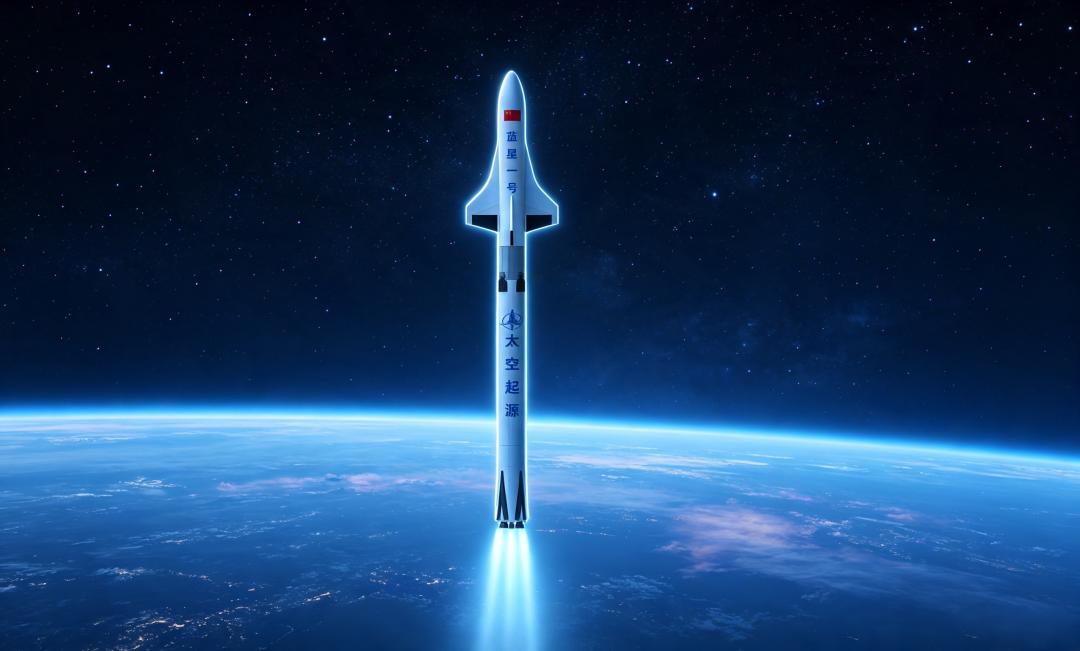
The self-developed "BlueStar-1" by Space Origin is the carrier of this system. In terms of technical route, BlueStar-1 chooses wing aerodynamic deceleration and horizontal glide landing, instead of the vertical landing of Starship. "There is no absolute advantage or disadvantage between the two paths, they are engineering choices made based on the respective team genes and reuse goals."
The definition of BlueStar-1 is broader than that of a second-stage rocket, and it is more accurate to describe it as a "space platform". The logic behind it is very simple: if a reusable second stage is only used to launch a payload once and then returns, its value is not fully released.
In the conception of Space Origin, BlueStar-1 is not only a rocket that can send payloads to orbit; after entering orbit, it is also a spacecraft that can act as an orbital transfer vehicle to send satellites from low orbit to higher orbits; it can also be an on-orbit service platform for on-orbit refueling, on-orbit maintenance and space experiments; it can stay in orbit for a long time to perform tasks such as observation, communication relay, on-orbit manufacturing and space debris removal; after the mission is completed, BlueStar-1 can carry the space payload back to the ground for maintenance and reuse.
"In this way, the cost of one launch is shared by three values: 'launch and deployment + on-orbit operation + return transportation', thus maximizing the economy of reusability." Tang Jibin explained.
The parameter design of BlueStar-1 also reflects this idea. BlueStar-1 has a diameter of 5 meters, which is the mainstream design size of medium and large rockets in the future, and it is also the maximum economic diameter that can be adapted to the existing large tank production, launch towers and launch sites in China at present. Its SSO transportation capacity is 10 tons, which can meet the large-scale launch demand of mainstream constellations in China for batch networking with one rocket carrying multiple satellites.
What is impressive is that BlueStar-1 has set the target launch cost at 5,000 yuan per kilogram. Zhao Feng, co-founder and CEO of Space Origin, introduced that this is the target cost calculated by the team after 20 times of reuse, amortizing the cost of structure, engine, maintenance and propellant, which is the critical point that makes the large-scale networking of constellations economically feasible.
When the technical path is clear, the outside world is more curious about the relationship between Space Origin and first-stage rocket companies. Zhao Feng defines it as industrial collaboration: first-stage rocket companies do a good job in first-stage recovery and reduce costs, Space Origin does a good job in second-stage recovery and on-orbit platforms, and the combination of the two will achieve the effect of "1+1>2".
In Zhao Feng's view, industrial collaboration of commercial rockets is an inevitable trend. After BlueStar-1 realizes second-stage reusability, joint launch with first-stage rockets will greatly reduce costs, which meets the economic considerations of end customers and presents a win-win situation for multiple parties. In addition, the technical difficulty of second-stage recovery is far greater than that of first-stage recovery. Realizing first-stage recovery does not mean having the ability to realize second-stage recovery. Space Origin takes the lead in laying out the second-stage recovery track in China, aiming to become the leader of second-stage reusability with first-mover advantage.
He judged that "with the large-scale development, the industry will inevitably usher in industrial division of labor, give full play to their respective advantages, and jointly expand the market through industrial collaboration. We firmly believe that this is closer to the end state of commercial aerospace than any company working alone."
China's Commercial Aerospace is Accelerating to Break Through
China's commercial aerospace is at an inflection point.
As everyone generally feels, the strategic positioning of commercial aerospace is undergoing a historic rise. I still remember that at the end of last year, the China National Space Administration established the Commercial Aerospace Department to promote commercial aerospace into a track of high-quality and safe development; the Shanghai Stock Exchange also announced at the same time that commercial rocket enterprises are applicable to the fifth set of listing standards of the Sci-Tech Innovation Board; this year, commercial aerospace has been officially included in the key tasks of the 15th Five-Year Plan.
Tang Jibin also clearly feels that the industrial window has opened. At present, local governments across the country are actively making layouts, constellation networking, commercial launches and supporting supply chains have increased visibly in recent years, and market demand is accelerating to release.
At the same time, technical routes are converging. It can be seen that the mainstream routes of first-stage recovery, engine power and rocket body structure have all had verification rockets that have completed test flights, and are no longer in the conceptual stage.
But he does not deny that the whole industry is still in the early stage of "transition from engineering verification to large-scale delivery". "There is still an order of magnitude gap between the number of domestic launches per year, the cost per kilogram and SpaceX, but this gap is a problem of engineering rhythm, not a problem of route."
At this moment, a question is inevitably raised: comparing the schedule of Starship and BlueStar-1, is Space Origin "too late" to enter the track?
Tang Jibin's answer is decisive — "The timing is just right." This is not the answer of a trend chaser, but a rational judgment made by a scientist after calculating the time window.
In his view, Starship has gone through all the pitfalls on the technical path, so latecomers do not need to fumble in the dark again, but move forward with solutions adapted to China's aerospace industrial foundation on a "knowledge map" where risks have been greatly reduced.
"What is really late is not entering the second-stage recovery track now, but starting to do it after the first-stage recovery matures." The logic behind this is self-evident — it may take another three to five years for the domestic first stage with transportation capacity of more than 10 tons to complete recovery and mature reuse. Space Origin aims to realize second-stage recovery in five years, which is exactly aligned with the rhythm of the former; if we wait until the first-stage recovery is fully completed before starting the second-stage recovery, we will fall behind by several years instead.
Nowadays, the industry generally realizes that there is a ceiling in the satellite launch market, and the greater increment will come from the space economy. This coincides with Tang Jibin's judgment. He believes that 2025 to 2030 will be the peak of satellite launches, and mainstream constellations such as the State Grid Constellation, Qianfan Constellation and Nebula Constellation will carry out intensive networking; after 2030, with the expansion of constellation scale, the increment will shift from satellite launch to "post-satellite market" and on-orbit services such as on-orbit refueling and on-orbit maintenance of satellites, and the second growth curve will emerge accordingly.
BlueStar-1 will also play a key role at the inflection point, becoming the "transportation platform + operation platform" of the space economy. As we all know, all new businesses in the space economy have a common premise — the cost of entering orbit must be low enough, and the aircraft itself can stay in orbit for a long time to perform operations. Therefore, only when "orbit entry + on-orbit stay + return" is reusable, can the aircraft realize on-orbit stay, maneuver, docking and return, and change the mode of "launch and leave" to "launch, stay, bring back and reuse repeatedly".
China's 2030 manned lunar landing plan has been officially announced. On the way to the moon, cislunar transportation is a key link. Tang Jibin has a clear positioning for Space Origin, "The state builds the main road, and we build the reusable branch lines that enable the main road to support regular flights and sufficient turnover." In the future, BlueStar-1 will not only send payloads into orbit, but also transport materials between the earth and the moon, perform on-orbit operations and return. The national team opens up channels and sets standards, and Space Origin fills in the part of "sustained operation after