Kimi is valued at 50 billion U.S. dollars. Why is Moonshot AI in a hurry to dismantle its overseas structure?
On November 13, according to The Wall Street Journal, Moonshot AI, the developer of Kimi, is adjusting its corporate structure ahead of the listing: it plans to terminate the operation of its Cayman holding company, repurchase the relevant shares held by early investors, and then arrange for investors to reinvest the funds into the main operating entity within mainland China.
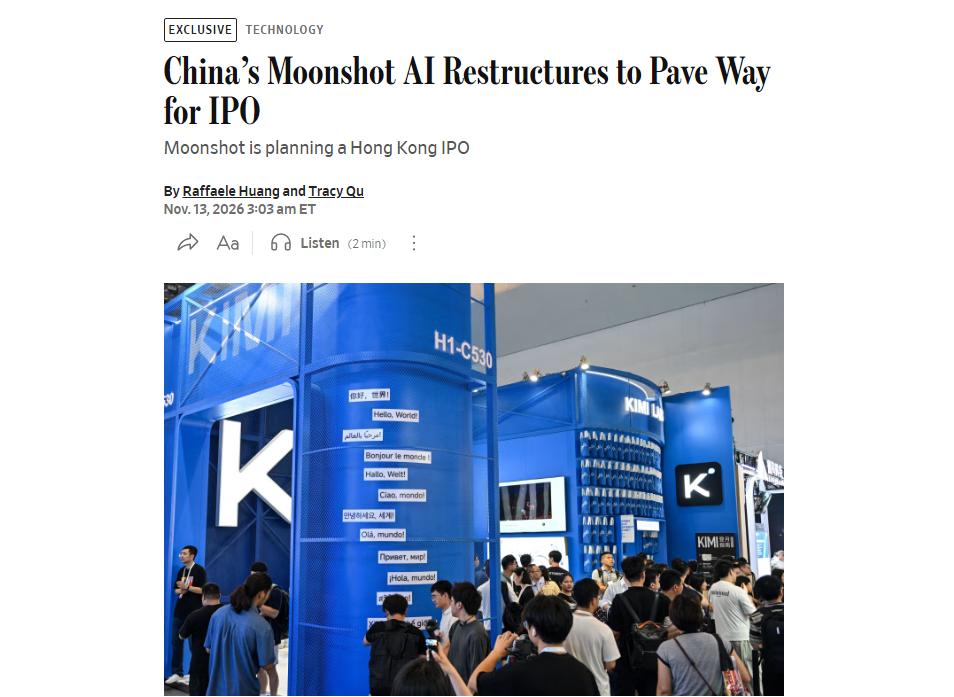
This adjustment is regarded by the outside world as a key step for Moonshot AI to prepare for its Hong Kong stock IPO.
Previously, the market has spread the news that Moonshot AI plans to list in Hong Kong. Bloomberg reported that the company's latest round of financing values it at about 500 billion US dollars, and it is considering landing on the Hong Kong Stock Exchange in the first quarter of 2027, with the maximum fundraising scale possibly reaching 50 billion US dollars.
If this plan is implemented, Moonshot AI will become an important representative of Chinese AI startups that march into the public market.
However, what deserves more attention than the listing time and fundraising scale is the capital structure it is adjusting.
Why does an AI company that started with US dollar funds choose to dismantle the overseas structure that once helped it raise financing when preparing for listing?
01
Starting with US dollar capital, why return to the domestic market?
In 2023, Yang Zhilin founded Moonshot AI and launched Kimi. Relying on its long-text processing capability, the company quickly gained market attention. Institutions including HSG, ZhenFund, Alibaba, Tencent, and Meituan have successively participated in its investment.

For a large model startup, financing capability is of vital importance.
Training models requires massive computing power, R&D requires continuous investment, and the talent cost is far higher than that of ordinary Internet startups. Before the product generates stable revenue, capital almost determines whether an enterprise can stay in the game sustainably.
US dollar funds and overseas holding structures used to be important ways for Chinese tech startups to connect with international capital.
A typical red-chip structure means that an enterprise sets up a holding company overseas, and then controls the domestic operating entity through equity or agreement arrangements. Overseas investors hold shares of the overseas company, which in turn controls the domestic business.
This structure facilitates the introduction of US dollar funds and reserves space for future overseas listing.
However, when an enterprise develops to a certain scale, the original structure may no longer be applicable.
Moonshot AI's core R&D, team and main business are all located within mainland China. As the company prepares for listing, what regulators and the capital market need to clarify is not only the list of shareholders, but also who actually controls the company, which entity owns the core assets, and how the rights and interests of overseas shareholders correspond to the domestic business.
For an enterprise that masters large model technology and involves a large amount of data and computing power resources, these issues are particularly critical.
Therefore, this adjustment by Moonshot AI is not as simple as just deregistering a Cayman company, but to re-sort out the relationship between domestic and overseas entities, so as to make the equity structure, core business and future listing entity clearer.
This does not mean that it will completely cut off ties with international capital.
According to The Wall Street Journal's report, after the structural adjustment, investors may still retain the option of conducting US dollar transactions through entities outside mainland China. In other words, what Moonshot AI hopes to adjust is the path for capital to enter the company, rather than simply closing the overseas investment channel.
Behind this is a new problem that Chinese AI startups are facing: in the early stage, they need international capital to help them grow rapidly, and after entering the listing stage, they must make the capital structure adapt to the regulatory requirements and listing rules of the place where the business is located.
02
Dismantling the overseas structure, the most difficult part is handling the old shareholders
The really complicated part of structural adjustment does not lie in deregistering an overseas company, but in how to handle the investors who have already entered the company.
Moonshot AI has gone through multiple rounds of financing. Different investors entered the company at different times, with different investment currencies, different shareholding entities and different future exit arrangements.
When the company decides to adjust its holding structure, the original rights and interests need to be re-sorted out.
According to the plan reported by the media, Moonshot AI will repurchase the relevant shares held by early investors, and then the investors will reinvest the funds into the domestic operating entity. This means that investors who originally held rights and interests through the overseas holding company need to re-establish an investment relationship with the domestic entity.
There are at least three issues involved here.
The first is how to connect the valuations.
When early investors entered the company, the company's valuation is completely different from that of today. The latest financing valuation spread in the market now is about 500 billion US dollars. When reinvesting, the shareholding ratio, investment cost and future income expectation of old shareholders may all be affected.
The second is the arrangement of funds and taxation.
Overseas share repurchase, capital transfer, and domestic reinvestment involve the legal and tax rules of different jurisdictions. How to handle US dollar funds, how to confirm the original rights and interests, and how to register shareholding after reinvestment all need to be solved one by one.
The last is the future exit channels.
For US dollar funds, investing in a Chinese AI company is not only optimistic about the technology, but also needs to consider how to exit in the future. If the overseas structure changes, investors must reconfirm how their rights and interests are protected, and whether there is still the possibility of US dollar transaction and exit in the future.
Therefore, this adjustment tests not only the company's execution capability, but also the coordination capability between the founding team and early investors.
For Moonshot AI, sorting out the equity relationship before listing can reduce the future audit and governance costs; for investors, the key is whether the original rights and interests can be properly inherited, and whether the future income and exit path are clear.
The $500 billion valuation makes this matter more sensitive.
It should be noted that the $500 billion is the financing valuation reported by the media, which is not equal to the final IPO pricing; $50 billion is only the upper limit of the fundraising scale spread in the market, not the determined issuance plan.
But these two figures at least indicate that Moonshot AI is moving from the financing logic of the primary market to the governance logic of the public market.
In the past, investors were willing to pay a premium for technological potential and growth expectations; after entering the listing stage, the market will also ask about the equity structure, financial quality, corporate governance and sustainable profitability.
Capital can help the company expand rapidly, but cannot replace the company to build a stable operation system.
03
After the $500 billion valuation, the market will see how it makes money
If we only look at the valuation, Moonshot AI's story is already dazzling enough.
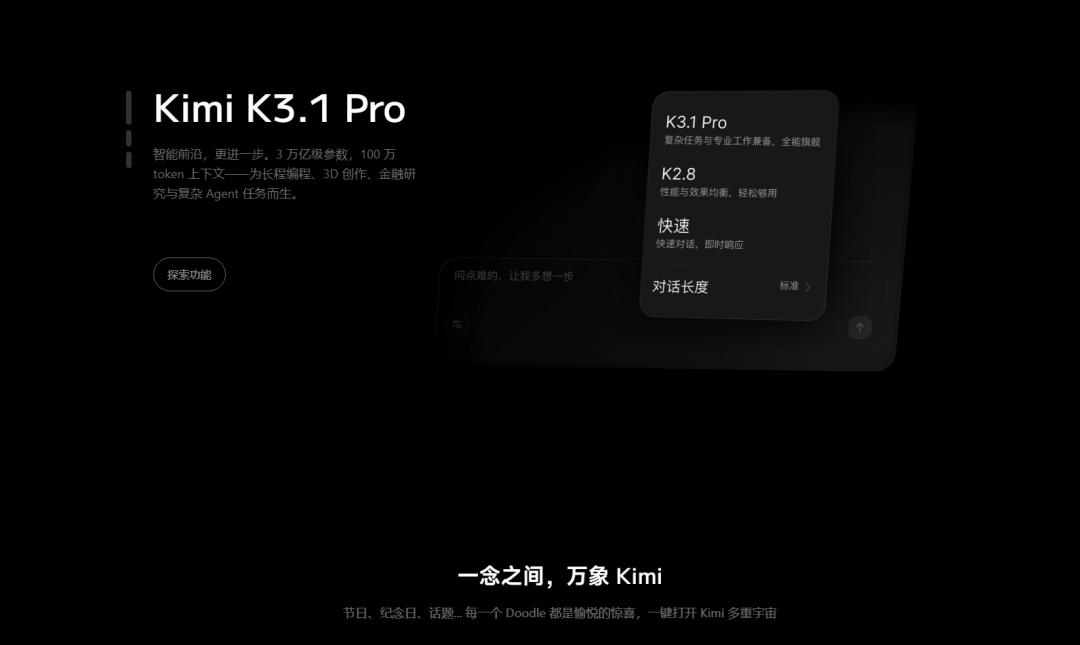
Kimi quickly opened up the market relying on its model capability, and the company is continuously launching new models and products. Media reports said that Moonshot AI once disclosed to investors that its annual recurring revenue (ARR) is expected to reach 2 billion US dollars by the end of 2026, doubling from 1 billion US dollars in August.
However, ARR is an annualized indicator calculated based on the current revenue operation, which is not equal to the confirmed full-year operating revenue, let alone that the company has achieved profitability.
This is exactly the problem that Moonshot AI must face after listing: how to convert model capability into sustainable and scalable revenue?
The commercialization of large model companies mainly has several paths.
For individual users, revenue can be obtained through subscription, but user scale is not equal to paying user scale. There are obvious differences among free users, paying users and high-frequency users. The stronger the model capability, the more willing users may be to pay, but the reasoning cost may also rise accordingly.
For enterprises and developers, fees can be charged through API calls, model services and enterprise solutions. This type of business is more likely to generate sustainable revenue, but customers also pay attention to call cost, stability, response speed and service guarantee.
In addition, computing power cost is also an unavoidable exam question. The larger the model call volume, the higher the revenue may be, but the computing power consumption will also increase. If revenue growth cannot catch up with the growth of reasoning cost, scale expansion may not necessarily bring profit improvement.
Therefore, what the capital market really cares about will not only be how many users Kimi has and how high the model ranks, but also the revenue structure, customer concentration, gross profit margin, computing power procurement cost and cash flow.
This is also the change that AI companies must experience after moving from the financing stage to the listing stage.
In the early stage, the market is willing to pay for technological potential, and enterprises can obtain time and growth space through financing. But after listing, investors need to see a clearer business model: who the customers are, where the revenue comes from, how to control costs, and whether stable profitability can be formed in the future.
Moonshot AI is not the only Chinese AI company facing this problem.
In the past few years, Chinese large model startups have experienced intensive financing and product competition. Now, the industry is gradually shifting from competing for model capability, talent and financing speed to competing for commercialization efficiency, computing power resources and organizational capability.
Listing can bring new financing channels to support R&D and computing power investment, but it also means that the company must accept stricter financial and governance scrutiny.
For Moonshot AI, adjusting the overseas structure is a threshold before entering the capital market. It needs to properly handle the rights and interests of early investors, and make the business and equity relationship of the future listing entity clear enough.
But this is only the first step.
The $500 billion valuation is the market's pricing for Kimi's past performance; the IPO is the market's re-examination of its future operating capability.
Dismantling the Cayman structure solves the problem of how the company gets listed. After listing, Moonshot AI also needs to prove that it can not only build competitive large models, but also convert technological advantages into revenue, profits and long-term competitiveness.
For Yang Zhilin, the next exam is no longer just a technical exam.
This article is from WeChat Official Account "Thick Snow Business", written by Wang Xin, and authorized for release by 36Kr.