New Battlefield of Sports IPs: The Battle for Childhood
Sports organizations are turning children-focused content into a more systematic business.
In 2026, ESPN launched ESPN JV, a YouTube channel targeted at children; sports technology company WSC Sports established WSC Studios, an original content production division, to create children's animations for sports copyright holders such as the NBA and La Liga. Behind these moves lies the sports industry's scramble for young audiences: as children have been accustomed to watching content on YouTube, sports organizations also hope to let them get to know players, teams and sports at an earlier stage through animations and stories.
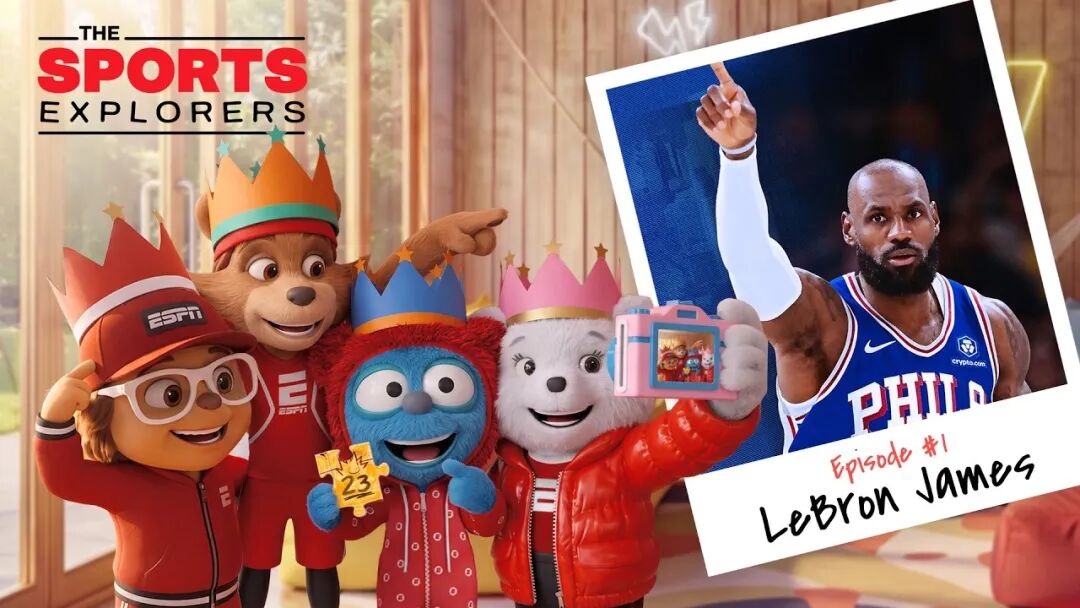
▲ The star character in the first episode of *The Sports Explorers* is LeBron James
This trend has also extended to the broadcast formats of major events. The 2027 Super Bowl will launch a real-time animated special broadcast with a Star Wars theme, a collaboration between ESPN, Disney, Lucasfilm and the NFL. With the help of data visualization technology from Sony's subsidiary Beyond Sports, and the participation of the original voice cast, athletes on the real-time competition field will be transformed into animated characters. Even at some highlight moments, characters from Star Wars will appear at critical moments, with various Easter eggs interspersed throughout the broadcast.
From children's channels and original animations to special event broadcasts, sports organizations are trying to enter the daily entertainment life of children and families in different ways.
01
Cultivate the next generation of fans
A basketball spaceship ignites and lifts off, carrying four little explorers from ESPN Squad through the timeline of LeBron James' career — this story originates from a cartoon character who wants to find inspiration for his art assignment.
This scene comes from *The Sports Explorers*, an animated children's series on the ESPN JV channel. Co-developed by ESPN Creative Studio and WSC Studios, this series combines animated characters with real game footage, and uses sports star IP to create an original children-themed series with unique characteristics.
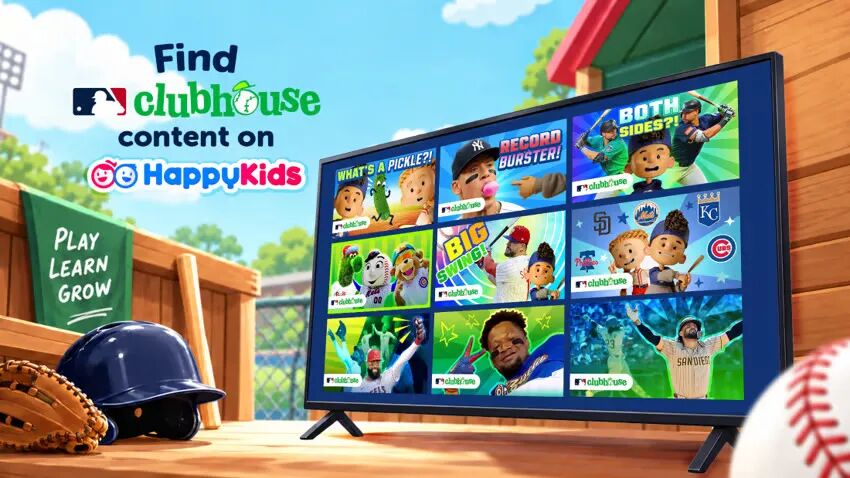
In April this year, MLB also launched the MLB Clubhouse channel on YouTube, producing a series of original animations, player stories, highlight reels and educational content. Centered on baseball and softball, it tries to use different content forms to let children get in touch with the sport through multiple entry points.
Why does the sports industry want to cultivate fans from childhood? And why do they all value YouTube channels?
A 2025 US survey by Pew Research Center points out that 85% of surveyed parents said their children aged 12 and under watch YouTube videos, and 51% of them said their children watch videos on YouTube every day. In 2020, 45% of parents of children under 2 said their children watch YouTube, and this figure rose to 62% in 2025. This means that YouTube has become a daily entertainment platform for many children, and children do not necessarily get access to sports through traditional sports channels or live TV broadcasts. For sports media and leagues, children-focused content is a new channel to enter the daily entertainment environment of young audiences.
More youth-oriented content allows sports events to penetrate into more daily life scenarios. Traditional live sports broadcasts mainly reach audiences intensively during game time, while children's content provides another way of engagement. Apart from watching live broadcasts, event highlights and reports on game days, children can also get in touch with sports through player stories, event rules, sports history, animations and interactive games on non-game days. For example, *Let's Play Ball* launched by MLB Clubhouse turns baseball and softball training methods, skills and tricks provided by top MLB and AUSL stars into a series of short videos. Sports media are no longer just competing for the time audiences spend watching games, but also competing for the time they spend on daily entertainment consumption.
Fan identification often starts to form at a very young age. A 2024 study released by Playfly Sports and Vision Insights points out that 71% of the most loyal NBA fans had already become fans of a certain NBA team when they were 12 years old. This at least shows that childhood is an important stage for the formation of fan identification, and it also explains why sports organizations are willing to reach out to younger audiences in advance.
However, this is not the first time the sports industry has tried to attract children with animations. In 2023, ESPN launched a real-time animated special broadcast of *Big City Greens* for NHL games. The median age of viewers of this broadcast on Disney Channel and Disney XD was 14 and 12 respectively, while the median age of regular programs on the two channels in that month was 22 and 28 respectively. Such attempts show that changing the presentation of games does have the opportunity to reach younger audiences. But special broadcasts only happen during games after all, and channels like ESPN JV and MLB Clubhouse hope to maintain continuous contact with them on non-game days.
02
From event highlights to customized content production
The establishment of WSC Studios is backed by the technology and sports copyright holder resources accumulated by WSC Sports over the years. Headquartered in Israel, this sports technology company mainly provided game video analysis tools for teams in the early stage, and then gradually shifted to sports content production.
In 2013, WSC demonstrated to the NBA its technology of analyzing game videos and identifying key moments, and proposed to automate highlight production. The two sides then signed a multi-year cooperation agreement. Bob Carney, senior vice president of NBA Digital and Social Content, once said that other companies have also promoted automated highlight technology, but few companies have actually achieved the promised scale.
In the 2016-17 season, WSC produced more than 300,000 videos for the NBA. Only on the NBA's Facebook homepage, the automatically generated videos by WSC got more than 7 billion views that year. WSC also provided technical support for the NBA's Facebook Messenger customer service chatbot and Google OneBox search results.
After that, WSC developed customized videos and AI-assisted script writing, dubbing and other tools. That is to say, before developing children's content, WSC no longer simply edited and collected game videos, but accumulated a set of technologies that can be used for large-scale production of sports content.
In October this year, WSC officially announced the establishment of WSC Studios, extending its previous video production capabilities serving sports organizations to original children's content. WSC Studios can provide services from creative conception, script writing, dubbing and directing, to animation production, localization and distribution strategy.
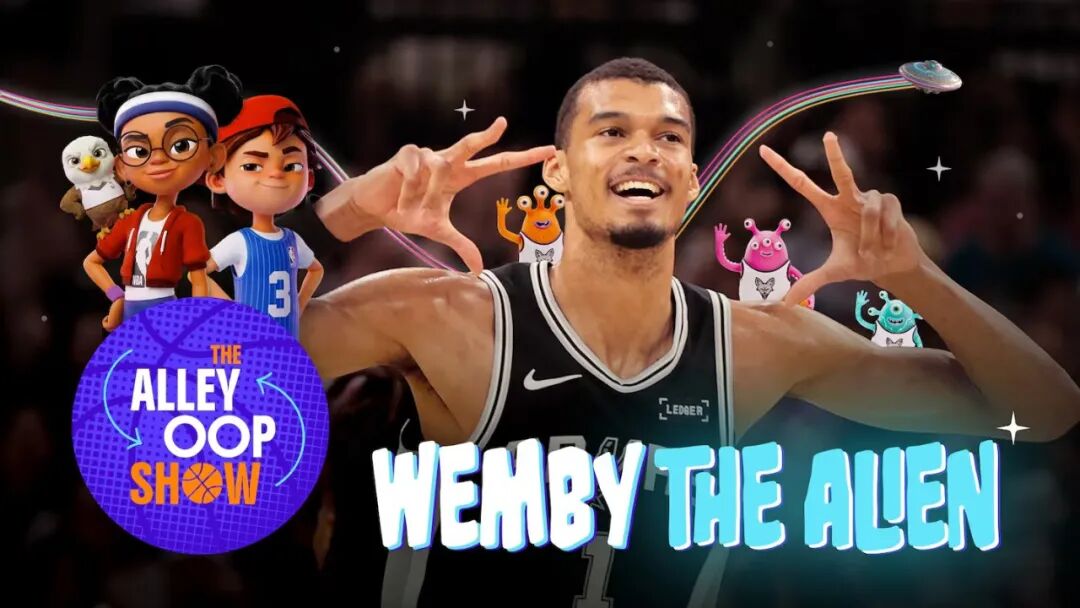
For example, the *Alley & Oop Show* program in cooperation with the NBA intersperses funny clips of three protagonists with popular science knowledge about active NBA players and team history. The first few episodes launched in the early stage of this program are mainly used to test and optimize the content format, with the view count usually ranging from thousands to more than 10,000. However, a single video themed around NBA star Victor Wembanyama had nearly 740,000 views as reported in late October.
03
Changes in technology and demand make mass production of content possible
AI provides support in links such as character animation, language translation, and voice cloning using real voice actors signed by WSC Studios. Itai Epstein, head of WSC Studios, said this process allows a series program to complete the whole process from conception to production within two to three months.
Bob Carney also mentioned: "When people talk about youth content, the first thing they think of is animation. But animation production has always been time-consuming and labor-intensive, so it is often difficult to find investment. But the situation is different now, it feels like 'wow, everything is possible'."
However, the pre-produced animations made by WSC are not the same product as the real-time animated special broadcasts of events such as *Toy Story*. The *Toy Story* animated broadcast launched by ESPN and NFL for the match between the Falcons and Jaguars in 2023 required the participation of multiple parties such as Beyond Sports, Silver Spoon and ESPN Creative Studio, and presented the stadium in real time with the help of technologies such as game tracking and motion capture.
With the development of AI-assisted production tools and the expansion of sports organizations' demand for children's content, the previous attempts centered on a single game are extending to sustainably updated original programs and professional content production services.
The previous special broadcasts were more like a brand investment and broadcast experiment, rather than a children's content brand in continuous operation. As sports media see the audience response in the experiments, these special broadcasts have gradually become series content. ESPN expanded its cooperation agreement with Beyond Sports to produce animated broadcasts for NFL, NHL, NBA and WNBA games through Disney and ESPN platforms during the 2025-26 season.
With the industry resources accumulated by WSC over the years, in addition to the NBA, WSC Studios has also produced *Goalitos* for La Liga, which updates about 5 minutes of program every week and produces versions in Spanish, English and Arabic. *Wagtales* in cooperation with the Australian Football League is co-developed with the participation of AFL Studios and the league's school education team. These projects show that different sports organizations have begun to continuously produce programs based on their own event resources and the needs of child audiences.
04
After reaching children, the revenue remains to be verified
At present, these content releases have been recognized by many audiences. The ESPN JV YouTube channel has jointly released content with many partners including MLB Clubhouse, Disney Jr. and Disney Channel animations. Since the channel was launched in October, ESPN JV currently has more than 10,000 subscribers and over 2.7 million views. Its fan growth rate is faster than that of the MLB Clubhouse channel established in November 2025, which currently has about 12,000 subscribers and about 8.31 million views. MLB officials said in April 2026 that the 2025 cooperation with the children's education app ABCmouse generated more than 11 million views.
However, all channels are still in the early stage of operation, and it is impossible to evaluate the long-term effect only by the number of subscribers and views.

As for whether children's content can be converted into actual revenue, from WSC's model, children's content is first a service that can be sold to sports copyright holders. According to SBJ reports, WSC Studios charges a service fee ranging from five-digit to seven-digit US dollars according to the project scale, and also provides a cooperation option of subsequent revenue sharing, while the copyright holders retain the ownership of original IP. That is to say, the studio can obtain direct revenue through project production, and also have the opportunity to participate in subsequent commercial development. The NBA also hopes to use the animated characters in *Alley & Oop Show* for merchandise, video games, creator programs and league marketing cooperation, but these are still development assumptions at present, and cannot be counted as realized revenue.
Although within one program or one season, the view count can only show how many audiences it has reached, in the long run, sports leagues hope that children can get to know players, teams and games through animations, gradually develop interest in a sport, and become consumers who continuously watch games, buy merchandise or subscribe to event services in the future.
But for now, the resources invested by sports media to cultivate the next generation of audiences may not necessarily bring all the returns to themselves. For example, the future audiences of ESPN JV may not necessarily choose ESPN to watch events, and they may also follow star players and watch NBA games through other platforms. But for the league, as long as the child eventually becomes a long-term fan, there is an opportunity to obtain value from event copyrights, merchandise and other businesses. As for content suppliers like WSC, it can get returns through production service fees and optional subsequent revenue sharing for some projects. But just like all businesses that bet on children, their investment today may take a very long time to truly show their final returns.
This article is from the WeChat Official Account "Lanxiong Sports" (ID: lanxiongsports), written by Huang Yi, and published with authorization from 36Kr.