Why is it hard for the home textile industry that counts dozens of listed companies among its players to spawn a 10-billion-yuan brand?
Home textile products have long entered thousands of households, but the over 300-billion-yuan Chinese home textile industry has not yet produced a single brand with annual revenue exceeding 10 billion yuan? Every household needs bedding products, everyone needs to sleep, and home textile bedding has long been a rigid demand for every family. A number of listed companies including Mercury, Luolai, Fuanna, Mengjie and Mlily have brands, products and channels, and have all made attempts at high-end positioning, lifestyle orientation, technology integration and globalization. However, when looking at their 10-year revenue curves, several leading enterprises are still hovering at the level of 3 to 5 billion yuan, and the 10-billion-yuan mark always feels like a mirage... Why has this business that every household and every person uses not grown a 10-billion-yuan brand with sustained structural growth?
There is a very interesting contrast in the home textile industry.
People sleep every day, and they spend one third of their lives in bed; but when it comes to actual spending, many people pay far less attention to a quilt or a pillow than to a mobile phone or a piece of clothing.
The industry is also sufficiently dynamic.
Four-piece bedding sets, quilt cores and pillow cores are becoming more and more segmented, and new products for children, wedding scenarios, high-end markets, silver-haired groups and technological sleep are continuously launched; e-commerce, live streaming, franchising and direct sales, no channel has been left behind. There are more and more products, but the revenue of leading enterprises always hovers back and forth at several levels.
Mercury grew from 2 billion yuan to 4.5 billion yuan, Luolai reached 4 to 5 billion yuan very early, Fuanna stayed at 2 to 3 billion yuan, Mengjie dropped from over 2 billion yuan, and Mlily has touched 9 billion yuan.
The five enterprises have taken five different paths, and have all encountered five different platform periods.
As the brand service provider shared by many listed companies in the home textile industry, Shi Zhangqiang, professor-level senior economist, founder of Jinkun Brand and dean of Lianshi Brand Research Institute, believes that to answer the question of 10-billion-yuan brands in the home textile industry, we must first figure out where each enterprise is stuck, and then explore why the whole industry is collectively trapped.
Why are the benchmarks of the home textile industry hovering in the platform period together?
The platform period seems to be just a revenue curve, but behind it is the real reaction after the original business model of the enterprise reaches its boundary.
Some enterprises reached over 4 billion yuan by relying on the main product category, some extended products to the whole house, some bet on art and high-end positioning, and some pushed revenue to the threshold of 10 billion yuan through overseas business.
Different paths lead to different sticking points.
Only by disassembling the five enterprises one by one can we see how the platform period of the home textile industry is formed.
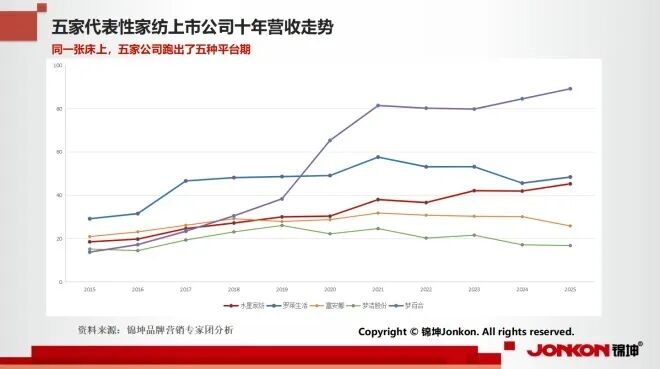
1. Mercury: Beyond quilt cores, how can the second growth curve grow independently?
Mercury's ten-year growth is very similar to climbing stairs.
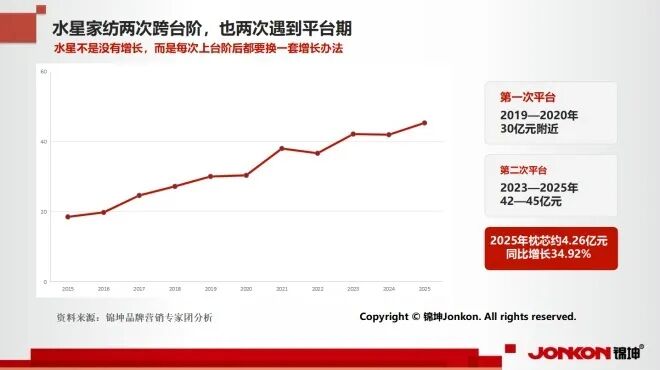
In 2015, its revenue was 1.851 billion yuan, reached 3.002 billion yuan in 2019, and was 3.035 billion yuan in 2020, stopping near 3 billion yuan for the first time.
In 2021, its revenue jumped to 3.799 billion yuan, and in 2022 it adjusted back to 3.664 billion yuan.
From 2023 to 2025, the revenue was 4.211 billion yuan, 4.193 billion yuan and 4.528 billion yuan respectively, and it stayed at the level of over 4 billion yuan for three years.
The two platform periods show that Mercury has growth capacity, but after each step to a new level, the increment brought by the original growth method will slow down.
Quilt core recognition, national channels and e-commerce have helped Mercury get to where it is today. Relying on these three advantages, revenue can still grow; but if it wants to move from 4.5 billion yuan to a higher level, it needs a new fulcrum that can independently support the scale.
Mercury is not short of new cards in hand.
It has already laid out pillow cores, ergonomic pillows, ice-cream quilts, wedding scenarios, children's products, silver-haired products, high-end products and technological sleep; Mercury Home Textiles, Balis, Mercury Kids, Mercury 1987 and STARZ HOME also cover different price points and crowds.
In 2025, the revenue of pillow cores was about 426 million yuan, a year-on-year increase of 34.92%, which has revealed a clue worth continuing to follow.
Here we need to distinguish three words that are easily mixed together.
A blockbuster product refers to a single product that sells large enough;
A large category refers to a group of products that jointly occupy a certain demand;
The second growth curve refers to a new business that can continuously contribute revenue and profit.
Mercury's pillow core is currently closer to the seed of the second largest category.
When consumers take the initiative to look for it, stores can explain it independently, channels can achieve stable sales volume, and the enterprise can make separate accounting for it internally, it will truly grow into the second growth curve.
However, to grow from a 400-million-yuan product to a 1-billion-yuan category, it is necessary for consumers to form a clear perception, stores to form a stable experience, channels to form an independent business model, and the enterprise to continuously invest resources in it.
Children's products, wedding scenarios and technological sleep are also facing this threshold. At present, they are more attached to Mercury's original bedding business, and have not independently rewritten the group's revenue structure.
To put it bluntly, where Mercury is stuck is that new branches have grown out, but the new main trunk has not yet matured.
2. Luolai: From home textiles to home living, why has the second largest category not yet emerged?
Luolai is facing another kind of platform period.
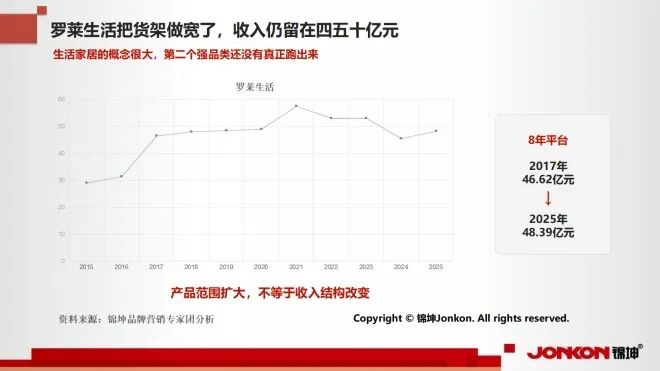
In 2015, its revenue was 2.916 billion yuan, and it had reached 4.662 billion yuan as early as 2017;
In 2021, it once reached 5.76 billion yuan, and in 2025 it returned to 4.839 billion yuan.
From 2017 to 2025, after eight years, Luolai is still moving back and forth in the range of 4 to 5 billion yuan.
Luolai realized very early that there is more space beyond the bedroom.
The company expanded from traditional home textiles to home living, extending products to living rooms, kitchens and dining rooms, bathrooms, fragrances and more household products.
The product shelf has become longer, and the coverage has expanded from the bedroom to the whole house.
The problem is that consumers' purchase reasons have not expanded synchronously.
Everyone knows Luolai because of its bedding products, and when they enter Luolai, the first thing they think of is still four-piece sets, quilts and pillows. Kitchen and dining products, bathroom products and fragrances can increase sales, but it is difficult to bring consumers into the store alone, and they have not formed a large category large enough to support billions of yuan in revenue.
Luolai's platform period is that the product portfolio is wide, but the categories are not strong enough.
Home living sounds very large, but for consumers, there is still a simple answer missing: besides bedding, why should I specifically buy other things from Luolai?
3. Fuanna, Mengjie and Mlily: How can characteristics and boundaries truly turn into scale?
Fuanna is stuck in how to amplify its unique characteristics.
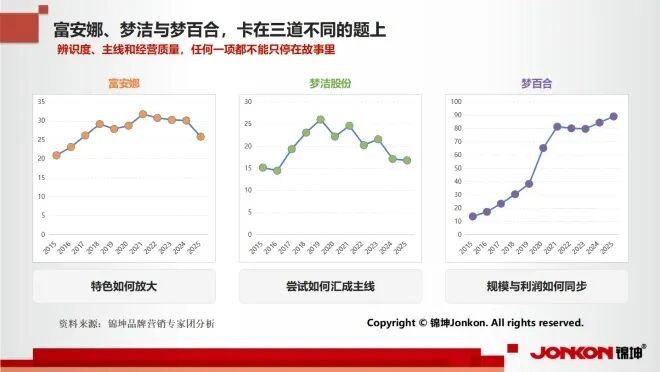
In 2015, its revenue was 2.093 billion yuan, reached a 10-year high of 3.179 billion yuan in 2021, and fell back to 2.585 billion yuan in 2025.
Artistic home textiles, design sense and high-end tone make Fuanna easily recognizable among a group of bedding brands.
Such characteristics can form preference, but also naturally define a specific group of people.
Aesthetics can make consumers like a set of bedding, but it is difficult to continuously increase purchase frequency.
To further expand art and high-end positioning, it is necessary to enter more life scenarios, form representative products and stable repurchase.
Fuanna has maintained its recognition, but it has been looking for a way to turn recognition into larger scale.
Mengjie is stuck in how to integrate multiple attempts into a main line.
In 2015, its revenue was 1.517 billion yuan, reached 2.604 billion yuan in 2019, and then the revenue continued to fluctuate, returning to 1.679 billion yuan in 2025.
Mengjie has tried high-end positioning, intangible cultural heritage, children's products, intelligence and digitalization.
Each direction makes sense on its own, but when combined, it is easy to disperse product, channel and communication resources.
The enterprise always needs to give a clearer choice on which item is most worthy of being remembered by consumers, and which item has the best chance to form a stable business.
After revenue and profit come under pressure, the space for trial and error is further reduced, and Mengjie's platform period has turned into a problem of re-stabilizing its basic market.
Mlily is stuck in how to synchronize scale and operating quality.
In 2015, its revenue was 1.377 billion yuan, reached 8.912 billion yuan in 2025, with a 10-year compound growth rate of 20.53%, making it the fastest growing among the five enterprises.
Memory foam, overseas customers, overseas production capacity and cross-border channels have pushed Mlily to the doorstep of 10 billion yuan.
Overseas channel costs, production capacity investment, exchange rate fluctuations and global management have also become heavier, and profits have fluctuated many times.
Mlily has proved that the home textile and sleep business can approach 10 billion yuan, and it also reminds the whole industry that crossing the revenue line is only the first hurdle. Profit, cash flow and global operation capabilities determine whether an enterprise can stay above 10 billion yuan for a long time.
Five enterprises, five different platforms.
Mercury is waiting for its new business to grow, Luolai is waiting for the second largest category to emerge, Fuanna is solving the problem of amplifying its characteristics, Mengjie first needs to find its main line again, and Mlily needs to stabilize both scale and profit.
Together, they show that the platform period of the home textile industry is far more complex than the "low-frequency consumption" description.
Enterprises have done a lot of things, and the real difficulty is to make products, categories, brands, channels and users change together.
As the leading brand service provider of industry-city-park-enterprise that has coached and served more than 400 specialized and sophisticated "little giant" enterprises, over 300 top brands in their respective sectors, more than 200 listed companies, over 100 city brands, more than 50 Fortune China 500 enterprises and over 30 Fortune Global 500 enterprises, Shi Zhangqiang, founder of Jinkun Brand, dean of Lianshi Brand Research Institute and expert committee member of Xinhua News Agency Brand Project, pointed out that the platform period of the home textile industry appears to be low-frequency on the surface, but in essence, the original main category has reached its boundary, while new products, brands and channels have not yet formed a second operating entity.
Why is it still difficult to produce a 10-billion-yuan home textile brand among dozens of listed companies?
The five enterprises have their own problems, but behind them we can see a set of similar industry cruxes.
Bedding products have long entered thousands of households, old demands are very stable, but new demands grow slowly;
Enterprises continue to expand products, brands and channels, but consumers' purchasing patterns have not changed much.
The ceiling of the home textile industry is gradually formed in these layers of actions that "seem to have been done".
1. There are many bedding products, but there are not many large categories that can be truly remembered by consumers and purchased repeatedly
When you walk into a home textile store, the products can fill several walls.
Four-piece bedding sets are divided into dozens of types according to material, pattern and season. Quilt cores include down, silk, wool and chemical fiber. Pillow cores include latex, memory foam and ergonomic types.
Enterprises see dozens of product lines, but consumers often only remember three things in the end: buy a set of bedding, change a quilt, pick a pillow.
This is the first sticking point of the home textile industry.
The classification on the shelf is very detailed, but the classification in consumers' minds is very rough. New products for children, weddings, high-end markets and intelligent scenarios keep emerging, but many of them are still understood as different styles of bedding, and have not yet become a new large category that can be independently searched, compared and purchased.
A real large category will turn a vague demand into a specific thing.
People who are afraid of heat know what to buy, people with uncomfortable neck and shoulders know what to choose, children of different ages know what products to change, and the elderly know how to sleep more easily at night.
Only when consumers can connect problems, products and brands can the category take root in their minds.
The home textile industry has many products, but there are too few categories that can independently solve a life problem.
2. Brands, series and channels are all expanding, but clear crowd division and operation closed loop have not necessarily been formed
Leading home textile enterprises are all developing multi-brand, multi-series and multi-channel strategies.
The main brand targets the mass market, and sub-brands target young, high-end or children's crowds; online channels cover e-commerce and live streaming, and offline channels cover direct sales, franchising and