AI Quick Site: Full website generation via dialogue, lowering the barrier to entry for website building with AI.
In the past, building a website required proficiency in coding, design and deployment, which posed a high threshold for ordinary entrepreneurs and small and medium-sized merchants. Leveraging conversational interactive capabilities, AI Quick Site allows users to generate a complete website simply by describing their needs in natural language, turning website building from a technical task into natural communication, and helping groups without technical backgrounds quickly launch their sites.
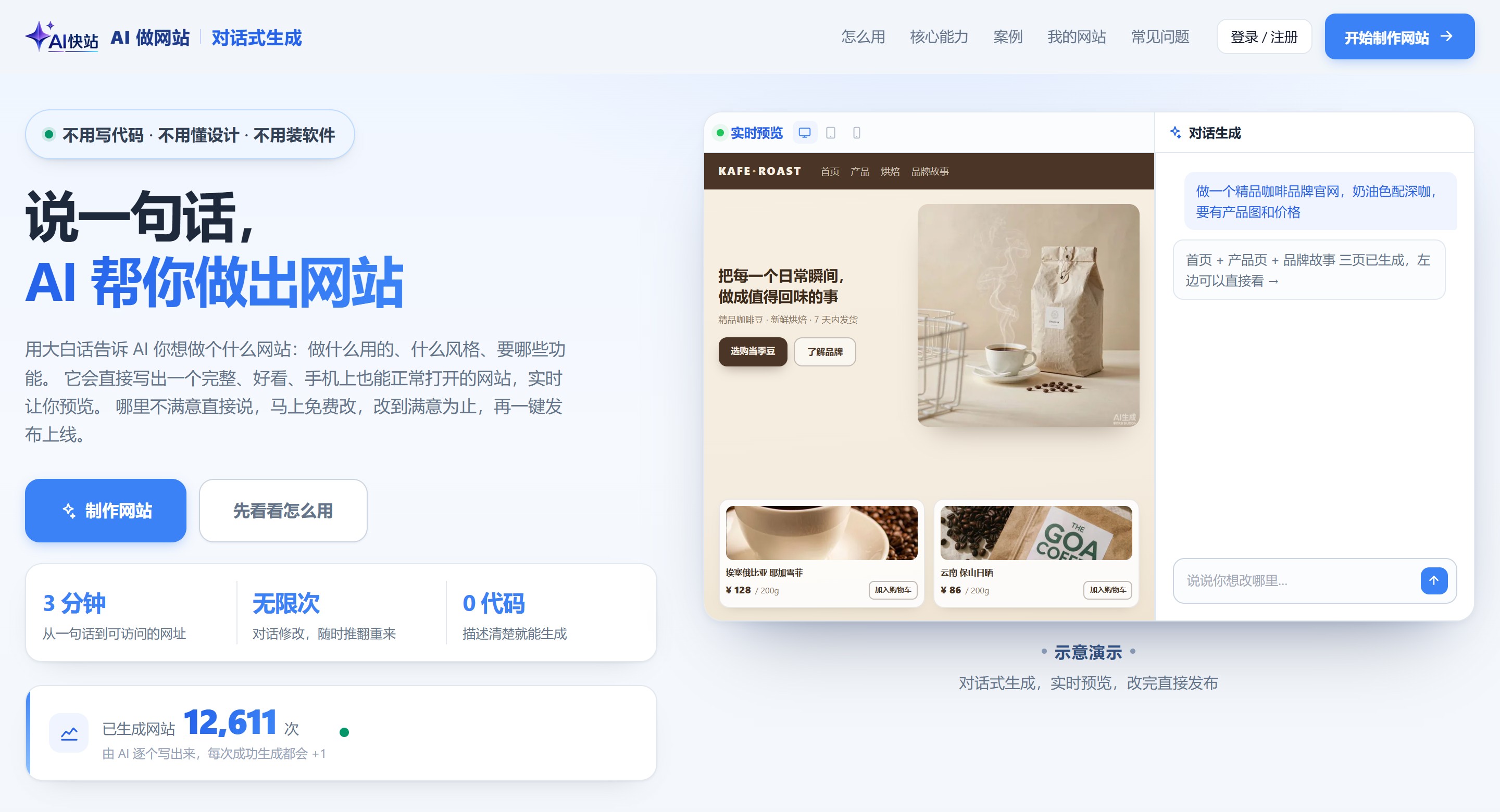
Recently, the conversational website building tool "AI Quick Site" has been launched and put into operation. Users do not need to enter the editor or drag components, and only need to state "the purpose, style and required functions" in daily language, and the system will generate a complete site including the homepage and multiple sub-pages. According to the official statement, it takes as fast as 3 minutes from a one-sentence description to an accessible website.
This product targets a demand that is not new but has not been properly solved for a long time: micro, small and medium-sized business entities need official websites, but the existing paths to meet this demand are all too cumbersome.
The threshold of website building is never just "getting the site done"
Using traditional outsourcing, from communicating requirements, producing design drafts, writing pages to configuring domain names for launch, it generally takes two to four weeks, and the cost ranges from thousands to tens of thousands of yuan depending on the complexity. What is more troublesome is after delivery — changing a phone number, replacing a main image, or adjusting a price often requires rescheduling and re-quotation. With template-based website building tools, the threshold is lower, but users still have to drag components, adjust spacing and align grids in the editor. People without a design foundation still get stuck in the situation where "it looks wrong, but I can't tell what's wrong".
The common point of the two paths is that the first completion is only the beginning, and every subsequent modification requires additional cost. The real status of small business operators is constant change — changing seasons, adjusting prices, launching new products, and modifying business hours. The demand is continuous, but the tools are one-off.
The approach of AI Quick Site is to replace this entry: instead of making users learn to use the tool, let users express themselves in the most familiar way. Enter a description, and you will first get a complete site that can be opened and browsed normally on mobile phones, then continue to modify it through voice commands on this basis. The whole process does not require registering an account or filling in any key for the model interface — these pre-actions are precisely the first step that ordinary users give up. During generation, the pages are presented as they are written, and every step that AI is taking is listed on the left, so users don't have to wait idly for a loading spinner.
The team's statement on this matter is that a good tool should not add new operational burdens to users, "leave the complexity of technology to ourselves, and return the simplicity of use to users".
The difference lies not in "fast generation", but in "easy modification"
Most of the AI website building products on the market currently follow the template route: choose a layout first, and then let AI fill in the content. AI Quick Site does not follow this logic. The page structure, style and copy are generated along with the requirements, so sites of different industries and different styles will not look identical.
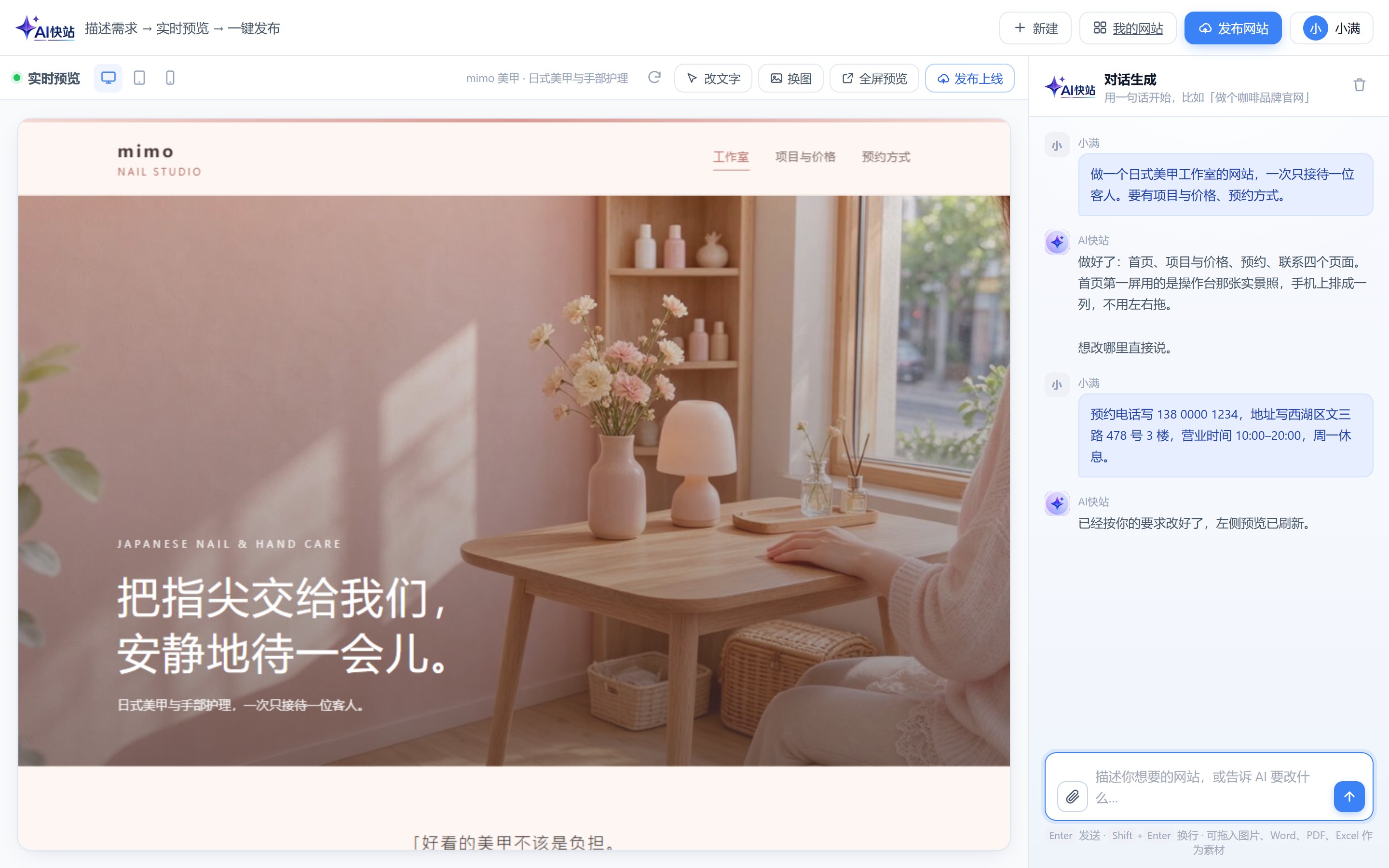
What further distinguishes it is its modification method. Most similar products adopt the mode of "one-time generation, rework for revision": if users want to modify a part, they have to overturn the whole site and regenerate it, and they tend to give up after modifying more than twice. The revision of AI Quick Site is partial: when the user says "change the price to 99", the system only replaces the content related to the price, and the rest of the layout and copy remain unchanged. This means that the cost of making ten modifications is close to that of making one modification.
In addition, you can roll back if you make a mistake. Each modification will be automatically archived, and the online version will not be overwritten. If you think a certain version is worse than the previous one, you can switch back to any previous version with one click. This feature actually determines whether users dare to make modifications — when there is no way back, most people will put up with the unsatisfactory parts. Modification does not fully rely on language description: in the real-time preview interface, users can directly select any text on the page to edit, saving the trouble of communication that is difficult to express accurately, such as "move the blue title in the second paragraph down a little".
The content side also "does not force users to prepare materials in advance". The generated site is a complete set of homepage plus several sub-pages (currently 2 to 3 sub-pages in addition to the homepage for a single site, up to 6 pages in total), with clickable top navigation, instead of only one scrollable long page. Users can upload product images, menus, and quotation sheets if they have them; the text in Word, PDF and Excel will be extracted and used as materials. If users have no materials at all, the system will match the copy style according to the industry and generate matching images as needed, leaving no blank placeholder boxes on the page. When a recognizable brand name appears in the demand, the system will first retrieve the public information of that brand before generating content, to reduce the wrong description of business scope.
The launch process is also fully optimized: responsive design is built in during generation, so the site looks the same on computers, tablets and mobile phones, no separate mobile version is needed. Binding your own existing domain name does not incur additional fees, and the HTTPS certificate is automatically issued. Each page generates its own title and description, and the sitemap is automatically submitted to search engines after launch. In addition, the full site source code supports packaged download, so pages, styles and images can all be exported together — this feature is not "cost-effective" for products that charge 9.9 yuan per month, but it answers the most frequently asked question from users: whether the website is truly theirs.
Only 9.99 yuan for hosting fee, and clearly defined boundaries
The charging structure of AI Quick Site is different from common SaaS subscriptions: generation and modification are free of charge, and only the "publication and launch" service charges a hosting fee, which is 9.99 yuan per month, 28.6 yuan per quarter, and 99.9 yuan per year. You can keep modifying the site as long as you don't publish it; if you don't want to bother with domain names when launching, you can use the free URL provided by the platform to access the site, and replace it with your own domain name at any time later. If you don't have a domain name, you can also register directly on the platform, the registration fee is subject to the real-time price of the suffix, and the resolution is configured by the platform.
The target group corresponding to this pricing is very clear: micro, small and medium-sized enterprises, studios and individual merchants without technical teams, as well as one-off demands that require decent presentation such as wedding invitations, event pages and personal portfolios. Their common feature is not "low budget", but that it is not worth investing the manpower of a whole project for one website building task.
The team has also defined the parts that they will not develop. Bookkeeping, to-do lists, calendars, and systems with background login are not within the scope of services — their core function is to "store data and identify users", and the page is just the outer shell, which is more suitable to be handed over to existing professional tools. Shopping carts and online payment are also not in the recent plan: behind transactions are orders, inventory, refunds and reconciliation, which cannot be solved just by making the page look better. In the AI website building track where many players tend to overpromise, this clear boundary explains why its pricing can be kept at such a low level.
Up to now, the platform has generated more than 12,000 sites in total. The team stated that current resources are focused on generation quality and revision accuracy. The next step will be to develop industry-specific templates, shorten the time from demand to launch-ready site, and gradually open up website building interfaces for developers and agents. The product has not started financing at the current stage.