Jensen Huang steps down, the launch of RTX 60 series is delayed. Amid the AI frenzy, have consumer-grade graphics cards been cast aside as abandoned assets?
The biggest gossip in the tech circle recently is Jensen Huang's resignation turmoil. Nvidia's sudden leadership reshuffle has caused huge shocks. Starting out with gaming graphics cards, Nvidia now holds absolute dominance in the AI chip field. Within Nvidia's business segments, the vast majority of resources are allocated to computing power cards, leaving very little for consumer-grade graphics cards.
Regarding Jensen Huang's departure, many gamers are concerned: will the release schedule of the next-generation RTX graphics cards be affected as a result?
But to be honest, no matter how the management changes, the reality is that in the business strategies of Nvidia and AMD, AI data center business has gained absolute priority, and consumer-grade graphics cards are being substantially marginalized. In the view of Leikeji (ID: leitech), even if Jensen Huang still sits in the CEO position today, the release node of the next-generation RTX graphics cards will most likely be delayed for a very long time.
This huge change triggered by the AI boom is quietly reshaping the entire PC hardware ecosystem. When consumer-grade graphics cards are no longer the main battlefield for GPU manufacturers to compete, and when the pace of hardware iteration slows down sharply, it can hardly be called good news for ordinary users and PC gamers.
In the AI era, consumer-grade graphics cards are no longer attractive
Since the beginning of this year, the most headache for consumer electronics brands and ordinary consumers is the crazy price hike of storage, which has directly pushed up the prices of mobile phones and PCs. Consumer-grade graphics cards are also facing a similar situation, and the market price of Nvidia RTX graphics cards has been rising continuously.
At present, the production capacity of global advanced processes (such as TSMC's 4nm and 3nm) and advanced packaging is extremely limited. For Nvidia and AMD, the allocation of each wafer is directly related to revenue and profit. In the past, consumer-grade graphics cards were the core business of these two companies, and also carried their latest technological achievements. But now, AI has changed the rules of the game. An AI acceleration card for data centers often costs tens of thousands of dollars, and enterprise-level customers usually purchase hundreds or thousands of them in batches, with astonishingly high profits.
In contrast, although a top-spec consumer-grade graphics card has already sold for as high as ten thousand yuan in the eyes of players, after deducting the cost of various components and the profits of channel distributors, the profit it can contribute to the original chip manufacturer is almost negligible compared with enterprise-level AI chips.
What's more, it is getting harder and harder to make money in the consumer market now. Ordinary players are sensitive to prices. When facing rising graphics card prices, they will choose to wait for price drops, compare prices across various platforms, and even turn to the second-hand market. However, those tech giants that are in urgent need of computing power to train large AI models are extremely insensitive to prices, and computing power cards are often in short supply.
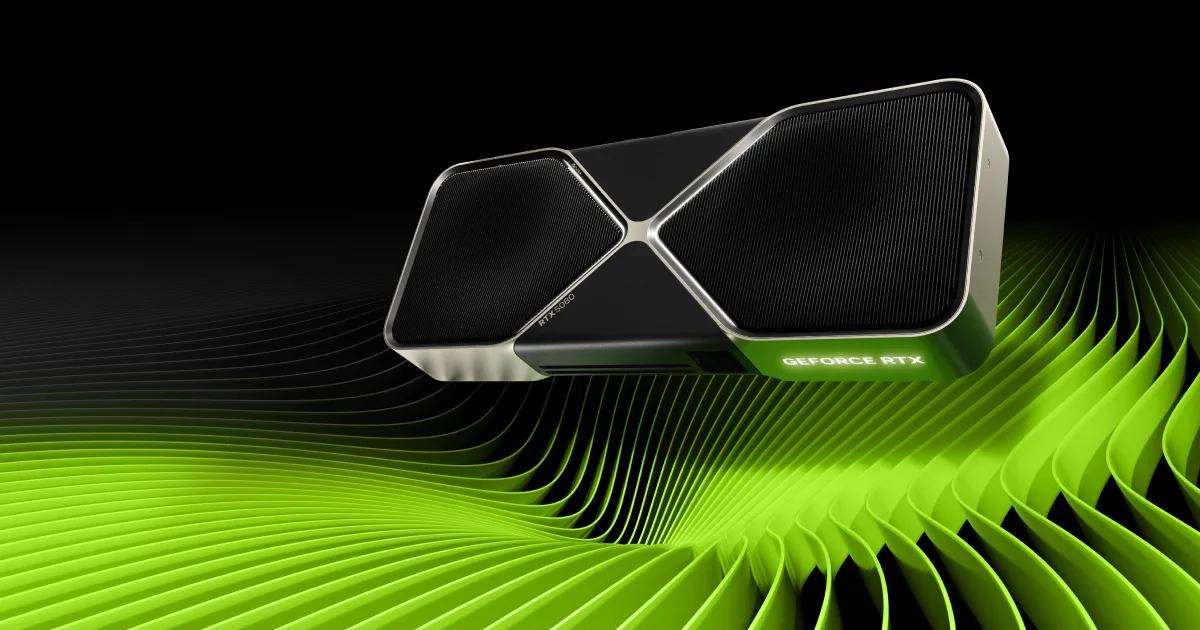
(Image source: Nvidia)
Faced with such reality, Nvidia and AMD, as commercial companies, naturally made a choice: to prioritize all the core R&D resources, most advanced process technologies, and most scarce advanced packaging production capacity to AI data centers. Consumer-grade graphics cards can only take the remaining production capacity, and are even forced to use mature processes that have already been widely applied.
At present, Nvidia's latest flagship gaming graphics card, the RTX 50 series, was released in early 2025. The launch time of the next-generation RTX 60 series has not been confirmed. According to leaks from various sources, it will be delayed to 2028 or even 2029. AMD's situation is similar. Leaks show that AMD will release some products based on the RDNA 5 architecture in 2027, while other new graphics cards will be postponed to 2028.
This situation certainly does not occur because they have encountered bottlenecks in technological R&D. Objectively speaking, the skyrocketing storage price has affected the procurement of video memory, and also increased the production cost of graphics cards. However, the main reason is that AI products are more profitable, and the priority of consumer-grade graphics cards has been greatly reduced.
Discrete graphics cards are too expensive, and integrated graphics may become the lifeline of PCs
At this stage, for DIY players, building a gaming PC is a very costly thing. The prices of memory and hardware are rising rapidly, and gaming graphics cards are getting more and more expensive. Now, almost all the PC building solutions that people can come up with are compromised versions. Even a mid-range graphics card costs three to four thousand yuan, and its video memory is often cut down.
The high premium and slow iteration of graphics card hardware have restrained the development space of gaming PCs on the one hand. Many players with limited budgets, facing the persistently high prices of graphics cards, finally choose to give up modifying their PCs. At the same time, more and more players are starting to look for alternative solutions, such as directly buying gaming consoles like Sony PS5 and Microsoft Xbox. In fact, gaming consoles are also raising prices, but the increase is relatively small. After all, the main profit of gaming console manufacturers comes from game content, and the hardware can be sold at no profit or even a small loss.
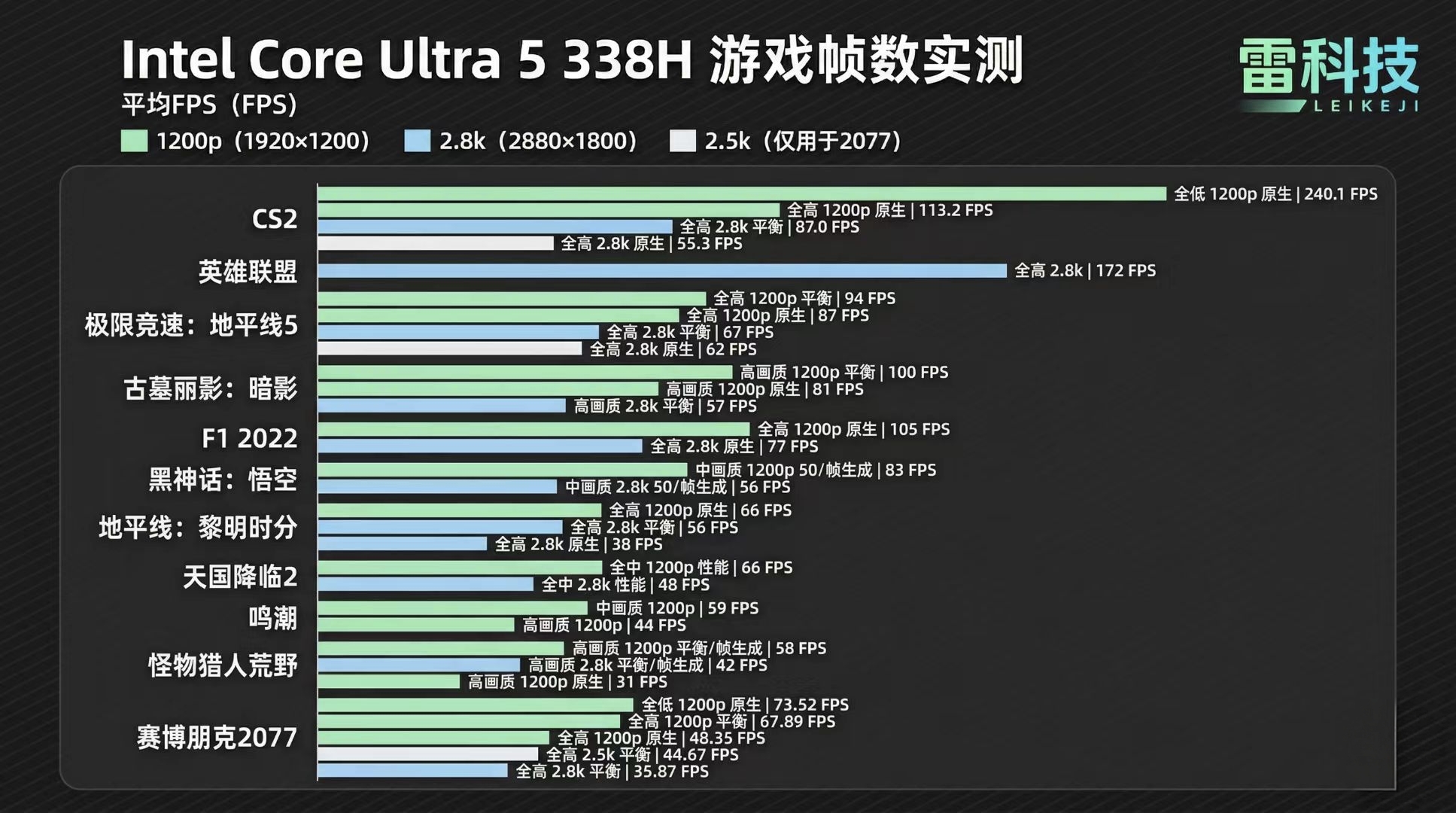
On the other hand, for ordinary users who still stay in the PC ecosystem, processor integrated graphics have become more important. In recent years, the performance of CPU integrated graphics has achieved a qualitative leap. Taking Intel's latest processors with powerful integrated graphics and AMD's APUs as examples, the performance of their integrated GPUs is already quite strong, which can run mainstream e-sports online games smoothly, and even barely handle some well-optimized AAA games at 1080P low image quality. We previously tested a laptop equipped with Intel Ultra 5 338H processor, and its integrated Arc B370 iGPU can run AAA games such as *Cyberpunk 2077* relatively smoothly.
(Image source: Leikeji)
Compared with discrete graphics cards, integrated graphics have another advantage: they do not need to be equipped with additional video memory, and can directly call system memory. It can be predicted that the ecological niche of entry-level discrete graphics cards will be gradually replaced by powerful integrated graphics in the future. In this case, the boundary between entry-level gaming PCs and regular PCs may become relatively blurred. After all, without the power-hungry discrete graphics card, the integration degree of internal PC components will be higher. Coupled with the progress of manufacturing processes, the form of PCs will become more compact and lightweight in the future. If you play games that do not have high performance requirements, a mini PC or a lightweight laptop can meet the needs.
However, when entry-level discrete graphics cards are replaced by integrated graphics, and mid-to-high-end discrete graphics cards are put on hold and delayed by chip manufacturers due to the AI boom, the choice space for PC gamers is actually being severely compressed. In the future PC consumer market, a polarization situation is very likely to emerge: either geek players with sufficient budget spend a lot of money to buy flagship discrete graphics cards with serious premiums, or ordinary consumers fully embrace integrated graphics and make do with what they have.
AAA games on PC, relying on frame generation to extend their lifespan?
Hardware foundation determines the upper limit of the software ecosystem. When players' hardware updates stagnate, the most affected parties are actually the PC game ecosystem and game developers at the downstream of the entire industrial chain.
In the past, the development logic of AAA games was coordinated with the performance upgrade of graphics card hardware. Nvidia and AMD launched more powerful graphics cards, game engines provided more realistic physical lighting technology, and developers used these to create games with more stunning picture quality, thereby attracting players to upgrade their hardware. This was a relatively positive business model, but now this model no longer works.
If nothing unexpected happens, in the next four to five years, the most widely owned graphics cards on the market will still be mid-range sweet spot products at the level of RTX 3060 and RTX 4060. For AAA game studios that often need hundreds of millions of dollars in investment and have a development cycle of several years, they will not set the configuration threshold of their games on high-end graphics cards that have not yet been popularized. To recover costs, developers are forced to make downward compatibility to take care of those old hardware whose performance is already slightly backward.
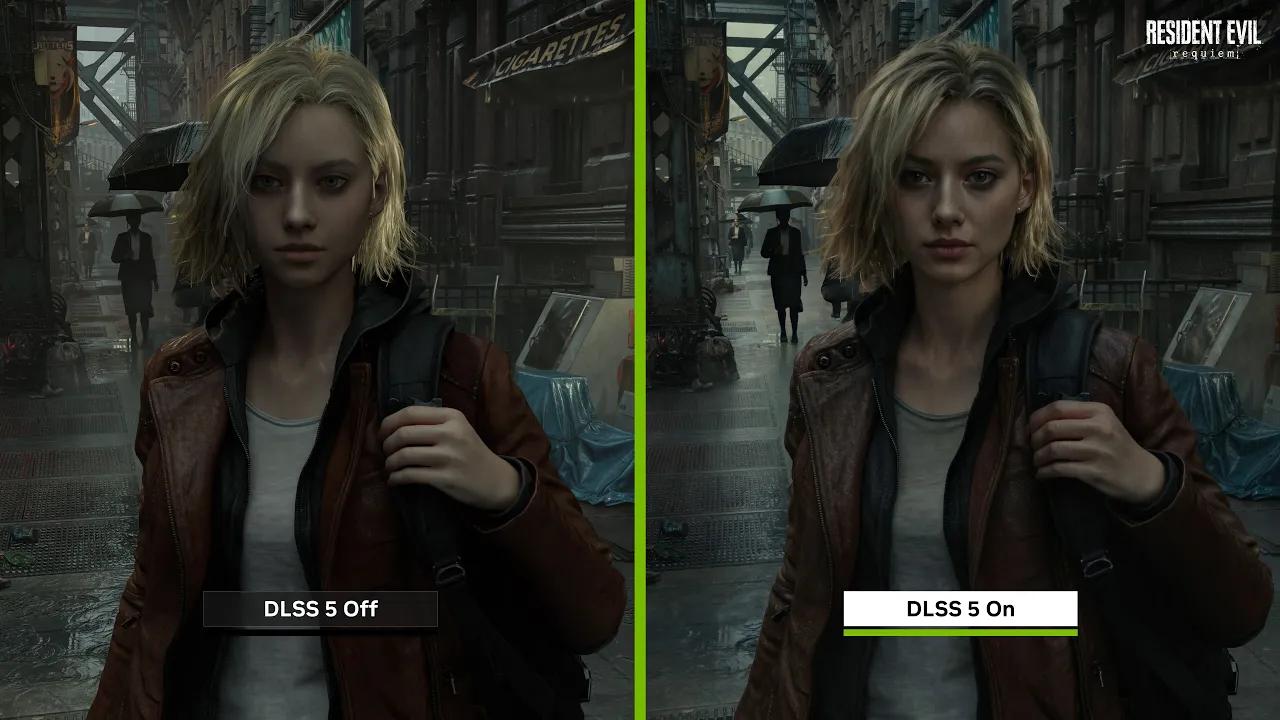
This forced compromise will most likely hinder the advancement of traditional physical rendering technology in the PC game field. So, how to continue to provide players with seemingly more exquisite pictures and smoother frame rates in this era of stagnant computing power? The answer is to use new technical solutions to deceive players' eyes, specifically, to make more extensive use of super-resolution and frame generation technologies such as DLSS and FSR.
(Image source: Nvidia)
In the past, DLSS and frame generation technology were only used as a nice-to-have auxiliary function to save scenarios with poor optimization, or to allow mid-to-low-end graphics cards to experience ray tracing. But now, these AI-based image reconstruction technologies on the end side are becoming key technologies to make up for the lack of hardware performance, and even become a rigid requirement for running AAA games.
We can see that more and more new games, the recommended configuration requirements given during promotion are obtained under the condition that DLSS or FSR is enabled by default. To some extent, this is a helpless self-rescue of the PC game ecosystem in the face of stagnant hardware iteration. If the computing power for physical rendering is not enough, then we can only use AI algorithms to make up for it. If the graphics card cannot natively render 144 frames of pictures, then let AI generate half of the fake frames in between. Half of the smooth pictures that players see on the screen are guessed by AI. It is slightly ironic that the problem brought by AI can only be solved by AI technology in the end. Although it sounds helpless, this is also the most practical solution at present.
Overall, the leadership reshuffle turmoil at Nvidia will most profoundly affect Nvidia's AI business. After all, Nvidia's soaring market value has always been supported by the CUDA ecosystem built by Jensen Huang from scratch. In our view, Jensen Huang stepping down is hardly good news for gamers.
Although Nvidia under Jensen Huang's leadership has marginalized the gaming graphics card business, it still sells graphics cards anyway. When the new CEO with a weaker technical background and no affection for the gaming business takes office, consumer-grade graphics cards may become a "unprofitable" business in his eyes and be further frozen.
In this era when computing power is kidnapped by AI, the golden age of consumer-grade graphics cards that evolved rapidly and doubled in performance every two years is most likely gone forever. As players, what we can do is probably adjust our mindset, and use a relatively reasonable budget to buy the device that suits us at the moment.
This article is from "Leikeji", authorized for release by 36Kr.