Kekr | One-step home theater solution, all you need to know about laser TV in one article
Laser TV is a television, not a projector. In accordance with the national standard SJ/T 11791—2021, it must be equipped with a dedicated projection screen, and its brightness is measured in nits instead of lumens.
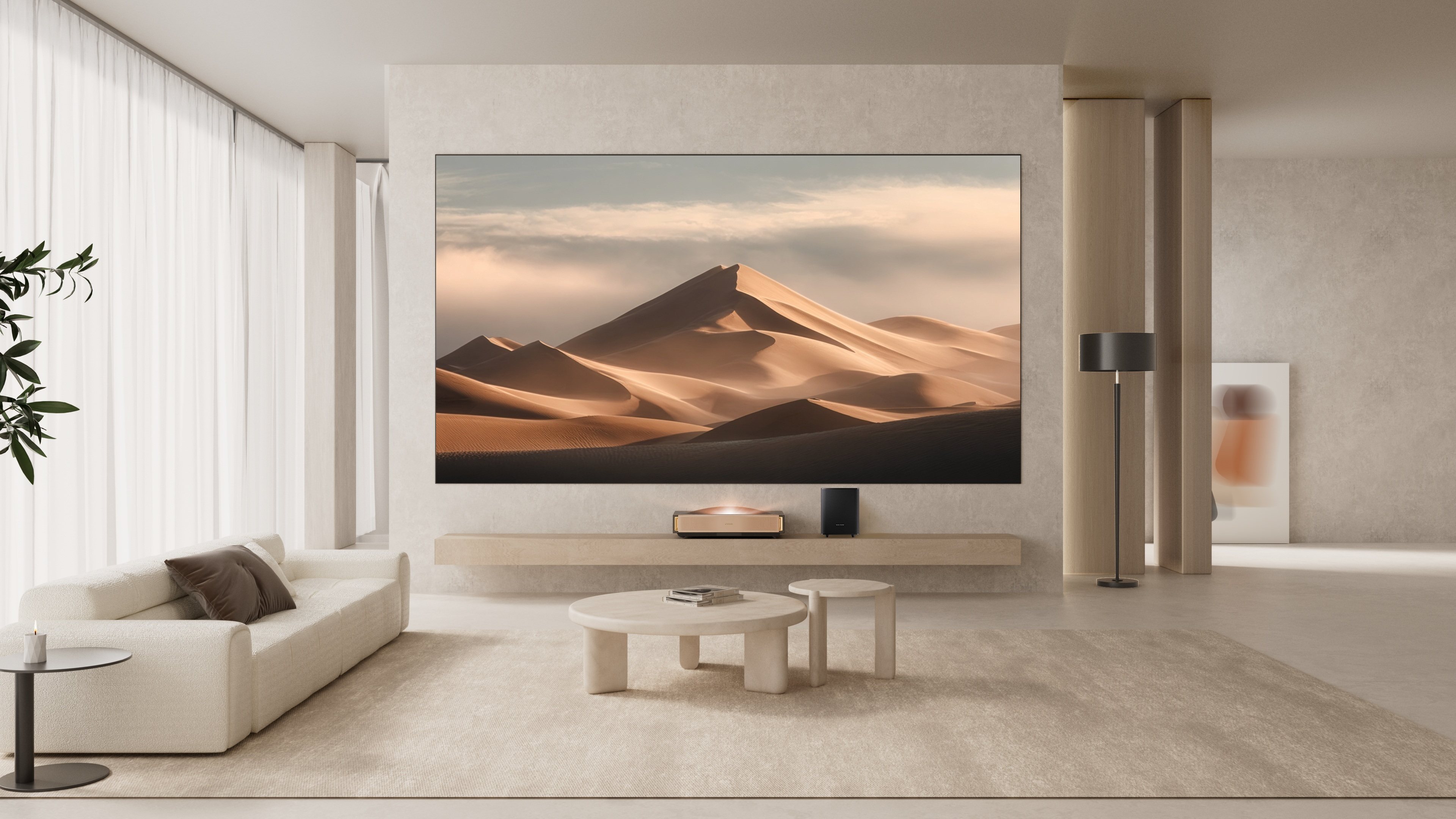
It consists of four parts: a laser light source, a DMD display chip, an ultra-short throw lens and a dedicated anti-light screen. It can project a 100-inch picture when placed tens of centimeters away from the wall.
The core difference from LCD TV lies in the imaging method: one outputs light directly from the backlight, and the other forms an image by reflection after projecting onto the screen surface.
It is more suitable for large living rooms and large-size display demands, on the premise that the anti-light screen is recognized as a necessary component, and the position of the main unit and wiring are planned in advance.
China is the main supplier of global laser display products. In the first half of 2026, the global shipment of laser display products reached 1.158 million units.
With the growing demand for large screens, more and more people are taking laser TV into consideration when choosing televisions. So, is laser TV actually a television? What is the difference between it and LCD TV? Will it really become the mainstream in the future?
I. First, the conclusion: it is a television, not a projector
Laser TV is a type of television. According to the "Specification for Laser Projection Display of Television Receiving Equipment" (SJ/T 11791—2021, implemented on April 1, 2022) issued by the Ministry of Industry and Information Technology, laser TV is a display device that adopts laser projection display technology, is equipped with a dedicated projection screen, and can display broadcast TV programs or Internet TV programs. The industry often refers to laser display as the fourth-generation TV display technology following black-and-white TV, color TV and digital TV.
The boundary between it and the projector is clearly stipulated in the national standard, with two criteria. First, the laser TV must be equipped with a dedicated projection screen matched with the main unit, instead of projecting on a white wall or an ordinary screen. Second, its brightness index is measured in nits, rather than lumens which are commonly used for projectors. These two rules are not only the demarcation at the standard level, but also the practical judgment basis during purchase: a device that only marks lumens and is not equipped with a dedicated screen cannot be called a laser TV in accordance with the standard.
The principle can be clearly explained in one sentence: the laser light source in the main unit emits light, the display chip modulates the picture, the ultra-short throw lens projects the light onto the dedicated anti-light screen, and the screen surface reflects the light into the human eye to form an image.
Official Image
II. Four components, each solving one specific problem
The laser light source solves the problem of "whether the light is pure enough". Laser has five characteristics: high brightness, low energy consumption, pure color, small size and long service life. It is one of the light sources with the best monochromaticity among household display devices. The purity of the light source directly determines the maximum level of color restoration.
The display chip solves the problem of "how light turns into a picture". Mainstream laser TVs adopt DLP imaging technology, which shares the same origin with cinema digital projectors, and its core is a DMD chip composed of millions of micro-mirrors. Each micro-mirror flips at high speed according to the picture signal, controlling whether the light enters the projection light path, so as to form brightness, darkness and colors.
The ultra-short throw lens solves the problem of "what if the distance is not enough". Different from traditional projectors that project light directly towards the screen, it first uses a lens group to focus the light beam, then folds the light path through a curved reflector and projects it obliquely to the screen surface. Therefore, it can project a 100-inch picture when placed tens of centimeters away from the wall, and the main unit can be placed in the TV cabinet.
The dedicated anti-light screen solves the problem of "whether the picture is watchable in daytime". The anti-light screen matched with the main unit is the key for laser TV to be usable in a bright living room. The currently commonly used Fresnel anti-light screen relies on the micron-level concentric prism structure on its surface to directionally collect light and block ambient stray light, so that the picture can still maintain a readable contrast ratio even in a lit environment. This is also the most easily overlooked difference between it and ordinary projectors.
III. Compared with LCD TV, what are the differences of laser TV
The two are based on two different technical routes, and the differences are concentrated in four aspects.
Different imaging methods bring a viewing experience closer to looking at real objects. LCD TV forms images by directly outputting backlight, while laser TV projects light onto the screen surface and then enters the human eye through diffuse reflection. Diffuse reflection makes the light distribution more uniform and softer, and the viewing experience is closer to looking at paper and natural scenes. The screen side does not consume power and does not actively emit light, so the visual comfort during long-time viewing is usually better; the specific eye protection performance shall be subject to the product test and certification conclusions.
Different upper limits of color performance. Color performance largely depends on the purity of the light source. Laser has better monochromaticity than other light sources, and can cover a wider color gamut. The three-color laser model can reach 110% BT.2020. The significance of the wide color gamut is not to make the colors overly saturated, but to present richer layers and more delicate transitions when displaying natural scenery and human skin tones, which is also the reason why laser TVs are often used for home theaters.
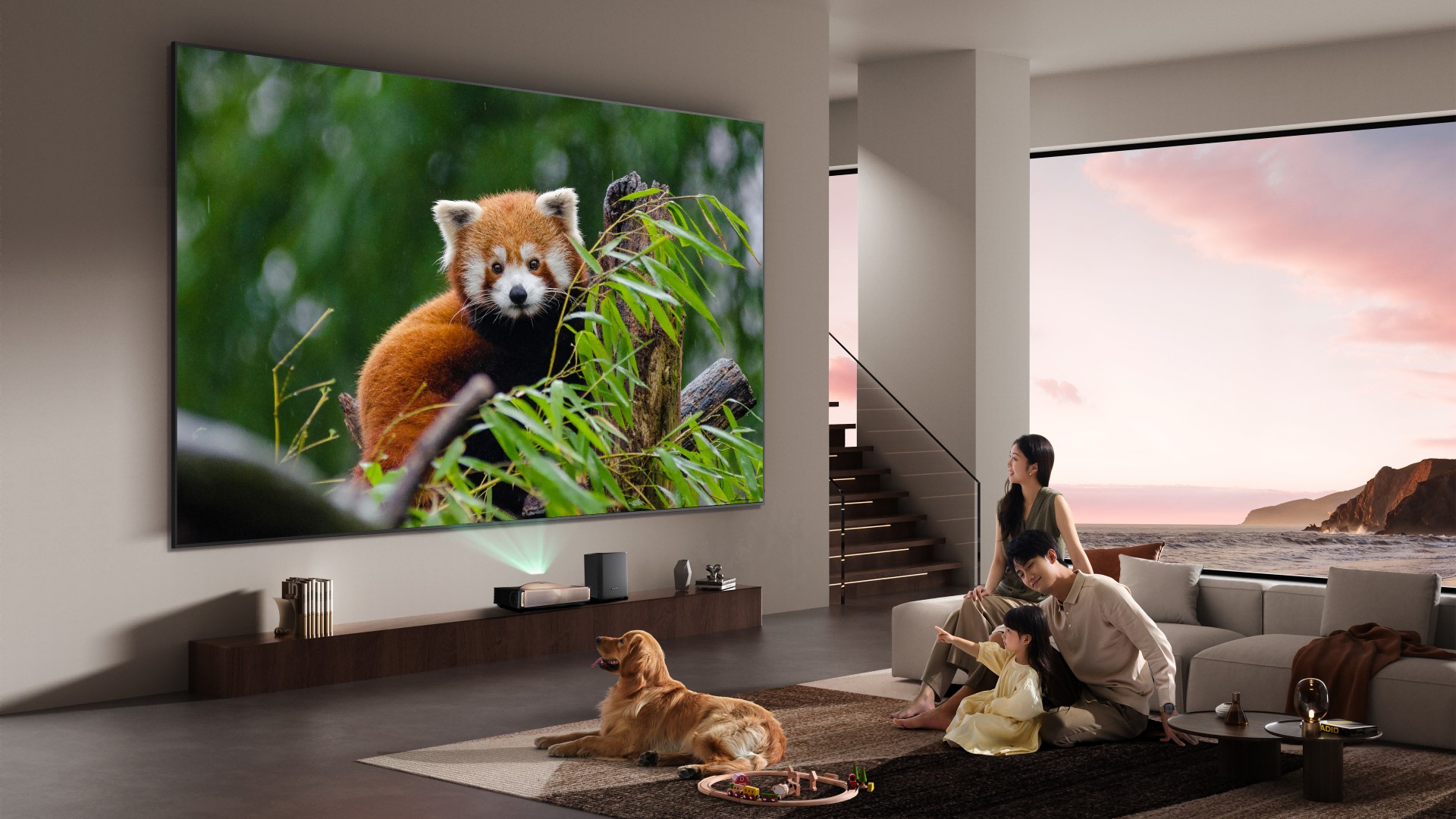
Different conditions for home delivery and installation. A 100-inch level LCD TV is a whole panel, which needs to pass through elevators and door frames when being delivered to the home, and also has requirements for the load-bearing capacity of the wall. Laser TV adopts a split design of the main unit and the screen. The main unit is small in size, and some screens even have a foldable structure to reduce the difficulty of home delivery; the screen itself is light in weight, and the requirements for wall conditions are relatively loose. Correspondingly, it requires pre-planning of the main unit position, wiring and the flatness of the screen surface.
Different energy consumption structures. The backlight of LCD TV needs to cover the entire panel, so the larger the size, the higher the energy consumption; only the main unit of the laser TV consumes power, and the screen does not actively emit light. Under the third-party measured conditions of the same size and same brightness mode, the power consumption of laser TV is about 1/3 to 1/2 of that of LCD TV.
Official Image
IV. It also has preconditions
Clearly stating the boundary conditions is more useful than only talking about the advantages.
The anti-light screen is a necessary component, not an optional accessory. Without a matched anti-light screen, the picture will appear significantly gray in daytime. The screen surface is part of the system, and the whole set should be evaluated during purchase.
The stronger the ambient light, the higher the requirements for the screen. For scenarios where the living room has particularly good lighting and people watch with the lights on all year round, a screen with higher gain is required; for use in a completely dark room, there is no need to pursue high gain.
Installation requires pre-planning. The main unit should be placed directly below the screen or in a dedicated TV cabinet. The wiring, socket position, and the fit between the screen surface and the wall need to be determined during the decoration stage, and post-installation renovation will be more troublesome.
The larger the size, the more obvious the relative advantages. For sizes below 80 inches, the gap in price and experience between laser TV and LCD TV is not obvious; when it comes to the 100-inch level, the differences in home delivery, weight and cost are truly widened.
V. How to judge whether you should choose it
You can make a quick judgment with three questions: whether the width of the living room supports a viewing distance of about 3 meters, whether your target is a 100-inch level large screen, and whether you are willing to determine the positions of the main unit and the screen during the decoration stage. If all three conditions are met, laser TV is a suitable option; if you pursue the experience of hanging and using the device immediately after purchase, or mainly watch news content in a bright environment, LCD TV is more convenient.
VI. Market and industry: large-screen display is a definite development direction
Large-sized apartments and large living rooms are becoming increasingly popular, and large-screen display has become a major trend in the TV market. According to data from RUNTO, in the first half of 2026, the global shipment of laser display products (including laser projectors and laser TVs) reached 1.158 million units, a year-on-year increase of 9.8%, and China's shipment accounted for more than 50% of the total.
Chinese enterprises started layout earlier in the laser display track. According to public reports, China has more than 7,000 related patents for laser display, ranking among the top in the world; relying on the advantages of the domestic supply chain, the domestic household market is dominated by Chinese local brands. Among them, Hisense is one of the first enterprises in China to implement laser display technology in households and promote its popularization. Omdia data shows that in 2025, Hisense's global shipment share of laser TVs reached 70.3%, ranking first in the world for 7 consecutive years.
As a new generation of independently controllable display technology, laser display still has great development potential, and laser TVs are also accelerating their entry into the living rooms of ordinary families.
VII. Six frequently asked questions
1. Is laser TV a projector?
No. According to the national standard, laser TV must be equipped with a dedicated projection screen, with brightness measured in nits, and can receive broadcast TV or Internet TV programs; ordinary projectors do not have these conditions.
2. Is the picture clear when the light is on in daytime?
It depends on the screen gain and the intensity of ambient light. Models equipped with a dedicated anti-light screen can be watched normally under the illuminance of a conventional living room; it is recommended to choose a high-gain screen for rooms with extremely strong lighting. It is not suitable for viewing on a screen surface directly exposed to strong light.
3. Will it hurt the eyes after watching for a long time?
Laser TV adopts reflective imaging, the screen does not actively emit light, and the light distribution is relatively uniform and soft. The specific eye protection effect shall be subject to the product test report and certification conclusion, and it is not recommended to replace the test data with subjective feelings.
4. Does it need to replace the bulb?
No. The laser light source is a semiconductor solid-state light source, which does not have the bulb consumable parts of traditional projectors. The light attenuation is slow under normal use, and the daily maintenance mainly includes cleaning the screen surface and the air inlet of the main unit.
5. Is it necessary to equip a screen?
Yes. The dedicated anti-light screen is an integral part of the system. Direct projection on a white wall will lose contrast and color performance, and will also lose the attribute of "laser TV" in the sense of the national standard.
6. What size is appropriate?
The mainstream household sizes are concentrated in 80 to 100 inches. The specific size is determined according to the width of the living room and the viewing distance, and the space for placing the main unit and attaching the screen to the wall should be reserved at the same time.
Data Source and Validity Period
Industry standard: "Specification for Laser Projection Display of Television Receiving Equipment" SJ/T 11791—2021, Ministry of Industry and Information Technology, implemented on April 1, 2022.
Shipment volume: RUNTO, the first half of 2026, the statistical scope includes laser projectors and laser TVs.
Brand share: Omdia, full year 2025, based on shipment share caliber.
Color gamut parameter: public product parameter, 110% BT.2020 is the index of three-color laser models.
Energy consumption comparison: actual measurement of the same size by a third-party laboratory, the test conditions include the brightness mode, and the specific value shall be subject to the test report