Jensen Huang has resigned, leaving six unsolved questions.
On November 12 local time in the United States, Nvidia announced that Jensen Huang has resigned from his three positions as President, CEO and member of the board of directors, with immediate effect. Since he co-founded Nvidia in 1993, he has been serving in the top management position of the company.
Prior to this, Jensen Huang was exposed to have two extramarital affairs; on Beijing time November 13, according to Reuters, Jensen Huang also had an intimate relationship with another employee.
Nvidia Executive Vice President and CFO Colette Kress will serve as interim CEO, while continuing to be in charge of financial work until the board finds a formal successor. Harvey C. Jones, who has served as a director for a long time, was appointed as the first chairman of the Nvidia board of directors.
The market reacted quickly. After the announcement, Nvidia's pre-market share price once fell to $150.13, down about 13.58% from the close of the previous trading day; after the market opened, the decline still exceeded 10%. At the close of the day, the decline of Nvidia's stock narrowed to 4.34%.
For 33 years, Nvidia has only had one CEO. Jensen Huang led it to grow from a graphics chip company to a critical supplier of global AI infrastructure. For customers and investors, he is not only the man in black leather jacket showing the next-generation chips on stage, but also the key decision-maker behind product delivery, technical direction and long-term cooperation.
Only four days passed from publicly admitting marital infidelity to resignation. Just four days ago, the board of directors also stated that it was "full of confidence" in Jensen Huang and his leadership team.
Resignation does not mark the end of the problem. Which investigations will continue? How difficult is it for the interim successor to take over the company? In what other ways can Jensen Huang, who still holds shares, influence Nvidia? How will this personnel change be transmitted to customers, suppliers and the expanding global AI industry?
Focusing on this incident, we have sorted out six key questions.
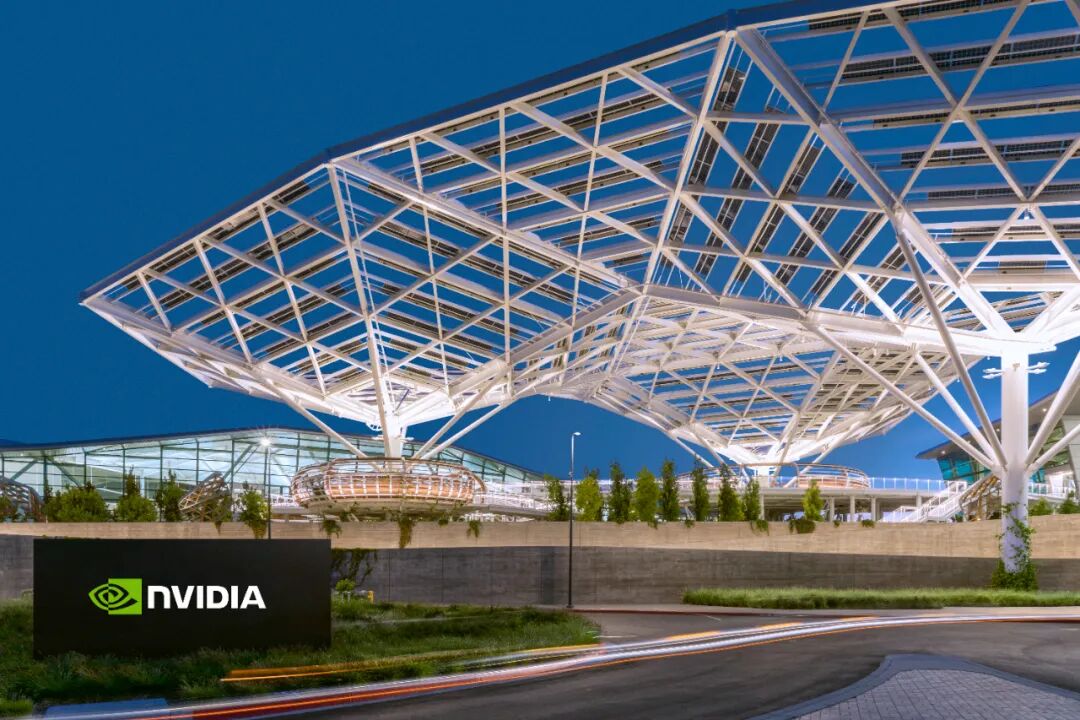
● Nvidia's Santa Clara headquarters. Source: Nvidia official website
After 33 years at the helm of Nvidia, why did Jensen Huang have to resign at this time?
From the outbreak of the extramarital affair incident to his resignation and leaving, Jensen Huang lost his position that he had held for 33 years in less than half a month. During this period, the pressure Jensen Huang faced went beyond the challenges of enterprise operation.
The first is the personal scandal. On November 8, Jensen Huang sent a letter to employees, admitting that he had an extramarital affair. On November 11, The New York Times reported that Jensen Huang had another extramarital affair, with a Nvidia executive who reported directly to him. On November 12, Jensen Huang resigned. Nvidia did not state the reason, nor did it explain whether he resigned voluntarily or was removed from his position.
The attitude of the board of directors changed rapidly in just three days. On November 8, the Nvidia board of directors announced the launch of an independent investigation, and the board also stated that it had confidence in Jensen Huang and his leadership team. On November 10, independent directors stated that they had hired external lawyers to assist in the investigation. By November 11, Reuters reported that the board of directors would hold a meeting to discuss whether to remove Jensen Huang from his position.
The stock price is also under pressure. On November 9, Nvidia closed down 4.27% at $178.67. After the market closed on November 11, affected by the news that the board of directors might discuss removing Jensen Huang, the stock price once fell by more than 8%. After the resignation news was announced, Nvidia's stock price plummeted by 13% at the opening on November 12. In less than half a month from October 30 to the close of US stocks on November 12, the decline in Nvidia's market value reached 18.7%, with the market value evaporating by about 920 billion US dollars.
After the Democrats won the majority of seats in the Senate and House of Representatives, the changes in the US political environment and the impact of geopolitics are also one of the important backgrounds.
Under the superposition of multiple factors, this CEO who has long served as the core decision-maker of Nvidia ended his tenure at Nvidia.
After the resignation, which investigations and lawsuits have not ended?
The investigations that Jensen Huang and Nvidia are undergoing can be divided into several categories.
The first is the investigation by the internal board of directors. On November 8, the board of directors announced the establishment of an independent director committee to supervise the investigation with the assistance of external independent lawyers. Two days later, the independent directors confirmed that they had hired Joon H. Kim, the former acting US Attorney for the Southern District of New York, and his law firm Wachtell, Lipton, Rosen & Katz to assist in the investigation. As of press time, the company has not released the investigation conclusion.
In addition, there are investigations from the judicial system. Trump stated on November 9 that the Federal Bureau of Investigation (FBI) is investigating the incident, but did not disclose the specific objects and scope of the investigation.
In the Congress, there are also a number of inquiries and supervision actions. On November 5, the chairs of three committees of the House of Representatives jointly wrote to Jensen Huang, asking him to attend a closed-door briefing on November 18.
The last is the filed civil lawsuit. On November 9, a retail investor named Mark Kistenmacher filed a securities fraud class action lawsuit against Nvidia in the Northern District Court of California, USA. According to the complaint, he purchased 7 lots of Nvidia stocks worth about $20,500 this year. Nvidia and Jensen Huang are both defendants, and the lawsuit accuses them of misleading investors.
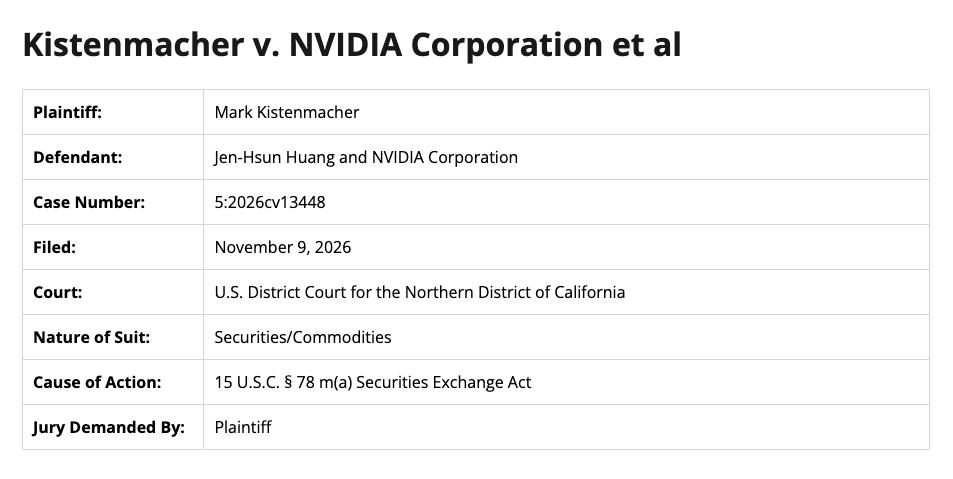
● Case and filing information. Source: Screenshot of the US court system
This class action represents all investors who purchased Nvidia shares between October 9, 2025 and November 8, 2026. The reason why October 9, 2025 is set as the starting point is that on that day, The New York Times reported that the US Department of Commerce was investigating Megaspeed (the company where Jensen Huang's extramarital affair partner served as an executive), and Nvidia gave a compliance guarantee at that time. November 8, 2026 is the time when Jensen Huang admitted his extramarital affair.
Who are the two people taking over, and why them?
This time, Nvidia did not directly appoint a new formal CEO, but respectively appointed Colette Kress as interim CEO while continuing to serve as CFO; Harvey C. Jones as the first chairman of the board of directors in Nvidia's history.
From the appointment arrangement, Kress is responsible for maintaining the daily operation of the company during the transition period, and Jones chairs the board of directors to provide support for successor selection and corporate governance.
Now 59-year-old Kress joined Nvidia in 2013 and has been the CFO of Nvidia for 13 years. Before joining Nvidia, she served as Senior Vice President and CFO at Cisco, and also worked at Microsoft for 13 years engaged in finance-related work. In the appointment announcement, Nvidia stated that she has a deep understanding of the company's business, customers, operating conditions and financial status, and has played a key role in the company's growth and development.
In many past earnings calls, she attended together with Jensen Huang, and she was responsible for explaining the figures. In the fiscal year when she joined, Nvidia's revenue was 4.13 billion US dollars. Now, this figure is 215.9 billion US dollars in fiscal year 2026.
Some analysts believe that Kress is the best candidate to maintain a stable situation during the transition period. When the market is in urgent need of a reliable voice, she is a familiar and trustworthy voice for the market.
Jones is the "founding veteran" of the board of directors. He used to be the CEO of Synopsys, a chip design software company, and Nvidia's founding team was his first client at Synopsys, so they got to know each other. He joined Nvidia in 1993, was one of the initial members of the board of directors, and has long served on the board's audit committee, nomination and corporate governance committee.
Before the news of the resignation came out, one of the most discussed internal successor candidates of Nvidia in the market was Ian Buck. The odds on the prediction market website Polymarket show that Buck is most likely to win among the successors, and Kress ranks second.
Buck joined Nvidia in 2004, holds a doctorate in computer science from Stanford University, and has long been responsible for technical business related to GPU general-purpose computing, which is a role closer to Nvidia's technical core. He is currently in charge of hardware and software products for large-scale AI business, and his most important contribution is participating in leading the development of the CUDA software system. CUDA is an important foundation for developers and AI enterprises to use Nvidia GPUs.

● Nvidia's current management team. Source: Screenshot of Nvidia official website
How else can Jensen Huang influence Nvidia?
Jensen Huang handed over three positions, but his relationship with Nvidia still remains in the shareholder register and his family members' jobs.
According to the shareholding change declaration submitted by Jensen Huang on September 18, 2026, after completing the transaction on September 17, the total of direct and indirect shareholdings declared by Jensen Huang is about 812 million shares. Estimated based on the approximately 24.1 billion outstanding common shares disclosed in the company's quarterly report, these shares account for about 3.37% of the total.
Calculated on a one-share-one-vote basis, they correspond to about 812 million votes, that is, about 3.37% of the voting rights of common shares. Resigning from management positions and director seats will not automatically cancel the rights corresponding to these stocks, which can still be used for the election of directors and other matters submitted to the general meeting of shareholders for voting.
However, these 812 million votes cannot be simply understood as votes that Jensen Huang can dispose of at will. Nvidia's general meeting of shareholders documents state that Jensen Huang and his wife Lori share voting and investment rights over the relevant trust holdings. Therefore, the above 3.37% is the estimated voting right corresponding to these shares, which is not equal to the voting right that Jensen Huang can independently exercise. The specific way the shares held by the trust are voted, sold or transferred must follow the corresponding trust arrangement.
In addition to equity, the next generation of the Huang family also works at Nvidia, participating in the expanding businesses of the company.
Jensen Huang's daughter, Madison Huang, is Senior Director of Product and Technical Marketing for the Physical AI Platform, and the products she is responsible for include Omniverse, Cosmos and Isaac robot platforms. These platforms serve scenarios such as industrial simulation and robot development. Her job is to help developers and enterprise customers understand what these technologies can do and how to use them.
She also participates in her father's external work. She is a member of a small team internally called "The Band", often travels with Jensen Huang to assist in preparing public speeches and demonstrations. For Nvidia, product release needs not only to clarify the technology, but also to let customers understand the direction of the next round of investment. The work she participates in is closely linked to the product promotion that her father has undertaken for a long time.

● Nvidia Cosmos. Source: Nvidia official website
Jensen Huang's son, Spencer Huang, serves as Head of Robot Products. Nvidia's official introduction places his work at the intersection of robotics, physical AI and agent systems. He is involved in the robot software product itself, which is a different link from the product marketing that his sister is responsible for.
Jensen Huang's son-in-law, Nico Caprez, is closer to customers and capital. He joined Nvidia in 2024 and was promoted to Vice President in January 2026, responsible for global AI infrastructure business development, and needs to establish connections with emerging cloud computing companies and data center operators. These enterprises need to purchase chips, raise funds and build computing power facilities, and they are also important partners for Nvidia to turn products into large-scale deployment.
However, the fact that family members are employed does not mean that he can still give orders through his family after leaving office. Nvidia disclosed in the 2026 general meeting of shareholders document that at that time, neither Madison Huang nor Spencer Huang were statutory executives of the company, nor did they report directly to their father; their remuneration was determined according to the practice of similar positions, and Jensen Huang did not participate.
How difficult is it to take over Jensen Huang's position?
For more than 30 years, Nvidia has only had this one CEO. Internally, dozens of people in charge are used to bringing problems directly to him; externally, customers and investors are also used to the man in black leather jacket telling them when the next generation of chips will be available and how much business they can bring. Taking over Jensen Huang means taking over all the work that was concentrated on him at the same time.
One of the most difficult to measure items is deciding where to invest when the market has not yet taken shape.
In 2006, Nvidia announced the CUDA architecture, which enabled the parallel computing capability of GPUs to be used for scientific computing beyond graphics processing. Six years later, researchers used two Nvidia GPUs to train AlexNet, making a breakthrough in the image recognition competition. Since then, GPUs have shown the potential to train neural networks, but there is still a long way to go before large-scale commercial applications. Nvidia then continued to invest in computing platforms and systems for AI research.
When the generative AI boom arrived, Nvidia had been preparing for many years. In March 2022, Nvidia released the H100, which was specially designed with a Transformer engine to accelerate large model computing. At that time, ChatGPT had not yet been launched. Jensen Huang's judgment on the technical direction was finally turned into deliverable products of the company through the pre-developed chips, software and tools.
Ming-Chi Kuo, an analyst at TF International Securities, believes that this is where Jensen Huang's value lies: he can balance strategy, organization, technology and supply chain at the same time, turning technologies that engineers consider feasible into products that the entire company invests resources in, takes risks and must deliver; when suppliers have more clear order expectations, they are more willing to cooperate with aggressive specification upgrades.
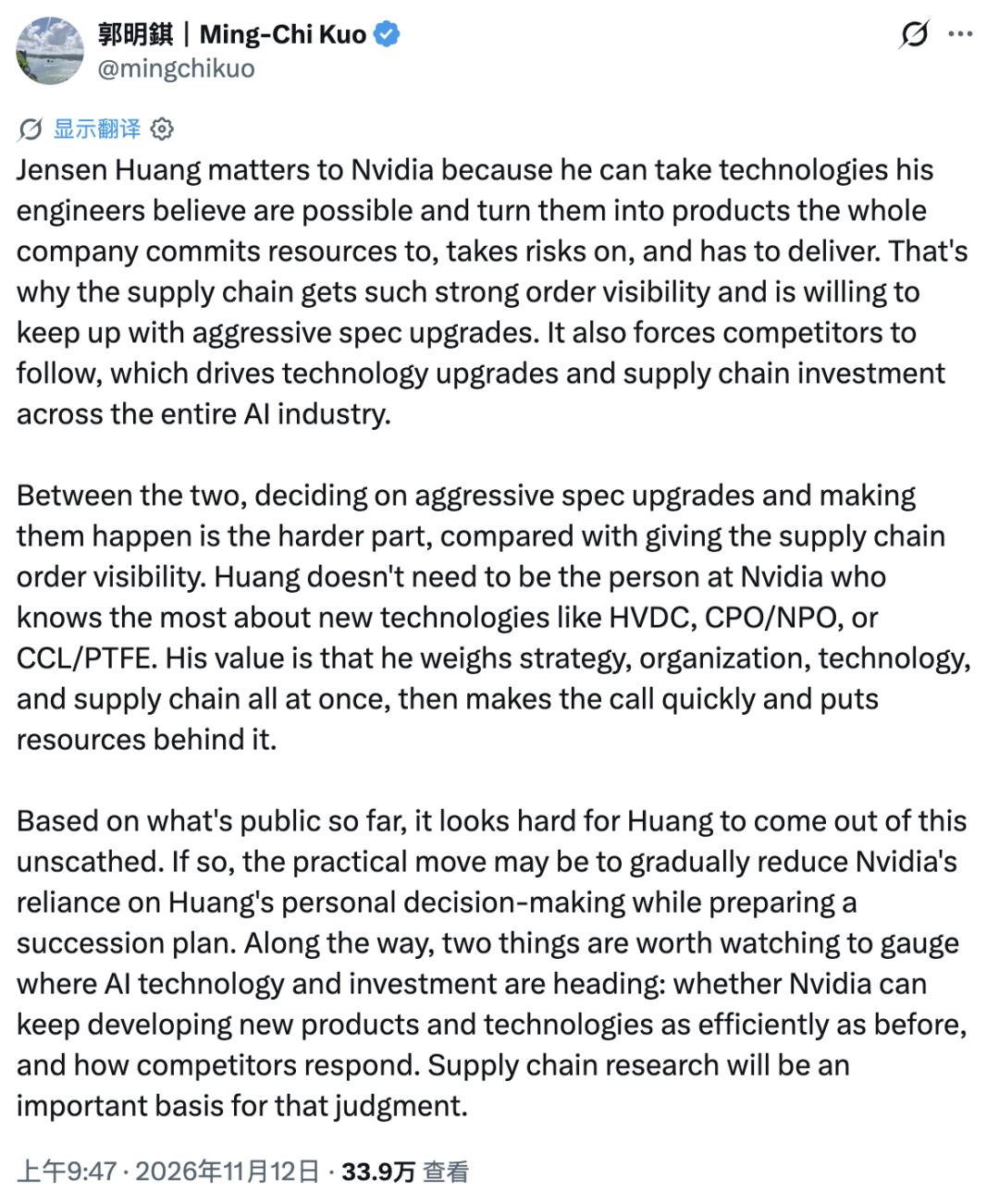
● The original evaluation from Ming-Chi Kuo. Source: Screenshot of