Google has carried out a major core revamp today, and the lightweight king Gemini 4 Hydrogen stages an upset victory over the flagship.
Finally, Gemini 4 Hydrogen is officially unveiled!
Google, which has been warming up for this launch for a whole week, has finally released this new flagship member of the Gemini 4 family.
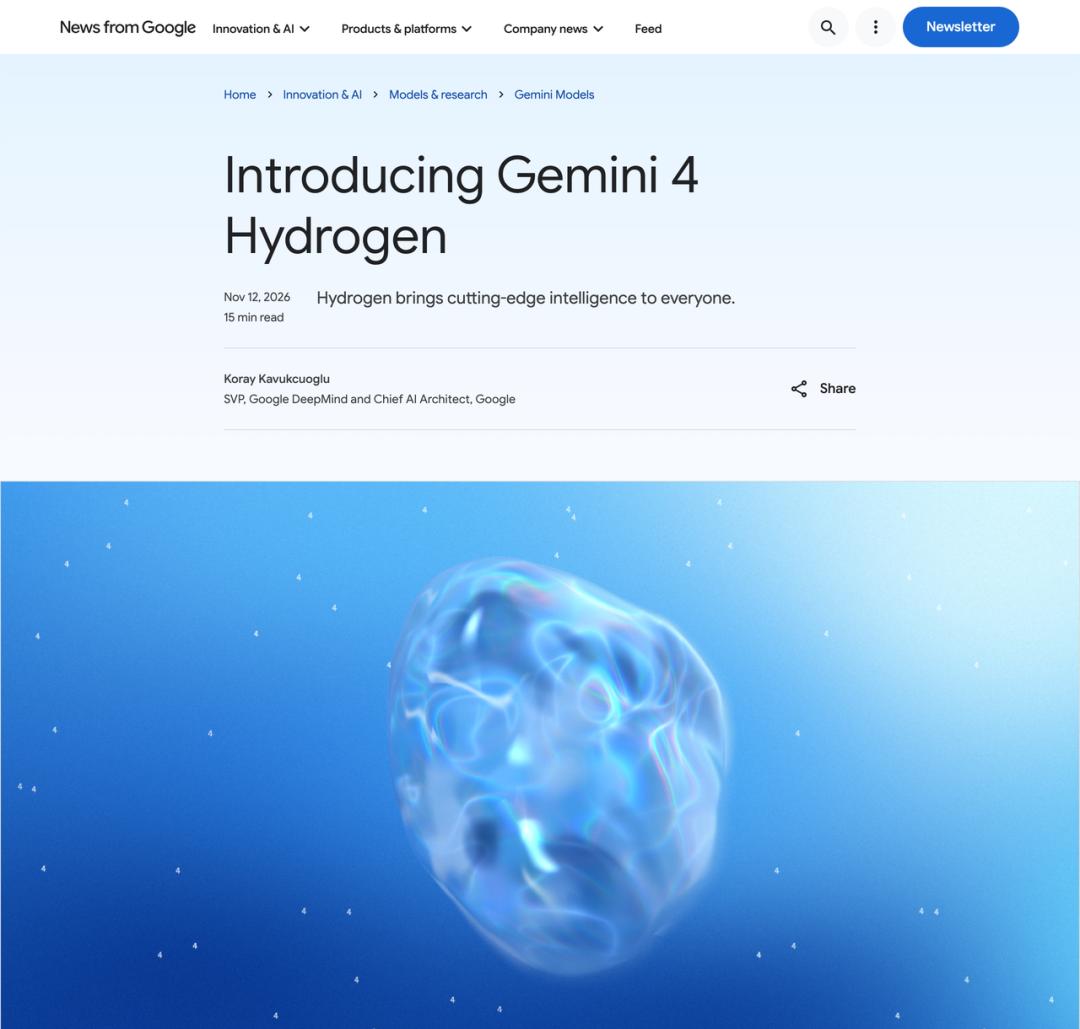
This model codenamed "Hydrogen" has broken the impossible triangle of high intelligence, ultra-fast speed and low cost this time.
Originally, there were two senior models focused on deep reasoning in the Gemini 4 family: Carbon and Argon.
Logically, Hydrogen, positioned for daily coding, agent workflows and consumer-grade applications, should have been the "junior" in the lineup, right?
However, the data released by Google shocked everyone —
Under the default high thinking mode, Gemini 4 Hydrogen scored 51 points on the AA Intelligence Index, directly surpassing Argon (50 points), its own flagship model focused on deep reasoning.
If you raise the thinking level to the brand-new xhigh mode, the score even jumps to 54 points!
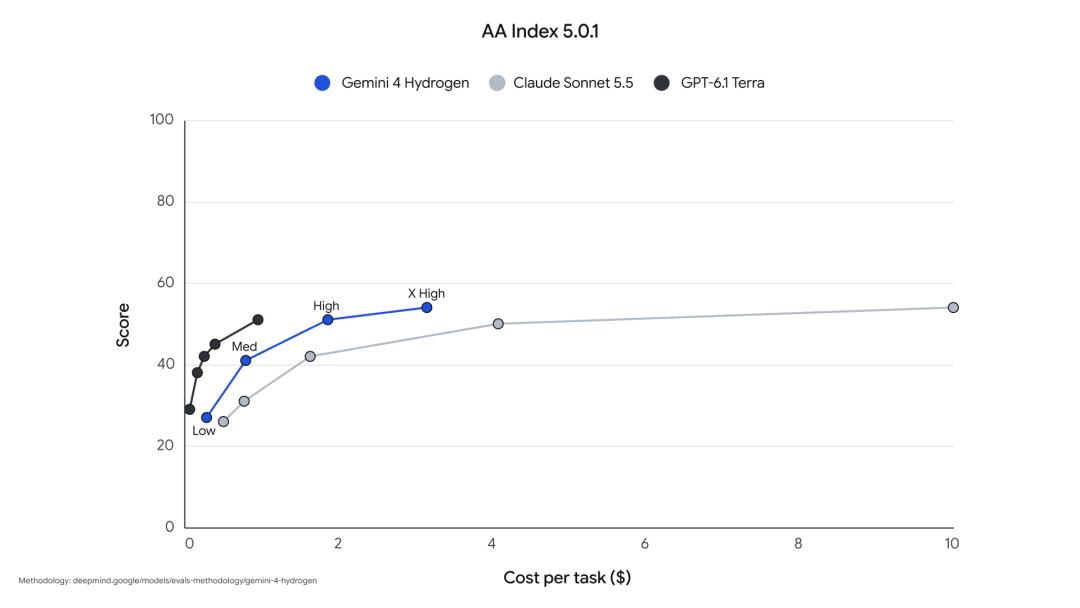
It is not only smarter, but also faster and cheaper. It also brings upgrades to Google Search, Google Sheets and the Gemini App at the same time, and is available to global users starting today.

Full suite of products upgraded simultaneously, Search sees its biggest revamp ever
Now, Hydrogen has taken over Google's core product lines.
Google Search, used by billions of people around the world, has received its largest-ever model upgrade to date.
The AI mode in Search has been fully switched to the Hydrogen base model.
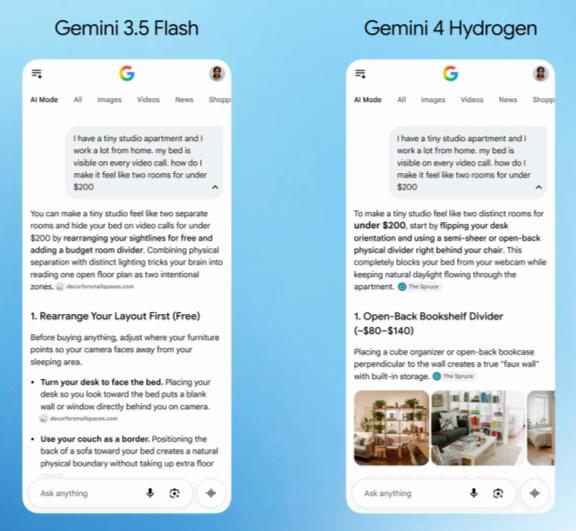
When faced with complex long sentences containing multiple conditions or spelling errors, the upgraded Search can break down the question and retrieve multiple sub-topics in parallel.

For example, if you ask it to pick breathable running shoes suitable for hot weather, Search will directly generate a graphic-rich parameter comparison table and purchase entry.
If you follow up to ask for furniture placement solutions for small-sized apartments, it can also quickly provide a visual guide with size recommendations.
Blowing everyone away: Is this really done by a lightweight model?
Several practical demos released by Google have pushed "productivity" and "imagination" to a whole new level.
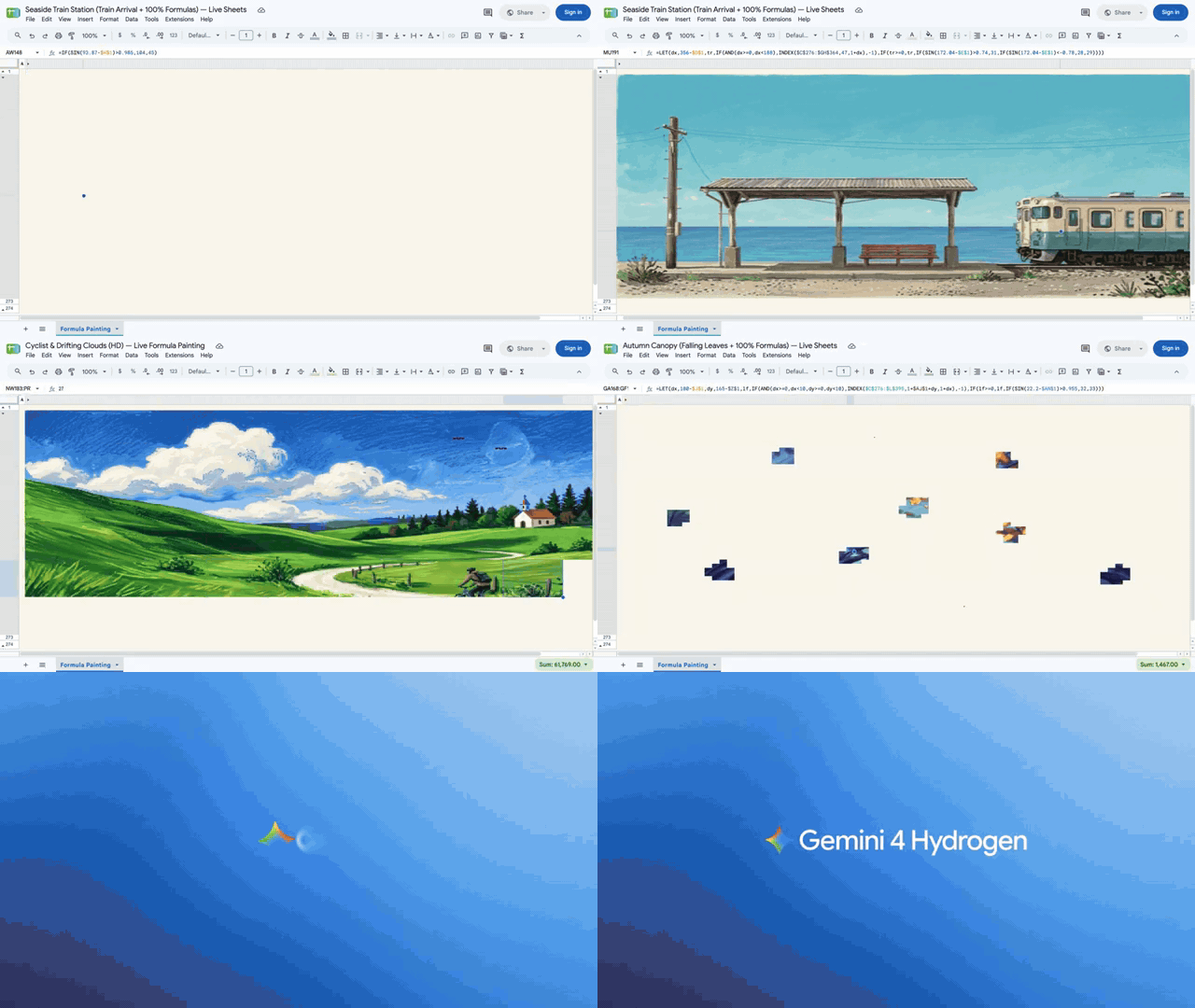
Take this example: it turns Excel into an animation player!
Can you believe that?
In Google Antigravity, Hydrogen directly transforms Google Sheet into a dynamic pixel canvas.
It combines Python, native =LET(...) formulas and conditional formatting, shrinks thousands of cells into pixels, and draws fully playable dynamic scenes!
In addition, you can create a 3D open world with one single sentence, and use Hydrogen for real-time 3D programming in Geminisland.
With just one prompt, Hydrogen can generate custom buildings on a voxel island, allowing players to walk in with a first-person perspective.

What's more romantic is that Hydrogen pulls real-time global lightning data, builds an interactive 3D Earth with pure code, and equips it with a Web Audio music engine.

Every time a lightning strikes on Earth, ripples will appear on the 3D Earth, and a piece of music will be triggered at the same time — thunderstorms all over the world are composed into a symphony by it.
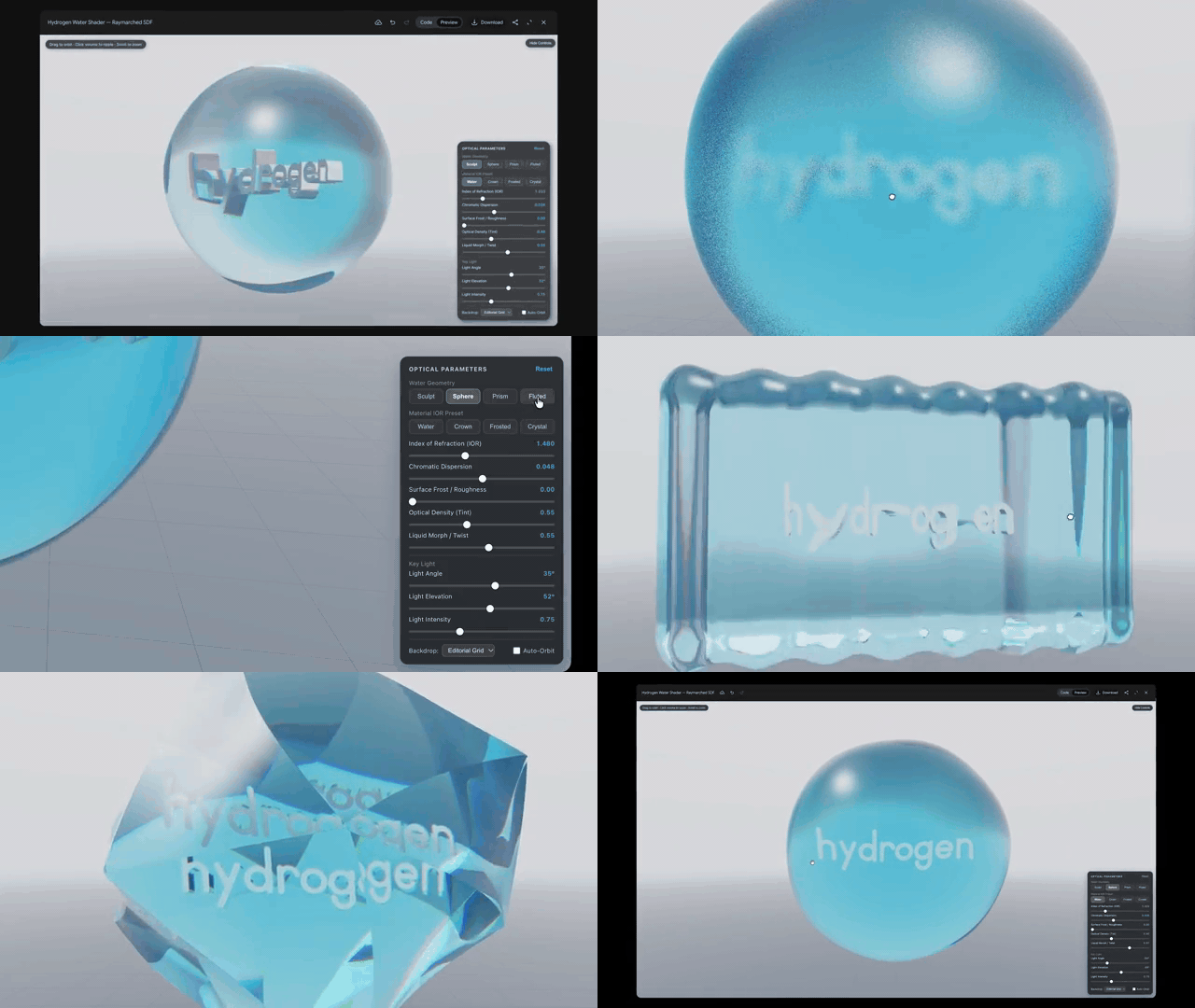
Even without any external materials, it can create a WebGL2 water and glass visualizer.
It is built entirely from pure formulas and SDF textures, and realistically simulates light refraction, reflection, dispersion and absorption effects, which is extremely lifelike.
Next comes the favorite feature for designers and PPT workers.
Paired with Google's brand new front-end design skills, Hydrogen generates an e-commerce official website for luxury goods in one shot.
If you are often tortured by making PPTs, now you only need to provide it with a YouTube launch event video and a set of design templates, Hydrogen can not only generate a full set of PPTs, but also check for typesetting errors on its own.
Google Sheets is also Gemini-optimized now, which is a great benefit for finance teams.
Hydrogen can quickly convert financial data into interactive models, dynamically adjust according to various forecasting scenarios, and the speed is more than 30% faster than the old model.
Next is the real device test.
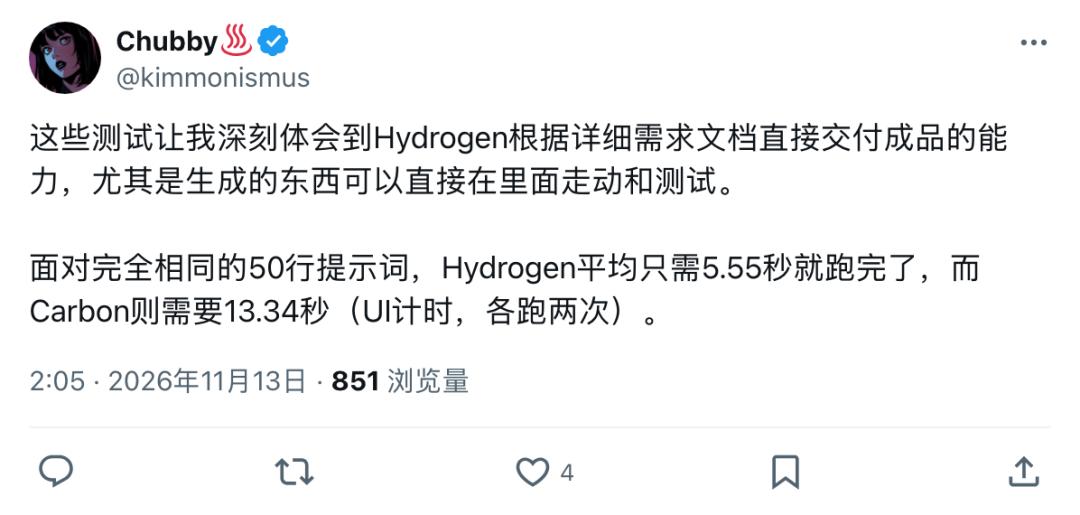
The actual measurement results from top tech influencer Chubby show that Carbon takes an average of 13.34 seconds to run the full task, while Hydrogen only takes an average of 5.55 seconds, and the 3D scenes and web games it writes can be used directly.
Take this 3D scene named "Fractal Cathedral" as an example.

A 3D web game with physical collision and scoring system is no challenge for it either.
In the "Canyon Flight" test, Hydrogen used Three.js to write procedural canyon terrain, dynamic water surface and 25 scoring levels.

Orchestrator, the magic tool for "mixed collaboration of large and small models" is here
The most impressive part of this launch is Orchestrator, which is launched synchronously in Google Antigravity.

This intelligent scheduler is simply a brilliant creation that wows all developers.
This is Google's real engineering killer feature after it holds three aces: Carbon, Argon and Hydrogen.
In real software development, teams need Carbon to do top-level architecture design, but there is no need to consume expensive flagship model quota every time they read files or run tests.
So Google simply lets the large models form a dream team of "general contractor + gold-standard worker".
Through Orchestrator, the system will dynamically switch between Carbon and Hydrogen in the same session.
Among them, Carbon acts as "Chief Architect and Coordinator", responsible for controlling the overall situation, breaking down complex tasks, and making the most difficult decisions.
Hydrogen acts as "Super Executive and Quality Inspector": it works simultaneously in multiple isolated workspaces, writing code, running tests, fixing bugs and verifying results in parallel.

How amazing is the performance? In the Terminal-Bench 4.0 test, its success rate is close to that of the pure flagship Carbon, while the computing power consumption is reduced by 24%, and the speed is 19% faster!
Moreover, even without teaming up, Hydrogen itself is also a master at handling large codebases alone.
It has mastered native batch parallel calls for file reading and search tools.
Previously, many models browse codebases by flipping through files one by one; but Hydrogen can read more than a dozen files at the same time at a glance, and only make "surgical-level precise modifications".
Real-world tests by enterprises in complex graph, SQL and data-intensive workflows show that Hydrogen runs 2 to 2.8 times faster than Gemini 3.8 Flash, while Token consumption is reduced by 12% to 23%!
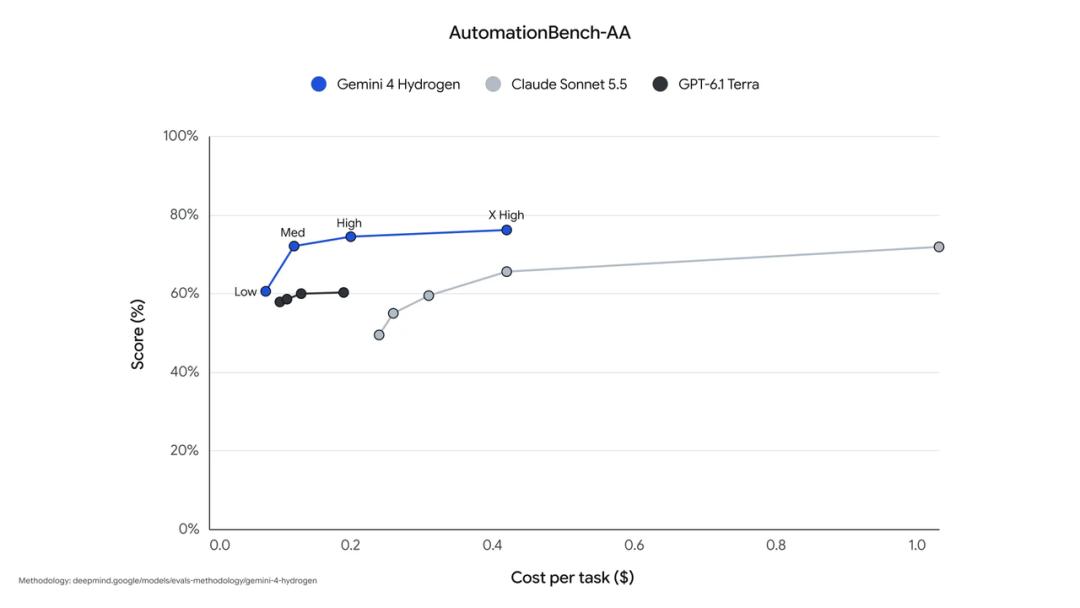
Intelligence level exceeds that of flagship models
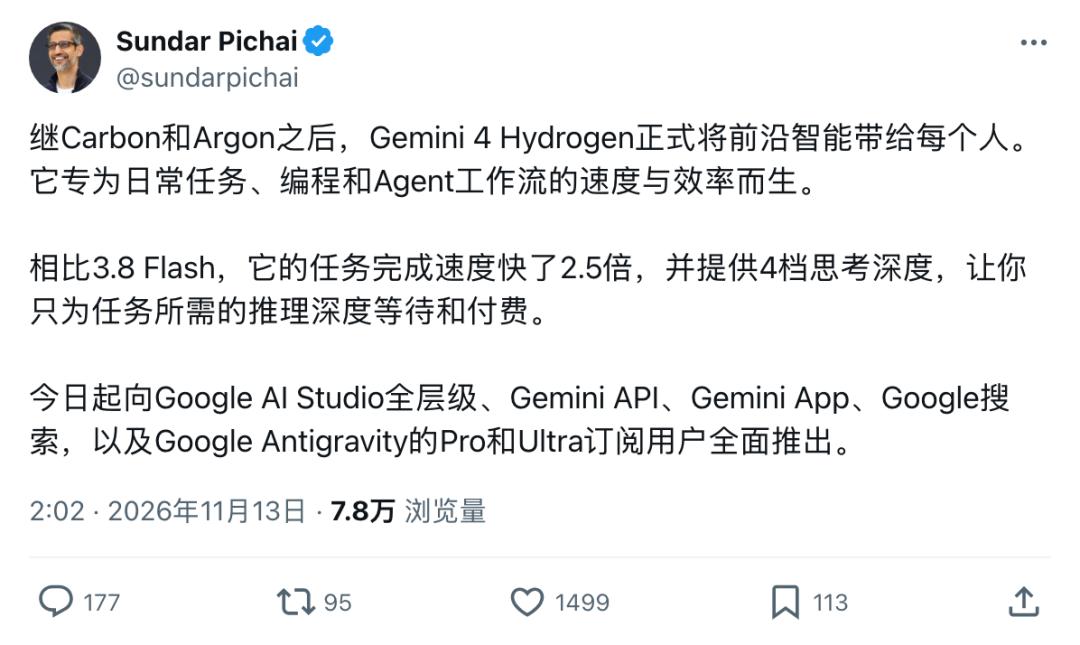
If you used to use Gemini 3.8 Flash or even 3.5 Flash frequently, you will definitely get an extremely smooth experience when migrating to Gemini 4 Hydrogen.
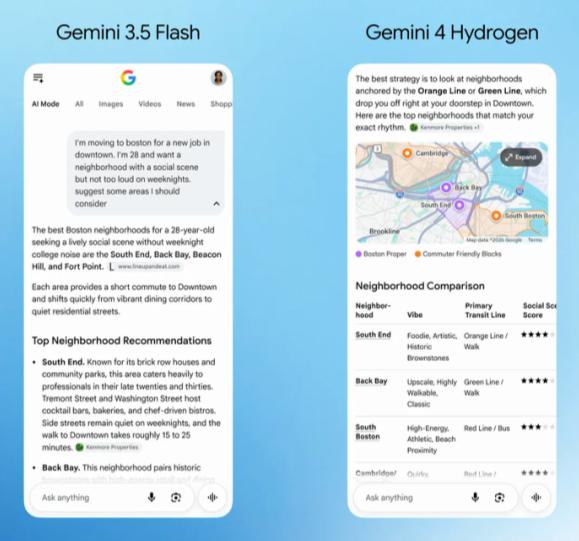
Its speed has skyrocketed: under the high thinking setting, the speed is increased by 2.5 times.
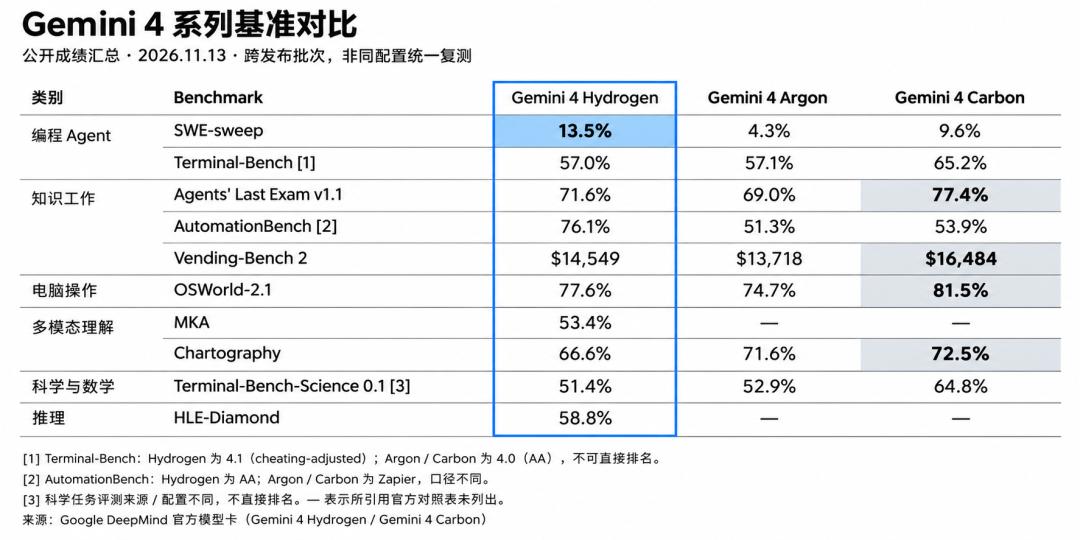
On hardcore benchmark tests, Hydrogen has achieved full performance leapfrogging.
In the Terminal-Bench 4.1 test, Hydrogen got a high score of 57%.
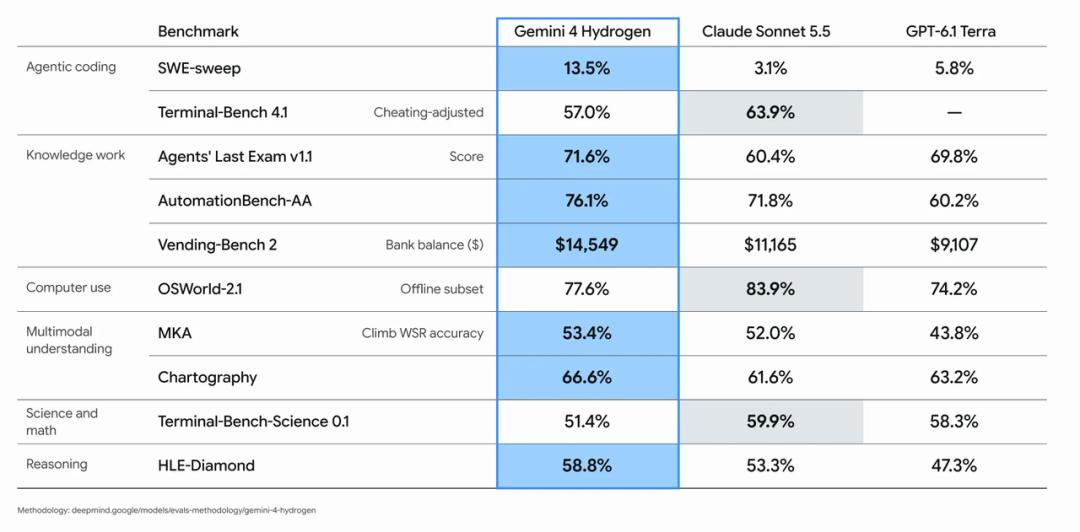
Moreover, its hallucination rate has been greatly reduced: the probability of making up false information has been cut by more than 5 times.
