Mind-blowing! 4K image generation can now be completed in less than 10 seconds, which completely turns the entire game development industry upside down.
In recent days, various AI game effect demos have been emerging endlessly online. Not long after someone shared a shooting prototype that can render real-time scenes only with the WASD keys on the keyboard, creators immediately rolled out cyberpunk blocks with fully realized neon reflections on rainy days, which have left people constantly stunned and slack-jawed in amazement.
People outside the industry who watch too many of these clips can't help but form an illusion that game development has advanced to the stage where you can type a few lines of prompts and get a full high-quality game out.
But if you actually visit a real project team, the situation is far from that easy. When I talked to several frontline artists and game designers about their daily work a while ago, the most headache part for them is still the basic upstream work of setting concept art.
When the graybox of a level is just built, you want to use AI to lay a layer of light and shadow to check the atmosphere. The rendered picture looks good, but the pre-reserved cover points and paths are arbitrarily changed by the model.
You finally pick out a satisfying concept art to hand over to the downstream team, only to find all the material seams are blurry when you zoom in. If you make minor adjustments to a certain part according to the lead artist's opinion, the AI will directly overturn and redraw the entire architectural structure of the whole image.
The game production pipeline is closely linked. No matter how many 3D or video tools are connected in the downstream, static 2D concept art is still stuck at the most upstream of visual production. A slight deviation in this part will lead to a lot of extra working hours for subsequent modeling and animation to fix the problems.
All these may also explain why, even though the slogan of all-powerful multimodal AI is extremely loud, top-tier big manufacturers are still investing heavily in the image generation track.
Just recently, MiniMax officially released and open-sourced its image generation and editing model H3-Image, which supports multi-image reference input, and brings 4K high-definition image generation to the 10-second speed range. Coupled with the continuously iterated Google Nano Banana 2.1 and Qwen-Image-2.1 which also opens weights, all players on the table obviously want to get rid of the old label of "gacha toy".
Taking advantage of the newly open-sourced H3-Image, we also conducted a round of actual tests combined with several common game development links, to see how much work today's AI visual tools can share for game developers, and how many new possibilities are hidden.
After achieving balanced capabilities, AI's aesthetic sense has also improved significantly
For a very long time in the past, when game developers used AI to assist visual work, they always had to endure the old problem of "uneven subject performance" of these models.
For example, text models like Claude have smooth logic, which can sort out visualization schemes clearly, but the visual effects they draw are inevitably dry and rigid. Old visual models like Midjourney have good aesthetic tone, but they will immediately show their shortcomings when encountering strict structural logic or complex text information presentation.
Game art is the most demanding, which requires both reasonable spatial and component matching, and qualified picture tone. Combined with previous multimodal technology accumulation and targeted optimization, the obvious change of H3-Image is that it takes into account both logical understanding and visual beauty.
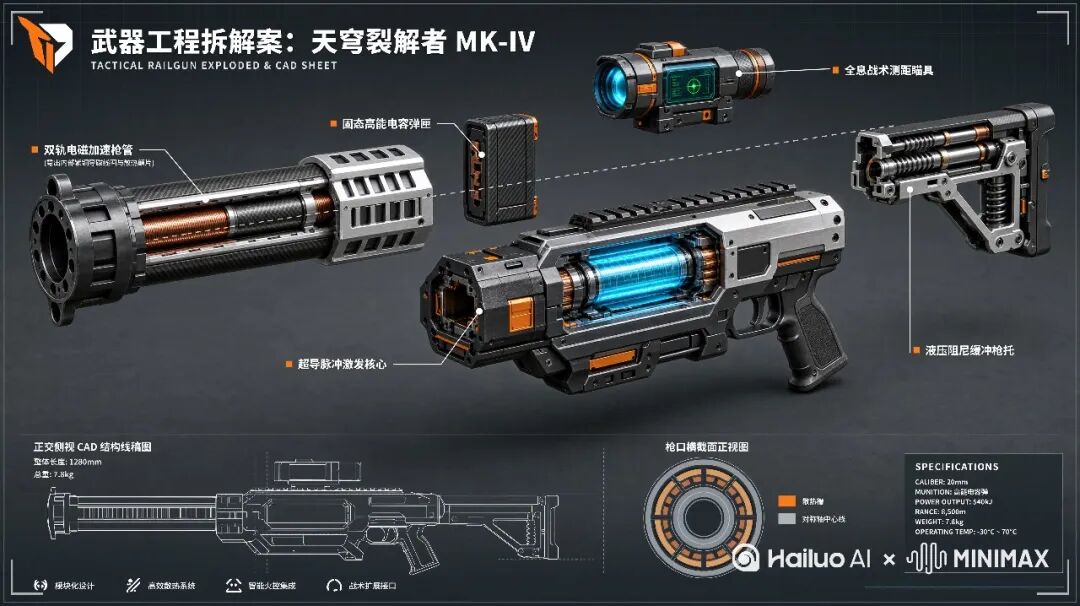
First look at the aspect of logical understanding. The requirements for original art in actual projects rarely only ask to draw a single weapon or a monster, and usually come with a set of disassembly and description requirements.
Take this "Sky Splitter" weapon disassembly diagram as an example. H3-Image presents a 3D explosion structure, side-view CAD line draft and muzzle cross-section diagram in the same canvas at the same time. The assembly relationship between the barrel coil, magazine and buffer stock is explained clearly, and the Chinese part labels are also arranged neatly.
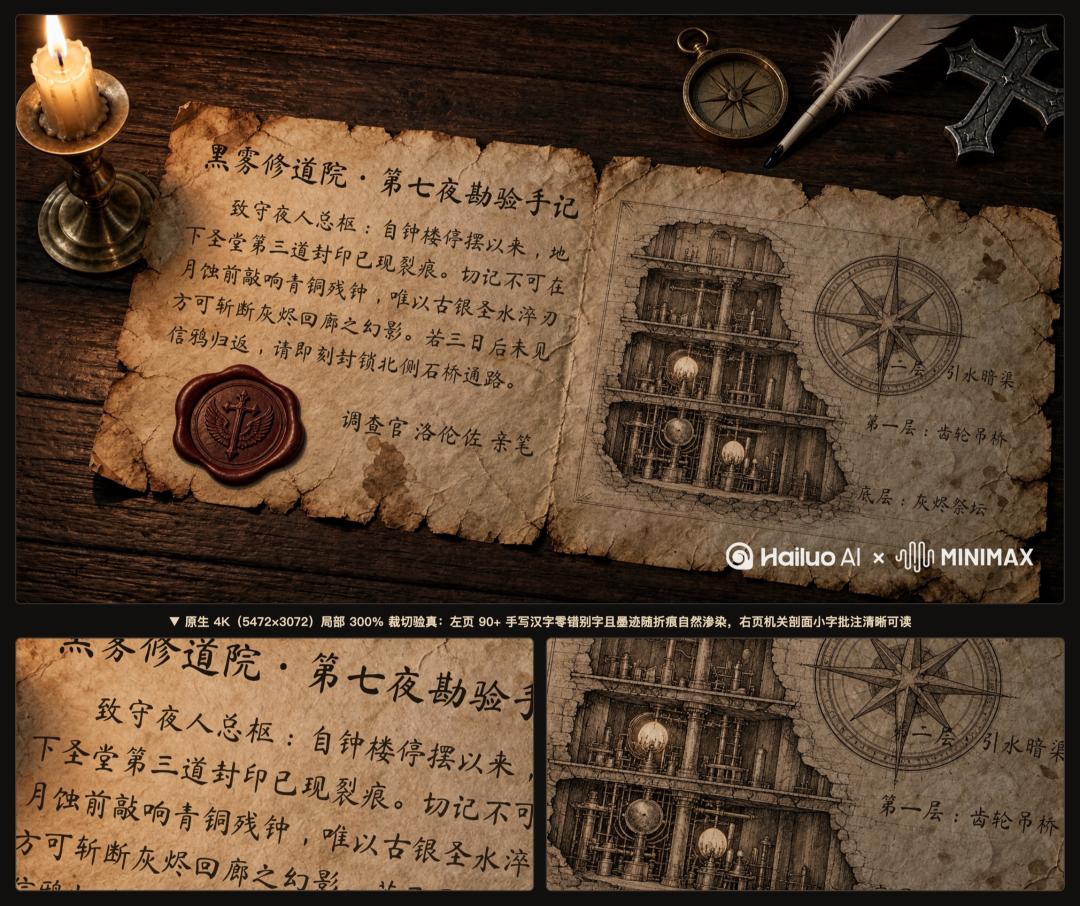
When it comes to the common in-game letter props in suspense-themed games, its text restoration degree and material fusion are also very stable. There is no garbled or wrong character in the large section of handwritten Chinese on the left page, and the ink naturally spreads along the creases of the parchment; the abbey mechanism cross-section diagram on the right page, the small labels inside are still clear and readable when zoomed in.
Of course, being able to draw the structure correctly is far from enough in the game workflow. What I care more about is that at this stage, AI has also made visible progress in visual aesthetics.
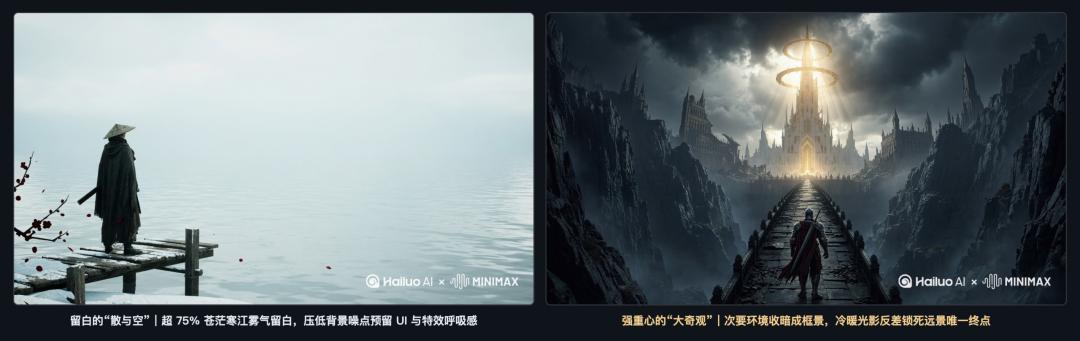
AI-generated images in the early days are easy to be identified as fake, often because they are too crowded, always piling up complicated patterns and highlights in every corner. To judge whether a model understands game visuals, it is enough to see if it can grasp the two directions of "blank space" and "visual focus".
A mature game screen, on the one hand, knows how to leave blank space, control background noise, and leave breathing room for character silhouettes, combat special effects and UI. On the other hand, it can also grasp the visual focus, and attract players' attention with spectacular buildings in open world or box garden levels.
According to our actual test, H3-Image can already handle this kind of scale well. The lone boat on the cold river in the left picture retains a large area of clean misty river surface, which looks restrained and ethereal; the right picture darkens the mountains on both sides, and naturally guides the line of sight to the temple at the end along the stone bridge and the contrast between cold and warm light and shadow, so that players know exactly where to go without looking at the mini-map.
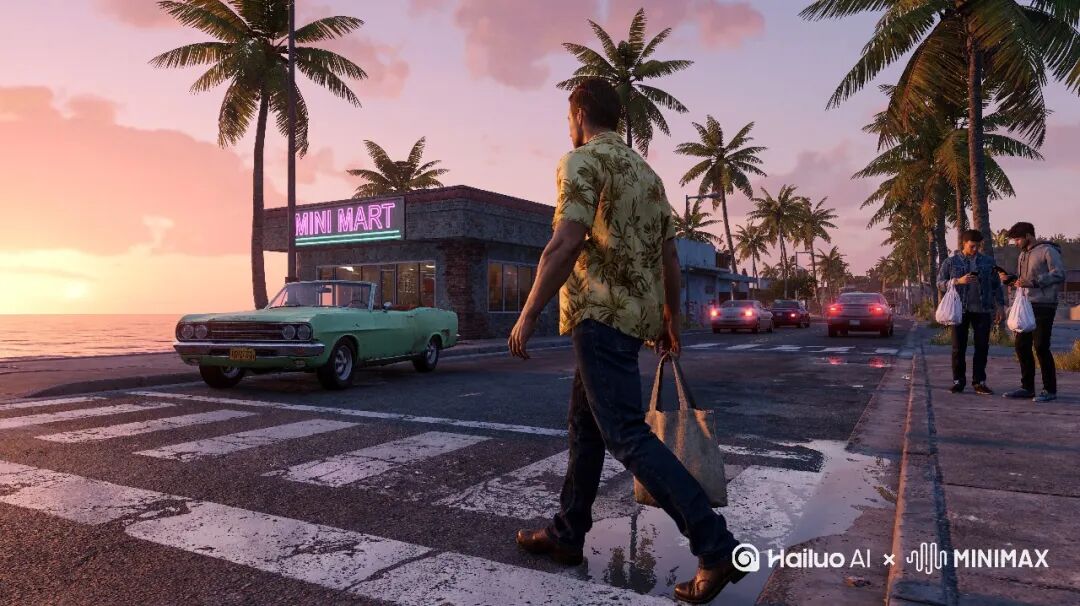
In the attempt of daily casual feel and diverse art styles, H3-Image's performance is also very natural. For example, when generating an open world street scene in GTA style, the zebra crossing under the sunset, passers-by crossing the road with bags and the accumulated water on the ground look very much like a frame of real game screenshot captured casually when players are exploring the map, with less deliberate promotional poster feel.
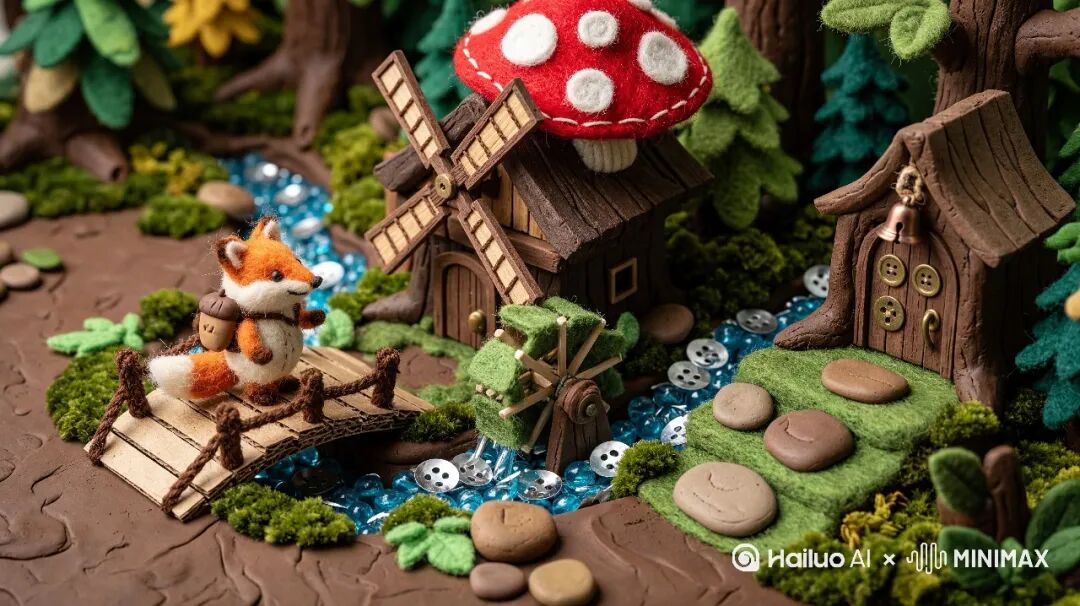
When switching to styles such as felt stop-motion animation, watercolor or paper-cut, the felt texture on the little fox and the details of the button stream are also very pleasant, which is suitable for small and medium-sized teams to test different art styles in the early stage of project establishment.
New practical solutions for scenes, 3D assets and CG previews
From the industry survey of GDC this year to the R&D trends disclosed by domestic top manufacturers, AI-assisted 2D art production is already very common in the industry.
Studios have long passed the novelty-seeking period of watching the fun. Now everyone is calculating the working hour cost, and care more about whether new tools can be smoothly connected to the upstream and downstream, and reduce rework. Focusing on the three commonly used links of game scenes, 3D assets and CG previews, we also tested the actual performance of H3-Image through several sets of tests.
The first is the "spatial discipline" in scene exploration. Modern level process usually builds a graybox first to determine the scale and cover movement lines. In the past, when using image generation models to modify scene concept art, the most worrying thing was that changing the weather and light and shadow would mess up the originally designed route.
We took a daytime level base map to conduct a targeted revision test, requiring the model to retain the layout of the container cover on the left, the main road in the middle and the corridor on the right, switch the picture to a rainy midnight and light up the beacon light on the top of the distant cliff, and take Seedream 5.5, which focuses on continuous editing, as a control.
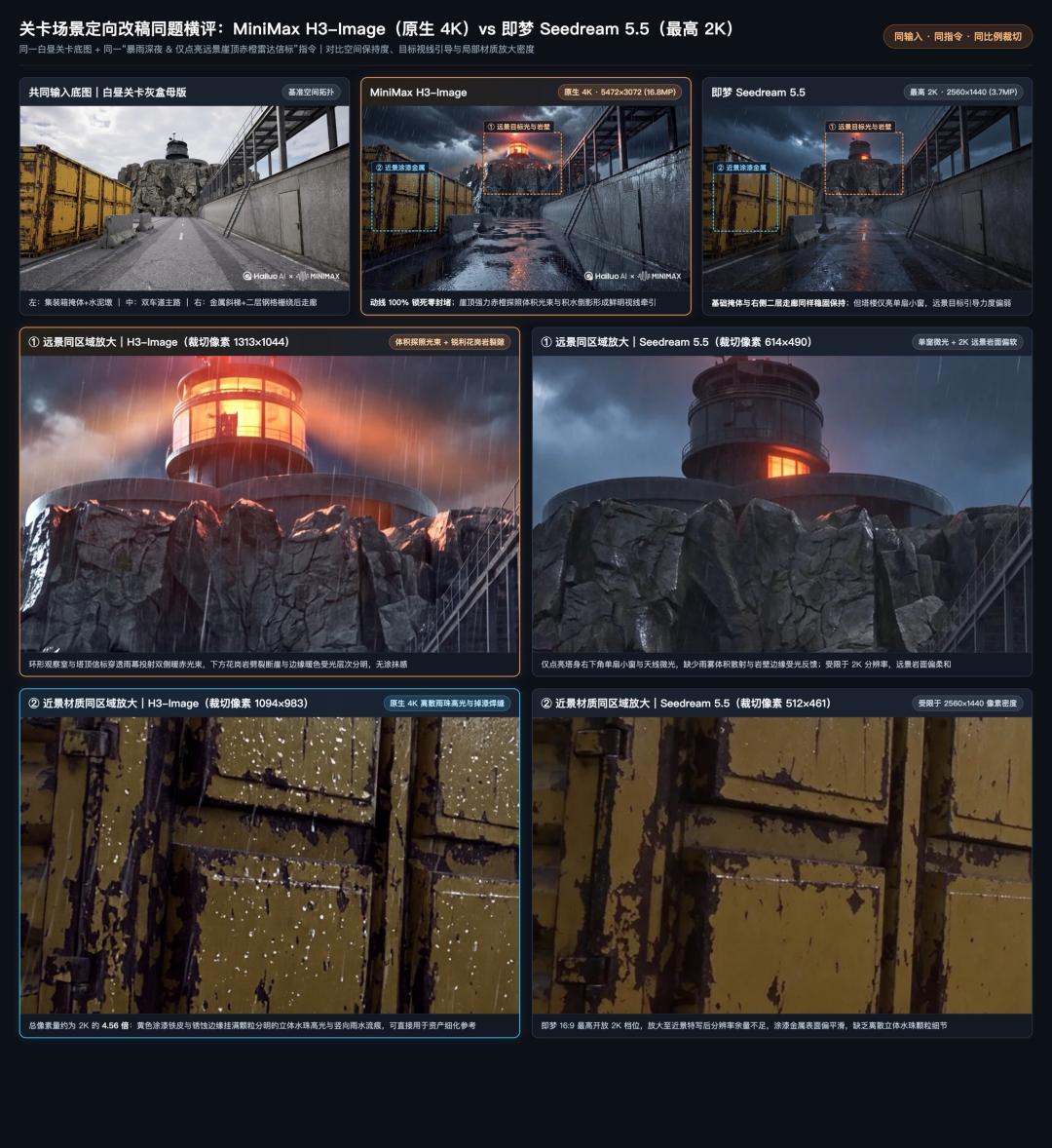
Although both models retained the basic road structure, H3-Image's processing of the searchlight on the top of the cliff and the reflection of accumulated water on the road is clearer, and the line of sight guidance is much more in place than Seedream 5.5 which only lights up a small window.
When zooming in on local details, the advantage of native 4K specification is also very obvious. The water droplets and rust on the iron container in the foreground and the cracks of the rock wall in the distance are still clear, which makes it more convenient for artists to disassemble material references, and it is much easier for small and medium-sized teams to try "multi-state changes of the same scene" at low cost.
Going downstream along the pipeline, we arrive at the handover link of 3D assets. No matter how good the stereoscopic effect of 2D rendering is, it is still different from the 3D mesh that can be directly imported into the engine. Subsequent polygon reduction, topology, UV unwrapping and material adjustment are all indispensable. Replacing the upstream with a smarter image model is mainly to allow the receiving modelers and mesh generation tools such as Hunyuan 3D to "guess the structure fewer times" in the end.
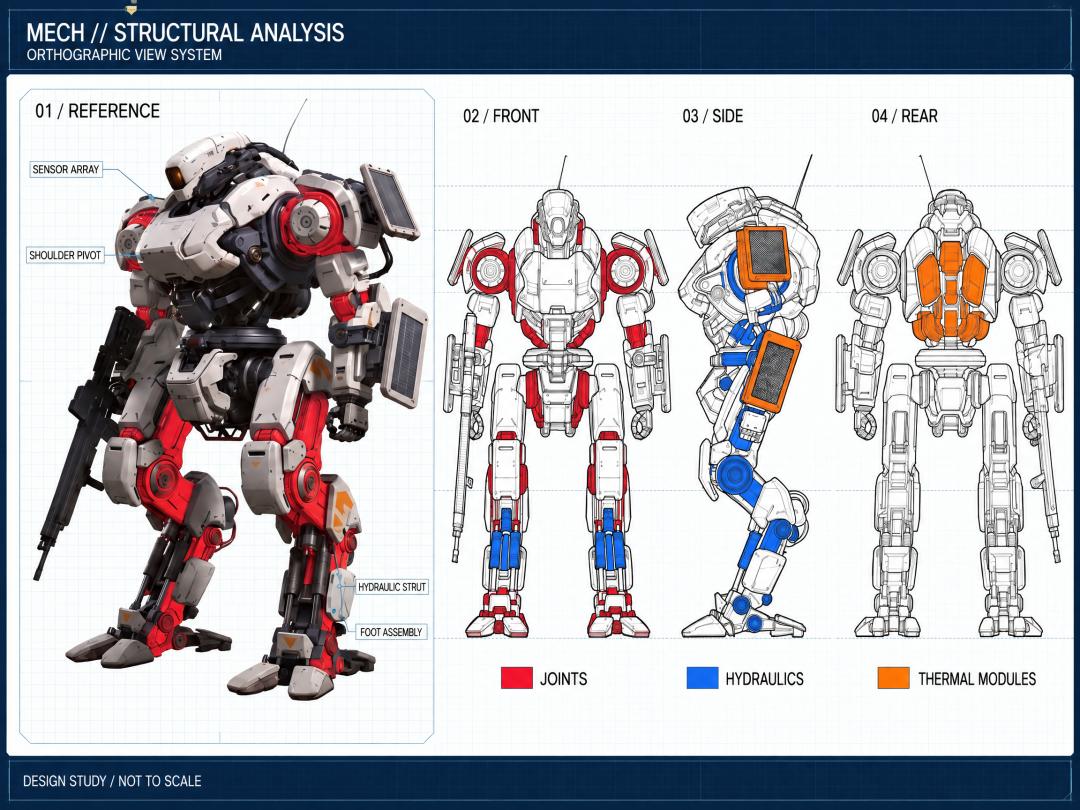
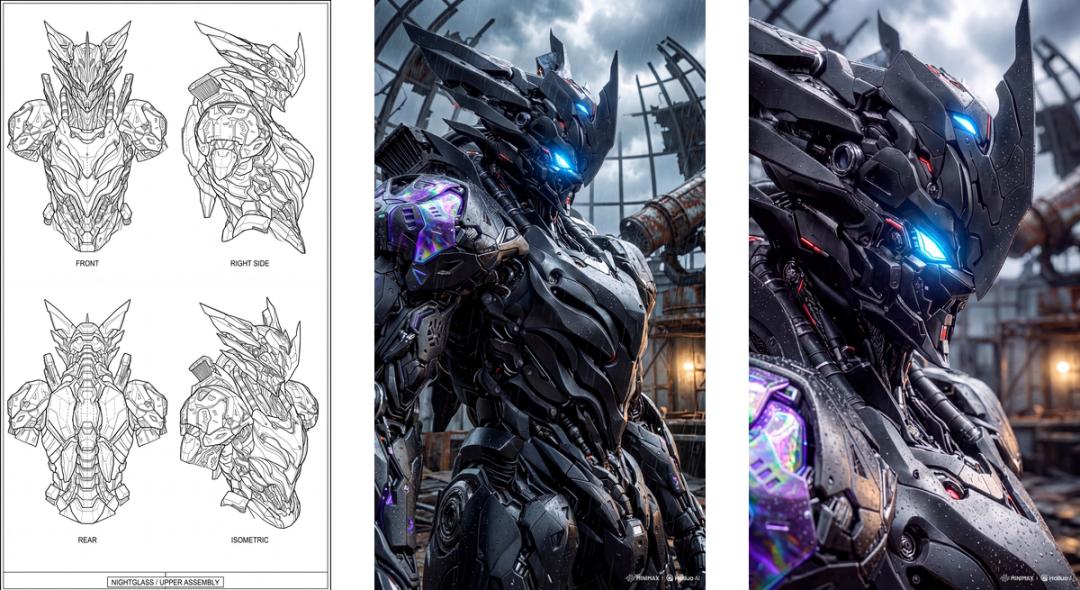
When overseas creator cyber was renovating an old mecha design, he used H3-Image to generate line drafts of front, side, back and isometric four views, and generated a rainy night rendering of the mecha based on that. The armor connection and surface water droplet texture are very regular, and the 4K image generation speed also satisfied him.
In order to further observe the cross-view stability of H3-Image when modifying parts, we also input a master version of the four views of "pneumatic grapple launcher", requiring to replace the top amber steam tank with a blue ice crystal cabin synchronously in the four views, and install a window breaking hammer at the bottom of the grip, while inviting Qwen-Image-2.1 which is also in the open source camp as a reference.
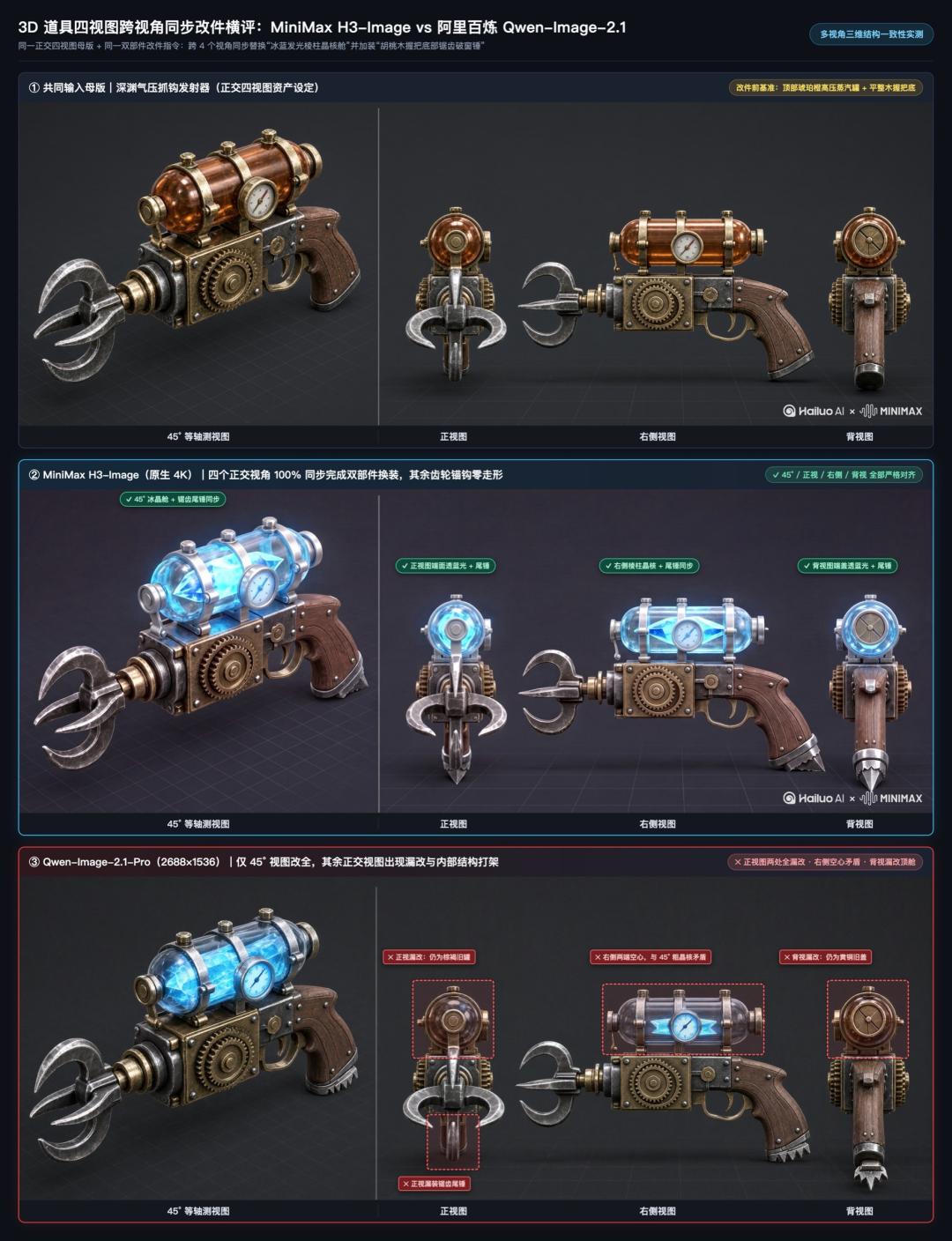
After comparison, Qwen-Image-2.1 only modified the isometric view correctly, and other orthogonal views had the situation of missing modification of the old tank or missing installation of the tail hammer; H3-Image completed the two part replacements synchronously in the four views, and the original gears and front grapple were not deformed.
Next, we arrive at the CG pre-production preview link. In the past, the thing that discouraged small and medium projects was the high pre-preparation cost. If you just want to test several sets of character color schemes in the early stage of project establishment, or explore the atmosphere of cutscene shots, it is too time-consuming to collect materials specifically to train a custom model.
Japanese creator Mankyu (@manaimovie) shared a set of no-training tests on X not long ago. He input an original art of a white-haired girl, and directly let H3-Image continuously generate variants of pink outfits, double ponytails and sailor suits, and finally put it into the dusk ruin background. The final image not only retains the complicated details of shoe buckles and ahoge, but also the effect of warm sunset light hitting the hair and clothing folds is very harmonious.
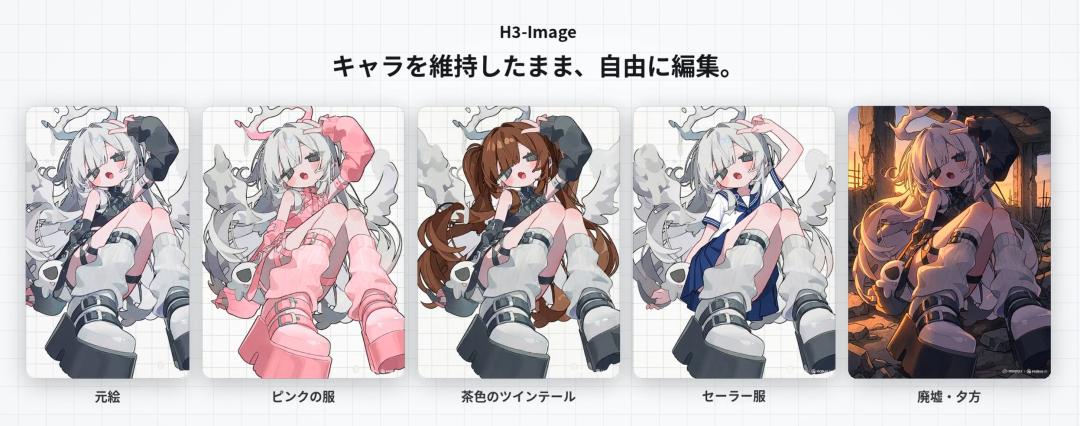
In the original tweet, Mankyu also objectively mentioned the current limit: in the pure 2D illustration scene, if the character's angle or posture is changed greatly, it is still a little difficult to strictly lock the original brushstroke art style.
For this kind of complex shot requirements with multiple camera positions and multiple elements, the feature that H3-Image supports up to 16 reference images to be imported at a time perfectly connects the subsequent workflow. The team can import the character, costume, scene structure and tone reference together, then directly