Robin Li, why do you want to build a new factory in the AI era?
Have companies achieved better financial returns after employees use AI to improve efficiency?
On November 12, at the 2026 Baidu World Conference, Li Yanhong, founder of Baidu, and his guest Yang Yuanqing, Chairman of Lenovo Group, discussed the AI transformation of enterprises.
The two heads of technology companies who have witnessed the Internet wave and AI wave at the same time agree that at this stage, enterprises' exploration of AI is still in the early stage, and it is necessary to continue to explore in an environment that encourages practice to figure out from which links the new productivity will be released.
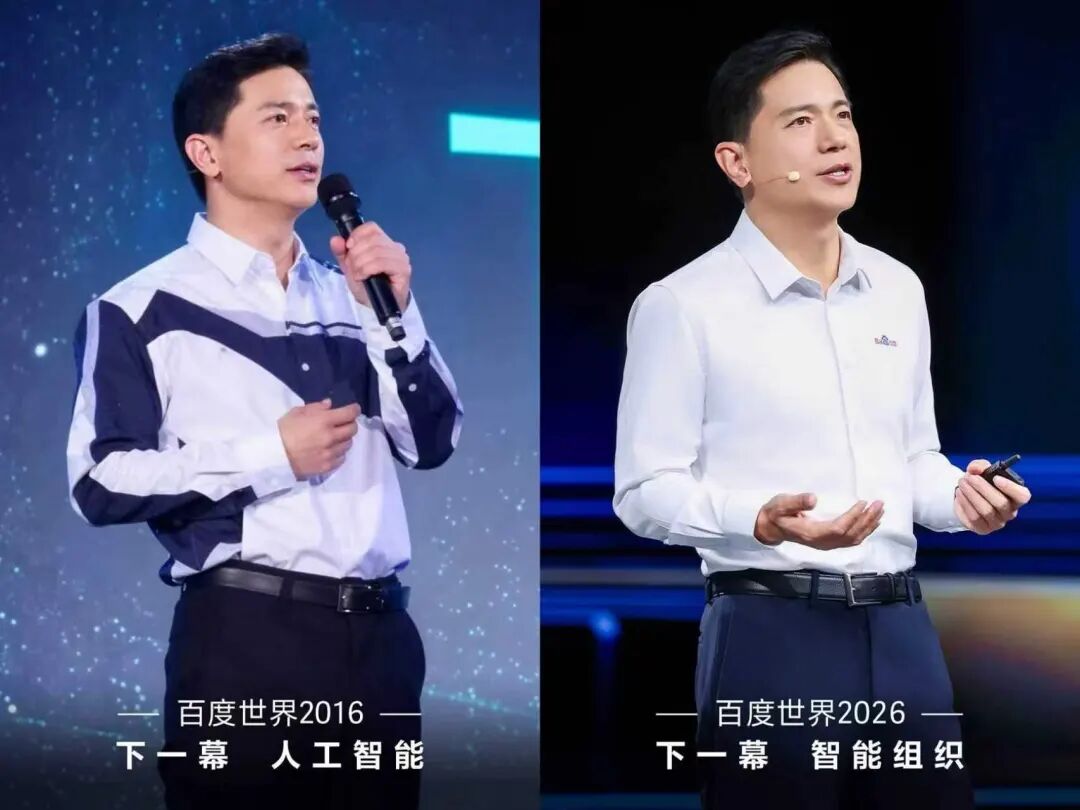
Li Yanhong said that in the past few years, Baidu has also encountered some pitfalls in the process of AI transformation, from allowing various business departments to train models on their own to chasing the hot spots of agent applications. However, the company gradually found that even if employees are highly enthusiastic about using AI, organizational efficiency does not necessarily improve.
It is not just Baidu. The situation where personal efficiency is improved but the overall profit of the enterprise is difficult to reflect has become the core pain point faced by many industries in the current AI transformation process. To solve this problem, at the conference, Li Yanhong put forward the breakthrough idea of "Smart Organization", an AI-native organizational system that is different from the currently prevalent hierarchical system.
In his view, artificial intelligence is the new electric energy, and the smart organization is the new factory in the AI era, where productivity is truly generated. The reason why AI has not produced the expected economic benefits is that at this stage, "we have only replaced the motor, but have not redesigned the factory."
The founder who has always adhered to "long-term technologicalism" is trying to find a new solution to the pain point of value transformation in the process of enterprise AI transformation. He pointed out that the upstream of AI technology is energy, and the downstream is organizational capability. The smart organization will create opportunities for enterprises to build new moats and open up new markets.
01 Where is the problem with the "efficiency paradox"?
Since the beginning of this year, more than one AI tool has focused on improving productivity and efficiency. However, a realistic dilemma is that employees repeatedly transfer tasks between different tools, and the progress is scattered everywhere. Although employees have become "super individuals" empowered by AI during this period, enterprises are faced with scattered AI permissions that cannot be unified, result audits that are difficult to trace systematically, and business value transformation that is difficult to quantify.
According to McKinsey's survey results this year, among 1719 respondents from 97 countries, 80% of the respondents reported that their personal productivity has been improved by AI; but only 37% reported that AI has made a positive contribution to the EBIT of their organizations, which is basically the same as the proportion in 2025.
An industry insider once mentioned to us that when AI is integrated into the office workflow, the number of deployed tools and the number of working hours saved by pilot projects are easy to show as achievements. What is difficult to calculate is where the saved working hours go. A business chain is connected by multiple links. If the upstream and downstream still hand over work at the original pace, and the approval authority, collaboration methods and assessment indicators remain the same, the speed increase of one link will be difficult to be transformed into the output of the whole chain. The easier it is for the pilot project to produce impressive figures, the more likely this gap will be ignored.
A report from the World Economic Forum titled "AI-First Operating System: A Blueprint for Operational and Business Model Innovation" found that global investment in the field of artificial intelligence exceeded 2500 billion US dollars in 2025, but only 25% of enterprises believe that AI has brought disruptive transformation and impact to them.
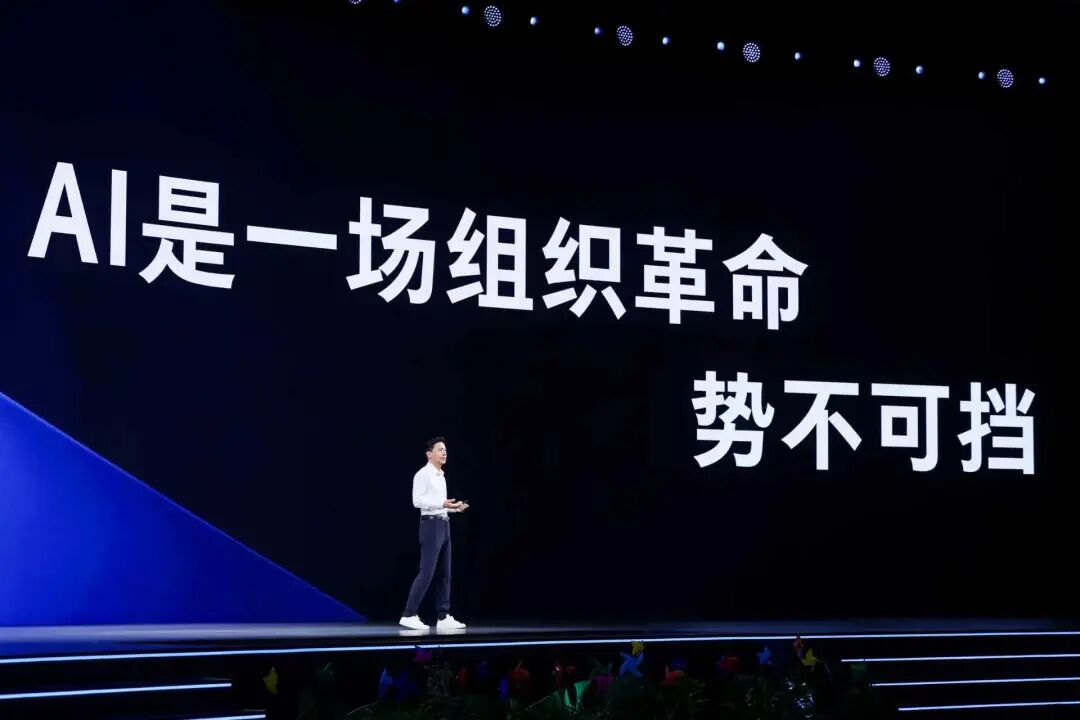
The report attributes the problem to the fact that most organizations "graft" AI onto existing processes, instead of rebuilding the entire operation model around "intelligence".
This is not a contradiction that emerged only when AI technology exploded. As early as 1987, Nobel Prize-winning economist Solow wrote an article saying, "You can see the computer age everywhere, except in the productivity statistics." This famous quote that is still cited today is summarized as the "Solow Paradox", that is, the "Productivity Paradox".
Li Yanhong believes that traditional organizations are job-centered, while organizations in the AI era will become task-centered. The boundaries of jobs will be broken, and organizational vitality will be further released.
For example, a case given by the Boston Consulting Group (BCG). A European energy service provider launched dozens of AI pilots in customer service, operation and support links, but customer problems often have to go through several departments. The original systems and processes split the service into several segments, resulting in limited business impact.
Later, the company re-transformed the process according to the capabilities of AI. Three cross-functional teams are each responsible for a key process, deciding from beginning to end which tasks are handed over to agents, which require manual supervision, and how to connect data and systems. According to the disclosure, after the transformation, the process quickly reached the level of manual service in terms of customer satisfaction indicators, the company's dependence on external service providers dropped by more than 90%, and the released cash was invested in subsequent transformation.
Taking this energy service provider as an example, what has really been changed is the division of labor between departments and who is responsible for the whole process from the customer raising a problem to getting the solution. What is missing between the pilot results and organizational productivity is exactly these decisions.
02 The ignored key to AI competition
In the past year, more than one enterprise founder has publicly mentioned that AI is forcing the operation mode of the whole enterprise to change. Therefore, the industry has reached a consensus that AI is iterating, and the enterprise itself also needs to evolve, otherwise the enterprise will stay at the superficial level of "AI empowerment".
Previously, overseas views compared the AI industry to a "five-layer cake". From bottom to top, the five layers are energy, chips, infrastructure, models and applications. Power supports computing facilities, models run on infrastructure, and applications bring model capabilities into specific industries. This framework brings the supply conditions that are easily covered by models and applications to the forefront, and also places applications at the position of realizing economic value.
At Baidu, this problem has been gradually narrowed and embodied. At Baidu World 2025, Li Yanhong proposed that enterprises should "internalize AI capabilities", combine AI with specific tasks, and make it a native capability for enterprise development and personal growth. At the Create Baidu AI Developer Conference in May 2026, he began to discuss how organizations can evolve themselves: when agents can independently undertake part of the work, the original team composed of people can become a "super organization" with a mixed formation of humans and agents. He also proposed DAA (Daily Active Agents) at the same time, and believed that we should not focus on the Token consumption indicator, but pay more attention to the output and results of agents, and use new standards to measure the value of AI.
At this year's Baidu World Conference, Li Yanhong continued to push the problem further downstream, further focusing on smart organizations, and believing that the reconstruction of AI to the organization itself is the key to releasing productivity.
Li Yanhong said that the large model industry is developing along two paths: one is to break through upward and push up the upper limit of intelligence; the other is to take root in reality and release industrial value. "We are moving forward on both development directions of large models. On the one hand, we will continue to invest in researching and developing more cutting-edge next-generation basic large models. On the other hand, we will adhere to the concept of "parallel evolution of models and agents" to optimize large models for applications."
Based on Baidu's existing full-stack layout of "Chip, Cloud, Model, Agent", he turned his attention to the "organizational layer": after the agent is connected to the enterprise, what tasks can it undertake, what data can it call, who will accept the delivered results, and who will take over after failure? The two sets of frameworks view AI from both ends of the industrial chain. One clarifies how intelligence can be produced on a large scale, and the other asks how enterprises can convert supply into their own productivity.
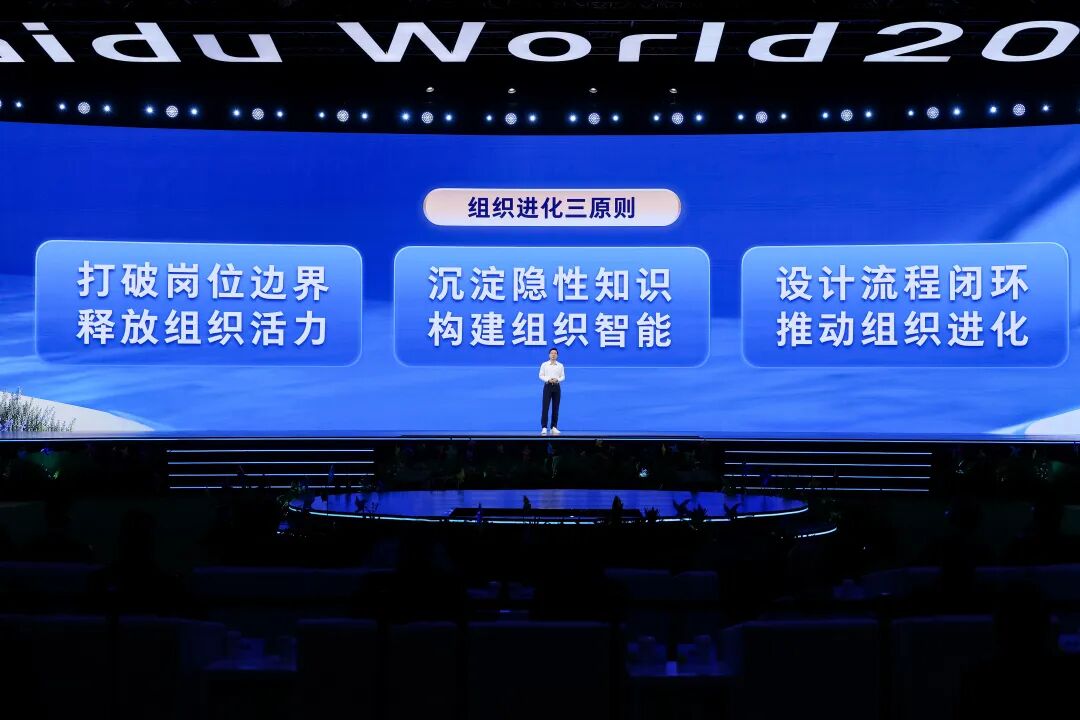
He put forward the "three principles of organizational evolution" for the first time: first, break job boundaries, precipitate tacit knowledge, design closed process loops to break job boundaries, and release organizational vitality; second, precipitate tacit knowledge to build organizational intelligence; third, design closed process loops to promote organizational evolution.
Within Baidu, the three principles have been initially verified. According to reports, in the past year, the number of daily active agents (DAA) within Baidu has grown from 5,000 per day on average to 37,000, an increase of more than 6 times; the number of effective tasks completed by agents has grown from 84,000 per week to more than 1 million per week; Baidu has built 4300 Workspaces, with more than 20,000 organizational Skills precipitated. "Let one person's experience become the ability of the whole organization."
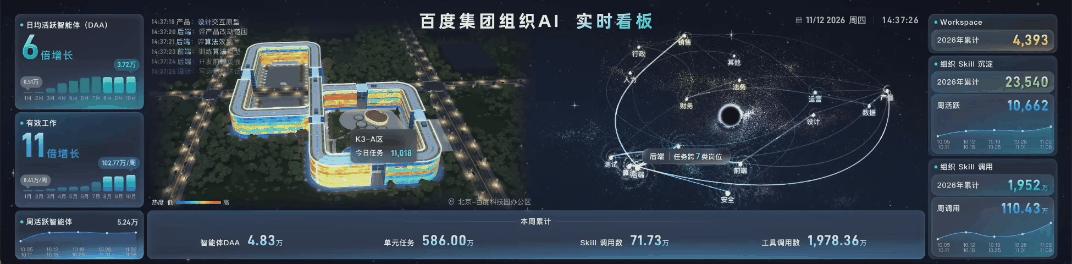
Li Yanhong summarized this method as "Measurable + Looping = Continuous Evolution". When applied to a customer service process, the measurement object can be whether the customer's problem is solved and whether the customer calls repeatedly. After the agent executes, the team can use these results to find out which problems are misjudged, which processing rules need to be modified, and which situations should be transferred to manual work in advance. After the rules are updated, use the same set of standards to see if there is an improvement in the next round. In this way, every time the enterprise completes a round of tasks, it has the opportunity to pass on what it has learned to the next round.
The product manager from Baidu Buddy also mentioned in the on-site sharing that half a year ago, he was still engaged in quantum computing research in the physical laboratory. After joining Baidu, he entered the product and enterprise scenario almost from scratch. With the help of Baidu Buddy, he can simultaneously play roles such as product, R&D and project management, and push forward from analyzing problems, forming solutions to verifying results. In the past six months, the team has completed tens of thousands of tasks together with Baidu Buddy, and the experience of each task has been brought to the next one.
03 Where to start the reform of "Smart Organization"?
Fourth Wave noticed that around the four-layer architecture of "Chip, Cloud, Model, Agent", Baidu released a number of achievements during the event: it officially launched the large model trading platform Token Exchange, released the preview version of Wenxin Large Model 5.5 Flash and two Wenxin application models; the four major agents of Baidu Buddy, Kuku, Baidu Yijing and Famou have been upgraded.
Li Yanhong said that in the first 9 months of this year, new models were released almost every day, and sometimes multiple models were released in one day. However, the token transfer station is not responsible for the model effect and service stability. The more models there are, the more difficult it is to choose. "The same model has different prices, various sources, and uneven quality. After choosing for a long time, people still feel uneasy and dare not use it."
He said that the Token Exchange is an exchange for large models, focusing on the two core capabilities of "verification of authenticity" and "credit investigation", so that enterprises and even individuals can easily find, purchase and use credible model Tokens. Since its launch one month ago, the Token Exchange has settled in more than 100 supply resources, with the daily average number of calls exceeding 50 million and the daily average call Token exceeding 700 billion.
At the event, Baidu also launched updates around the comprehensive advancement of the four major agents to make organizational evolution happen in business. For example, Baidu Buddy has been upgraded to a unified entry connecting all professional agents of Baidu, and fully opened the Harness engine and Agent API. In the past quarter, Buddy has become the fastest-growing general-purpose agent. It is said that the Baidu Buddy team is also a practitioner of the three principles of organizational evolution, iterating more than 160 times in half a year, with 90% of the code and 50% of the external communication materials generated by Buddy.
In addition, the digital human agent Baidu Yijing has also launched the "Short Comic Drama Studio", covering a one-stop creation link from creativity, script, storyboard to finished film. Creators can use Baidu Yijing to complete the localized adaptation of plot, characters and scenes of verified works with one click, helping short comic dramas go global; based on the self-developed video generation model, the cost is only 0.2 yuan per second. The video clip of digital human Xijiayi interviewing Li Yanhong, founder of Baidu, demonstrated at the conference was generated by Baidu Yijing.
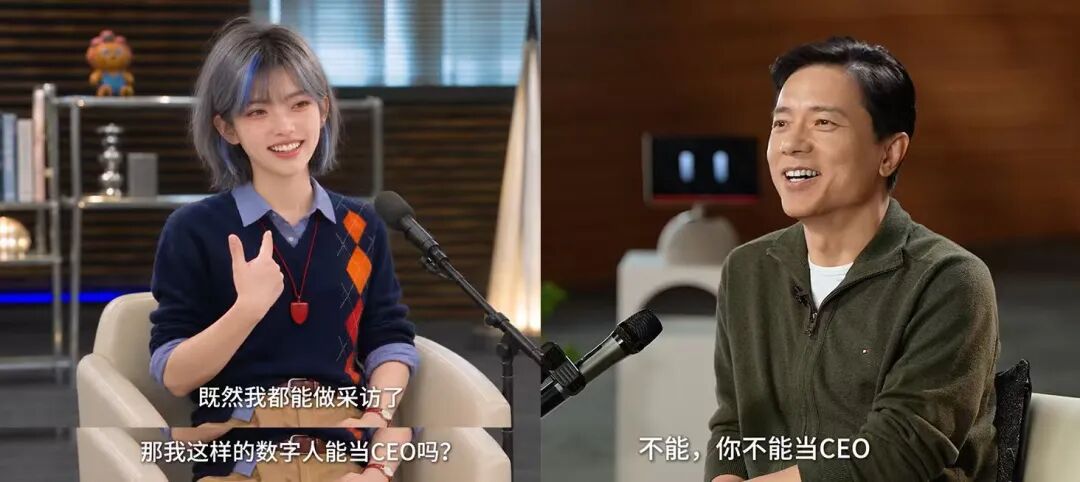
Digital human Xijiayi interviews Li Yanhong, founder of Baidu.
From the perspective of Fourth Wave, for such collaborative agent products, a progress worthy of further tracking is whether the agent can participate in improving itself, and how the team defines tests, accepts modifications, and decides what can be launched. The organizational evolution agenda of Baidu World also takes how agents enter the daily work of the team as the key observation point.
In the industry, McKinsey uses the term "Agentic Organization" to describe the operation mode of forming human-machine teams around business results. Microsoft uses "Frontier Firm" to describe companies where humans lead and agents participate in execution.
It is undeniable that when AI has gone deep into the enterprise workflow, the long-term problem that the latter has to face is direct value transformation. In Li Yanhong's view, smart organizations will usher in three major opportunities. The first is asset-light operation. "When one person or a very small number of people can lead a group of Agents to complete various tasks, human resources will no longer be the bottleneck for enterprise expansion, and the iteration speed will be greatly accelerated."
Secondly, it can build a new moat for enterprises. Enterprises can precipitate the tacit experience of top employees into reusable digital assets, and then encapsulate them into agent modules, which can be deployed globally in milliseconds and run 7*24 hours.
In addition, smart organizations can also create and discover new markets. Li Yanhong mentioned that organizations that can evolve by themselves will form a closed loop. It can perceive changes, conduct rapid tests, continue to learn, and replicate on a large scale. "Enterprise innovation has shifted from relying on a few 'innovation departments' to concurrent exploration across the whole organization, so it is more likely to discover and create new markets and cultivate new growth curves."
On the whole, whether Agents can truly become enterprise productivity ultimately depends on business results. For enterprises, smart organization is a must-answer question for the "top leader" of the enterprise. What the "top leader" needs to ask is which handover links the time should be spent on during the process, and who should be responsible for changing them. In Li Yanhong's words, now is the time to promote the intelligent evolution of organizations.