Why does the AI productivity revolution need a "new plant"?
If one day, a digital human comes up to you and asks: "Can I be a CEO?" How would you respond?
This is not a hypothetical scenario, but a real moment that took place at the 2026 Baidu World Conference.
In a digital human interview video generated by Baidu Yijing in one continuous shot, facing this rather challenging question, Li Yanhong gave a straightforward answer: No.

This answer is somewhat unexpected. After all, over the past few years, AI has been deeply integrated into all links including code development, copywriting creation, and customer service. More and more tasks that used to be completed by professionals can now be handed over to AI.
However, a practical problem has also emerged: AI makes employees more and more capable, but why the overall operational efficiency and profits of enterprises do not necessarily improve synchronously?
Perhaps the problem lies not only in what AI can do, but also in how enterprises organize these capabilities, and which matters still require human decisions.
This is also the question that Li Yanhong tried to answer at this year's Baidu World Conference.
Ten years ago, he compared artificial intelligence to new electric energy, judging that AI would become an important force for the next round of industrial transformation. Since then, from emphasizing the internalization of AI capabilities, to proposing the self-evolution of individuals and organizations, and then focusing on "intelligent organizations" this year, there is actually a clear context in Li Yanhong's thinking on AI productivity: after technological capabilities continue to break through, what factors ultimately determine whether it can truly create value?
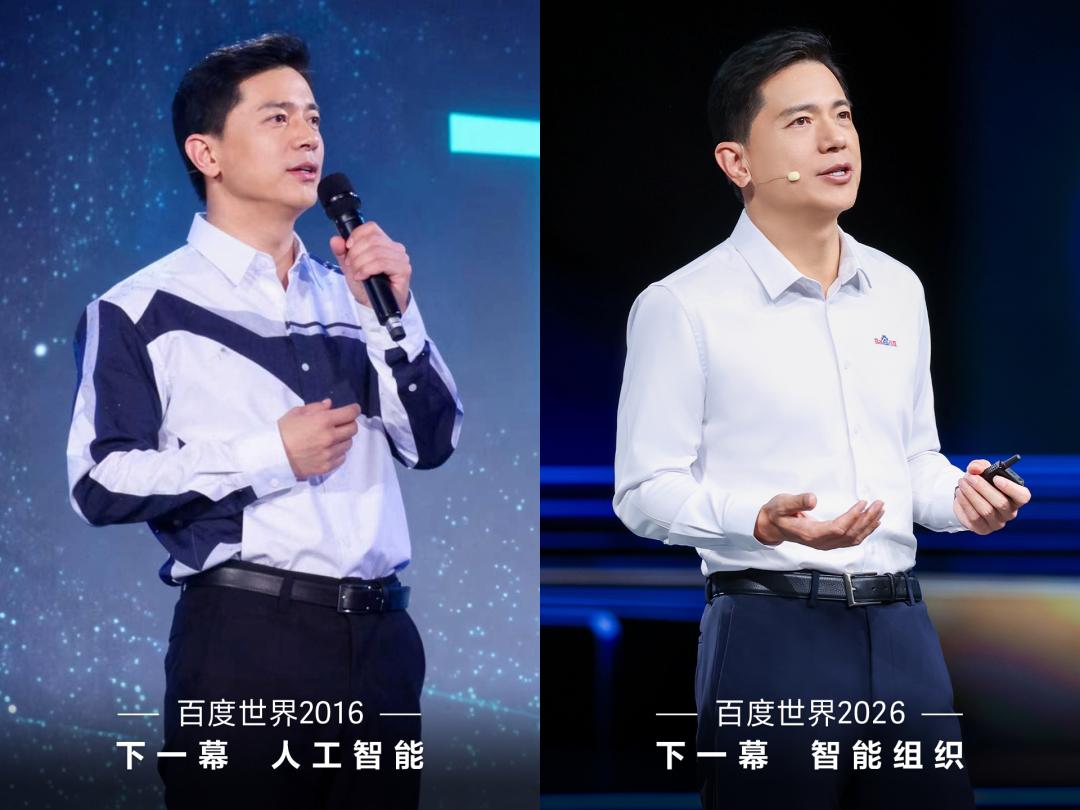
This time, he put forward a more organizationally meaningful metaphor: AI is the new electric motor, and the intelligent organization is the new factory building. If the motor is replaced but the factory building is not redesigned, no matter how advanced the machine is, it will be difficult to fully unleash productivity.
If the core task of the AI industry in the past decade was to build a sufficiently powerful "new electric motor", then next, how to build the "new factory building" has become a new problem that enterprises need to face.
01
Enterprise AI transformation is encountering an "efficiency paradox"
Since the industrial era, enterprises have gained large-scale production capacity relying on professional division of labor. Each person is responsible for part of the work, and collaboration is completed through departments and management processes. This system is very effective in the era when human labor plays the dominant role, but when AI begins to undertake more and more professional tasks, new friction may arise in the original work allocation mechanism.
The global AI survey released by McKinsey in August this year is very illustrative: 80% of respondents said AI has improved individual productivity, but only 37% said AI has a positive impact on the enterprise's EBIT.
A huge gap has emerged between individual efficiency improvement and organizational gain.
The reasoning is very simple: a task that originally took eight hours to complete may only take one hour for AI to finish, but if the subsequent approval, communication and delivery still take two days, the final efficiency improvement obtained by the enterprise is far less significant than that shown in a single work link.
In other words, if in a project, the actual "execution" time only accounts for 30%, and the remaining 70% is spent waiting, aligning information and going through procedures, even if the execution efficiency is raised to infinitely high, the overall cycle can only be shortened by 30%.
Therefore, in the AI era, when part of professional capabilities can be called at any time, how to reduce task handover, information loss and decision-making friction may be more important than simply improving the working speed of employees.
The deeper problem is that individual efficiency does not naturally equal organizational capability.
A salesperson can use AI to quickly study customers, analyze demands and formulate plans, but if these judgments still remain in the personal chat records, other salespeople cannot call them, and the enterprise cannot reuse them in the next business, then the value created by AI still largely stays with the individual.
The same is true for R&D, design, operation and other positions. An employee's proficiency in using AI to complete complex tasks does not mean that his experience has become a capability that the entire team can continuously use.
When enterprises spend money to introduce AI, they may first cultivate a group of "super employees", but not necessarily own a "super company" as a result.
For this reason, the criteria for enterprises to measure AI transformation cannot only look at how many times employees use tools, how many Tokens are consumed, or how much time is saved for a certain task. What is more worthy of attention is whether the work process has been truly shortened, whether personal experience can be transformed into team assets, and whether these changes can continuously improve business results.
In its 2026 Work Trend Index, Microsoft calls this phenomenon the "enterprise AI transformation paradox": employees are already using AI to improve efficiency, but business processes, collaboration methods and evaluation mechanisms remain in the past, and the organization has hardly changed. BCG put it more absolutely: companies should be redesigned for AI, rather than letting AI adapt to the original company.
Therefore, Li Yanhong's proposition of "new electric motor, new factory building" is not just a technical metaphor. For enterprises, the real productivity revolution cannot only rely on installing more advanced motors into the original factory buildings. The return on AI investment is also transforming from a technical capability issue to an organizational efficiency issue of enterprises.
02
From production to organization, the moat of enterprises is being rewritten
Microsoft found in its 2026 Work Trend Index that only 19% of respondents have both high personal AI capabilities and high levels of organizational support, and another 10% of respondents have strong personal AI capabilities, but their organizations fail to provide corresponding support.
This means that in the past, it was often enterprises that pushed employees to learn new technologies, but now it may be that employees have already moved ahead, and the company has instead become the party that needs to make up lessons.
However, for enterprises, what is really worthy of attention is no longer just how much work AI has done for people, but whether there is still room for redesign of the original working methods.
This is also a continuation of Li Yanhong's judgment on AI productivity.
From the 2025 Baidu World Conference emphasizing the internalization of AI as the native capability of enterprises, to the 2026 Create Conference proposing that humans and agents form mixed teams to promote organizational self-evolution, and then to the proposal of "intelligent organization" at this Baidu World Conference, the focus of his thinking is gradually deepening: from letting AI enter business, to letting humans and AI re-collaborate, and finally enabling the organization itself to have the ability to continue evolving.
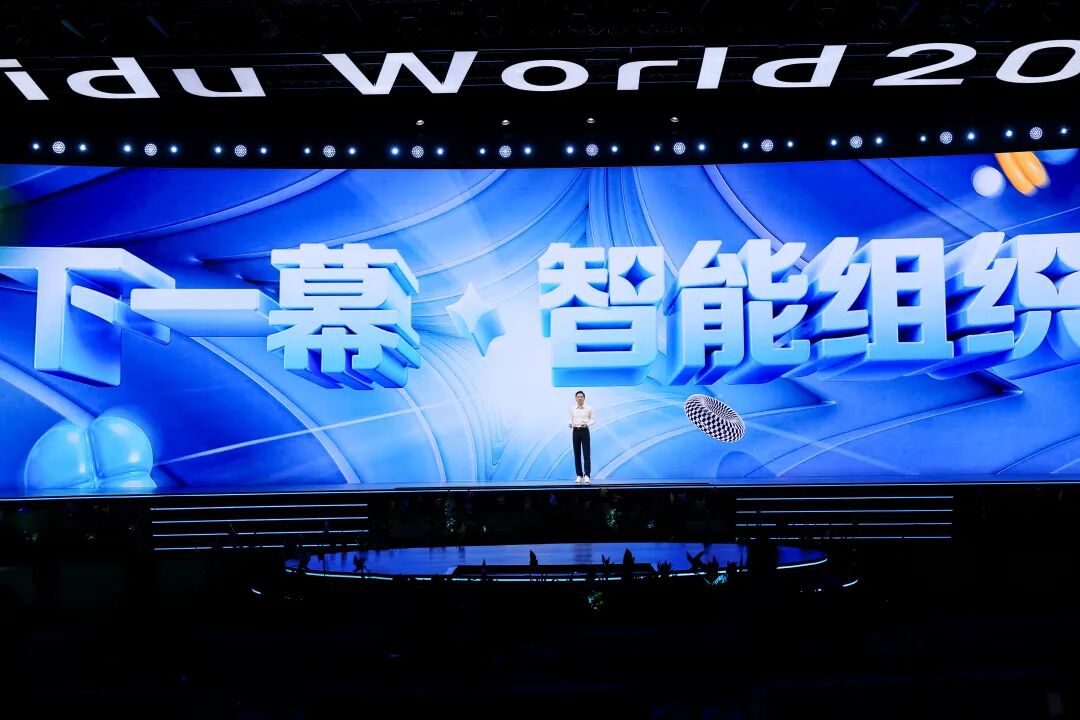
Behind this continuity is the judgment on the change of productivity bottlenecks. When technology is no longer the only restricting factor, enterprises need to re-examine their own organizational methods. And this reconstruction is taking place at three levels at the same time.
The first to be challenged is the traditional boundary of positions.
In the past, from the proposal of demands to the official launch of a product, it usually required multiple roles such as product managers, designers, engineers, and testers to complete the work in relay. After the participation of agents, part of the tasks can be reorganized around goals, and one employee can use different Agents to undertake part of cross-post tasks.
Of course, this does not mean that professional positions will disappear. Complex businesses still require professional judgment, and key decisions are inseparable from human responsibility. But the basic logic of the organization may change: in the past, positions were divided first, and then tasks were assigned; in the future, tasks can be clarified first, and then it is decided who and which agents will collaborate to complete them.
Positions are no longer the fixed boundary of capabilities, and tasks may become the starting point for the reorganization of organizational resources.
Secondly, the core assets of enterprises are shifting from "people who master knowledge" to "precipitatable organizational knowledge".
For a long time, many enterprises have a common trouble: the most valuable knowledge is often not in the systems and documents, but in the minds of a small number of senior employees. That is why when some core employees leave, what enterprises lose is often not just the labor force in a position, but also the business judgment and tacit knowledge accumulated over many years.
Large models have lowered the threshold for knowledge acquisition, but general knowledge is not equal to the competitiveness of enterprises themselves. What can truly form a barrier is the unique experience accumulated by enterprises in specific businesses, and the mechanism to transform these experiences into reusable capabilities.
For example, in the cooperation between China Southern Power Grid and Baidu Dazi, power fault analysis that used to rely heavily on the judgment of senior experts has been transformed into a professional analysis capability that can be called and verified through historical fault data, line information and expert experience.
What is more noteworthy about this practice is not just how much time a certain fault analysis can save, but that the experience that used to be in the hands of a few people now has the opportunity to become a capability that the entire organization can continuously use.
Finally, the growth mode of enterprises is changing from "phased reform" to "continuous evolution".
The capability upgrading of traditional enterprises often relies on recruitment, training, system adjustment and management reform. Whether the experience accumulated from a successful project can be used for reference by the next team largely depends on the active summary and transmission of people.
When AI enters the business execution process, the task itself has the opportunity to become a source of organizational learning. Li Yanhong's proposition of "Measurable + Looping = Continuous Evolution" this time is actually trying to establish such a mechanism: let task execution, effect evaluation and feedback optimization form a closed loop, so that organizational capabilities no longer fully rely on periodic management reforms, but continue to accumulate in daily operations.
Of course, this does not mean that as long as enterprises deploy enough Agents, they can automatically complete evolution. Redesigning how tasks flow, how knowledge is accumulated, and how results are fed back, so that every effective work can become the basis for the next work, is the key that distinguishes the "new factory building" from traditional enterprises.
In fact, these three levels of changes also correspond to the "three principles of organizational evolution" proposed by Li Yanhong this time: break the boundary of positions to release organizational vitality; precipitate tacit knowledge to build organizational intelligence; design closed-loop processes to promote organizational evolution. The key to these three principles is to enable enterprises to acquire a capability that was difficult to establish in the past: they can continuously accumulate and improve their working methods without relying on the personal performance of a certain employee.
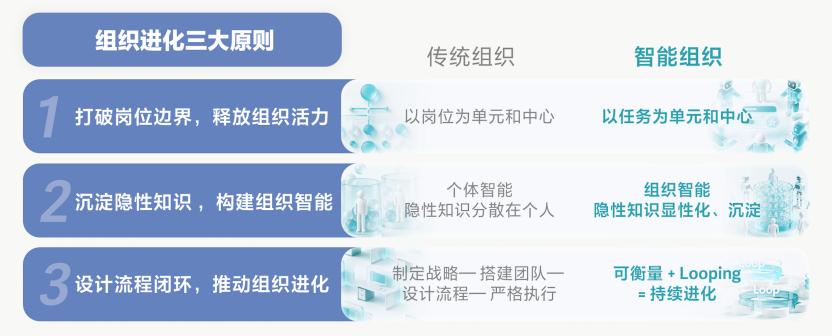
Frankly speaking, as model capabilities become more and more accessible, technology itself may not be able to continuously widen the gap between enterprises, but the business knowledge, organizational collaboration mechanisms accumulated by enterprises over a long period of time, and the ability to continuously improve themselves from operational feedback, are difficult to replicate directly by purchasing a set of AI tools. This also means that intelligent organization is not just a new concept related to efficiency, but may even become a new path for enterprises to build long-term competitive advantages.
03
The next evolution of companies already has samples
For most enterprises, intelligent organization still sounds like a very futuristic concept. But inside some enterprises, the organizational transformation centered on AI has begun to move from conception to practice.
The signals in overseas markets are already very clear.
Anthropic disclosed in September this year that the number of daily active R&D Agents in its internal system has reached 30,000; in October, it further announced that the time employees spend working with Agents has reached 6 times that of humans, and the job functions of some employees have begun to change. When Agents are deeply involved in the R&D process, the smallest operating unit of the organization is no longer an individual, but a "human + Agent team".
Microsoft has also taken relevant actions. CEO Nadella put forward the "dual capital theory", arguing that enterprises should accumulate both human capital and Token capital, and precipitate their own knowledge, experience and business processes into sustainable AI capabilities. Microsoft has internally realized the unified management of more than 500,000 Agents through Agent 365, and at the same time formed a cutting-edge deployment engineering team of about 6,000 people, which is directly embedded in customer enterprises to help them redesign business processes.
Back to China, Baidu itself is also an observation sample of this change.
In Baidu's Digital Human Innovation Business Department, the boundaries of traditional product, R&D, design and test positions are being broken again. The team promotes members to transform into Builders, and uses AI to complete a more complete task chain from demand understanding to product delivery.
According to the internal practice data disclosed by Baidu, only in the third quarter of 2026, the team achieved 564 iterations of production and R&D, precipitated 130 Skills and 729 organizational assets, the per capita throughput of production and R&D increased by 125.3%, and the delivery cycle was shortened by 28.8%.
A very representative detail is that a new graduate recruited through campus recruitment, with the help of AI, completed the demand delivery that used to require five roles to collaborate and take at least ten days in only one day.
This change has also begun to be reflected in Baidu's enterprise-oriented products.
For example, Baidu Yijing, which attracted much attention at this conference, is not only capable of generating highly realistic digital humans, its capabilities have extended to real-time interaction, short comic drama creation, and business scenarios from brand marketing to customer service. With the help of AI brain and multi-agent collaboration, the content production process that used to require multiple roles such as screenwriters, directors and producers to participate can now have more execution work undertaken by AI.
But interestingly, the closer technology gets to real humans, the more worthy of discussion the unique value of humans becomes.
In the clip of Baidu Yijing's digital human interviewing Li Yanhong, AI can already communicate with people with an image and expression way close to real people, but being able to simulate human expression does not mean being able to replace humans to make all judgments.
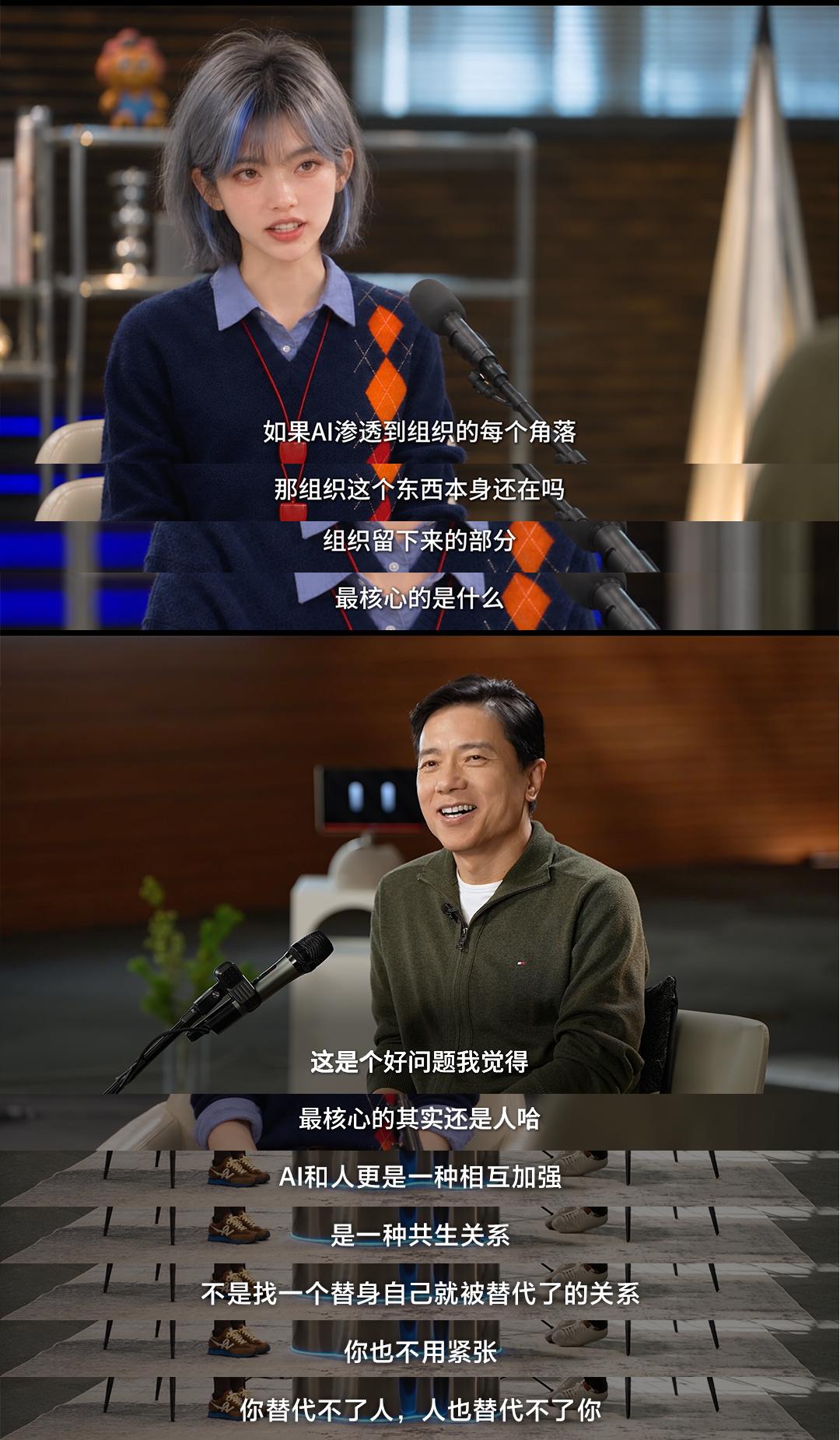
This precisely reveals the deeper change of intelligent organization: AI undertakes more and more execution work, and people can invest more energy in goal setting, creative decision-making, as well as emotional connection and trust building between people.
It is also worth noting that when enterprises begin to use AI on a large scale, the model capability is not only a matter of how strong it is, but also a matter of whether it can be called stably and credibly.
Baidu's newly launched Token Hub tries to enable enterprises to obtain credible model resources more conveniently through model service verification and quality monitoring. According to Baidu, after one month of trial operation, Token Hub has settled more than 100 supply resources, with the daily average call volume exceeding 50 million times and the daily average Token call volume exceeding