"Yuanbao Search" goes online, what pain points is Tencent eyeing?
A little-noticed domain name has quietly gone online.
On November 11, when you open so.qq.com or update QQ Browser to the latest version, you can switch to a new name in the search engine — Yuanbao Search.
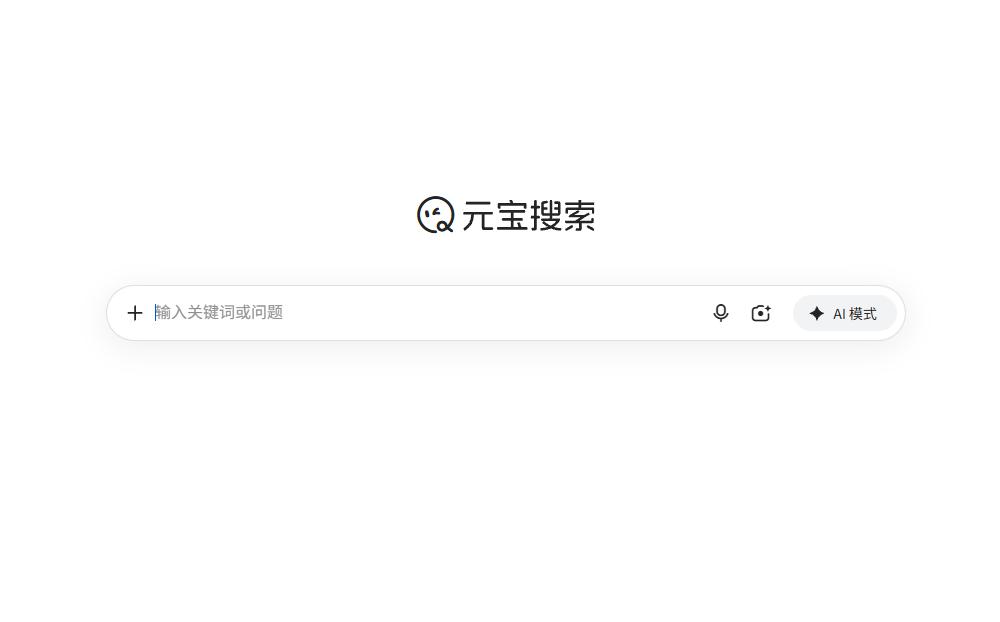
This is Tencent's reintroduction of general web search to C-end users following its earlier Soso and Sogou services, and the first time it has integrated large language models across the entire search chain. The 28-year-old company is taking on the tough challenge of search all over again.
Tencent is no newcomer to the search sector. In the years after its early Soso product, its search capabilities were mainly embedded in QQ Browser and WeChat Search. This time, Yuanbao Search retains the open entry for traditional web search, but its underlying logic has been completely revamped.
Traditional search relies on keyword matching, requiring users to sift through links one by one on their own. Yuanbao Search, by contrast, first understands the user's query, retrieves relevant evidence, sorts the content by credibility, and organizes it into a clear answer. An AI-generated summary is displayed at the top of the result page, and users can enter the AI mode to ask follow-up questions with full context retained. Each result is labeled with its source, official websites are marked with distinct identifiers, and the academic and popular science channel preserves full citations of original papers.
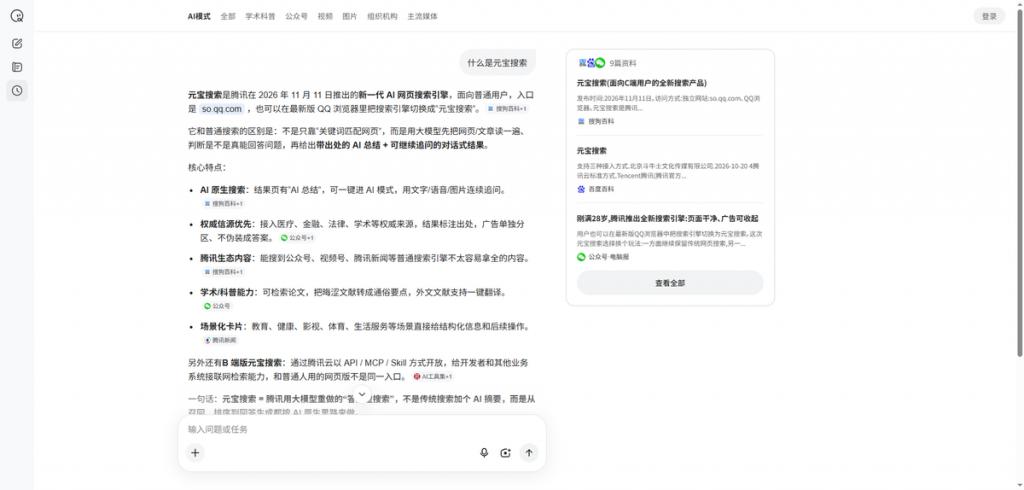
In terms of content, Yuanbao Search is connected to Tencent's in-house ecosystem content including WeChat Official Accounts, Channels, and Tencent News, and has set up dedicated channels for categories such as academic popular science, organizations and institutions, and mainstream media.
Li Ruizhang, Product Lead of the web version of Tencent Yuanbao Search, said: "We hope the content from Official Accounts and Channels can complement the web content across the internet, to enhance the overall experience of full-web search." In high-frequency scenarios such as automobiles, films and television, and healthcare, it uses structured cards to directly present key information and subsequent access entries.
Technically, Tencent disclosed that Yuanbao Search is built on a hundred-billion-level index, with a long-tail query recall rate of over 94%, millisecond-level search stability, and a 90% reduction in unit inference cost. This underlying architecture is not built on an ad-hoc basis: on October 20, Tencent just upgraded its search service for enterprises and developers, which is open to users via Tencent Cloud in forms of API, MCP, Skill and other methods, so that C-end and B-end users share the same system.
What Tencent is targeting are the long-standing pain points that have plagued traditional search for years.
Users have to dig through lists of links to find answers, commercial promotions are mixed with organic results, low-quality content occupies top positions, and professional information often has unclear sources that are hard to trace.
Li Ruizhang said at the briefing: "We can return to the search market as a reformer or challenger, to solve the many widely criticized pain points of existing search products."
He also admitted that Baidu, with its deeply rooted brand, is an object worthy of learning from. Yuanbao Search does not intend to completely subvert the traditional search form, as users expect not only answers, but also traceable sources, access to official websites, and downloadable materials. The team explicitly stated that it will not evolve in the direction of an AI assistant, but will focus on search itself.

Commercialization is an unavoidable question.
Yuanbao Search does not reject ads, but adheres to a restrained principle: ads are physically separated from organic results, with clear sponsor labels and an option to collapse them. Commercial content will not interfere with the ranking of organic results, and the accuracy of results will never be compromised for commercial gains.
At the initial stage after the product launch, the team pays more attention to user quality, namely "whether users will stay and be willing to use it again", and the scale of active users is not the core goal at this stage. The team also stated that it is confident to "build a user-friendly and responsible search product in the long run".
From the perspective of the entire search market, this business is still large enough in scale.
According to the report from the China Internet Network Information Center, as of December 2025, the number of search engine users in China reached 782 million, accounting for 69.5% of all internet users; as of the first half of 2026, the number of generative AI users exceeded 700 million, with a penetration rate of over 50%.
Demand remains strong, but the entry points are shifting.
Traditional search engines have successively added AI Q&A features, while AI assistants are tapping into real-time information through internet retrieval, making the boundary between the two increasingly blurred. On the traditional search track, Baidu still has an advantage in user brand perception; on the AI search track, Q&A products such as Doubao have already occupied user mindshare; within Tencent's own ecosystem, the positioning and synergy between QQ Browser, Sogou and Yuanbao Search also need to be straightened out.
Tencent holds no shortage of strong chips: the B-end verified retrieval technology, exclusive content ecosystem of Official Accounts and Channels, plus the basic traffic entry of QQ Browser.
Li Ruizhang left a sentence: "Delivering a better search experience is our long-term commitment. We will provide users with an anticipated new search product with high-quality content, excellent experience and continuous iteration."