With price wars on one hand and a race for breakthrough innovation on the other, can this alleviate the anxiety of homogeneous competition in the Agent industry?
The Double 11 shopping spree has spilled over into the AI video tool market.
LibTV kicked off its Double 11 carnival season, offering three major video models including Wan3.0, Kling4.0 and Minimax H3 with unlimited access for up to 30 days with zero points, stacked with multiple benefits such as instant discounts, extended duration and point giveaways. The personal annual package of Jimeng is as low as 45% of the original price, the team annual package is as low as 42% off, and the quarterly membership starts at 43% off. AniShort, a platform focused on film and television collaboration, offers as low as 23% off for first-time purchases, with a maximum instant discount of over 30,000 yuan.
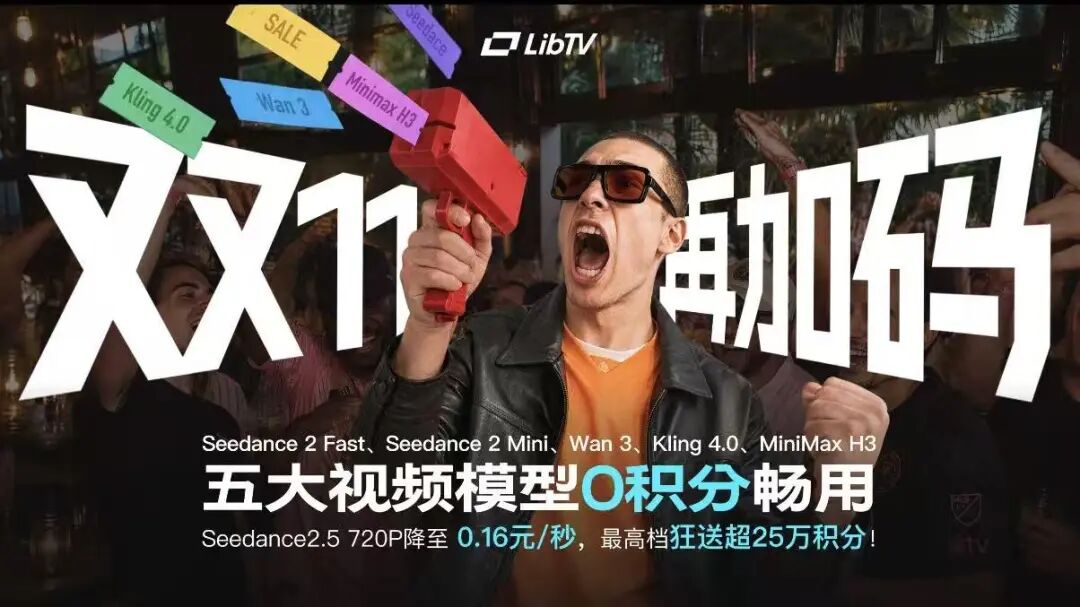
Double 11 is just a microcosm of the intensifying price war in the AI video tool market over the past six months. Back in March and April this year, we observed that with the technological leap of large video models and the rapid development of the AI short drama market, a large number of AI video tools from different backgrounds emerged in the market.
The current competition in the AI video tool market is clearly different from the stage in the first half of the year when the whole industry entered the market for trial operation: there is less room to make up for the limitations of large models, and it is difficult to win the market by simply stacking functions and piecing together workflows. The focus of competition has shifted from simple function supplementation to the deep water zone of creator ecosystem binding and business model exploration.
The computing power discount war has not stopped, and top super creators and hackathons have become new marketing battlefields for Agents. They point to the more difficult-to-quantify capabilities in the film and television industry above tools and processes, such as aesthetics and experience; they also point to tasks that cannot be fully completed by individual creators, such as commercialization and public communication. All efforts are ultimately aimed at answering one question: why do creators need Agents at a time when model capabilities are constantly evolving?
The price war shows no sign of stopping
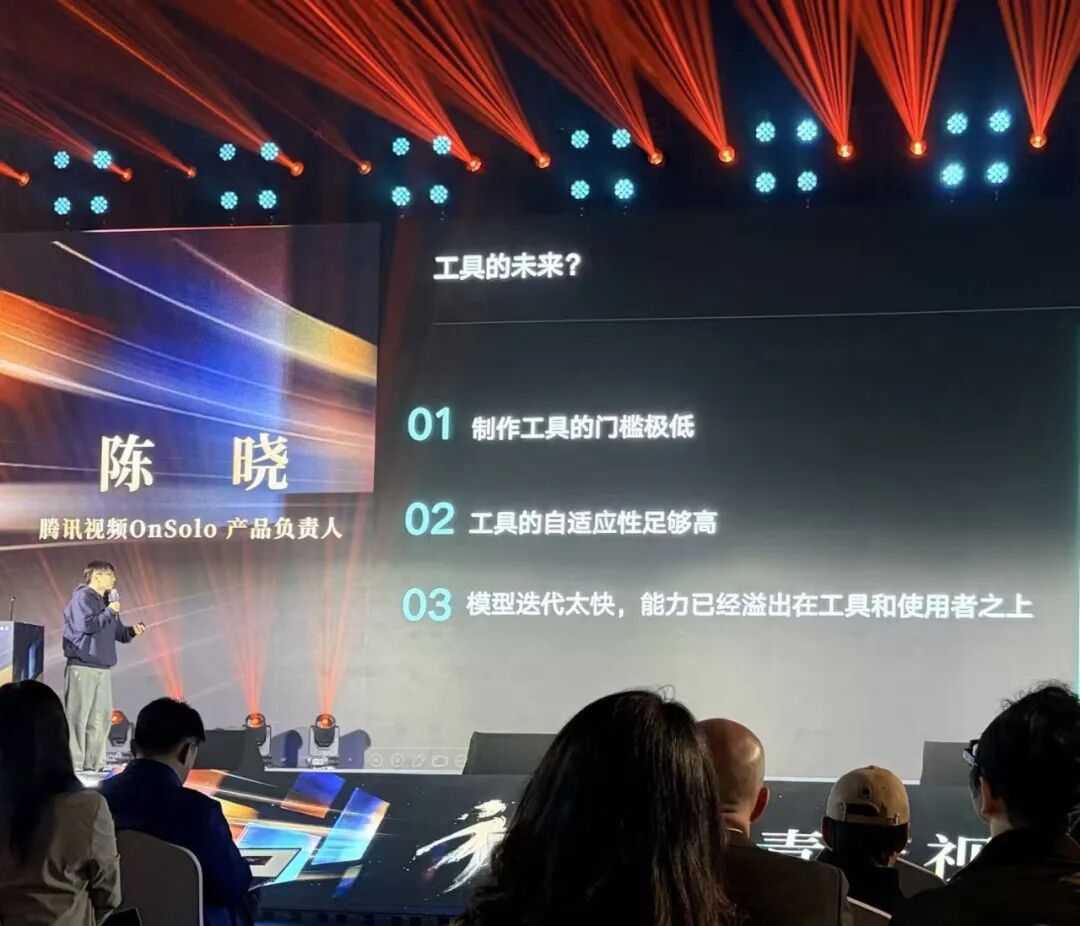
"The threshold for Agents is very low, and many production companies also have dedicated tools; tools themselves are not scarce, and tool iterations cannot widen the generation gap." At the just-concluded Original Heart Award Forum, this statement from Chen Xiao, product lead of Tencent Video OnSolo, perfectly reflects the current state of the video Agent ecosystem.
These Agents are basically on par in terms of speed of accessing new models, and mainstream functions such as infinite canvas, character/space consistency, 3D director console and spatial preview have become standard features, making it difficult for Agents to widen gaps at the functional level. Even if there is product innovation, other Agents can follow up in a very short time. As a result, the current Agents "all look similar, with severe homogenization".
Since the second half of this year, with the evolution of the capabilities of large video models themselves, the value of AI video tools has been further diluted, and competition has become increasingly fierce.
Many AI super creators once told "Thirty Generations" that in their view, there is little difference in which Agent they choose to use, "because the key to determining the quality of the work is the generation capability of the large model itself"; the core competitiveness of super creators often lies in their own prompt engineering capabilities and model usage methods, rather than the exclusive skills of a specific Agent.
At the same time, the mainstream customers of Agent tools are actually short comic drama companies that spend hundreds of thousands or millions of yuan per month. For comic drama companies that emphasize production capacity and efficiency, their core demand for Agents is still to reduce costs.
In this case, users lack loyalty in their choice of tools, and user stickiness is not as strong as expected; the price war remains the most core and sensitive competitive reality at present.
Many super creators will move between different platforms, prioritizing the consumption of discounted or free computing power quotas. Touch AI is an Agent for the comic drama track independently developed by Jellyfish Intelligence. Miao Zang, its founder, mentioned that even studios that are willing to pay them millions of yuan will first use up the 10% off computing power on other platforms in the first week of each month before switching back to mainstream tools, "they will not stop using other tools just because their assets are here".
Some industry practitioners even lamented to us that at present, most Agents are essentially just resellers of computing power. Some industry investors also admitted frankly that the current business model of most Agents focusing on B-end customers is not healthy.
Segmented creation and segmented tools
The AI content track is constantly segmenting and diversifying, giving rise to more vertical creation demands. Over the past period of time, Agents have also been continuously improving their adaptation capabilities for different creation scenarios.
"Thirty Generations" mentioned in the article "ByteDance is building a complete AI video tool ecosystem": In mid-August, ByteDance launched an internal test of the Agent "Comic Drama Creation Tool" for the comic drama industry; on September 21, its overseas brand BytePlus launched the short drama production Agent "Dramagic"; during the Douyin Creator Conference, Jianying released the AI video creation entry - Jianying Hub, which connects AI generation and editing. At present, ByteDance has built an AI video tool matrix in its ecosystem that includes Jimeng, Little Skylark, Comic Drama Creation Tool, Dramagic and Jianying Hub.
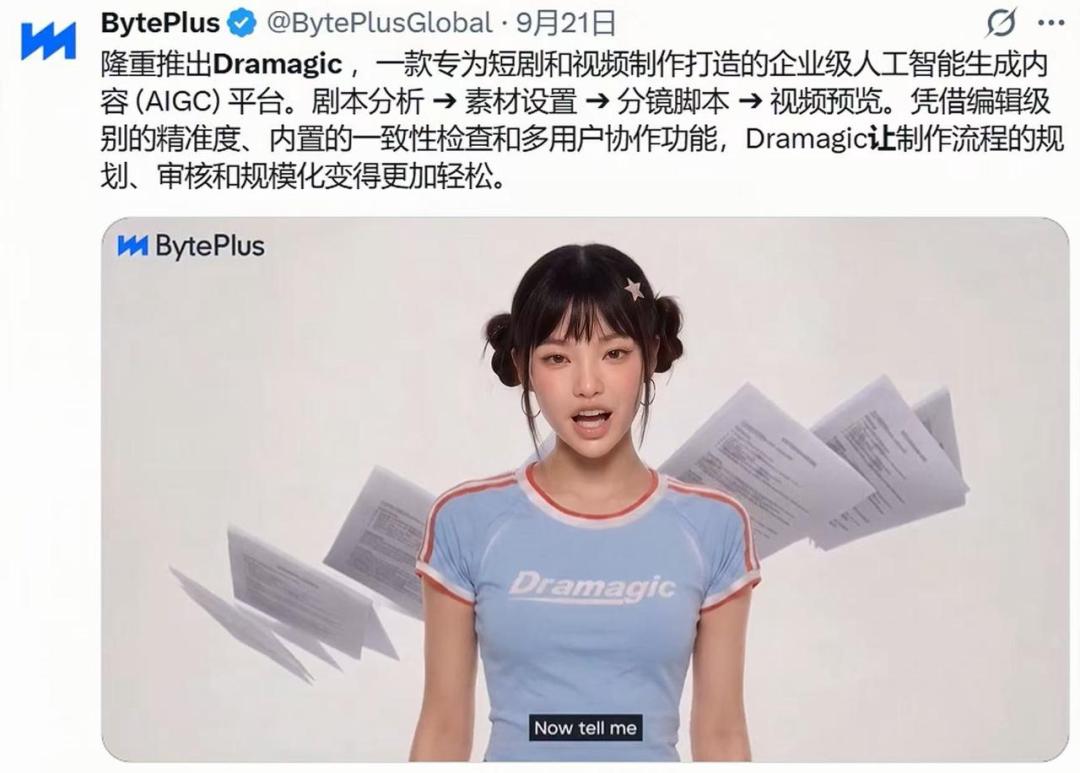
BytePlus launched Dramagic on September 21
With the largest number of creators and the most diverse demands, AI short drama tools were the first to start providing verticalized functions and even move towards independent features.
Wondershare Theater and Shanhai Xingchen NOVA AI are both vertical tools for short dramas. On October 26, Jimeng AI officially launched the short drama studio, which connects the entire short drama production chain from script creation, asset management, storyboard generation, video production to post-optimization with a unified project space, and also provides functions targeting the core pain points of comic dramas, such as intelligent script diagnosis, multi-style asset generation, and team engineering management.
OiiOii is exploring a differentiated competitive path by diving into different vertical industries and providing targeted AI content creation solutions. Zhou Shuang, its partner and COO, specially emphasized OiiOii's specific commercial capabilities and the team's idea of avoiding involution by refining and expanding multi-industry customer groups.
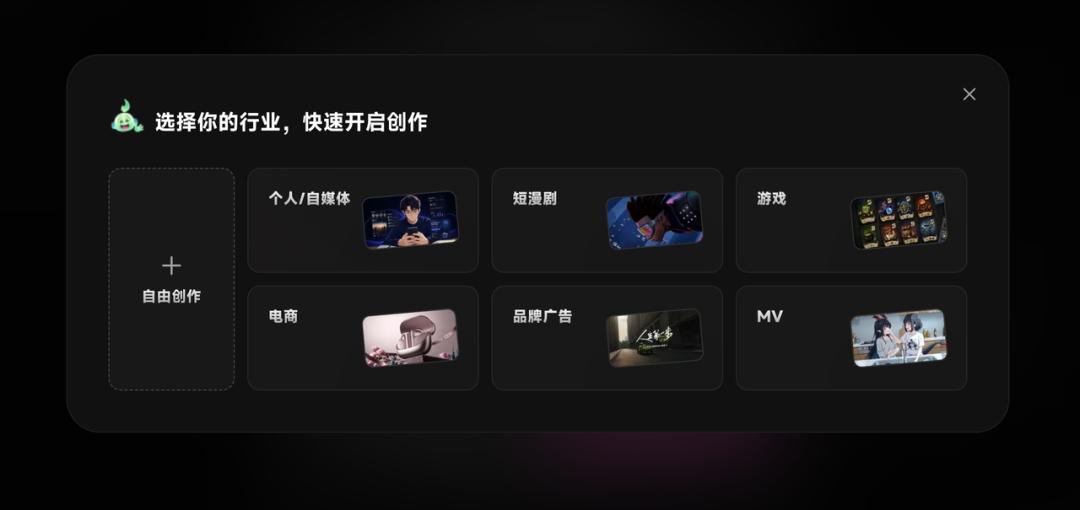
At present, OiiOii has launched professional functions for different creation scenarios for industries including AI self-media, short comic dramas, e-commerce, advertising and games. Zhou Shuang said: "The workflows and demands of people in different industries when using videos are completely different, and we will make distinctions in our products." Instead of applying a one-size-fits-all system to all scenarios, OiiOii splits into different tool chains according to the demands of C-end creators and B-end commercial customers.
For customers engaged in e-commerce and advertising traffic delivery, they usually only need 5 to 10 seconds of footage, and have strong demands for chasing hot trends and mass-producing content. In response to this, OiiOii provides a fast one-click material replacement function, which supports quickly replacing elements such as products, characters and scenarios on the basis of retaining the original video structure, special effects and transitions, turning popular ideas into mass-producible marketing materials.
For self-media bloggers who have demands for story creation, OiiOii provides functions such as AI 3D preview, actor library and style library, helping creators control the picture effect more accurately, and precipitate reusable IP assets to support serialized creation and subsequent commercialization.
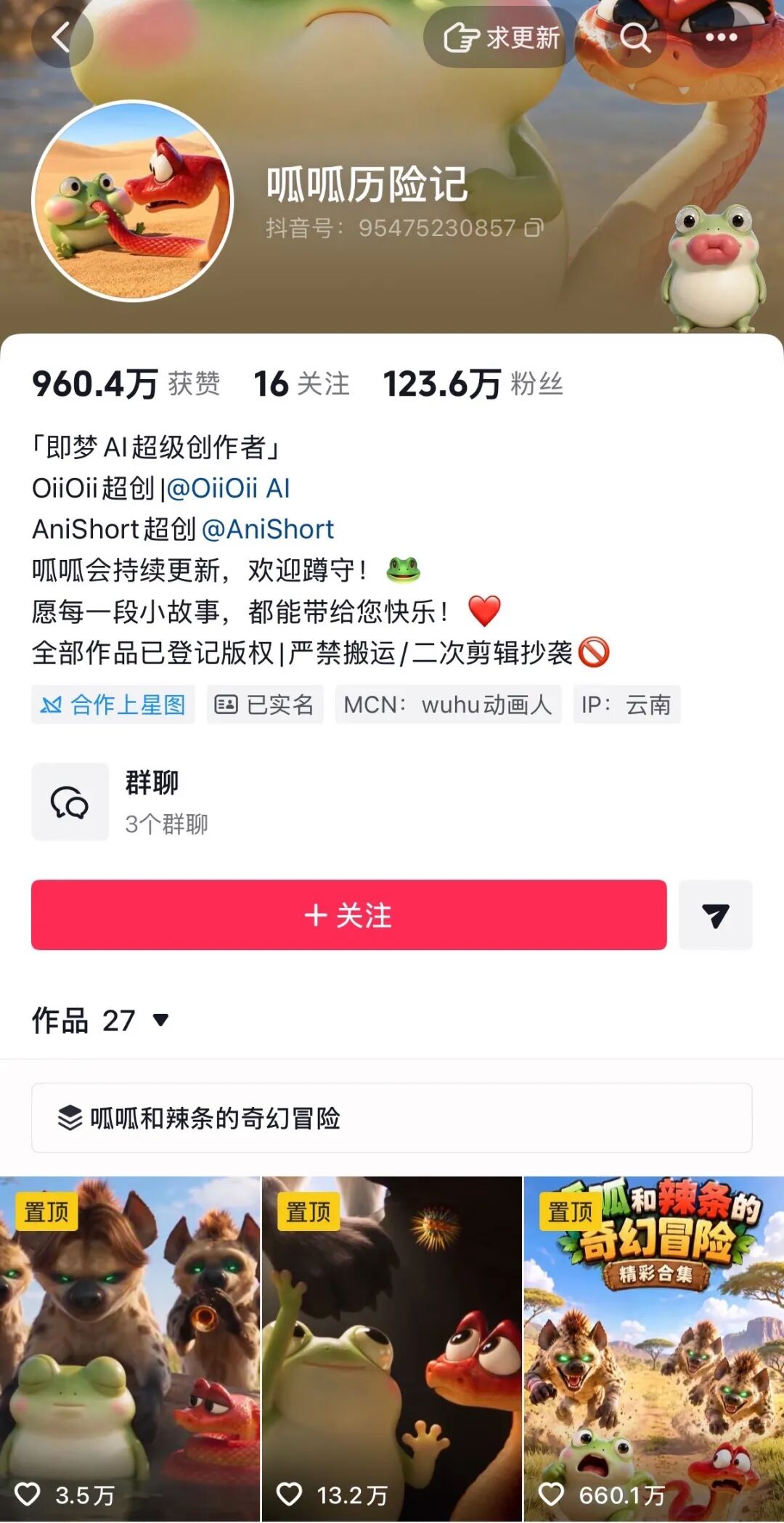
Guo Zixiang, the creator of the hit AI animation "The Adventures of Guagua" which has received more than 6.5 million likes across the network, once said in an interview that OiiOii integrates text, images and video models through an intelligent canvas, connects the tool chain, and completes the connection from text to video in a single workbench, so that he does not need to re-upload assets in different tools, cutting the production time of a single video in half.
OiiOii's one-click global release function also supports batch video production in 12 languages, which enables the same work to enter different markets efficiently, and greatly enhances the potential for global IP distribution and commercialization.
"The core lies in industry know-how and product capabilities, and an excellent product manager is extremely rare. The competition at the application level ultimately depends on whether the product is easy to use, whether the product capabilities are excellent, and whether the insight into users is accurate. If the product is easy enough to use, users will pay for it and stay." Zhou Shuang said.
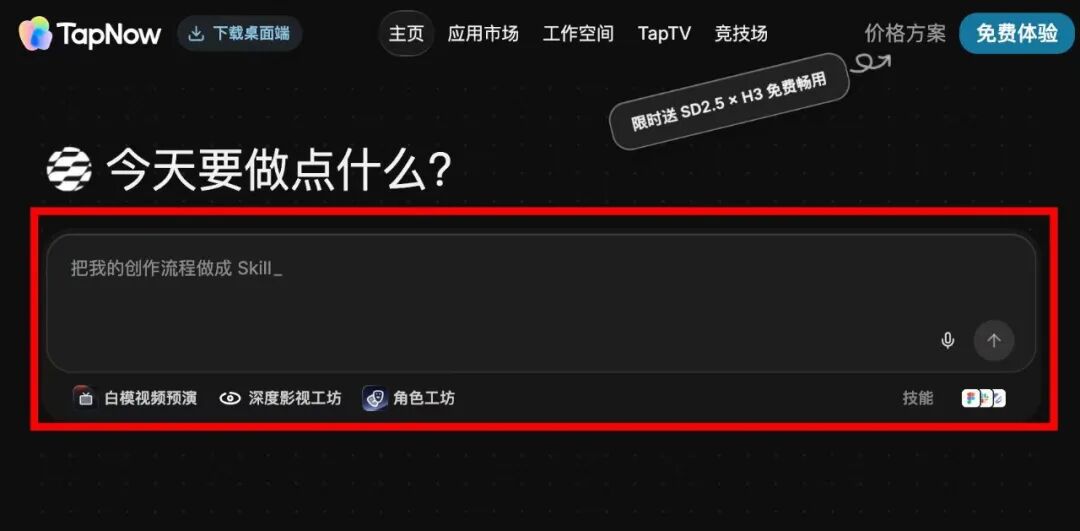
TapNow is a representative of AI video tools that has clearly taken the "AI film and television route" from the very beginning. Its homepage is very concise, with only a prompt input box, as well as three functions: white model video preview, in-depth film and television workshop, and character workshop, which is clearly positioned for professional film and television creators.
TapNow is also one of the most active tools in the industry to cooperate with various international film festivals and AI hackathons. In May 2026, TapNow participated as a technical supporter in the Golden Rooster Roundtable Forum of the China Film Association at the Cannes Film Festival, and screened two hit works "Paper Phone" and "Signboard" on site; TapNow was the only Chinese AI imaging tool on site. In September 2026, TapNow entered the core industry unit Venice Production Bridge of the 83rd Venice International Film Festival, and hosted the only official forum "AI×Cinema: The 10,000 Parallel Universes Initiative" focusing on AI imaging at this VPB. TapNow has also launched many AI hackathons, continuously strengthening its market image of "high taste, high aesthetics, serving professional creators".
The real barriers are invisible
"What Agents need now is not to make patchwork modifications on the basis of large models, but to improve efficiency and aesthetics on the premise of recognizing the extremely strong capabilities of large models." In the view of Gao Xiangchen, founder of AllFUNAI, an AI-native content creation platform, Agents standardize the aesthetics and experience workflows of top creators, "making Agents a person with higher aesthetics, assisting ordinary directors who originally only scored 70 points to produce works of 85 to 90 points".
He believes that the underlying content understanding and aesthetic differences of Agents are the undisclosed black technologies of every Agent. Why are the generated results different even with the same prompt? Why is the video texture of my Agent better? Why is the success rate of getting ideal generated results higher? This invisible threshold cannot be announced by the platform, cannot be quantified with values, and is difficult for users to understand.
Since the second half of the year, we can clearly feel the shift in the marketing focus of Agents, from functions to top creators and hit works. In the context of converging product functions, specific super creators and works can let the public intuitively perceive the capability upper limit of Agents more easily.
"Jumping Horizon", an AI video creation tool under Malt Media, launched public beta on August 25. In addition to highlighting specific functions such as 5,000 yuan per drama and one-click streaming, Ran Xu, vice president of Malt Media, said, "Jumping Horizon is a product precipitated from Malt's long-term accumulated content experience, production methods and digital assets, and its product demands come from actual content projects."
It is not difficult to see that its logic is also to bind Agents with Malt's industry capabilities, emphasizing the actual delivery capability and hit production capability of Agents.
Touch AI also transformed from a traditional generation tool to a creation decision-making tool platform in May and June this year. It added a decision matrix driven by comic drama market ranking data and hit knowledge base inside the tool, extending the reach of Agents from simple generation to content decision-making in the upstream and acceptance and delivery in the downstream.
Miao Zang believes that by the middle of this year, the comic drama market has passed its dividend period, and the foam has been squeezed out; at this time, Agents should not solve the problem of generating videos, but more practical problems in business scenarios. "Everyone thinks that carefully produced dramas with high costs end up with unsatisfactory data performance?" The real pain point of the industry has become: how to increase the hit rate? So Touch AI launched functions such as topic selection desk, AI review desk, emotion curve and highlight map, and operation desk.
The topic selection desk is driven by market ranking data, which can refine popular and feasible topic directions into three or four levels below basic themes such as fantasy and time travel. In the review desk and emotion curve, AI can scan the whole film, identify pleasure points, reversals and hooks, and draw the user emotion curve. By analyzing the "density" and "amplitude" of emotions, problems such as sparse rhythm or unattractive hooks can be found.
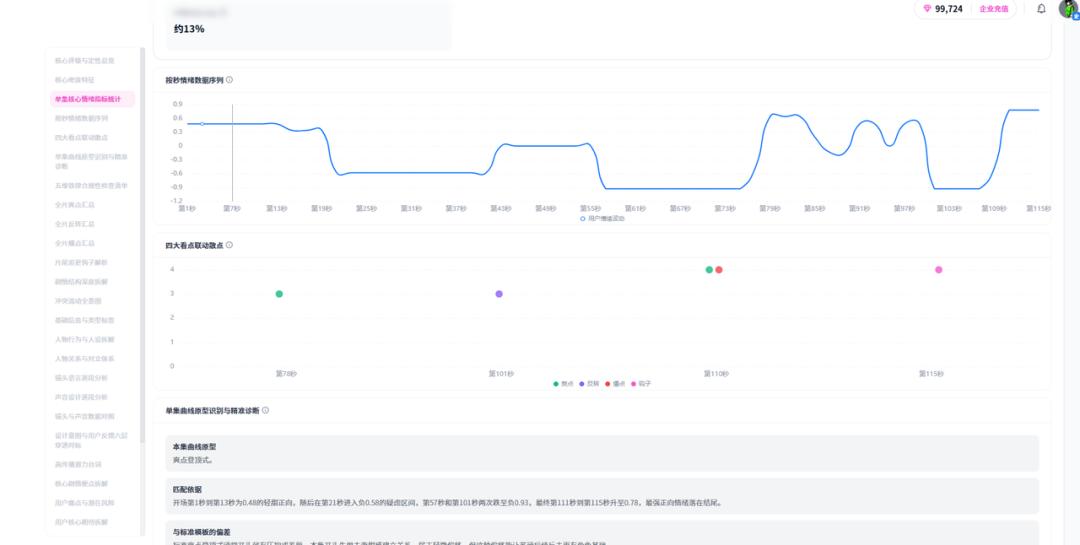
Touch AI's "second-level emotion data sequence" function breaks down work data into individual shots
Miao Zang's perception of assets has also changed accordingly. He believes that real assets are not just visual elements such as character models and scenes, but point to "data and experience libraries that can effectively assist creation decisions and determine the success or failure of business".
At present, Touch AI's decision-making capabilities are not only applied to creation scenarios, but also extended to investment transactions in the primary and secondary markets, where Agents can provide specific investment suggestions. Miao Zang mentioned that Touch AI has been connected to relevant trading scenarios of Chengdu Cultural Property Exchange.
The potential of communities and platforms begins to emerge
The expansion of the scale of the AI creation community and the UGC trend in its structure, and the bet of Agents on the creator ecosystem, are not only demonstrations of tool capabilities, but also layouts for the community and platform ecosystem.
Frequently held creator competitions are the most direct and effective means for platforms to attract users. Through support such as generous prize pools and industry resource exposure, platforms can quickly screen out creators with content potential, absorb them into the ecosystem, and