With an investment of tens of millions of yuan but a box office of only 1.8 million yuan, why did the first AI theatrical film flop at the box office?
On November 12, the 21st day of its theatrical release, *Sanxingdui: Future Past* still has 29 screenings arranged at 17 cinemas across Beijing. By noon, not a single ticket had been sold.
According to data from Maoyan, since its release, the film has grossed a total box office of 1.802 million yuan, and the latest single-day box office (November 11) was 3,900 yuan.
The first three days of the premiere, from October 23 to 25, were the period with the highest box office, with the single-day box office reaching 300,700 yuan, 464,400 yuan and 379,600 yuan respectively. The number of audiences per screening was also the highest, all exceeding 1 person. This situation then experienced a cliff-like decline.
If it were not for AI, it would have disappeared silently from the public view like many domestic films with poor box office performance. However, as the first domestic theatrical film produced with AI technology and obtained the public screening license from China Film Administration, its production method has brought it extraordinary industry attention.
The film is about 100 minutes long, set against the background of the ancient Shu civilization of Sanxingdui and the future world, with iconic cultural relics such as the Bronze Divine Tree, the Great Bronze Standing Figure, and the Bronze Vertical Eye Mask running through it. In the story setting, future humans rely too much on algorithms and fall into a global crisis, and the clues to solve the dilemma are hidden in the ancient Shu inscriptions 3,000 years ago.

Screenshot of the trailer of *Sanxingdui: Future Past* (Source: Internet)
01
According to Xinhua News Agency, this film is produced by Boyue Xingji Lantu (Chengdu) Film Technology Co., Ltd. and Boyue Xingji Lantu (Shanghai) Film Technology Co., Ltd. under Bona Film Group, and Shengshu Technology Vidu provides AI technical support.
Among them, Shengshu Technology was established in March 2023, and initially focused on multimodal generation models such as images, 3D and videos. The company once released the Vidu video generation model jointly developed with Tsinghua University at the 2024 Zhongguancun Forum, demonstrating the 16-second, 1080P video generation capability, which was once quite representative in the industry.
In terms of division of labor, the main creative team of this film clearly stated in an interview that AI undertakes generation and execution work, and all creative conception and creative judgment are completed by the human creative team.
In addition, a reporter from Jiemian News learned from people close to the project that Shengshu Technology, as the partner of the video generation model this time, on the one hand provides computing power support for film creation, on the other hand focuses on solving underlying technical problems such as enabling AI films to be screened on large screens, and does not interfere with the creative decision-making of the film in the process.
For this set of cooperation processes, from the feedback point of view, the audience did not fully accept it.
On the Douban homepage of this film, there are a large number of one-star and two-star reviews in the short comment section. The criticism mainly points to three levels: in terms of aesthetics, some audiences say that the picture lacks cinematic texture and does not reflect the art of light and shadow; at the technical level, AI facial expressions are distorted, and the dubbing does not fit the picture well; in terms of character shaping and narrative, it is considered that the character lines have a strong AI flavor, the plot logic and narrative rhythm are chaotic, and the story cannot support the grand setting.
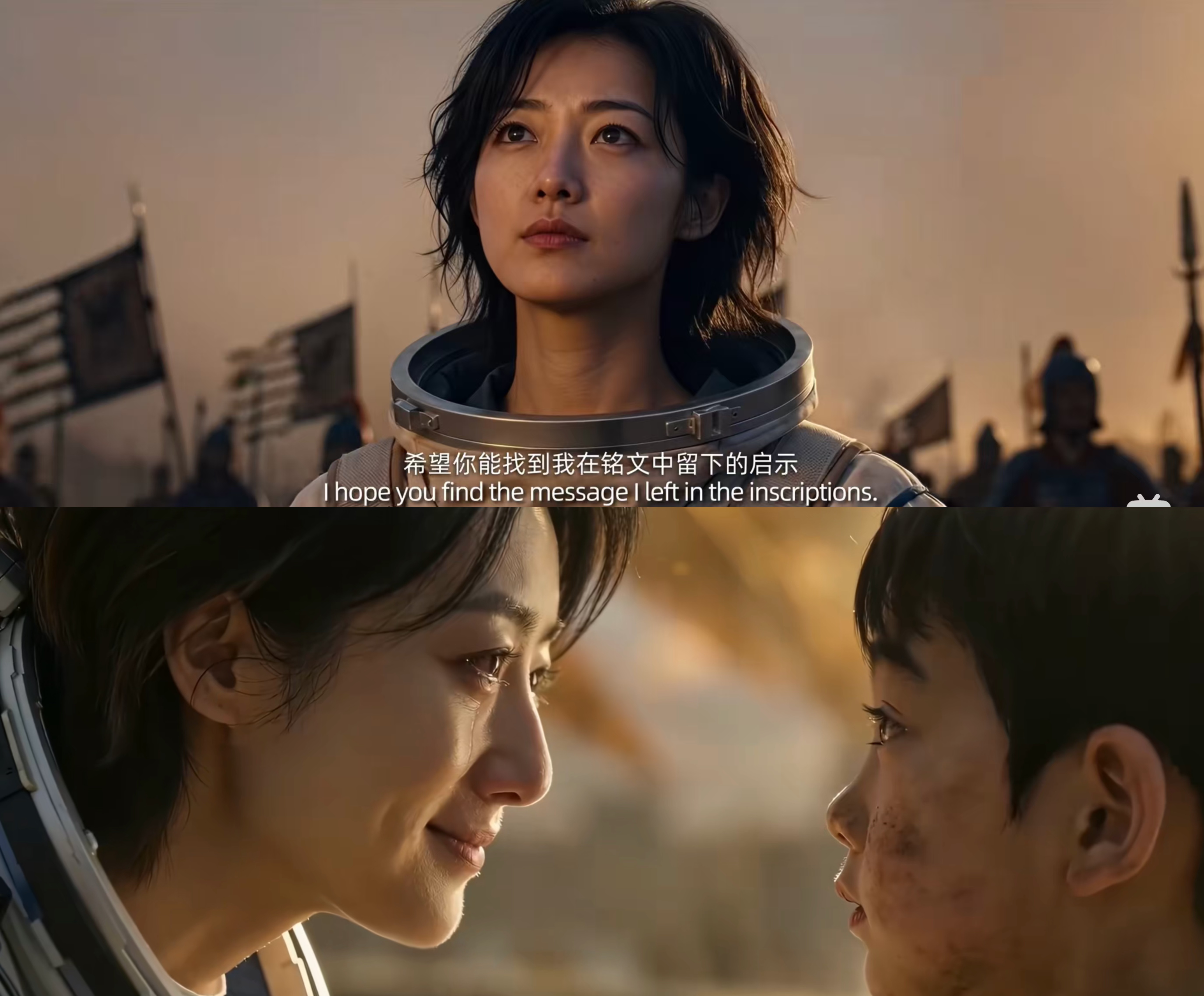
Screenshot of the trailer of *Sanxingdui: Future Past* (Source: Internet)
02
Most of the more positive evaluations recognize the producer's attempt at new technology and the creativity of combining ancient Shu civilization with science fiction.
These opinions correspond to different levels: problems such as distorted expressions and mismatched sound and picture are more related to the generation ability of the model and the production process of the team; character setting, lines and plot logic still fall within the scope of responsibility of the creative team.
Apart from the performance of the results, the greater concern of the AI film production method lies in revenue and cost.
Quji Xiaojiang, the producer, previously disclosed to the media that the production cost of this film is at the level of tens of millions of yuan. If the same theme follows the traditional live-action shooting path, the cost may reach 800 million to 900 million yuan. Its team is nearly 100 people, and it took two years to polish before and after, generating a total of more than 1.2 million base maps, undergoing hundreds of revisions, of which 5 major revisions were remade.
Jiang Defu, Chief Administrative Officer of Bona Film Group, once said in an interview with East-West Entertainment that AI saves part of the shooting cost of actors and shortens the rendering time of some shots and large scenes, but the manpower and time cost of the team have not been reduced, and technology iteration also continues to generate costs.
The current cumulative box office of 1.8 million yuan still has a significant gap from the production cost disclosed by the main creators, and the box office revenue also needs to be shared with cinemas and other links. The existing domestic theater revenue is obviously not enough to cover the publicly disclosed production investment.
However, Jiang Defu also said that Bona did not take the box office as the primary goal this time, but wanted to use AI technology to explore a feasible path to see if it can provide new solutions for the industry.
At this point, this first domestic AI theatrical film actually reflects the core demands of two industries under the AIGC trend.
On the one hand, the film and television industry continues to pursue cost reduction and efficiency improvement. After the explosive growth in the AI short drama market, this transformation extends from short dramas to theatrical films and long dramas; on the other hand, when video models are verified in the short drama market, video model manufacturers represented by Shengshu Technology are accelerating the attempt of more commercial possibilities, especially targeting the medium and long drama and theatrical film markets that have not yet formed a head pattern.
This trend is already obvious in the film industry. The Golden Rooster and Hundred Flowers Film Festival held on November 10 set up the AI unit of the Golden Rooster Film for the first time, focusing on screening 20 works that adopt creative forms such as AI animation, integration of AI and live-action shooting. From creators, model manufacturers to film and television production companies, all parties seem to be stepping up efforts to promote this process.
From the perspective of model manufacturers, this may be one of their few opportunities.
Startups have found it difficult to gain more share in the AI short drama market. A person from a video Agent manufacturer told a reporter from Jiemian News that his platform is connected to video models such as Seedance, MiniMax H3 and Keling at the same time, and Seedance accounts for the main part of the platform's call volume. He revealed that among the two leading models, the call volume ratio of Seedance and MiniMax H3 is close to 7:3.
Although there are limited mature application cases for medium and long dramas and theatrical films, they also leave more room for competition. The aforementioned respondent believes that film parties will choose model manufacturer partners according to the film style and production cost, and startups can still compete through multiple directions such as cooperation degree, cost performance and network resources.
"Because currently only the revenue model of short dramas has been proven, medium and long dramas and theatrical films definitely need to find the first batch of pioneers." he said.
This article is from "Jiemian News", author: Wu Yangyu, editor: Wen Shuqi, published by 36Kr with authorization.