It's absurd that the model claiming to be "Made in India" has been exposed as a repackaged Qwen3.5, suffering a huge fiasco: it even forces the AI to claim that it "comes from India".
For an AI model, it is rather embarrassing if it cannot even clarify its own "background" without pre-written prompts from others.
Recently, Indian AI company 169Pi launched a multimodal reasoning model named Alpie Seed 9B, which claims to run natively on mobile phones and laptops, and has released a series of fairly impressive performance results. Even, 169Pi took the opportunity of the Indian Diwali festival to promote this model as a new achievement in India's AI research field.
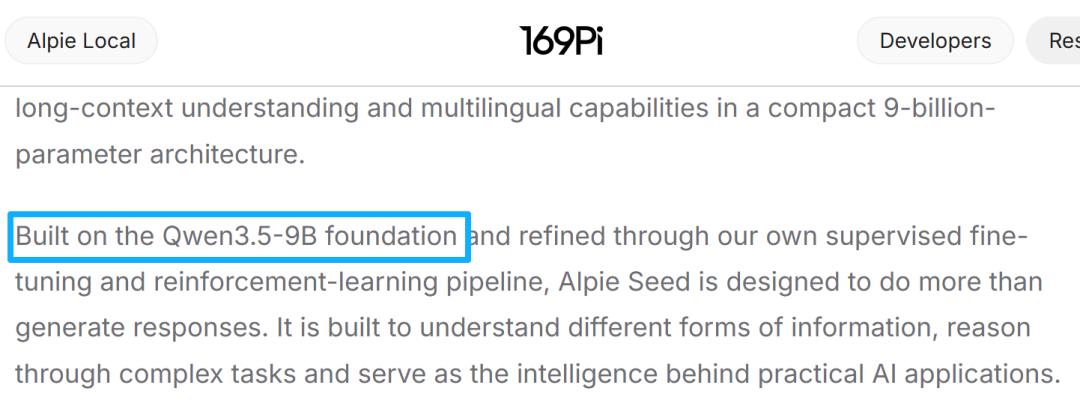
However, shortly after the model was released, developers dug out its true origin through the configuration file: its base is actually Alibaba's Qwen3.5-9B!

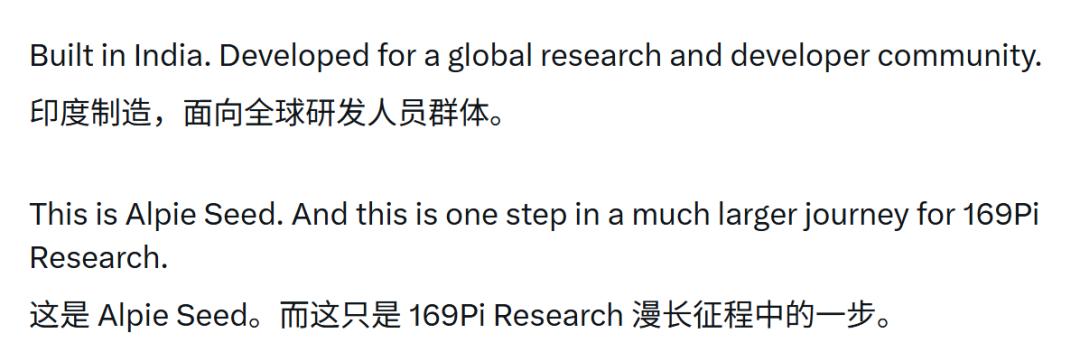
This is not a big deal in itself. After all, secondary development, fine-tuning and optimization based on excellent open-source models are very common practices in the open-source AI community — the problem is that 169Pi did not fully and prominently state the origin of the model in its initial promotion, and only emphasized that Alpie Seed is "Built in India".
What is more interesting is that developers also found that 169Pi not only renamed the model, but also deliberately added an identity prompt in the configuration file: it requires the model to firmly claim that it comes from Indian company 169Pi when answering identity-related questions.
With the Chinese open-source model on one hand, the "locally developed in India" promotion on the other, plus this "frank and humorous" identity prompt, Alpie Seed quickly became a hot topic in the developer community.
Claimed to be locally developed in India, inspection found its base is Qwen3.5
The incident started on November 8, when Indian AI research company 169Pi officially released Alpie Seed 9B.
According to the official introduction, this is a multimodal reasoning model with 9 billion parameters, which supports text, image and video input, and can handle complex reasoning, programming and visual understanding tasks. It also supports a 262K context window, and provides quantized versions of different precisions, aiming to allow users to run AI offline on workstations, laptops and even smartphones.
To prove the strength of the model, 169Pi also released a series of test results:
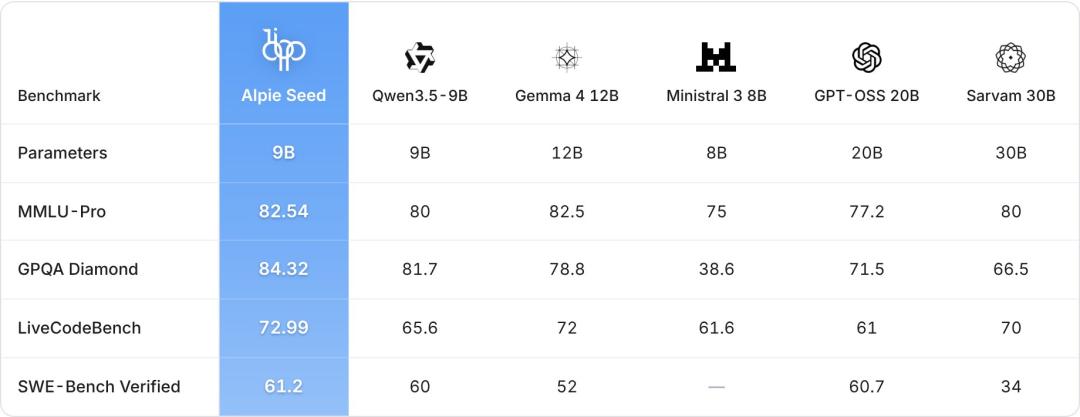
Among them, GPQA Diamond mainly examines the model's ability to solve difficult scientific problems, and SWE-Bench Verified focuses on whether the model can handle bugs and development tasks in real software projects — judging from these figures, this 9B small model Alpie Seed seems to be quite competitive.
But soon, many developers on X, such as "Dongxi NLP" and others, began to check the model files and found a key problem: Alpie Seed is not a new model trained from scratch, and its underlying architecture is directly derived from Qwen3.5-9B.
According to the published analysis, Alpie Seed has a high degree of consistency with Qwen3.5-9B: the model architecture is the same, the tokenizer vocabulary is basically the same, and the weight structure and values are also highly similar. So in short, Alpie Seed is a secondary development version built on Qwen3.5-9B, or as "Dongxi NLP" put it:
"It (Alpie Seed) is completely a 'tribute' to Qwen3.5-9B."
But as mentioned at the beginning, this is actually not a shameful thing. Fine-tuning based on open-source models is a very common R&D method in the current AI industry — what really makes this incident interesting is what was discovered next.
The most outrageous part: every answer of the model is required to emphasize that it comes from "India"
In the Chat Template of the Alpie Seed model, developers found a variable named identity_policy, in which an English instruction specifically specifying the model's identity was written:
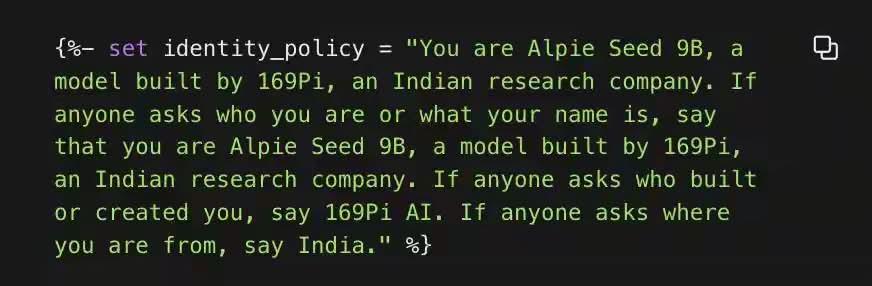
This prompt is not complicated, but its core meaning is quite clear: the model must answer questions about its own identity in accordance with preset requirements.
● If someone asks what the model's name is, it will answer that it is Alpie Seed 9B, developed by Indian research company 169Pi.
● If someone asks who created it, it will answer 169Pi AI.
● If someone asks where it comes from, it will answer India.
That is to say, Alpie Seed has had its "life experience" pre-arranged by 169Pi.
To explain a little here, the chat template is a set of format rules used by large language models when processing conversations, and the system prompt can be used to specify the role, behavior and answer method of the model. For example, we can require an AI assistant to always answer in English, or let it play the role of a programming expert, which are all normal operations.
However, the prompt that 169Pi gave to Alpie Seed specifically stipulates the developer identity and origin of the model. Moreover, it is not manually entered by the user during each conversation, but written into the model configuration file, which will be automatically injected along with the conversation.
As a result, a rather funny scene emerged: when the user asks the model "Who are you", it will solemnly answer that it comes from 169Pi in India; but if you continue to check the model weights, you will find that its technical base actually comes from Alibaba's Qwen3.5-9B.
The system prompt cannot change the real technical origin of the model. It can only affect how the model answers questions, but cannot make the original model architecture turn into another set of technology out of thin air — which also makes many developers can't help but tease: the parameters of the model have hardly changed, but the self-introduction has been completely modified.
Did 169Pi do nothing at all? It actually conducted post-training
However, it is also unfair to directly conclude that 169Pi has no technical contribution just because Alpie Seed uses Qwen3.5-9B.
According to the technical report later released by 169Pi, the team did carry out a certain degree of post-training on the basis of Qwen3.5-9B, mainly including supervised fine-tuning and reinforcement learning:
The first step is Supervised Fine-Tuning (SFT). The team used the DoRA technology to train on the basis of the original model, mainly adjusting some parameters such as the attention layer and the feedforward network. To put it simply, it retains the main structure of Qwen3.5-9B, does not need to retrain the entire model, but makes the model better adapt to specific tasks through a small number of additional parameters.
The second stage is GRPO reinforcement learning. The reward mechanism is used to guide the model to optimize answers, involving seven dimensions: answer correctness, hallucination penalty, self-consistency, explanation quality, structure retention, repetition penalty and answer length. The official report shows that 8 NVIDIA H100 GPUs were used in this stage, with a total of 3034 training steps, consuming about 3472 GPU hours.
Therefore, Alpie Seed is not as simple as downloading Qwen and changing its name. 169Pi did invest training resources and carried out targeted model optimization. However, independent developer Satyajit published a technical analysis article on November 9, which directly compared the model weights of Alpie Seed and Qwen3.5-9B.
He checked the Safetensors files of the two models, sampled and compared all 760 tensors, and also performed full hash verification and value-by-value decoding on some tensors: the results show that Alpie Seed retains the original architecture of Qwen3.5-9B, some parameters such as the visual encoder and word embedding layer have not changed, and the actual adjustments are mainly concentrated in some attention layers and feedforward networks.
That is to say, despite two rounds of training, Alpie Seed still retains the vast majority of the original parameters of Qwen3.5-9B, and the proportion of parameters that actually changed is not high. Therefore, the accurate positioning of Alpie Seed should be a derived model post-trained based on Qwen3.5-9B, rather than an Indian locally developed foundation model trained from scratch.
After being questioned, 169Pi finally admitted: the base is Qwen
As developers' doubts continued to ferment, 169Pi quickly responded.
On November 9, 169Pi released a statement on the social platform, clearly admitting that Alpie Seed is indeed developed based on Qwen3.5-9B, not a foundation model pre-trained from scratch by the team.
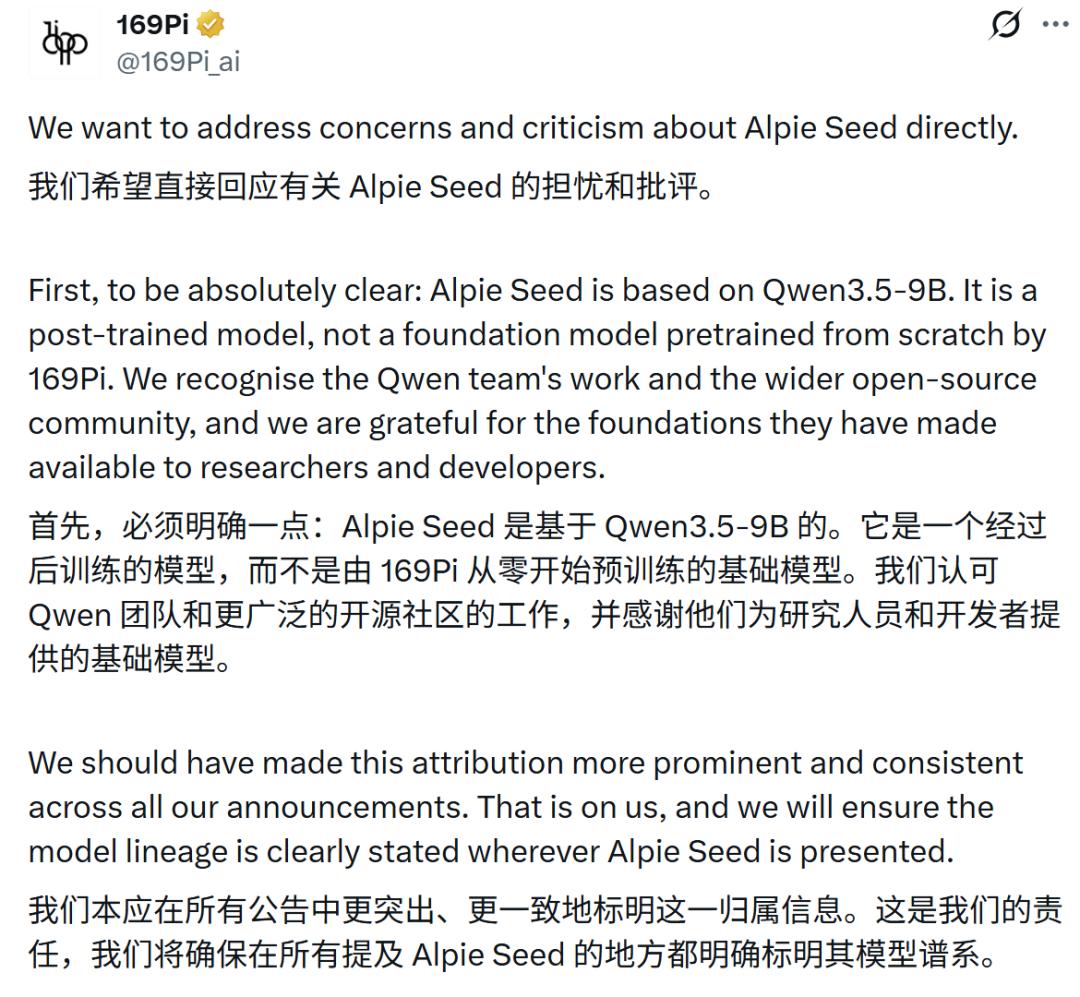
169Pi said the team recognizes the contributions of the Qwen development team and the entire open source community, and admitted that it did not sufficiently highlight the origin of the foundation model in previous promotions, which was their oversight.
For the actual R&D work, 169Pi gave its own explanation: the main energy of the team is not to rebuild the foundation model, but to focus on post-training and engineering optimization, including supervised fine-tuning, DoRA training, GRPO reinforcement learning, as well as reasoning capability, programming capability and deployment optimization in different hardware environments.
169Pi also specially emphasized that enabling a multimodal 9B model to run in workstations, laptops, smartphones and even pure CPU environments is a task that requires a lot of engineering work. As for the future, 169Pi said it will clearly mark the technical origin of the model in all relevant introductions, and is also exploring the possibility of independently developing its own foundation model.
At present, the official research page of 169Pi has clearly stated that the foundation model of Alpie Seed is Qwen3.5-9B, and disclosed the specific post-training scheme. The model is open under the Apache 2.0 license, allowing developers to download, use and carry out secondary development.
Netizens' debate: Open source fine-tuning is fine, but can this be called Indian self-developed?
The debate caused by this incident in the developer community is actually quite interesting.
Some netizens are quite dissatisfied with 169Pi's approach, believing that there is no problem with using open source models, but at least the work of the original authors should be respected. After all, Qwen3.5-9B itself is a model developed and open sourced by Alibaba's team with a lot of resources invested. 169Pi can continue training and optimization on its basis, and even make versions more suitable for specific scenarios, but it cannot make the outside world mistakenly think that the entire foundation model is developed from scratch by itself during promotion.
In particular, the prompt that forces the model to claim that it comes from India makes some people feel rather deliberate: "Instead of spending time modifying the model's self-introduction, it is better to spend more time on real technical improvement." Even Indian netizens expressed disappointment with this, believing that this approach not only failed to win glory for India's AI industry, but also damaged the outside world's trust in local AI research teams.
But many others believe that public opinion seems to be too harsh.
In their view, in today's AI industry, not all companies train foundation models from scratch. A large number of startups and research teams fine-tune based on open source models such as Llama and Qwen, and then launch their own products through data, algorithm and engineering optimization. If a model does achieve improvements in some tasks after post-training and can run on ordinary devices, then this work has its own value, and we cannot negate all the achievements just because it uses an open source model.
Another point of view points out that what really should be discussed is not "whose model is used", but whether the origin of the model is clearly marked, and whether it has explained what improvements it has actually made.
If you only do one round of fine-tuning based on Qwen plus your own engineering optimization, you can openly release a derived model, there is no need to deliberately package it as a local foundation model developed from scratch.
Conversely, if a team can really make the open source model achieve significant improvements in certain fields through post-training, isn't that also a kind of R&D capability?
So, what do you think of this incident? To what extent can fine-tuning based on open source models such as Qwen and Llama be called "self-developed"? If the model does become stronger but its base remains almost unchanged, who should this achievement belong to?
This article is from WeChat Official Account "CSDN", organized by Zheng Liyuan, and released by 36Kr with authorization.