Li Na has signed with Juewei, while Xu Fei is rumored to have signed with Zhou Hei Ya: Is the braised food track also about to usher in a drama-filled, fiercely competitive era full of deep-seated old grudges?
Recently, Juewei and Zhou Hei Ya each hit the hot search list once, and neither incident had anything to do with braised food.
With the hit of Mango TV variety show *See You Later, Friend*, an old comment from Xu Fei and Li Na 20 years ago unexpectedly made Juewei's duck tongue go viral. The brand responded quickly, leading to a shortage of duck tongue across its outlets. On the other side, rumors spread that Xu Fei would sign a cooperation deal with Zhou Hei Ya, but no official announcement has been made so far.
While netizens are hotly commenting "I trapped myself in a self-made prison, Li Na!", they have also included the two braised food brands in the "side story of business war": "The one standing on my absolute opposite side will be you", "Trading economic loss for a business contract".
But meme is just meme, and projection is just projection. There is no personal old grudge between the two companies, but a different kind of "entangled fate of competition and shared origin": they have competed head-to-head on the same braised food track for more than ten years, one chose to develop franchised stores to the left, the other chose to launch shelf-stable products to the right; one focuses on operating offline stores, the other focuses on placing products on retail shelves. The so-called "entangled fate" refers to the opposite development paths that bring respective costs, as well as their shared origin and mutual reference as peers in the same industry.
What netizens are chasing is the old grudge from 20 years ago, while the two companies are calculating the same new account in the industry's transition period.
One confirmed deal landed, the other follow-up move not yet released
In late October, Xu Fei recalled in the variety show *See You Later, Friend* that 20 years ago when they lived together, Li Na taught her to bite duck tongue just like eating sunflower seeds. When netizens asked which brand it was, Li Na replied with two words: Juewei. The traffic came completely out of the blue.
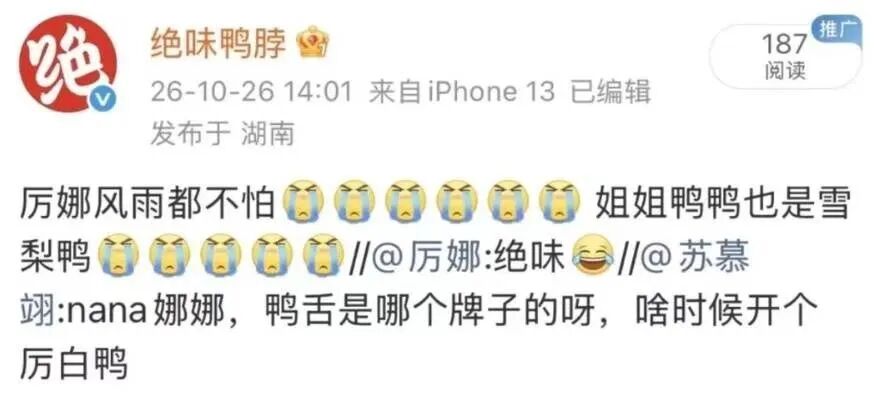
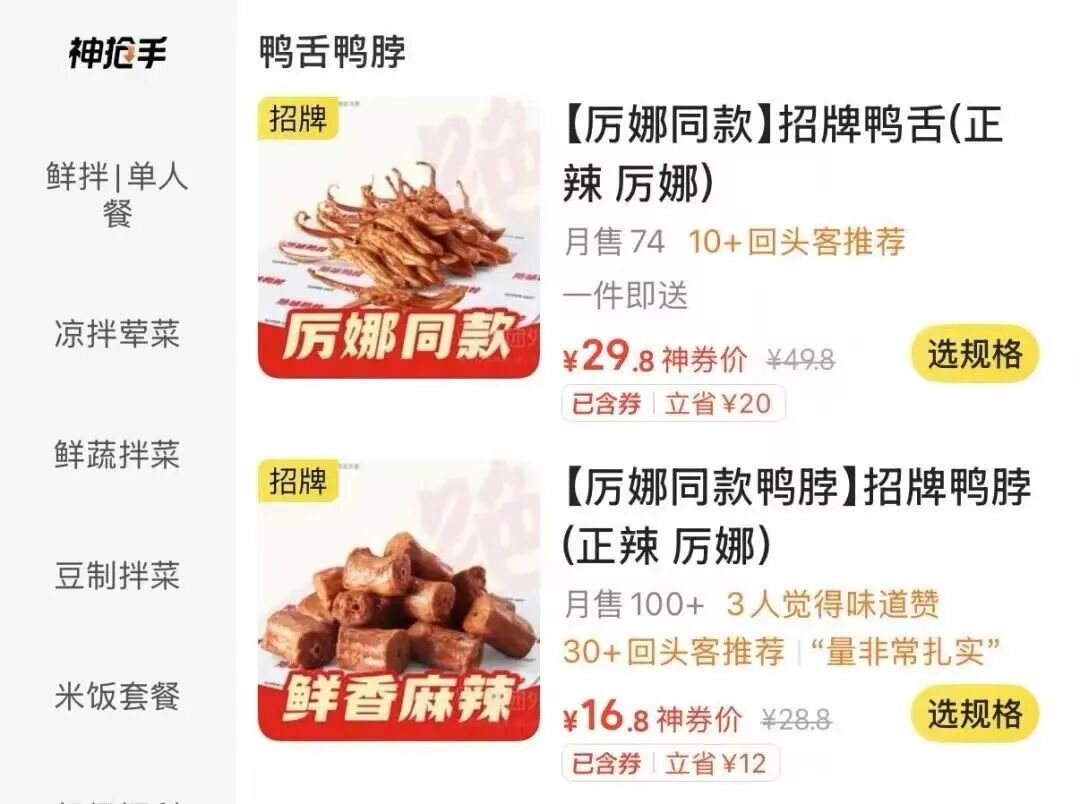
Juewei responded very quickly: on October 26, its official account started to test the waters by playing the meme; on November 1, it released a silhouette poster to tease the "fresh promotion ambassador"; on November 3, its official Xiaohongshu account posted an apology saying "Sorry we are out of stock, Li Na", admitting that duck tongue was out of stock in outlets across many regions and emergency restocking was underway; on November 5, Li Na officially became the brand's "fresh promotion ambassador", the "duck tongue same as Li Na's pick" was launched immediately, with the factory arranging extra production on a rush basis and cold chain distribution prioritized.
According to channel data, the order volume of Juewei's duck neck and duck tongue on Taobao Flash Purchase increased by 200% week-on-week and 280% year-on-year; the sales volume of group-buying live streams on Douyin rose by 72%, and outlets in many regions sold out all stock. The brand's public awareness remains, and its channel reach is still online. The fact that an old comment from 20 years ago can be quickly converted into orders, and the response speed of only 10 days from catching the meme to signing the spokesperson is worth noting; but we should also note another point: "national shortage of duck tongue" means the instantaneous supply flexibility is insufficient, and the marketing move ran ahead of the supply chain capacity.
As for Zhou Hei Ya, no official announcement has been made as of press time, and the news still stays at the level of netizen memes and oral statements from store staff — the source of the rumor is only an oral statement from a store employee saying "Zhou Hei Ya's staff said the official announcement will be made on the 8th", with no endorsement from the brand side or the artist side; on November 10, the actual business cooperation officially announced by Xu Fei was joining the *Crazy Good Six Night* gala, which has nothing to do with Zhou Hei Ya. One responded quickly, the other took a slower pace, there is no need to over-interpret this as a gap in capability.

Image source: Xiaohongshu
But it needs to be pointed out that this round of traffic only brings a pulse growth of a single product, not a turning point in business operation. The sell-out of duck tongue proves that the brand still has public awareness; but whether the business can return to the profit track does not depend on duck tongue, but on offline stores and retail shelves.
Juewei: Focus on offline stores, bet on franchising, optimize store network
Juewei lays its foundation on franchised stores. According to the 2025 annual report of Juewei Food, the company's wholesale revenue of braised food directly to franchisees reached 3.931 billion yuan, accounting for 71.91% of the total annual revenue. Franchisees are both customers and distribution channels. It is worth noting that 2025 was the year when the company corrected accounting errors, paid supplementary taxes of 342 million yuan, and recorded its first loss after nine years of listing, so the denominator of this financial report is relatively low; by the first half of 2026, the revenue structure has changed — the proportion of braised food in main business revenue dropped to 79.41%, while the proportion of supply chain logistics rose to 15.34%. The number of stores is still the foundation of its revenue.
However, this foundation is shrinking. The number of stores dropped from 15,950 at the end of 2023 to 8,982 by mid-October 2026 (data captured by Zhaimen Canyan on October 12; the figure was about 9,350 in the statistical caliber of August), with a net reduction of about 6,900 stores in more than two years. The company has stopped disclosing the specific number of stores since its 2024 semi-annual report, and still stated at the performance briefing in June 2026 that it "has more than 10,000 stores" — but according to third-party monitoring, this statement is no longer valid since then.
The store closure move should not be simply interpreted as a total collapse, nor should it be interpreted as a voluntary strategic switch. The company's original statement in the investor relations activity record sheet on August 28, 2026 is that it will decide the retention or closure of stores according to the return on investment of franchisees, and "will not maintain stores with unviable profit models through long-term subsidies" — this is a passive clearance under return screening, not a strategic shift. The truly proactive part lies in the single-store model: stores in Wuhan and Chongqing are testing new formats such as fresh braised mixed dishes and hot braised rice bowls, all introducing staple food like rice and mixed noodles, with the price range anchored at the fast food level of around 20 yuan.
The cost is directly reflected in the financial statements. Q3 revenue reached 1.343 billion yuan, down 6.79% year-on-year; attributable net profit was 33.53 million yuan, down 68.03% year-on-year, the lowest single-quarter figure since Q1 2024. The total revenue of the first three quarters was 3.857 billion yuan, down 9.46% year-on-year; attributable net profit was 168 million yuan, down 39.95% year-on-year; non-recurring profit deducted net profit was 110 million yuan, down 54.26% year-on-year; net operating cash flow was -120 million yuan, compared with +602 million yuan in the same period of last year. However, the cash flow of Q3 single quarter has turned positive, with a net inflow of 62 million yuan. The fourth quarter will be the first observation window to see whether this positive turn can become a trend.
It is worth noting that the gross profit margin of Q3 single quarter was 23.26%, down 7.64 percentage points year-on-year, the lowest in the past 11 quarters. The raw material side does not support such a decline: raw duck is the upstream of duck by-products, and their prices are highly linked. According to data from Zhuochuang Information, the average national price of Cherry Valley raw duck in mid-October 2026 was 3.78 yuan per jin, down 2.07% year-on-year, still about 30% lower than the stage high in Q1 2023 (Wind caliber, 5.4 yuan per jin in Jining, Shandong); according to the same statistical caliber of Jining, the price had dropped to 3.10 yuan per jin by the end of October, with a cumulative decline of more than 40% compared with the end of Q1 2023. The year-on-year decline has narrowed from double digits in 2025 to 1-2 percentage points: the national average price monitored by Zhuochuang in mid-October decreased by 2.07% year-on-year, and the average purchase price of frozen fresh duck in Huangshanghuang's semi-annual report decreased by 1.15% year-on-year. In other words, raw material prices have stabilized at a low level, without rising.
The reversal only occurred in small categories. In the first half of 2026, the purchase price of duck wings turned to rise by 3.26% year-on-year, and the price of duck tongue rose by 23.39% (from Huangshanghuang's semi-annual report, industry reference caliber). The research report of Kaiyuan Securities on November 1 attributed the decline of Q3 gross profit margin to three factors: store adjustment and profit transfer to franchisees, terminal promotion discounts and insufficient capacity utilization — none of which are on the raw material side.
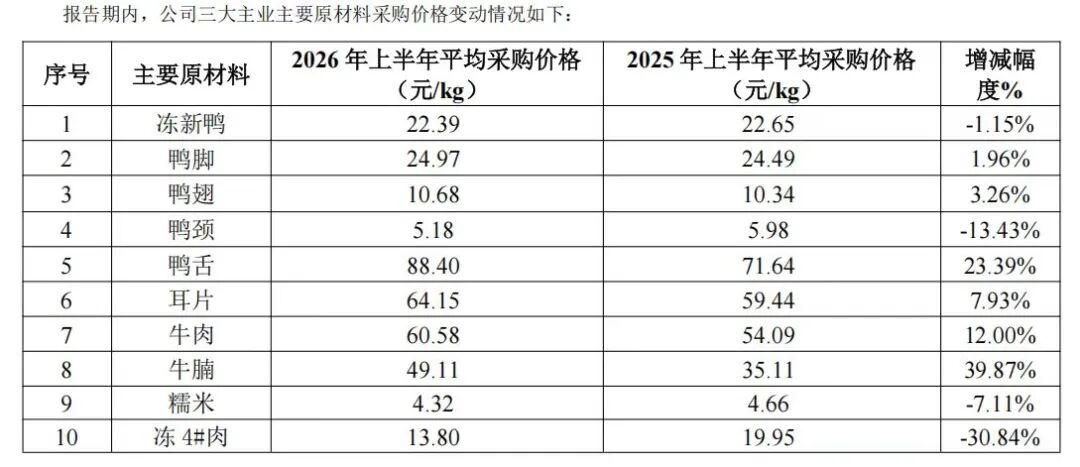
Image source: Huangshanghuang semi-annual report
Capacity utilization is another unsolved issue. As stores shrink, the demand from factories decreases, and the capacity utilization rate also goes down. Juewei's 21 central factories are a moat when running at full capacity, but now they are in a stage of pending capacity release — the fixed cost still exists, which needs to be gradually diluted by rising revenue. The 2026 semi-annual special report on raised funds mentioned that many braised food projects have not reached the expected profit, the reasons point to the fact that capacity utilization has not reached the designed upper limit and the revenue scale has not reached the expectation. This is not only the source of current cost pressure, but also the part with the greatest elasticity after revenue recovery: the factories have been built, the capacity is ready, and what is waiting is only the store side and channel side to pull the sales volume up again.
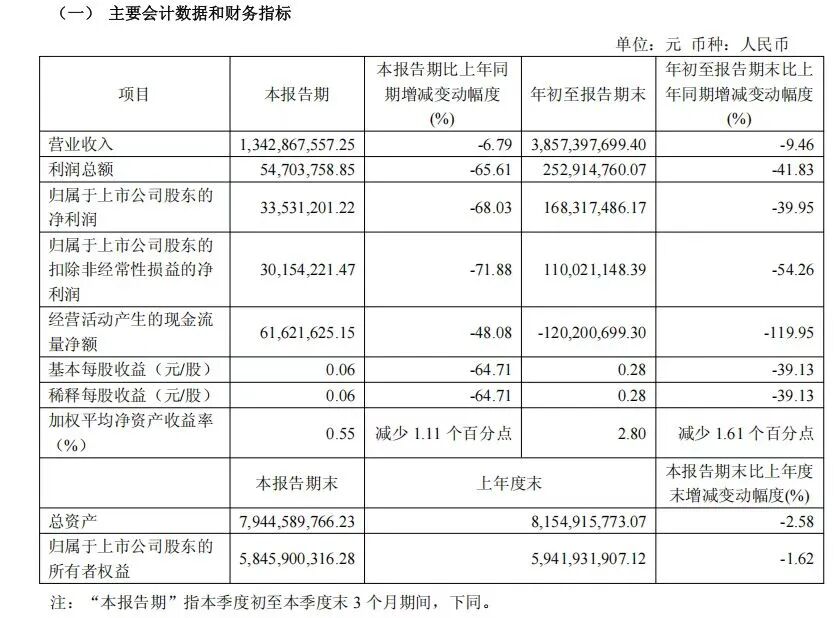
Image source: Juewei 2026 Q3 financial report
However, new growth points are also emerging. The revenue of supply chain logistics in 2025 was 588 million yuan, up 20.14% year-on-year; the revenue of packaging products was 417 million yuan, up 14.38% year-on-year, and external output is opening up new revenue dimensions. On the store format side, "Juewei Baobao" opened its first store in Shenzhen in 2025, with the turnover exceeding 10,000 yuan on the opening day; the supermarket-style store "Juewei Fresh Braised" landed in Changsha in October 2025, with more than 90 SKUs.
In addition, Juewei distributed 2.5 yuan per 10 shares in the 2026 semi-annual period, with actual cash distribution of about 149 million yuan, accounting for 110.82% of the attributable net profit in the same period; in the same period, it also announced a share repurchase plan of 100 million to 200 million yuan. In the year when net operating cash flow outflowed in the first three quarters, the follow-up moves are worth observing.
Zhou Hei Ya: Expand shelf placement, bet on distribution channels, achieve scale growth
Zhou Hei Ya took another path: reduce the number of self-operated stores, and increase shelf placement — the incremental sales are undertaken by third-party channels.
By the end of June 2026, the number of Zhou Hei Ya's stores dropped to 2972, but the proportion of self-operated stores rose to 62.6% instead. The revenue of self-operated stores reached 799 million yuan, up 12.2% year-on-year, and the main store business is stabilizing. At the same time, the channel business revenue in the first half of the year was 412 million yuan, up 80.4% year-on-year, the offline third-party channel grew by 207.2%, with more than 50,000 sales points. Sam's, Pang Donglai and snack discount stores have become the fulcrums for sales growth. The administrative expense rate decreased by 2.3 percentage points year-on-year to 7.2%, and internal cost reduction is also being carried out simultaneously.

Image source: Zhou Hei Ya semi-annual report
This is a path of "muscle growth": instead of insisting on opening stores on its own, it embeds its products into the traffic entrances that others have already built. It has an extra leg outside its own stores, and its reach is even wider than in the era of 10,000 stores.
The cost also falls on the profit side. In the first half of the year, Zhou Hei Ya's revenue reached 1.461 billion yuan, up 19.5% year-on-year; attributable net profit was 91 million yuan, down 15.2% year-on-year; gross profit margin dropped from 58.6% to 54.7% (caliber of the first half of 2026, the company did not disclose the Q3 report). The company attributed this to the rising cost of duck by-product raw materials and the increasing proportion of low-margin channel business. The change of channel structure and the rise of raw material cost each account for part of the impact, and whether the profit can gradually precipitate with the expansion of channel sales still needs to be observed in the next few quarters.
