Are the massive layoffs at large corporations really caused by AI taking jobs away from humans?
Has AI really caused massive unemployment?
The U.S. macro data shows the opposite: data from the U.S. Department of Labor released last night shows that initial jobless claims dropped to 189,000, matching the lowest level in 57 years.
On the same day, a report from outplacement consulting firm Challenger showed that layoffs in October reached only 43,994 people, the lowest number for the same period in three years.
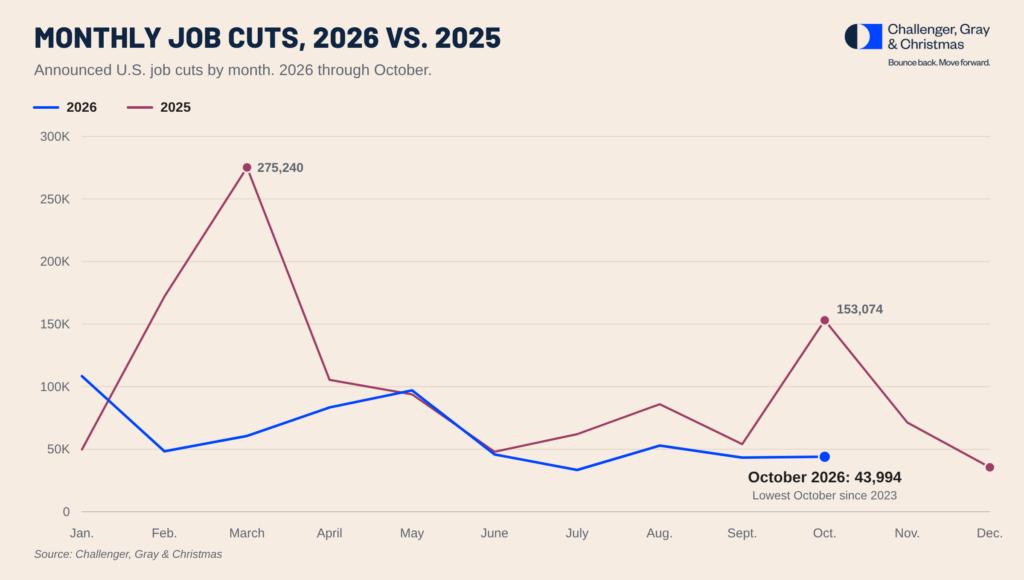
Challenger's monthly layoff statistics: 43,994 people in October 2026, lower than the same period last year. Image source: Challenger, Gray & Christmas.
However, for tech giants in Silicon Valley, there is another "hellscape" scenario.
This week, Reuters exclusively reported that Google has expanded its voluntary separation program to five overseas countries since June. There are about 5,000 Google employees in Switzerland alone.
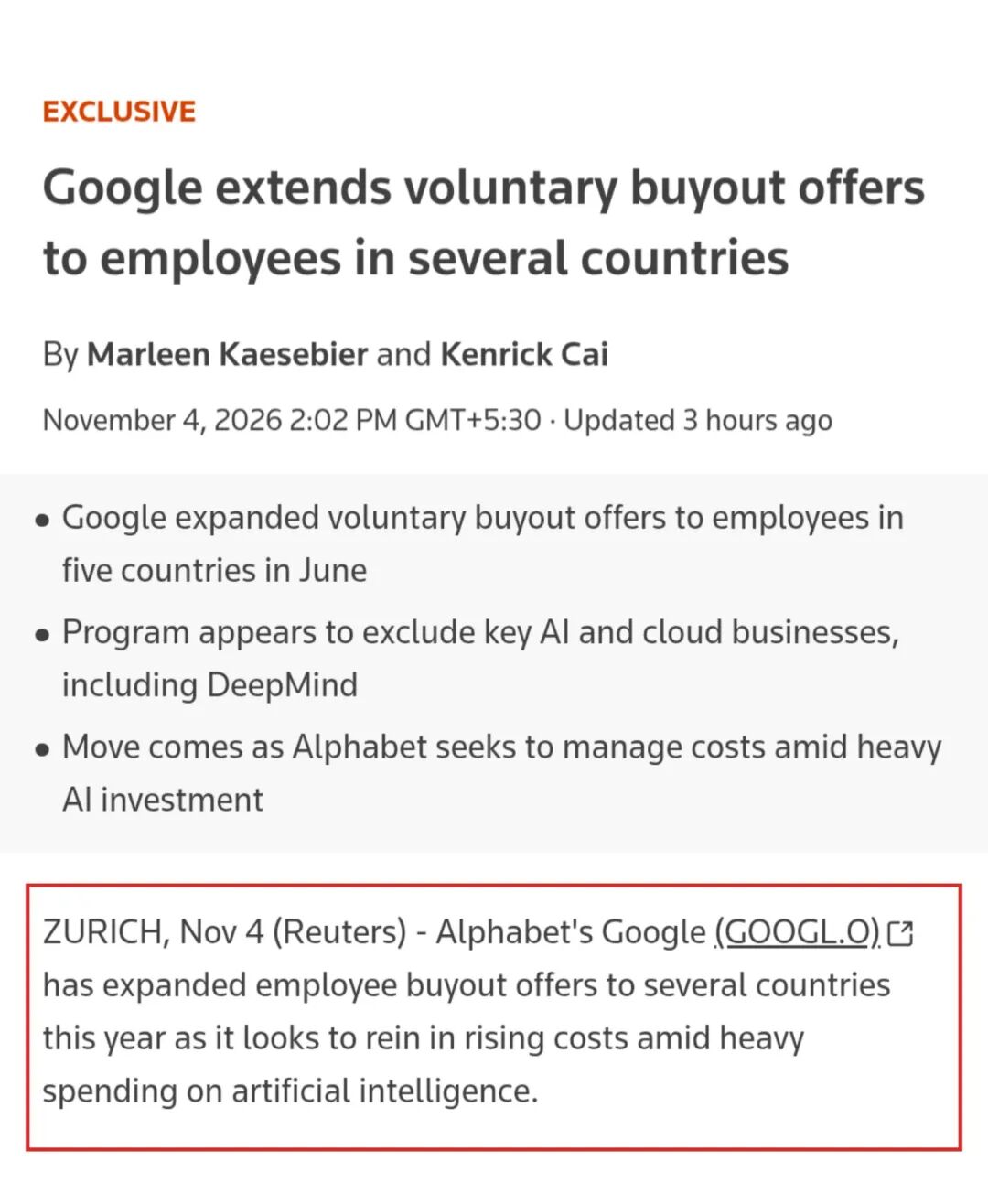
Reuters exclusive report on November 4: Google has expanded voluntary severance packages to multiple countries this year to control rising costs amid heavy AI investment. Image source: Reuters.
Instead of laying off employees directly, paying extra to ask people to leave on their own has become a new habit of large tech companies in the past two years. The compensation offered by Google this time is up to 12 months of salary. A week earlier, Microsoft sent voluntary separation invitations to about 60,000 employees, equivalent to a quarter of the company's total headcount.
Paying a high price to get employees to leave voluntarily serves two purposes:
The first is to avoid lawsuits: directly laying off senior employees in the U.S. is likely to lead to age discrimination lawsuits, and employees who leave voluntarily have to sign a waiver of the right to sue. The second is to avoid public notification: large-scale layoffs in the U.S. require notifying the state government 60 days in advance.
The willingness to spend so much money to buy out employees' careers precisely shows that large companies are well aware that the number of layoffs this time is large and the impact will be negative.
When the dot-com bubble burst in 2001, the U.S. tech industry laid off about 168,000 people throughout the year.
Only ten months have passed this year, and Challenger's statistics show that layoffs in the tech industry have exceeded 170,000 people, 20% more than the same period last year, ranking first among all industries and breaking the record set in the year the bubble burst. The employment situation in the broader market remains good, but the tech industry alone has cut more jobs than it did back then.
Can such large-scale headcount reductions at tech companies be simply explained by AI entering workflows and replacing human employees?
Has the AGI moment already arrived?
Hyping the anxiety of AI replacing humans is factually untenable
Just a few months after ChatGPT was launched, a March 2023 report from Goldman Sachs began to hype the story of AI taking human jobs. It estimated that about one-fifth of jobs worldwide could be completed by AI, equivalent to 300 million full-time positions.
Then the media also smelled the sensational appeal: the headlines were extremely easy to write and full of emotion. The headline of the British newspaper The Independent was "Generative AI could threaten 300 million jobs", while headlines from Chinese media were more direct: "Goldman Sachs: AI may cause 300 million people worldwide to lose their jobs".
This narrative reached a climax in February this year.
Citrini Research wrote a hypothetical report titled 2028 Global Smart Crisis, envisioning that the U.S. unemployment rate would reach 10.2% and the S&P 500 would retrace 38% by June 2028. The report went viral online over the weekend. On Monday, the Dow fell 800 points, IBM fell 13% in a single day, marking its worst performance since 2000.
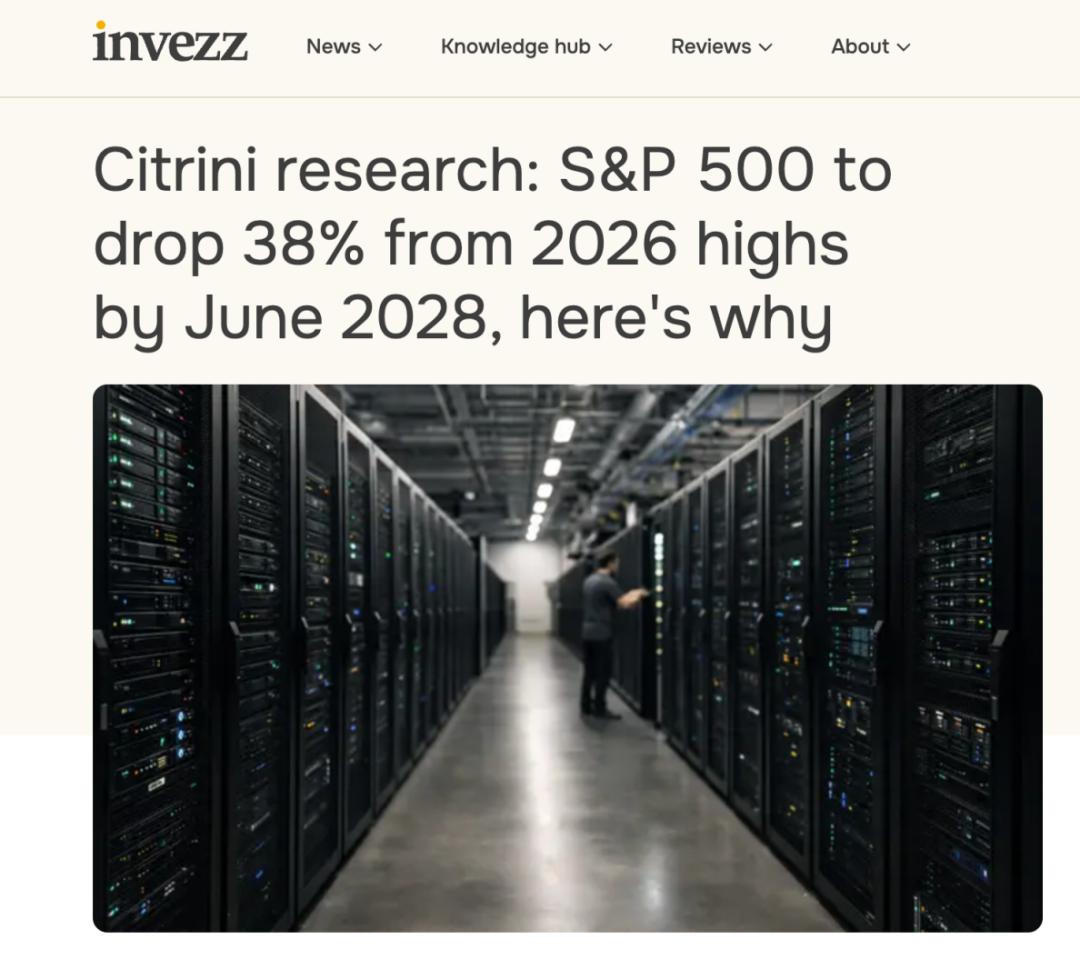
Invezz's report on Citrini's hypothetical crisis scenario. Image source: Invezz.
The headline of Entrepreneur magazine directly asked: "Did this viral AI doomsday report cause the Dow to drop 800 points?"
But if you think carefully, the claim that "AI has widely replaced humans" has at least four logical flaws:
1. The AI replacement narrative cannot explain who is being laid off
If AI were replacing humans, the first people to be replaced would be basic jobs that are easiest to automate, not senior employees, or even managers.
However, Microsoft's voluntary separation program in April this year targeted employees whose combined age and tenure with the company were no less than 70 years, such as 50-year-old employees who had worked at the company for 20 years, involving about 8,750 people. Many of these people are senior employees and management, the longer their tenure, the higher their salaries and stock compensation, so asking this group of "expensive" employees to leave is obviously for financial reasons.
Looking at the business side, Amazon shut down its Fresh and Go supermarkets while conducting layoffs, and the most affected team during Microsoft's layoffs was Xbox, these are all marginal businesses that the giants have failed to make profitable for many years.
On the contrary, headcount is still increasing in AI and cloud business lines.
According to Reuters, Google has excluded Google Cloud and DeepMind from all these rounds of voluntary separation packages. Meta laid off about 8,000 people while transferring about 7,000 people to new AI teams. Microsoft's October voluntary separation plan, according to media reports, also excluded some teams such as data centers, sales, and cybersecurity.
IBM laid off thousands of people in the U.S. this year, but Bloomberg reported that it will triple its recruitment of new U.S. graduates in AI and hybrid cloud directions.
To put it bluntly, layoffs are targeted at unprofitable old businesses, and no one is willing to let go of a single employee in AI and cloud, the areas they bet on for the future.
2. Total factor productivity has not improved significantly, so how can AI have taken over?
Oxford Economics calculated that in the first 11 months of 2025, only nearly 55,000 people were laid off by U.S. companies citing AI as the reason, accounting for 4.5% of all layoffs; the number of people laid off due to poor market and economic conditions was four times that of AI-related layoffs.
The conclusion of this study is: "If AI were already replacing labor on a large scale, productivity growth should be accelerating. Overall, it is not."
Data from the U.S. Bureau of Labor Statistics confirms this: the annualized growth rate of U.S. labor productivity in the first and second quarters of 2026 was only 0.8% and 1.4% respectively.
Labor productivity is also affected by factors such as overtime and layoffs. What is more illustrative is total factor productivity, which measures whether the same people and the same machines can produce more output.
Torsten Slok, chief economist of Apollo, cited data from the Federal Reserve Bank of San Francisco in October, pointing out that this figure is still slightly below zero, and total factor productivity has not accelerated at all after large companies started pouring money into computing power.
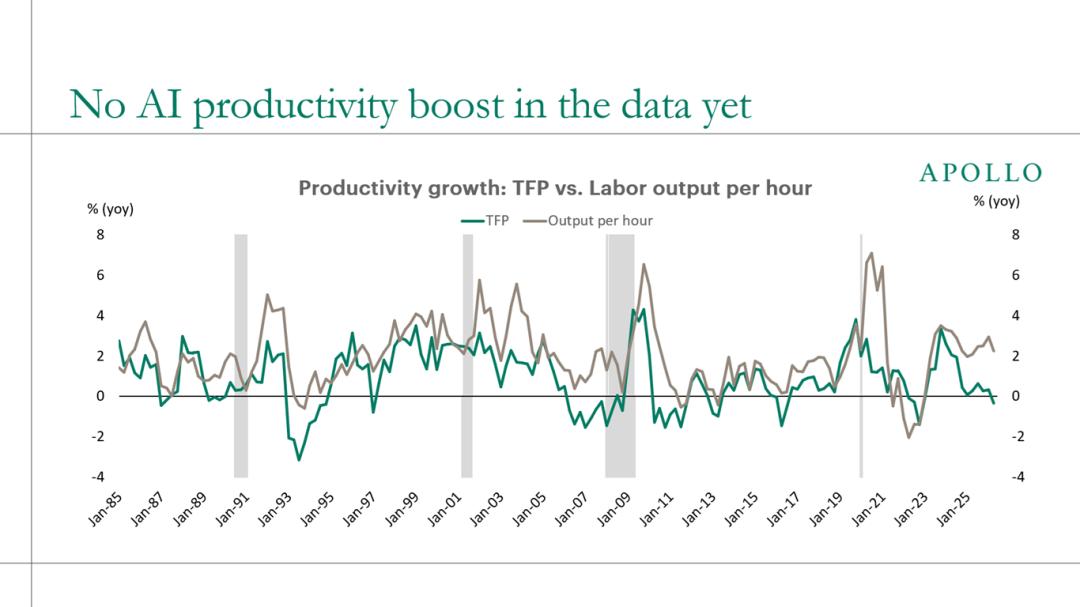
The green line represents total factor productivity, and the gray line represents output per hour. Image source: Torsten Slok, Chief Economist of Apollo, October 5, 2026.
The contribution of AI cannot be seen in macro data, and the same is true when it comes to specific work scenarios.
3. In real work scenarios, AI is not good enough to be fully trusted to work independently
When talking about layoffs now, most people imagine a scenario: AI learns your job, and then takes your workstation.
However, people who use AI deeply know that when it comes to letting AI independently complete a complete work task, the performance of most Agents is still not ideal, requiring continuous human input and calibration.
The Center for AI Safety and Scale AI tested 240 real freelance projects, and even the highest-scoring model Opus 5.5 only achieved professional-level performance in about 21% of the projects.
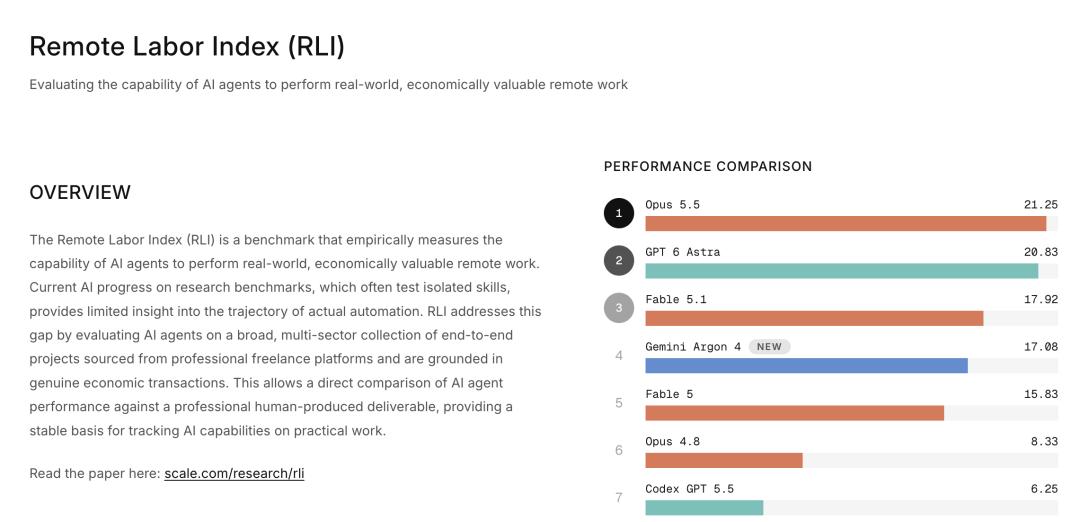
Remote Labor Index (RLI) ranking, Opus 5.5 scored 21.25. Image source: Scale AI.
Mark Zuckerberg also admitted in July this year that the progress of Agents "has not accelerated in the way we expected". Earlier, Andrej Karpathy, founding member of OpenAI, poured cold water on this. He said on a podcast last October that current Agents are far from being usable as interns, and it will take ten years to make them work properly.

Karpathy talks about the shortcomings of Agents. Image source: Dwarkesh Podcast, October 17, 2025.
Coding is the scenario that is closest to full automation. However, after many companies adopted Coding Agents, the amount of new code per capita increased significantly, but the end-to-end development cycle did not shorten proportionally, and the workload of review waiting and rework actually increased.
4. If AI is more capable and cheaper than humans, why have companies recently started cutting employees' AI spending?
At the beginning of the year, large companies were competing to see who used more Tokens, but soon they could no longer afford the bill.
There is a figure in Anthropic's prospectus: in April this year, the amount of internal use of Claude by its employees, if calculated at the price sold to customers, has exceeded the company's monthly salary expenditure (excluding stock incentives).
If large company employees really use AI to the fullest like Anthropic does, the Token bill will skyrocket directly.
According to TechCrunch citing Bloomberg reports, Uber spent its full-year AI budget in just four months, so it had to set a monthly cap of $1,500 per employee for each programming tool. Tesla is even stricter: since July, each employee is only given a weekly quota of $200. Microsoft sets a token cap by department, and its executive vice president said very directly in an internal email: "tokenmaxxing is not the goal we want to optimize."
Domestic large companies are not as wealthy as Silicon Valley companies, and their restrictions are even stricter. In March, rumors spread on Maimai that Tencent allocated a 220,000-yuan annual Token quota per person; by June, a Tencent employee's monthly quota was reduced from $2,000 (about 13,500 yuan) to 1,400 yuan, cutting nearly 90% of the original amount.
Alibaba employees call Qwen and other domestic models in their office Agents, and they have to apply to the finance department once the usage exceeds the limit. ByteDance can only partially reimburse the cost of calling external models.

Image source: Economic Observer, June 13, 2026.
Even employees' AI quotas are cut sharply, so why are layoffs still being blamed entirely on AI?
AI is being used as a scapegoat for large tech companies' weak business performance
If the media keeps amplifying the anxiety of AI hitting white-collar jobs for traffic, for story ideas, or even just out of ignorance;
Then when tech company management says layoffs are because AI is too powerful to cover up their business decline, that is purely "malicious".
Admitting that business is shrinking is a sign of management and strategic failure, but announcing that "AI makes me not need so many people" becomes a sign of strategic leadership, instantly turning "loss" into "win".
The most typical example is fintech company Block, which announced in February that it would cut its headcount from more than 10,000 to less than 6,000. Its CFO claimed that it would use "a smaller, more talented team to automate more work with AI".
However, Block's former head of public relations directly called out his former employer in The New York Times, saying that this restructuring "reads like a regular priority adjustment and cost management, not an AI-driven transformation".
The narrative was publicly debunked by its former PR head, but Wall Street doesn't care: the "win" is real in terms of stock price. In the eyes of investors, layoffs are almost equivalent to focusing on AI.
On the night Block announced it was cutting nearly half of its employees, its stock price rose about 25% in after-hours trading. Snap announced it would lay off about 1,000 people in April, and its stock price rose more than 11% in pre-market trading; Cisco said in May that it would cut about 4,000 people, and its stock price also surged in after-hours trading. In the past, layoffs were a signal that the company was in trouble; now as long as it is tied to AI, bad news can be packaged as good news.
Google, which has not been able to launch new breakthrough models recently, probably also hopes that this