Space computing power is transitioning from the conceptual stage to industrial development. Who will be the first to achieve successful full commercialization?
Elon Musk has once again drawn an overly ambitious blueprint for space computing power.
In January this year, SpaceX submitted an application to the U.S. Federal Communications Commission (FCC), hoping to obtain approval to deploy up to 1 million satellites carrying AI data centers. After the news was released, space computing power quickly became a new hotspot in the technology industry. Companies including Google, StarCloud, Blue Origin have also successively announced relevant plans, and space data centers that once existed only in science fiction works have begun to enter the real agendas of tech giants.
However, for all the hype, actually sending servers into orbit is an extremely difficult task.
On the ground, data centers need to solve problems of power supply, land occupation and heat dissipation; in space, every link including energy supply, thermal management, radiation protection and inter-satellite communication needs to be redesigned. What's more, the huge infrastructure investment that often amounts to tens of billions of yuan, there is still no clear answer on what kind of business can eventually recoup the cost.
Cao Dezhi, Co-founder and COO of Spacety, shared a relatively sober judgment: Large-scale space data centers still face quite a few challenges before achieving real commercialization, but the opportunity for satellite intelligence is already on the table.
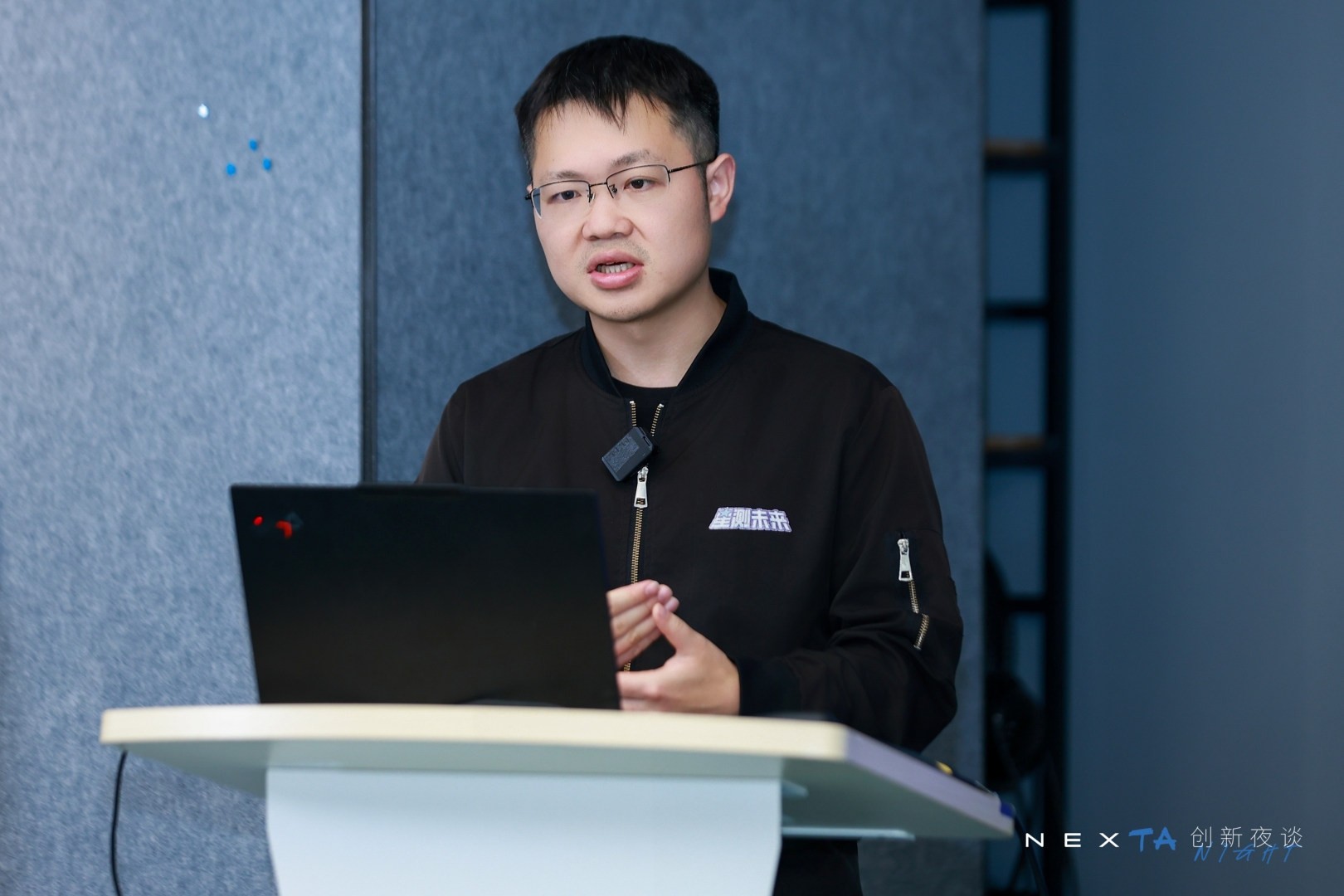
This company was founded in 2020. Back then, "space computing power" was not yet a popular term, but Spacety had already begun to try to send GPUs and AI models into orbit. Six years on, the company has deployed a total of 40 computing power platforms, with 37 GPUs sent into space successively.
Nowadays, as the industry's popularity rises, Cao Dezhi and his team have begun to think about a more practical question: apart from building computing power in space, can we make full use of the existing satellites? In his view, in the next five years, a direction worthy of serious investment is to connect scattered remote sensing satellites, so that users can call satellite resources on demand just like using internet services.
I. Space Data Center: A Long-term Game for Patient Players
Space computing power is not a brand new concept that emerged out of nowhere. As early as around 2000, some satellites were already equipped with computing devices such as CPUs, FPGAs and DSPs to process remote sensing images. After 2016, as new computing architectures such as NPUs and TPUs gradually matured, neural network algorithms began to be deployed on satellites, and tasks such as image recognition and data screening could gradually be performed in orbit.
By 2023, commercial companies had begun to use on-board GPUs to process infrared satellite data, turning capabilities such as wildfire monitoring and oil and gas pipeline monitoring into specific businesses. It was only with the development of AI chips that the computing power on satellites gained new room for imagination. And it was Elon Musk who first made the story of space computing power widely known.
But in Cao Dezhi's view, the million-satellite plan proposed by SpaceX has its own logic under the U.S. industrial environment, while China needs to promote its implementation in accordance with its own national conditions.
The construction of ground data centers in the United States is facing constraints such as land, power and water resources, while the demand for AI computing power is growing rapidly. Deploying computing facilities in space has naturally become a new alternative. The situation in China is different: there is still much room for development in terms of green power in the western region, land resources and ground computing infrastructure construction. Whether it is necessary to move large-scale data centers to space needs to be recalculated based on actual demand and cost.
The engineering difficulty is also not negligible. Cao Dezhi mentioned in his sharing that estimated based on the H100 server solution, the power consumption of a single computing power satellite may reach 150 kilowatts; if more advanced chips such as B200 and B300 are used, the power consumption may further increase. In comparison, the power of the Chinese Space Station is about 40 kilowatts, which means that a single computing power satellite may need to undertake an energy supply task far exceeding that of ordinary existing satellites.
Heat dissipation is not as simple as directly moving the ground liquid cooling system to space. As we all know, there is no air convection in space, and the heat generated by the server needs to be conducted through a special thermal management system and then released in the form of radiation. In addition, how to deploy solar wings, how to keep satellites stable, and how to achieve high-speed communication between different servers all need to go through practical engineering verification.
At present, several global technology companies have put forward different solutions for these problems.
StarCloud prefers a centralized architecture that combines high-density GPUs into a computing cluster, focusing on solving the problem of high-speed communication between servers; Google is exploring the formation of clusters of multiple satellites to achieve high-speed interconnection through laser links; SpaceX hopes to connect computing power satellites to the Starlink network and use the existing communication infrastructure to form a distributed computing system.
However, he believes that all these solutions are still in the early stage of exploration at this stage, and the conditions for large-scale replication will not be met until the engineering technology matures.
According to his judgment, as rocket launch costs further drop and satellite communication bandwidth increases, China will also gradually enter the stage of large-scale in-orbit server construction.
"Truly large-scale space data centers actually require a huge amount of additional efforts" — this sentence almost sums up Cao Dezhi's attitude towards the current industry hype.
But Cao Dezhi is not pessimistic. Space computing power requires long-term investment, and engineering verification cannot wait until commercial demand is fully mature to start. For Chinese enterprises, it is necessary not only to pay attention to strategic resources such as orbits and frequencies, but also to accumulate capabilities in chips, energy, heat dissipation and communications in advance. What really needs to be grasped is to find a commercially sustainable path that can be continuously promoted before the technology matures.
On this matter, Spacety has already accumulated six years of experience.
II. Six Years to Send GPUs into Space
The founding story of Spacety can be traced back to the "Tiange Project" of Tsinghua University.
Around 2016, Cao Dezhi and his senior fellow apprentice Cang Jirong were still studying in the Department of Engineering Physics of Tsinghua University, participating in the space science exploration project "Tiange Project". The team independently developed nuclear detectors and sent them into space to detect gamma-ray bursts in the universe.
This was a scientific research task, but the team encountered an engineering problem very early: the detector will generate a large amount of data during in-orbit operation. If all the data is transmitted back to the ground, it will not only occupy communication resources, but also hardly meet the requirements for timely processing.
The team began to try to use FPGAs and algorithms to complete data compression, feature extraction and preliminary identification on the satellite side.
This experience made them realize that satellites need not only communication and sensing capabilities, but also computing capabilities. With the gradual maturity of AI chips, can small models be combined with satellite data to allow satellites to complete more processing tasks in orbit?
In 2020, several senior and junior fellow apprentices from Tsinghua University decided to start a business, and Spacety was founded as a result. Cang Jirong served as CEO, Cao Dezhi served as COO, and Pan Xingyu joined at the end of the same year as CTO. The three "Tsinghua PhDs" formed the co-founding team.
At that time, the current wave of large models had not yet arrived, and commercial aerospace was far less prosperous than it is now. The direction the team chose was not considered particularly attractive, and they even needed to spend a long time explaining to customers why satellites need to use GPUs.
The real difficulty is that high-performance chips on the ground cannot be directly used in space.
Cosmic rays and solar activities in space will generate high-energy particles, which may interfere with chip operation, causing data errors or even system failures. Traditional aerospace equipment usually uses special radiation-hardened chips, but such chips are relatively high in cost, and their performance iteration is relatively slow, making it difficult to keep up with the rapid development pace of AI computing power.
How to use computing chips with stronger performance and faster iteration while ensuring reliability has become the primary problem that Spacety needs to solve.
The team finally chose to start with mature industrial-grade and automotive-grade chips from the ground, and gradually adapted these chips to the space environment through radiation hardening and system reliability design. This route can not only make use of the mature industrial chain and iteration speed of ground chips, but also put forward higher requirements for the team's accumulation of space radiation technology.
The team's background in nuclear science and technology has precisely become the entry point for this route. Their past research accumulation in nuclear detectors and space radiation environment has given them a deeper understanding of radiation protection.
From completing the first in-orbit verification of 12nm advanced process GPU in China in 2022, to realizing the world's first in-orbit verification of 7nm advanced process GPU in 2024, and then realizing the in-orbit application of domestic 7nm GPU in 2026, Spacety has gradually established a complete technical system from chip adaptation to system engineering.
According to the data disclosed by Cao Dezhi on site, the company has currently deployed a total of 40 computing power platforms and 37 GPUs operating in orbit, with a single device operating stably in orbit for more than four years.
Behind this set of figures are rounds of real in-orbit verification. For aerospace equipment, the performance indicators in the laboratory are only the starting point. Whether it can work stably in the complex orbital environment is what customers really care about.
However, sending chips to space is not all that Spacety wants to do.
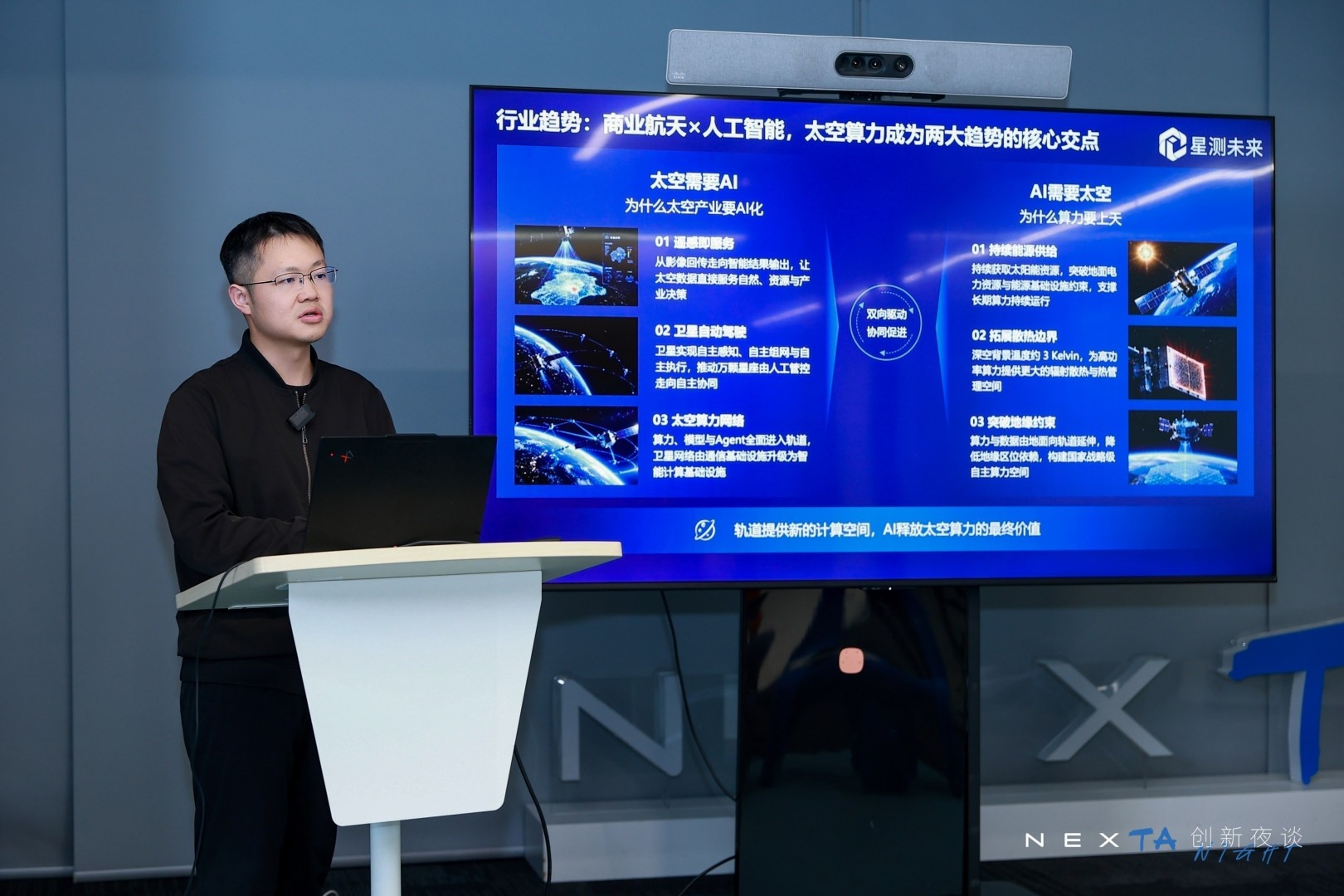
In Cao Dezhi's view, in the past few years, the team mainly solved the problem of how GPUs and AI enter space. Now, as the computing power system gradually matures, the next step is to consider how to combine computing power, models and satellite data to make them truly serve specific industries.
This also means that Spacety's business has begun to extend from simple supporting of computing platforms to in-orbit data processing and industry applications.
III. Let Satellites Receive Orders Like Ride-hailing Cars
Throughout the sharing, Cao Dezhi used a very down-to-earth metaphor to explain the future satellite service model: "Didi for satellites". For this model to operate smoothly, the first problem to solve is how to organize scattered satellite resources.
At present, remote sensing satellites are constructed and managed by different operating entities. If users need satellite images of a certain area, they usually need to plan the shooting task in advance, wait for the satellite to pass by and complete the shooting, and finally transmit the data back to the ground for processing. The whole process involves multiple links such as satellite resources, communication links and data processing.
But if different satellites are connected to a co-construction and shared network platform, the situation will be different.
Cao Dezhi cited the example of flood season monitoring in Hangzhou.
Assuming that the local government needs to continuously grasp the flood change in a certain area, it may want to obtain the water level and rainfall conditions every two hours for a period of time. In the past, it was necessary to find suitable satellite resources in advance, plan the shooting time, and then wait for the data to be transmitted back.
In the future, users only need to put forward monitoring requirements, and the platform can automatically generate task plans, and dispatch remote sensing satellites passing over the target area during this period to shoot. After the satellite completes image collection, it will carry out identification and analysis through the in-orbit model, and finally feed back the flood risk and water level change to the relevant departments.
"No matter what demand you have, you can describe it in natural language and submit it to this resource pool. The large model will automatically convert the natural language description into the final satellite task plan."
The key to this model is to organize the originally scattered satellite resources. Users do not need to own satellites, nor do they need to understand the operating orbits of satellites, they only need to pay for the services they need.
Cao Dezhi believes that in the next five years, remote sensing satellites will have the opportunity to gradually form such a schedulable network. This development path of space computing power has clearer technical and commercial logic.
Spacety is also trying to implement this into specific businesses.
In the emergency field, optical satellites and radar satellites can be used in combination to identify fire points and monitor flood changes, providing more timely data for disaster analysis. In the financial and shipping fields, satellites can conduct fixed-point and continuous shooting of key sea areas, identify ship passage and cargo transportation, and provide decision support for shipping monitoring and bulk commodity research.
The team is also carrying out mineral monitoring and analysis with partners, extracting relevant indicators from satellite images and combining them with mineral production forecasts to provide new data references for bulk commodity research.
These scenarios share a common feature: customers do not need a single satellite image, but information that can help them make judgments.
This also makes Spacety begin to think about how to combine hardware, models and data into continuously deliverable services.
During the on-site Q&A session, a guest raised a practical question: SpaceX has its own rockets and global communication network, while Chinese enterprises do not have the same launch capacity, will the commercial scale of space computing power be restricted?
Cao Dezhi does not agree with this concern. He believes that after a satellite enters orbit, it can continue to fly, which does not mean that it can only serve the sky over its home country. As long as they have the corresponding communication and service capabilities, Chinese enterprises also have the opportunity to provide space computing power services to Africa, Latin America, and even European and American markets.
But he then pulled the topic back to the business itself: How exactly does a server make money?
In his view, the development of large models has provided a referenceable answer. In the past, after ground computing centers were built, there might be a large amount of idle resources; after the emergence of large models, the demand for training and reasoning grew rapidly, and computing power was gradually transformed into chargeable Token services.
The same is true for space computing power. The amount of computing power built is not directly equal to commercial success. What really matters is how many demands can be met, and how high the utilization rate of the equipment can maintain continuous operation.
Even on the cost issue, it is impossible to completely copy the depreciation logic of ground data centers. Cao Dezhi mentioned that even if some high-performance GPUs on the ground have been used for several years, they can still maintain high value due to supply and demand relations. If the demand for Tokens in space is sufficiently strong, computing power equipment may also recover investment faster through continuous services.
At the end of the day, sending servers to space is only the first step. Whether you can continuously receive orders and make full use of the computing power afterwards is what determines whether this investment can be recouped.
In September this year, Spacety released the "Fuyao Plan", focusing on the layout of the cloud-edge collaborative computing power system. For the team, this is not only an advance preparation for the long-term space computing power infrastructure, but also a business strategy upgrade.
Cao Dezhi gave a clear roadmap: in the next five years, the focus will be on integrating sensing and computing and remote sensing applications, to promote the formation of a commercial closed loop for in-orbit intelligence; later, as launch costs, communication bandwidth and engineering technology gradually mature, the team will further explore the construction of large-scale space computing centers.
Elon Musk's million-satellite plan has quickly brought space computing power into the public view. But for Spacety, the industry's popularity not only brings new room for imagination, but also means that the technological accumulation of the past six years has finally ushered in greater application opportunities.
Large-scale space data centers still need to wait for the maturity of technology and infrastructure, while satellite intelligence already has more clear landing scenarios. Next, Spacety hopes to continue to focus on remote sensing satellites and the integration of sensing and computing, promote satellites to process data in orbit, and explore the scheduling of satellite resources through a unified platform, so that computing power can truly enter industries such as emergency response, finance, transportation and energy.
Starting from a scientific research project, to sending GPUs into space, and then to finding the combination point between computing power and industry demands, Spacety has spent six years. For Spacety, the story of space computing power has only just begun, and